
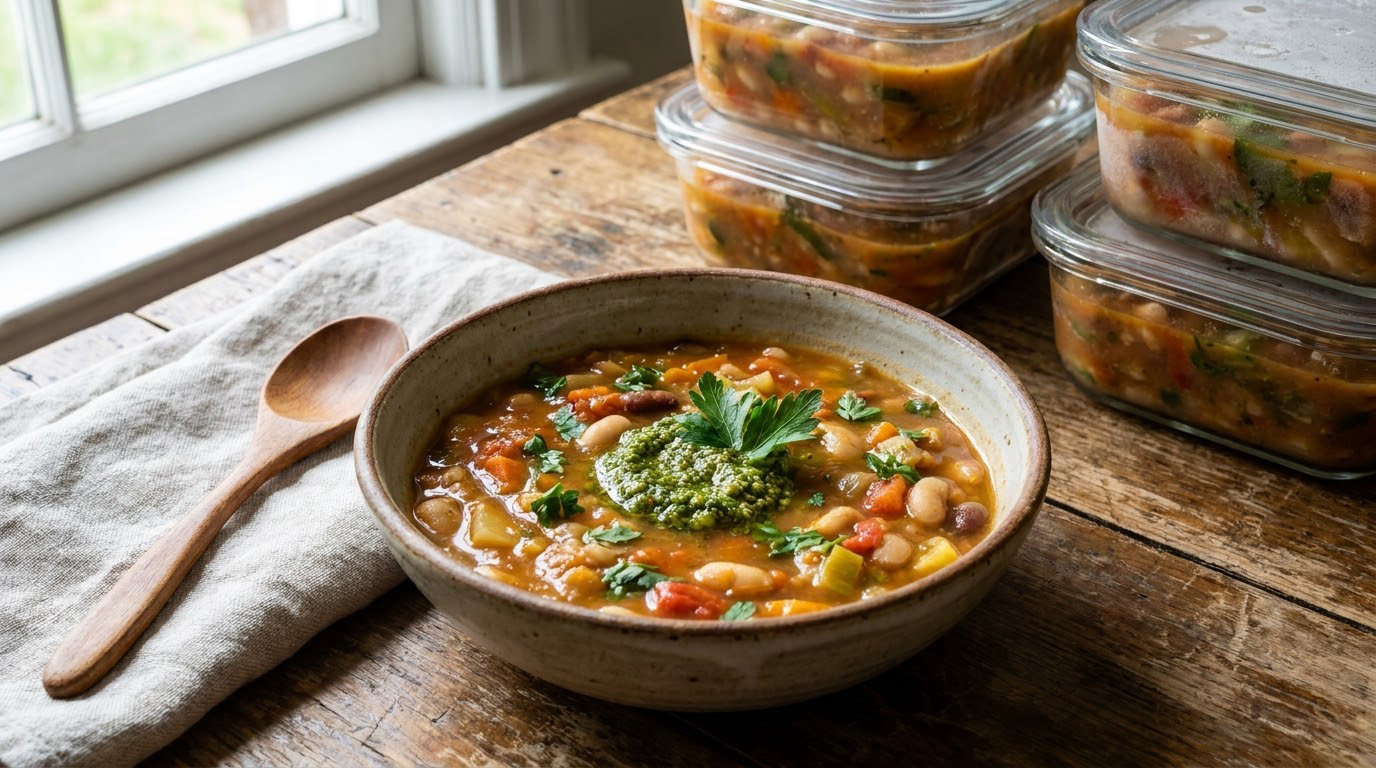
Cool the soup completely, ladle it into labeled freezer-safe containers with about half an inch of room for expansion, and lay it flat at 0°F or below. One Sunday batch gives you a week of dinners that only need reheating.
Fall is when most of us make soup, and most of us then put a single enormous container in the freezer and forget about it until March. That is the version nobody wants on a Wednesday.
The fix is boring and it works: smaller portions, flat stacking, and a label that tells you what is inside and when it went in. Here is how I freeze homemade soup for the week, plus how to thaw it without ending up with a bowl of warm water.
Table of Contents
How to Freeze Homemade Soup for the Week at a Glance
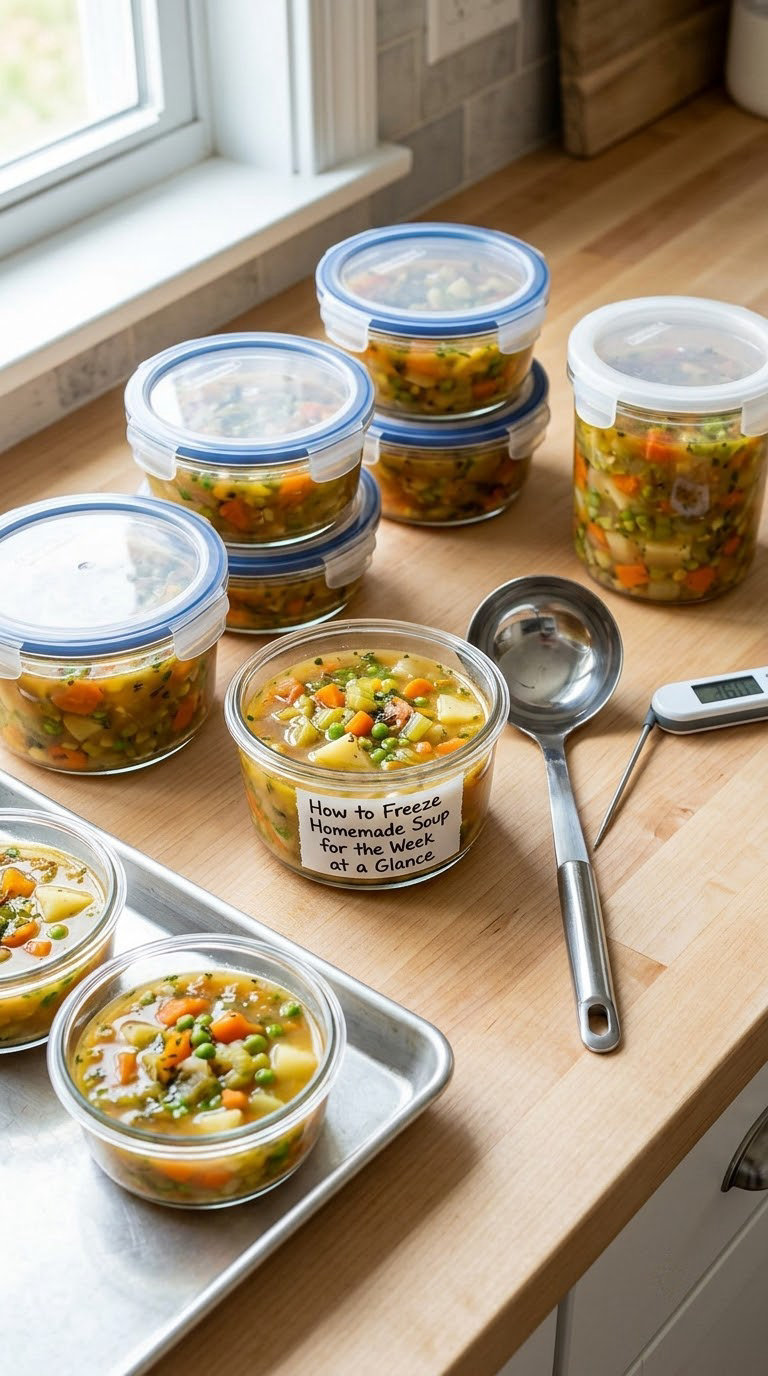
Here are the numbers most people need, in one place.
| What to know | The short answer |
|---|---|
| Cooling time before freezing | About 1 to 2 hours, using an ice bath or shallow containers |
| Headspace to leave | Half an inch in every container or bag |
| Best portion size | 1 to 2 cups for one person, 3 to 4 cups for a family meal |
| Freezer storage | 0°F or below, best flavor within 2 to 3 months |
| Thawing, single serving | 4 to 6 hours overnight in the refrigerator |
| Thawing, family size | 12 to 24 hours in the refrigerator, or in cold water |
| Fridge life after thawing | 3 to 4 days |
| Reheat temperature | 165°F (74°C), verified with a thermometer |
What Types of Soup Freeze Best?
Broth-based soups are the easy ones. Chicken vegetable, beef stew, minestrone, lentil, chili, split pea, tomato, and French onion all come back close to how they left.
A few things change on the way. Knowing which is which saves you a disappointing dinner.
- Skip the pasta and noodles. They drink liquid while thawing and turn soft and gluey. Freeze the broth plain, then cook noodles fresh.
- Leave the cream out. If a soup has more than 1 cup of dairy in it, freeze it without and stir the cream in as it reheats. Dairy tends to grain and split otherwise.
- Be careful with starchy thickeners. Roux and potato-thickened soups thicken further in the freezer. Thin them with broth after thawing.
- Skip raw garnishes. Fresh herbs, cilantro, parsley, and green onion go in at the end.
- Cooked root vegetables hold up fine. Carrots, potatoes, turnips, and squash are all good. It is the cooked pasta and the finished cream sauce that cause trouble.
For recipes that are built for the freezer, start with our cozy fall soup recipes that freeze well.
How to Cool Homemade Soup Before Freezing
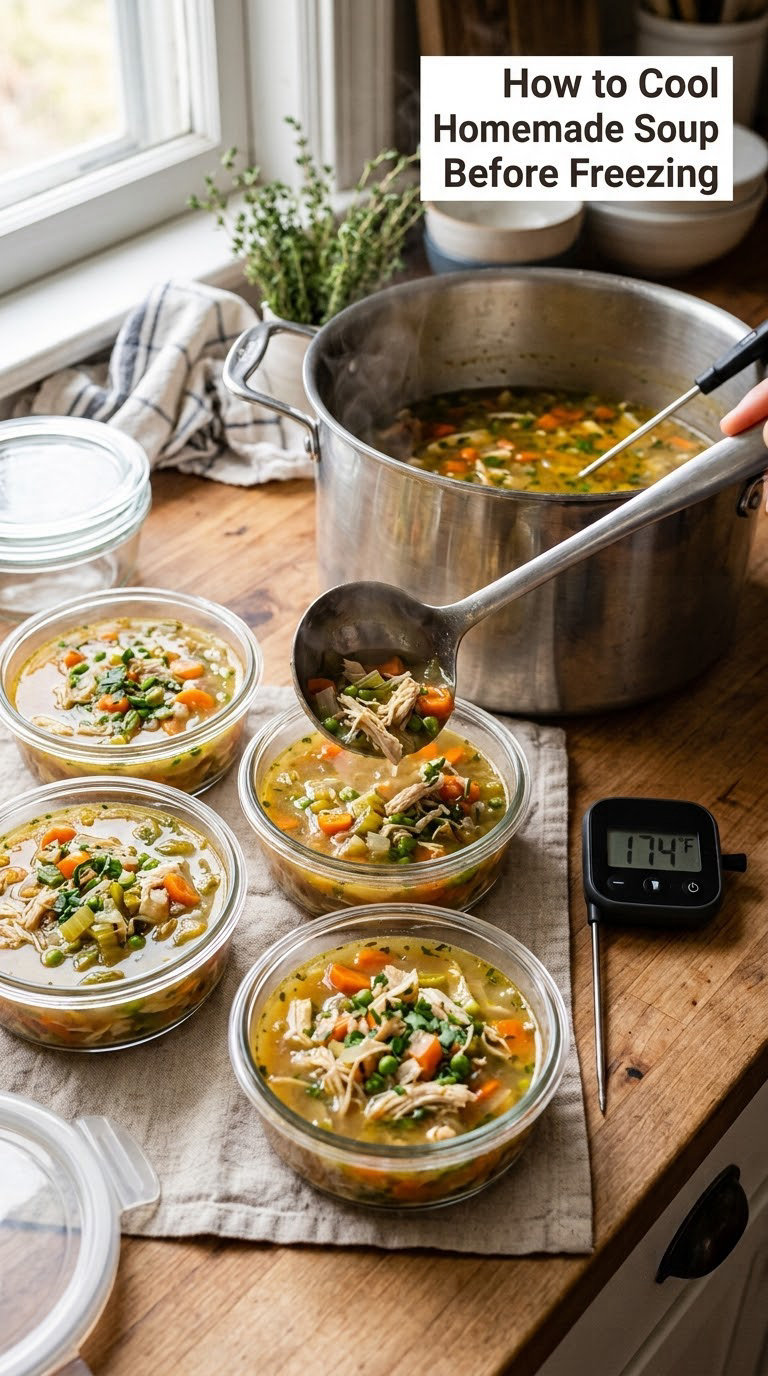
Yes, you need to cool it first. A big pot of soup holds heat for a long time and creates exactly the conditions bacteria like.
The temperature danger zone is 40°F to 140°F (4°C to 60°C), where bacteria multiply quickly. The rule from the USDA Food Safety and Inspection Service is two hours: cooked food should move through that range in no more than two hours, one hour if the room is above 90°F.
What works in my kitchen:
- Split the batch. Ladle it into shallow containers no deeper than 2 inches, or into a large bowl. A big pot cools from the outside in.
- Use an ice bath. Set the container in a sink or bowl filled with ice water and stir every few minutes. This drops the temperature in minutes rather than hours.
- Or use a fan. Point a box fan at the uncovered soup. Moving air speeds up cooling noticeably.
- Check with a thermometer. Aim for 40°F or below before it goes anywhere near the freezer.
A countertop fan or an ice bath is not decoration. It is the difference between soup that cools in twenty minutes and soup that sits warm for two hours.
How to Freeze Homemade Soup for the Week
Once the soup is cold, the freezing itself takes five minutes.
- Label before you fill. Write the soup name and the date on masking tape or a freezer label. Add any instructions, such as add cream after reheating.
- Portion it for real meals. One container per serving, not one giant container for the whole batch.
- Leave headspace. Headspace is the empty space above the liquid, and soup expands as it freezes. Half an inch is enough in a jar or tub. Skip this and you get cracked lids and a mess.
- Seal and lay it flat. Squeeze the air out of a freezer bag, seal the tub, and lay everything on its side so it stacks like books.
- Move one portion to the refrigerator the night before. Put the next serving in the fridge at dinnertime the day before. That single habit is what makes a freezer plan actually work.
Laying soup flat matters more than people expect. A quart tub standing on its end is awkward; the same tub on its side stacks three deep.
A simple seven-night rotation
Eat the same soup seven nights in a row and you will start dreading it. The fix is one base batch split into a few directions before it hits the freezer.
| Night | What to pull |
|---|---|
| Monday | Plain base soup, one ladle of Greek yogurt stirred in at the end |
| Tuesday | Base soup with a cup of frozen corn and a handful of chopped cilantro |
| Wednesday | Base soup with a can of rinsed beans and a squeeze of lime |
| Thursday | Base soup blended smooth with a potato for thickness |
| Friday | Base soup with shredded cheese melted over the top |
| Saturday | Base soup with leftover roast chicken and a splash of stock |
| Sunday | Whatever is closest to the front of the freezer, oldest first |
Add the extras after thawing and reheating, never before freezing. That way one batch of base soup feeds seven different dinners.
Best Containers and Portion Sizes for Frozen Soup
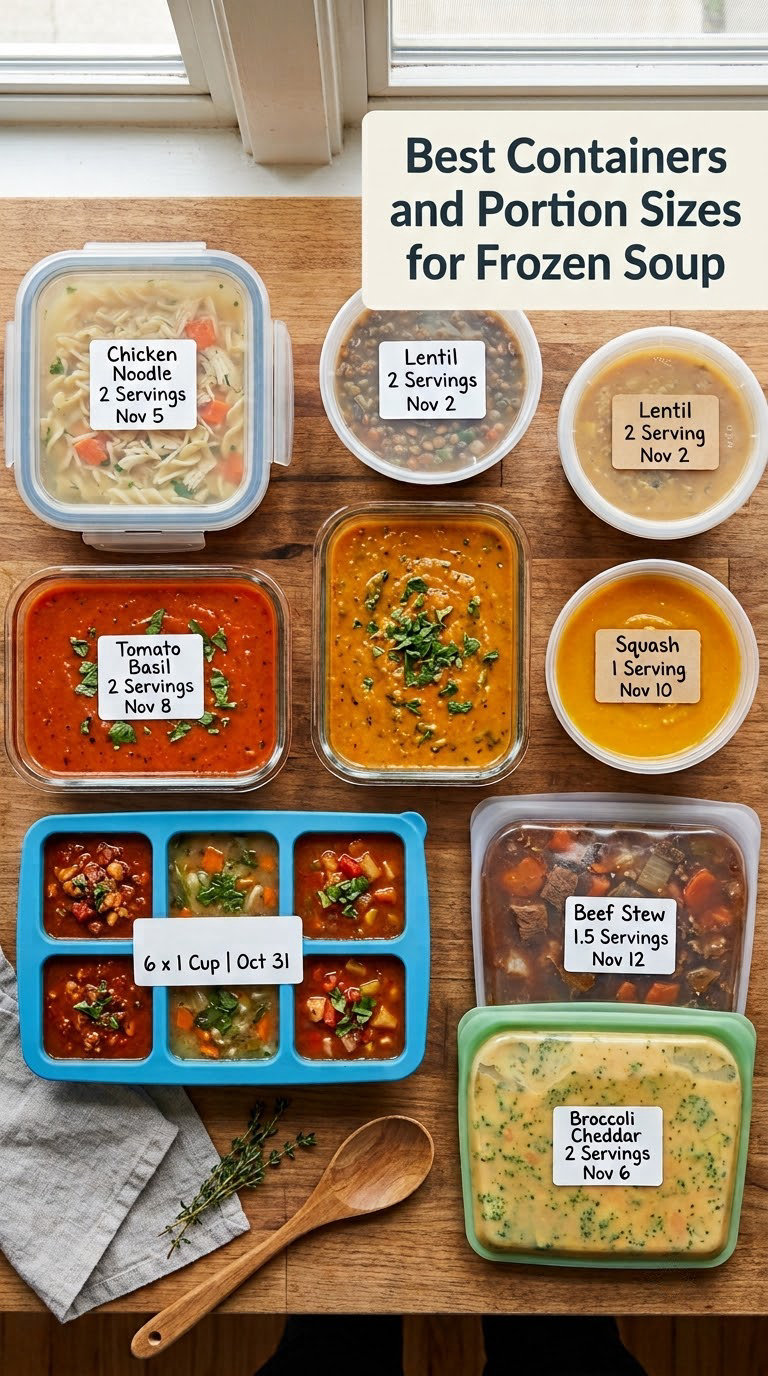
Bags or containers, both work. Containers stack better and you can see what is inside; bags freeze flatter and take up less space.
| Container | Good portion | Headspace | Notes |
|---|---|---|---|
| Borosilicate glass tub with lid | 2 to 4 cups | Half an inch | Stack well, check the piece is freezer-safe, move to the fridge to thaw because never microwave glass from frozen |
| Freezer-safe plastic tub | 2 to 4 cups | Half an inch | Lightest option, can go straight to the microwave |
| Resealable freezer bag | 1 to 2 cups | Squeeze out air | Lay flat like a book, best for small single servings |
| Silicone souper cubes or tray | 1 to 2 cubes | Fill to the top, freeze then bag | Portion cubes, later pop them into a resealable bag |
| Wide-mouth mason jar | 2 cups in a 24 ounce jar | Half an inch, freeze upright | Thaw in the refrigerator only |
My favorite trick, borrowed from people who batch cook on Sundays: freeze soup in single-serving plastic cups, cut the frozen block off with kitchen scissors, and drop the blocks into a labeled freezer bag. Then you pull out one block at a time instead of thawing a whole tub.
For portion sizes, match the container to the eater. A 1-cup tub works for a workday lunch or a small child. Two cups covers most adults. Three to four cups is a family dinner.
How Long Does Homemade Soup Last in the Freezer?
Store it at 0°F or below and frozen soup is safe for about 3 months. That is the number the USDA gives for frozen cooked foods.
Safety and flavor are two different clocks. Soup stays perfectly safe for the whole window, but herbs dull, vegetables soften, and flavors blend together after about 6 months. I plan around 2 to 3 months because that is when it still tastes like the pot it came from.
Label everything with a marker pen that will not wash off, and keep a simple list of what is in the freezer on the door. Frozen soup is invisible until it is thawed.
For fridge storage in the meantime, read how long homemade soup lasts in the fridge and what to do in those last few days.
Freezing is not the only way soup gets starchy. If you want a thicker pot without flour, see how to thicken soup without flour.
How to Thaw and Reheat Frozen Soup Safely
Three routes, depending on how much time you have.
- Refrigerator, overnight. The safest and best option. A single serving needs 4 to 6 hours; a family-size tub needs 12 to 24 hours.
- Cold water. Put the sealed container in a bowl of cold tap water and change the water every 30 minutes. A single serving softens in about 30 minutes.
- Microwave. Only for plastic or glass containers marked microwave-safe. Cook on 50% power in 1 to 2 minute bursts, stirring between each, until steaming throughout.
Do not thaw soup on the counter. Room temperature is where bacteria are happiest.
Reheat until it reaches 165°F (74°C), stirring often so hot spots do not scorch the bottom. Use a food thermometer, not a guess.
| Ingredient in the soup | Minimum internal temperature |
|---|---|
| Poultry, including chicken and turkey | 165°F (74°C) |
| Ground meat | 160°F (71°C) |
| Beef, pork, veal, and lamb steaks, chops, and roasts | 145°F (63°C) with a 3-minute rest |
| Fish and shellfish | 145°F (63°C) |
If the soup still tastes flat after reheating, a pinch of salt and a squeeze of lemon bring it back. Thawed soup that sits in the fridge should be eaten within 3 to 4 days.
Common Mistakes When Freezing Soup
Freezing it warm. The pot cools slowly and the middle can sit in the danger zone for hours. Split it into shallow containers and use an ice bath.
Filling containers to the rim. Soup expands as it freezes, so a full tub pushes the lid off or cracks the container. Half an inch of headspace, every time.
Freezing one giant batch. You then thaw the whole thing to use a third of it. Portion by serving instead.
Adding noodles, potatoes, pasta, or cream before freezing. Noodles go mushy, dairy splits. Freeze the base and add them after.
Standing containers upright. They take up twice the shelf space. Lay bags and tubs flat and stack them.
Not labeling anything. An unlabeled freezer bag becomes a mystery. Every container gets a name and a date, every time.
Reheating unevenly. The edges boil while the middle stays cold. Stir every minute and check the center with a thermometer.
Serving soup that turned watery. This one comes up constantly, and it has a simple fix. Ice crystals break vegetable cell walls, so thawed soup releases water. Thicken it: stir in a tablespoon or two of cornstarch slurry, add half a cup of cooked rice, or simmer it down for five minutes with the lid off. If it is too thick instead, loosen it with a splash of broth or water.
Frequently Asked Questions
Can I freeze soup for a week?
Yes, and one week is the easy case. Frozen soup keeps safe at 0 degrees F or below for roughly 3 months, so a week of dinners is well inside the window. Cool the soup first, portion it into single-serving containers or bags, leave half an inch of headspace, label each one, and lay it flat to freeze.
How long should soup cool before it goes in the freezer?
About 1 to 2 hours. Cooked food should pass through the 40 to 140 F danger zone in no more than two hours, one hour in a room above 90 F. Split the pot into shallow containers no deeper than 2 inches or set the bowl in an ice bath and stir, and you will cool a large batch to 40 F or below in well under an hour.
Can I freeze soup in a mason jar?
Yes, in wide-mouth jars, and leave half an inch of headspace so the soup can expand. Freeze jars upright, not on their side, and thaw them in the refrigerator overnight rather than in the microwave. Jars can crack from the cold shock of going straight from freezer to hot water, so move them to the fridge first.
Should I freeze soup with noodles or potatoes?
Leave cooked noodles and pasta out of it, always. They absorb liquid as the soup thaws and turn mushy. Potatoes freeze fine, though they soften, so if you like them crisp, add them after reheating. The same goes for cream: soups with more than 1 cup of dairy freeze better without it, stirred in at the end.
What is the best way to thaw frozen soup?
Thaw it in the refrigerator overnight. A single serving needs 4 to 6 hours and a family-size container needs 12 to 24 hours. For a faster option, seal the container and submerge it in cold tap water, changing the water every 30 minutes. Never thaw soup on the counter, and microwave only containers marked microwave-safe.
How do I know frozen soup is still good?
Check the label date first, then look at the soup. Discard it if the container is bulging, leaking, or has ice crystals around the outside, or if it smells sour or off after thawing. At 0 F or below it stays safe for about 3 months, but flavor fades after 6 months. Thawed soup belongs in the fridge for only 3 to 4 days.
Start with the cooling step this Sunday. Get the soup cold fast, portion it into single servings, leave half an inch of headspace, label each container, and lay everything flat.
That is how to freeze homemade soup for the week without any weekday cooking. On the night you want it, move one portion to the fridge, heat it to 165°F, and add the noodles or cream you deliberately left out.