
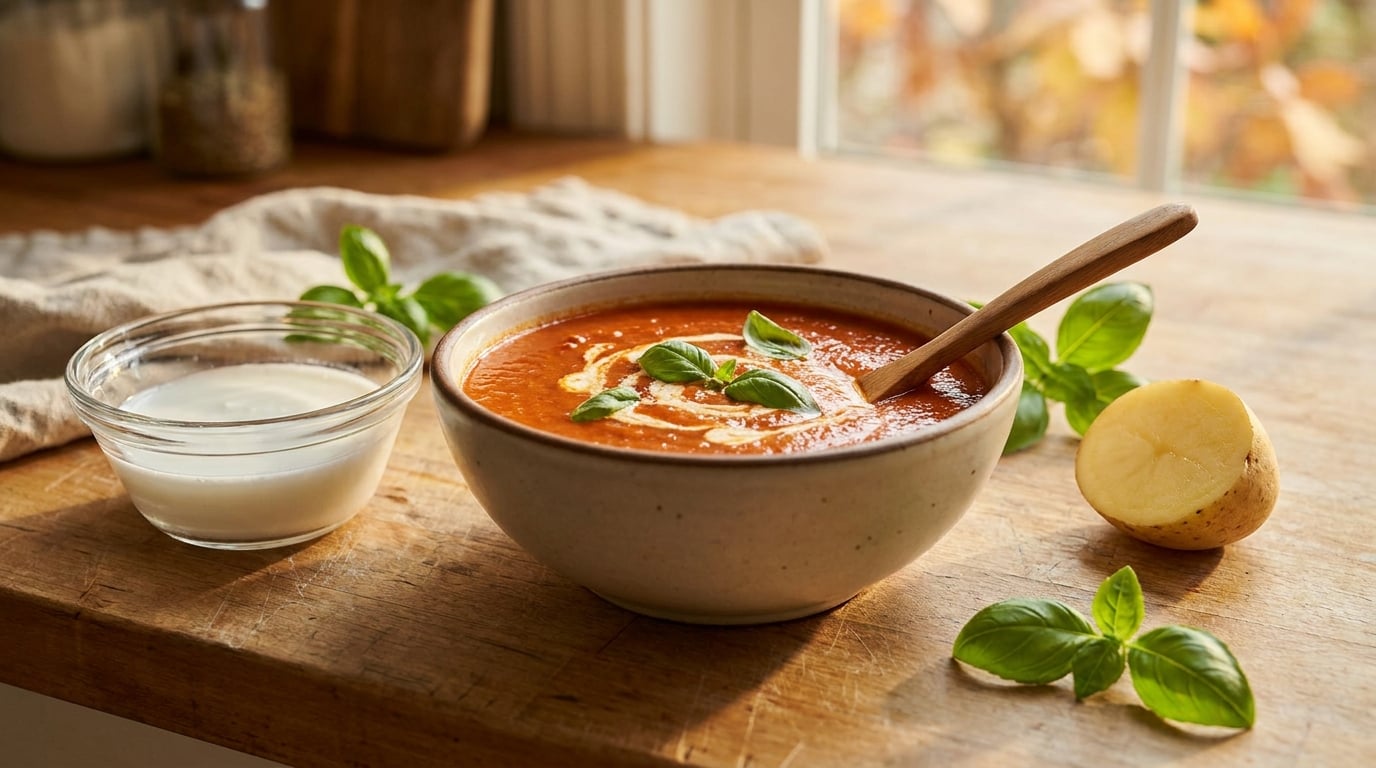
You can thicken soup without flour by simmering it down, whisking in a cold starch slurry, blending part of the pot, or adding fat, dairy or nut butter. Each one needs a small, measured amount and a quick taste test. Pick the method that matches your soup, and you will not need a roux at all.
Most of the kitchen disasters I get asked about start the same way: someone adds the thickener, gets impatient, dumps in too much, and ends up with glue. The fix is always the same too. Start small, stir, taste, and add again.
I keep these ratios in a note on my phone and re-checked them for 2026, because the details people argue about on cooking forums are almost never about technique. They are about quantity.
Table of Contents
1. How to Reduce Soup to Thicken It Without Flour
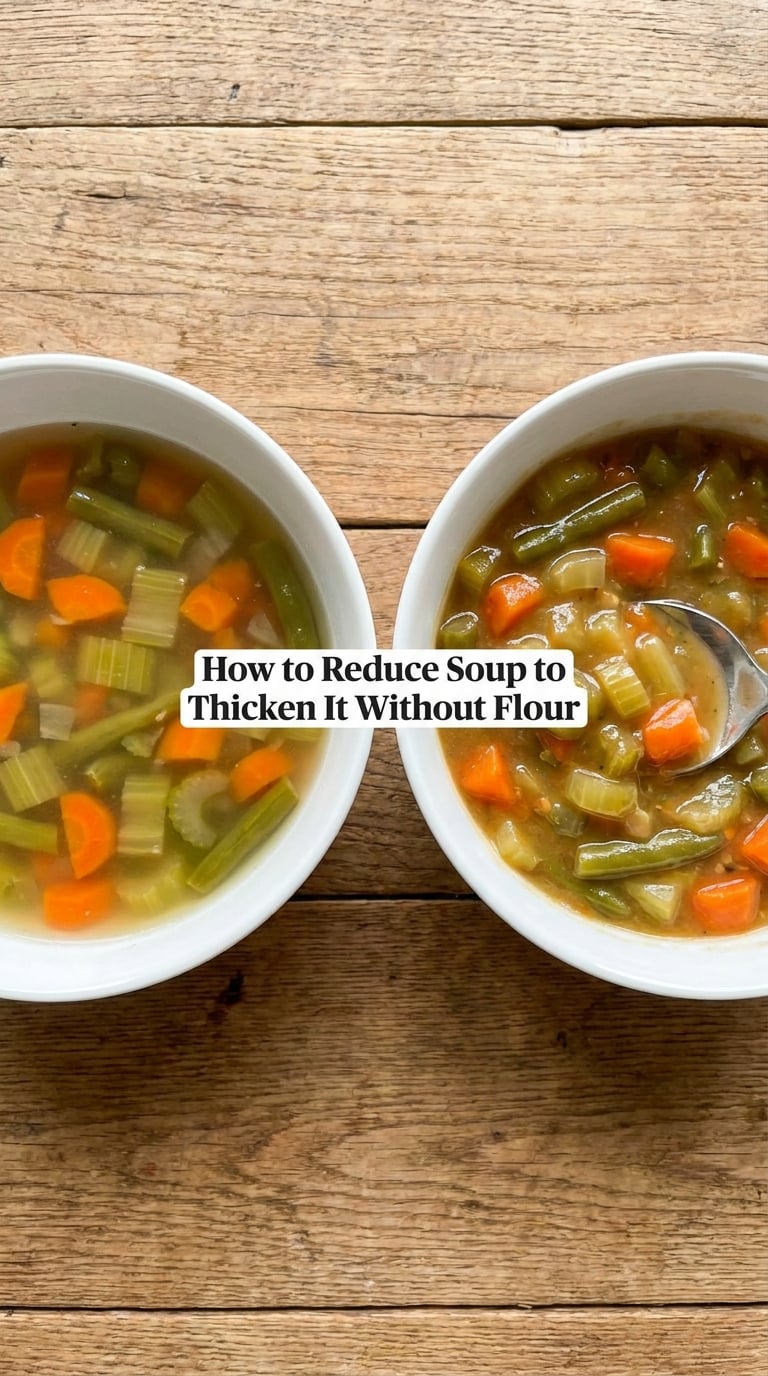
Reduction is the only method here that adds nothing at all. Simmer the soup uncovered and water boils off, so what is left tastes more concentrated and sits heavier on the spoon.
The trade-off is time and volume. You lose roughly a quarter to a third of a pot over a normal reducing session, so make sure there is enough headroom in the pot before you start.
| Soup type | Simmer time, uncovered | What you should see |
|---|---|---|
| Clear or thin broth-based soup | 20-30 minutes | Bubbles get slower and glossier, spoon leaves a faint trail |
| Medium vegetable or bean soup | 15-25 minutes | Soup drops off the spoon instead of running flat |
| Vegetable-heavy or potato soup | 10-15 minutes | Surface looks satin, not wet |
| Cream or dairy soup | 5-10 minutes, lowest heat only | Just enough body, no film on top, no breaking |
How to thicken soup without flour by reducing it
Simmer uncovered over medium-low heat for 15-30 minutes, stir often so nothing catches on the bottom, and stop when the soup lightly coats a spoon. Keep it at a lazy bubble the whole time. A hard boil scatters fat, dulls flavour, and can split a dairy soup outright.
Stir more often as it thickens, because the bottom of the pot gets hotter as the liquid level drops. Use a wide pot instead of a narrow one and you will cut the time roughly in half.
For soup with meat, fish or poultry, cook to the safe internal temperature first and keep the soup hot while you reduce it: poultry to 165°F (74°C), ground meat to 160°F (71°C), fish to 145°F (63°C), and beef, pork, veal or lamb cuts to 145°F (63°C) with a 3-minute rest.
2. Thicken Soup with a Cornstarch, Potato Starch, or Arrowroot Slurry
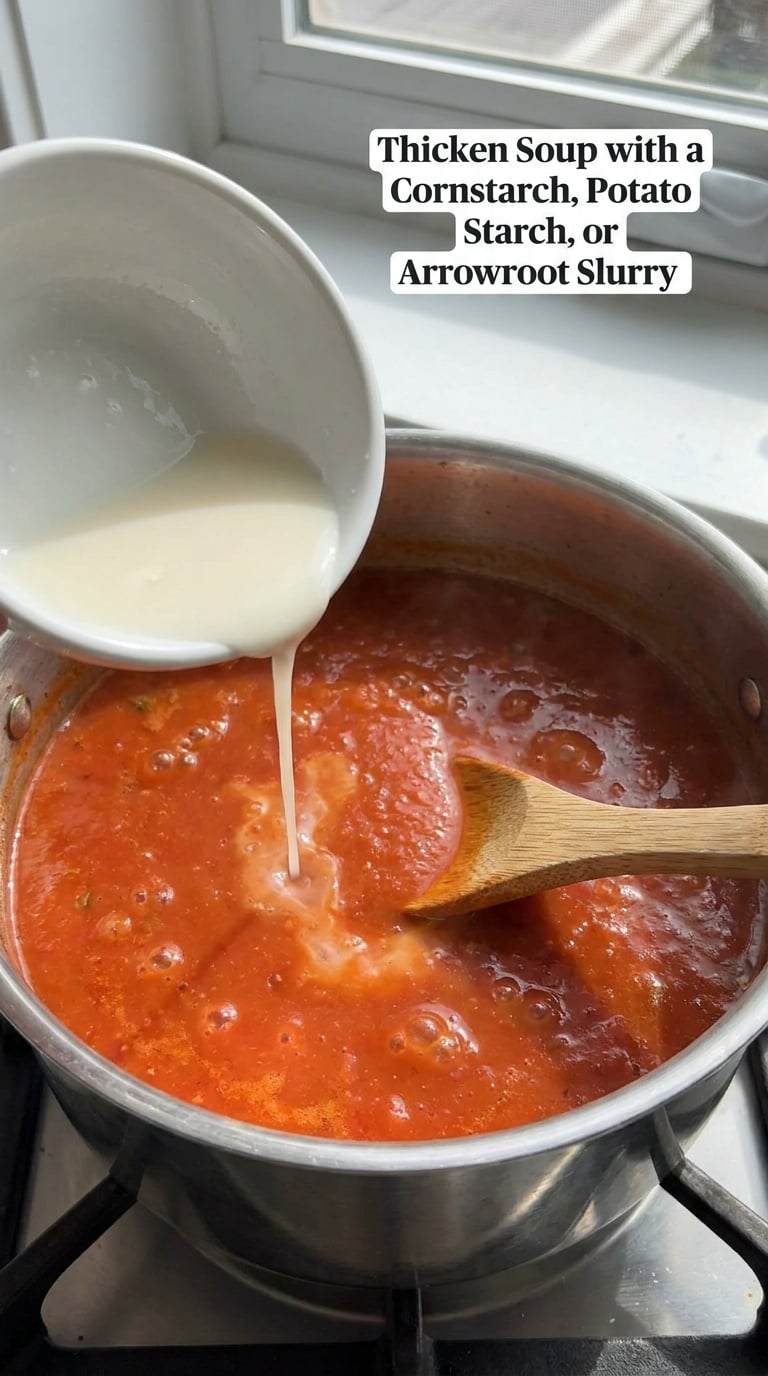
A slurry is starch suspended in cold water, and cold is the whole trick. Warm or hot water cooks the starch on contact, and that is what gives you the little pale lumps that never whisk out.
Starch needs heat to activate. Once the slurry goes in, bring the soup back to a simmer and cook it for a full minute before tasting, otherwise you are judging it raw.
| Starch | Per 1 cup of thin soup | Result |
|---|---|---|
| Cornstarch | 1 tsp starch whisked into 2 tbsp cold water | Light gloss, slight translucency, holds up to reheating well |
| Cornstarch, for a bigger correction | 2 tsp starch whisked into 3 tbsp cold water | Noticeably heavier body, chowder and chili territory |
| Potato starch | 1 tsp into 2 tbsp cold water | Clearer, glossier and a little more neutral than cornstarch |
| Arrowroot | 1 tsp into 2 tbsp cold water | Very clear and silky, but loses thickness if boiled hard or reheated |
| Tapioca or instant granulate | 1 tbsp dry, sprinkled in | Softer, slightly grainy, forgiving of boiling |
- Measure cold water into a small bowl or cup first.
- Add the starch and whisk until no dry pockets remain at the bottom.
- Turn the soup to a gentle simmer and stir it with one hand.
- Pour the slurry in a thin stream while you stir with the other.
- Bring it back to a simmer and cook 1 to 2 minutes, stirring constantly, until the soup looks glossy and a spoon drawn through it leaves a trail that closes slowly.
Arrowroot gives you the clearest finish of the starches, which is why it works in a broth you want to still look like broth. The catch is heat tolerance. Arrowroot is a poor choice for anything you will boil hard, chill and reheat, because it relaxes and goes watery again. Cornstarch is the opposite and is why it is the default for freezer soup.
3. Thicken Soup with Potato or Vegetable Puree
This is my favourite method, because it thickens and flavours at the same time. Starch released from cooked potato and fine vegetable particles physically suspend in the broth, so you get body for free.
Start with about a quarter of the cooked volume for a modest change, and a third to half for a real transformation. Pull out cooked potatoes or a ladleful of the soup itself, mash or blend with a splash of the hot broth, then stir it back in.
Potato, carrots, parsnip, sweet potato, rutabaga, butternut squash, cauliflower, and white beans all blend smooth. Cauliflower is the low-carb pick, and blended it gives a creamy finish with no starch at all. Broccoli and leafy greens are better left with some texture unless you are chasing a smooth bowl.
Decide on straining before you start. Leave it rustic and you keep every bit of texture and flavour. Push it through a fine mesh sieve for a restaurant-smooth bisque, knowing you will lose some of the solids you paid for.
4. Thicken Soup with Cream, Half-and-Half, or Evaporated Milk
Dairy is the easiest fix for a thin soup and the least transformative. Fat suspends fine particles and gives you a round, velvety mouthfeel rather than a starch-heavy one, and it will not glue.
For 4 cups of thin soup, start with a quarter cup of heavy cream or half-and-half, stir it in off the boil, and simmer gently for 5 minutes. Evaporated milk gives roughly the same body with a slightly sweeter, rounder flavour and no extra fat added to the pot.
Cold dairy hitting a hard boil is how soups break and go grainy. Take the pot off the heat, add the dairy, and let the residual heat bring it back to a bare simmer.
For a dairy-free version, full-fat coconut milk is the closest match in body. Add it the same way, off the boil. It brings its own aroma, so save it for soups where coconut reads as intentional rather than surprising.
5. Thicken Soup with Butter and Oil
A small knob of butter whisked into a thin soup rounds it out and softens the edges of a sharp broth. It is a finisher, not a rescue, and it will not fix a soup that runs off the spoon like water.
Use about 1 tablespoon of butter per 4 cups, or 1 teaspoon of olive oil if you want the effect without the dairy. Whisk it in off the heat so it emulsifies into the liquid rather than sitting in one slick on top.
For a thin soup that needs real volume of body, fat still has to be backed by something that binds water. Whisk the butter in first, then add a small starch slurry if the spoon test still fails. Give the mixture another minute of simmering after the starch goes in.
6. Thicken Soup with Nut or Seed Butter
Nut and seed butters thicken by sheer emulsified solids, and they change the flavour of the dish, so think of them as an ingredient rather than a neutral fix.
Whisk 1 to 2 tablespoons of almond, cashew or sunflower seed butter into 4 cups of warm soup, off the heat, until the liquid turns uniformly creamy. Cashew butter is the mildest of the three and the least likely to fight a delicate broth. Tahini works in soups built around garlic and lemon.
Sunflower seed butter carries a nuttier, roasted note than the others and can split if the soup is very hot. Bring the pot off the heat, then whisk it in slowly.
Two things to know. If the soup is at a rolling boil the butter will seize and stay in streaks, so temper it first with a ladleful of broth. And if you are serving anyone with a nut allergy, sunflower seed butter is the swap, though it still counts as a seed allergen in many kitchens. If you want a nut-free, seed-free option, use the potato puree or a bean purée instead.
7. Thicken Soup with Instant Potato Flakes
Instant potato flakes are the pantry answer when the recipe calls for flour and the box is empty. They thicken more than mashed potato per spoonful because the flakes are dried starch, not just potato.
| Starting soup | Flakes for 4 cups | Resulting texture |
|---|---|---|
| Thin and watery | 2 tablespoons | Light body, still pourable |
| Medium | 1/3 cup | Noticeably creamy, close to a thin chowder |
| Extra thick | 1/2 cup to 3/4 cup | Spoon-holding, closer to a thick stew than a soup |
Sprinkle the flakes over the surface with the pot off the heat and stir immediately. Adding them into a bubbling soup gives you lumps that look like dumplings, and no amount of stirring fully breaks them down.
The finish is close to freshly mashed potato folded into the pot, just slightly drier and more concentrated in flavour. Some people find the dehydrated edge a little pasty if they overdo it, which is the main reason to add less than you think you need.
Which Flour-Free Thickening Method Should You Use?
| Method | Amount per 4 cups | Texture | Flavour change | Difficulty | Best for |
|---|---|---|---|---|---|
| Reduce | No addition, 15-30 min uncovered | Concentrated, slightly syrupy | None, only intensified | Easy, just slow | Any soup, especially broths and stocks |
| Starch slurry | 1 tbsp starch in 2 tbsp cold water | Glossy, light to medium | None when measured | Easy | Tomato, bisque, chili, chowder, pot pie filling |
| Potato or veg puree | 1 to 2 cups blended, stirred back in | Rustic to smooth, full | Adds the vegetable | Easy | Vegetable soups, chicken and rice soup, gazpacho-style |
| Cream or coconut milk | 1/4 cup | Round, velvety, light | Dairy adds richness; coconut is distinct | Easy | Bisque, chowder, pumpkin soup |
| Butter or oil | 1 tbsp or 1 tsp | Smoother, glossier, not thicker | None to slight | Easy | Finishing a soup that is nearly right |
| Nut or seed butter | 1 to 2 tbsp | Creamy, slightly grainy | Clearly nutty or earthy | Easy to medium | Sweet potato, squash, tomato, chilli-based soups |
| Instant potato flakes | 1/3 cup | Very creamy, slightly pasty if overdone | Mild potato note | Easy | Baked potato soup, thick winter soups, emergency rescue |
One note on clear soups. Reduction, a bean purée, and a low dose of arrowroot are the only three here that will not cloud a broth. Everything else, including cream and blended potato, changes the character of the liquid, and in a consommé-style soup that is a real loss.
Common Mistakes and How to Fix Them
| Problem | Why it happened | Fix |
|---|---|---|
| Gluey or gummy texture | Too much starch, and it was cooked too long after boiling | Add hot broth a ladle at a time and stir for a full minute to work the starch back out |
| Lumps in the soup | Slurry was mixed with warm water, or starch hit a hard boil | Whisk the slurry in cold liquid, pour in a thin stream while stirring, and keep the pot at a simmer not a boil |
| Soup went thin again in the bowl or the fridge | The starch was set with a hard boil, or the soup reheated too fast | Thicken a ladleful in a small pan and stir it back through the whole pot, reheating gently |
| Thin at the bottom of the pot | Starch settled, common after reheating | Stir from the bottom every time you lift a ladle, and give the pot a shake over low heat |
| Dairy soup turned grainy or split | Cold dairy hit soup already at a hard boil | Take the pot off the heat, add dairy slowly, and bring it back only to a bare simmer |
| Watery puree, thin results | Vegetables were blended dry with no liquid to puree | Add hot broth to the blend a little at a time until it pours easily, then stir it back in |
| Gluten-free soup that will not hold thick on reheat | Usually arrowroot, which relaxes with heat and time | Use cornstarch or potato starch instead; if you have already used arrowroot, finish with a small cornstarch slurry |
| Too thick now | Over-corrected, common when adding thickener in one go | Add hot broth or stock a quarter cup at a time, stirring fully between additions |
The rule behind most of this: never dump in a second large measure of thickener to solve a problem you have not looked at yet. Add a little, stir, wait a minute, then look again. If the fix does not work, the problem is usually heat or stirring, not quantity.
If you are working without any starch at all and need a last resort, a small amount of xanthan gum sifted through a fine sieve will thicken almost any soup in seconds. Go easy on it. It clumps easily and a very small amount does a lot of work.
Thickened soup keeps three to four days in the refrigerator, and thickened soups that have not been cream-based are among the easiest things to freeze. Cool it fast, leave headroom, and reheat on low with a splash of broth, stirring from the bottom.
For more ideas built on the same pantry logic, my January soup recipe roundup and this one pot unstuffed cabbage roll soup both show how much thickness you get from the ingredients alone. The golumpki soup is a good example of a brothy soup that leans on its own solids rather than a thickener.
Frequently Asked Questions
What is the best way to thicken soup without flour?
The best method depends on the soup. For a quick, neutral fix, whisk 1 tablespoon of cornstarch into 2 tablespoons of cold water and simmer it into the soup for 1 to 2 minutes. For flavour and body, blend a ladleful of the soup itself and stir it back in. For a broth you want to concentrate, simmer it uncovered for 20 to 30 minutes.
Does cornstarch make soup taste like flour?
It can, if you add too much or cook it too long after boiling, which turns it gluey and pasty. Measured carefully, 1 tablespoon per 4 cups, and simmered for about a minute, cornstarch is neutral and adds only a light gloss. The flour taste people remember usually comes from raw flour whisked straight into hot liquid.
What is the best flour-free thickener for gluten-free soup?
For a gluten-free soup, the top choices are a cornstarch slurry, potato starch, blended potato or cauliflower, white beans, and reduction. Cornstarch is the most reliable on reheating, which makes it better than arrowroot for soup you will chill and freeze. Blended potato or white beans add body, flavour, fibre and protein at the same time.
How do I fix soup that is too thin after adding cornstarch?
Let the soup simmer a full minute after the slurry goes in, since cornstarch needs heat to thicken. If it is still thin, make a fresh small slurry in cold water and add it in increments rather than one large pour. Starch that has already set will not thicken further, so the second addition has to be new slurry, stirred in while the soup simmers.
Can I thicken soup without cooking it?
Only partially. Blending in a puree of cooked potato, white beans or roasted vegetables, or whisking in nut butter, thickens a soup without heat, though the texture is less integrated. Starches need boiling to activate, so a slurry will do nothing in a cold soup. If you want thickness without a stove, blend a portion of the finished soup and stir it back in.
How long can thickened soup stay in the refrigerator?
Thickened soup keeps three to four days refrigerated, the same as any cooked soup, and it reheats more reliably than a thin broth because the starch is already set. Cool it in shallow containers so it chills fast, and reheat on low with a splash of broth, stirring from the bottom so the thickened base lifts off.
Conclusion
Start with reduction if you have twenty minutes and want the most flavour for the least effort. Start with a cold starch slurry if you want a neutral, fast correction, and start with a blended portion of the soup itself if you want more flavour and body at the same time. Cream, nut butter and instant potato flakes each work well once you know how much the dish already gives you.
Whatever you pick, add less than you think you need, stir it in properly, and give it a full minute of heat before you judge it. That is how to thicken soup without flour and still end up with a bowl worth eating.