
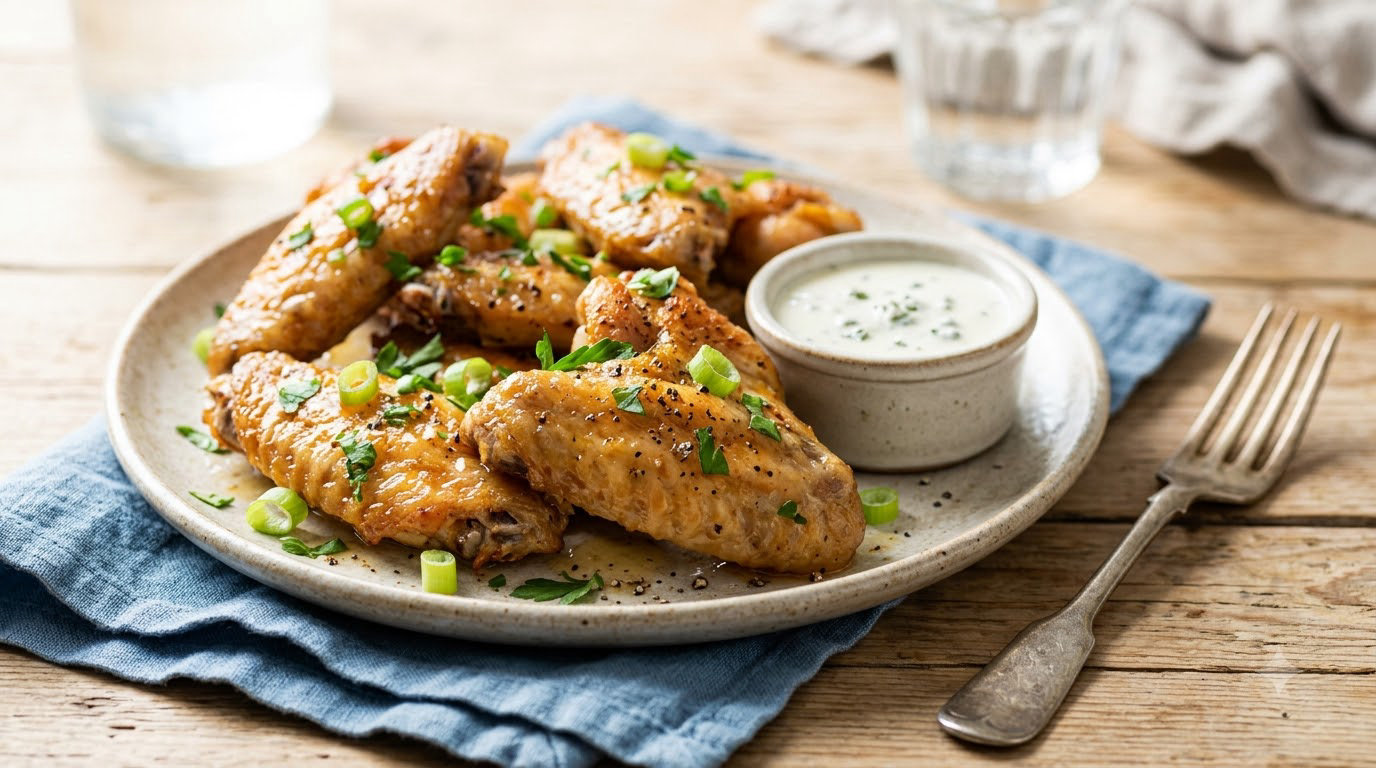
Bake chicken wings at 425°F (218°C) for the crispiest skin, and 400°F (204°C) is a perfectly good all-purpose choice. Plan on 45-60 minutes for raw wings, turn them every 15-20 minutes, and pull them when the thickest part of the meat hits 165°F (74°C).
That one number answers most of the question, but game day is not the only time wings go in the oven. Frozen bags, fully cooked takeout wings and giant party platters all need different times, and that is where most batches go wrong.
Here is the whole picture: what temperature to cook chicken wings in the oven, how long each temperature takes, and the few small habits that turn a tray of pale wings into a tray people fight over.
Table of Contents
What Temperature to Cook Chicken Wings in the Oven: Quick Guide
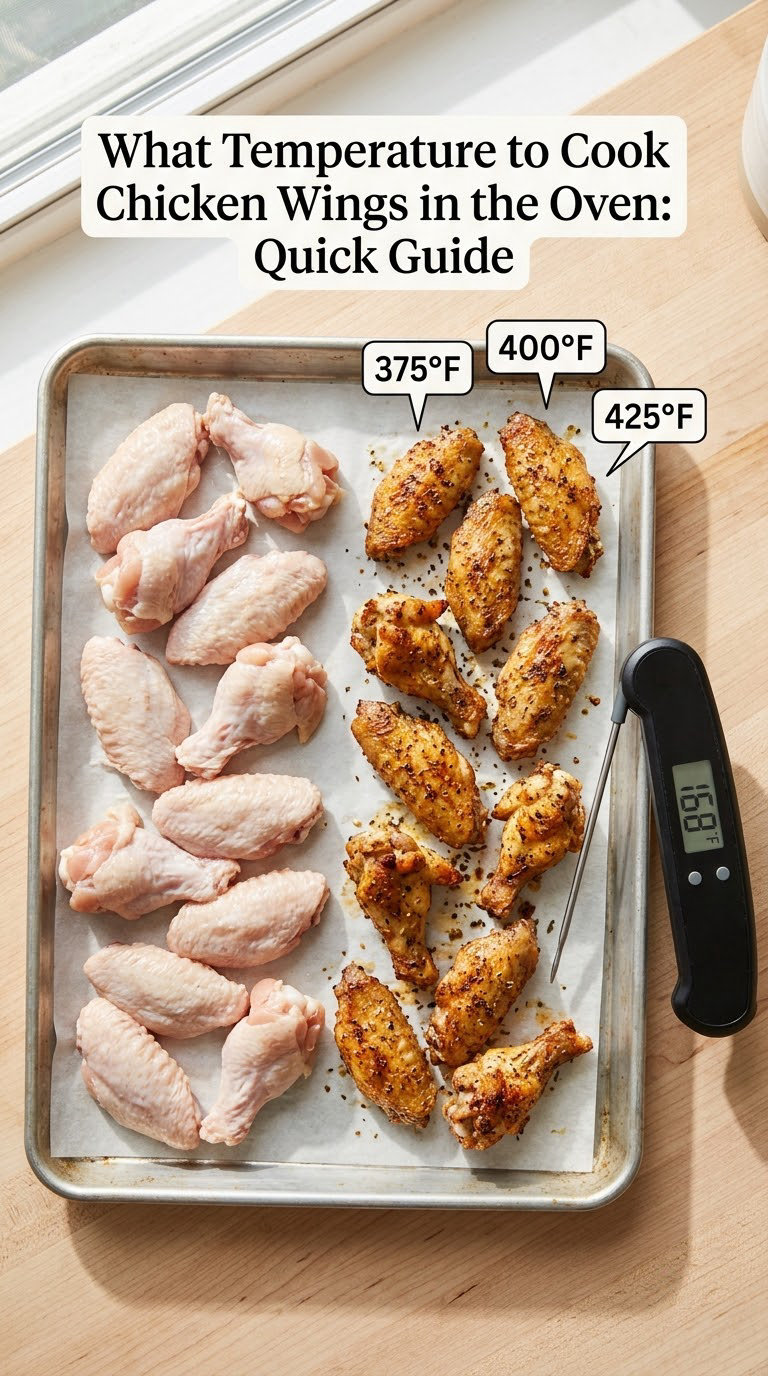
The short version: 425°F (218°C) for crisp skin, 400°F (204°C) for an even cook that is forgiving on sugary rubs, and 375°F (191°C) when you want gentler heat and do not mind waiting longer.
| Wing type | Oven temperature | Approximate time | Safe internal temperature |
|---|---|---|---|
| Raw, thawed, medium wings | 425°F (218°C) | 45-60 min | 165°F (74°C) |
| Raw, thawed, medium wings | 400°F (204°C) | 45-60 min | 165°F (74°C) |
| Raw, thawed, medium wings | 375°F (191°C) | 60-75 min | 165°F (74°C) |
| Raw, frozen, store-bought | 425°F (218°C) | 55-75 min | 165°F (74°C) |
| Pre-cooked or takeout, reheating | 375°F (191°C) | 20-25 min | 165°F (74°C) |
| Two-stage: low then hot | 250°F (121°C), then 425°F (218°C) | 30 min, then 40-45 min | 165°F (74°C) |
Times assume medium wings, roughly 1.5 to 2 ounces each, spaced in a single layer. Larger jumbo wings and whole wings run 10-15 minutes longer, and wings baked on a convection setting run about 20% shorter.
Which Oven Temperature Gives the Best Chicken Wings?
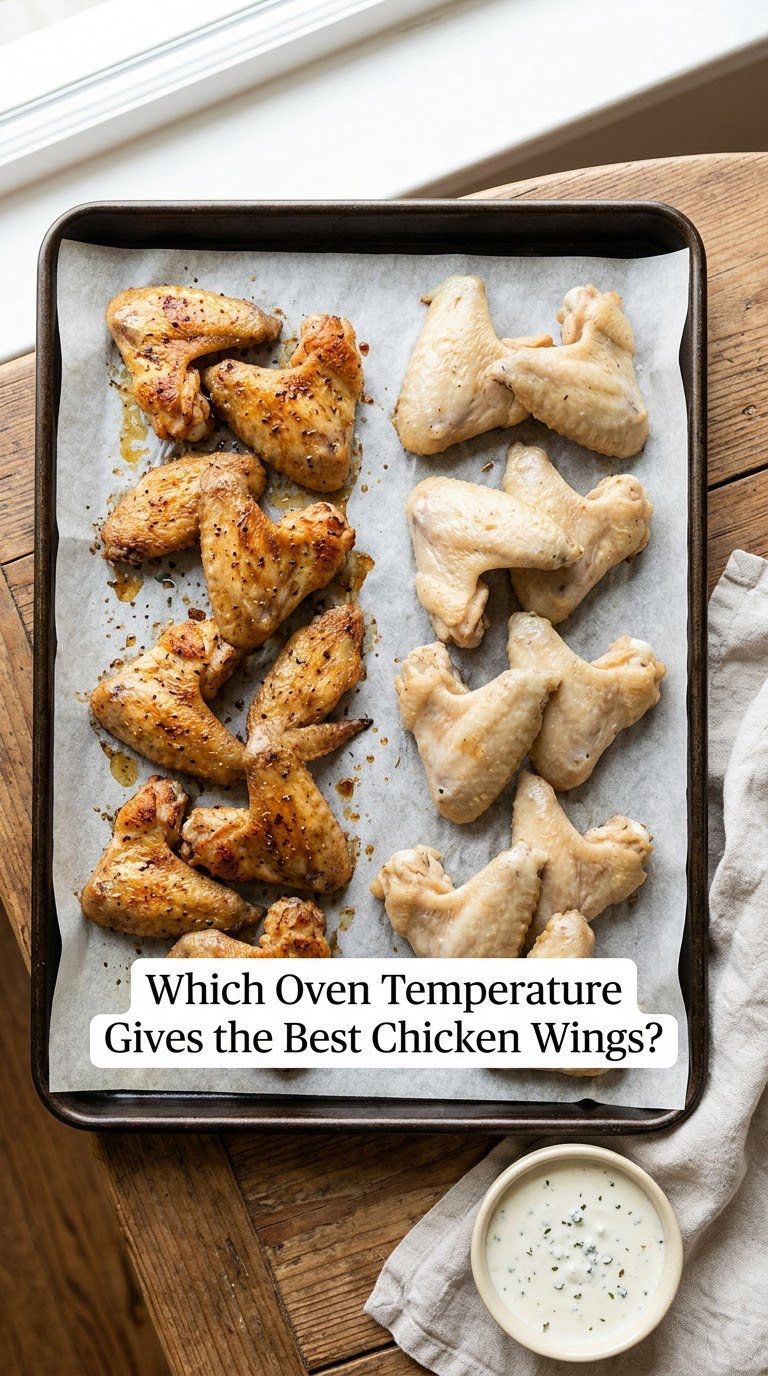
425°F (218°C) gives you the best chicken wings, because high heat renders the fat under the skin and drives off surface moisture fast enough that the skin sets and crisps before the meat has a chance to dry out.
At 400°F (204°C) you give up very little crispness and gain a wider margin on timing, which is why so many reliable recipes sit there. At 375°F (191°C) the skin is more forgiving but noticeably softer, and the cook stretches past an hour.
Two details change the result more than most people expect. Oil and parchment both matter: a light coat of oil browns skin faster, while parchment is easier to release from but slows browning slightly. A wire cooling rack set over a rimmed sheet gives air under the wings and is the single best setup for crisp skin.
If you like a shortcut and own an air fryer, my air fryer chicken wings method gets similar results in about half the time at 400°F (204°C).
How Long Should Chicken Wings Cook at Each Temperature?
Use this grid as a starting point, then check with a thermometer. Time is a guess; temperature is the fact.
| Oven temperature | Bake time | Turn at | Result |
|---|---|---|---|
| 350°F (177°C) | 70-85 min | 30 min | Tender, soft skin, forgiving of sugar |
| 375°F (191°C) | 60-75 min | 25-30 min | Even cook, mildly browned skin |
| 400°F (204°C) | 50-65 min | 20-25 min | Balanced: good browning, juicy meat |
| 425°F (218°C) | 45-60 min | 15-20 min | Crispiest skin, watch sugary rubs |
| 450°F (232°C) | 40-50 min | 15 min | Very crisp with a burn risk on sugar |
Wing size moves these numbers more than anything else. A table of flats cooks faster than drumettes, because a flat is all skin and meat with no bone to work around.
| Wing cut | At 400°F (204°C) | At 425°F (218°C) |
|---|---|---|
| Flats | 45-55 min | 40-50 min |
| Drumettes | 50-60 min | 45-55 min |
| Whole wings, split | 50-60 min | 45-55 min |
| Whole wings, unsplit | 60-70 min | 55-65 min |
| Frozen bagged wings | 60-75 min | 55-70 min |
Batch size barely matters as long as nothing touches. If you are cooking drumsticks alongside wings, they need that same heat and take a little longer, so the oven baked drumstick method runs in a useful side-by-side bake.
How to Cook Raw Chicken Wings in the Oven
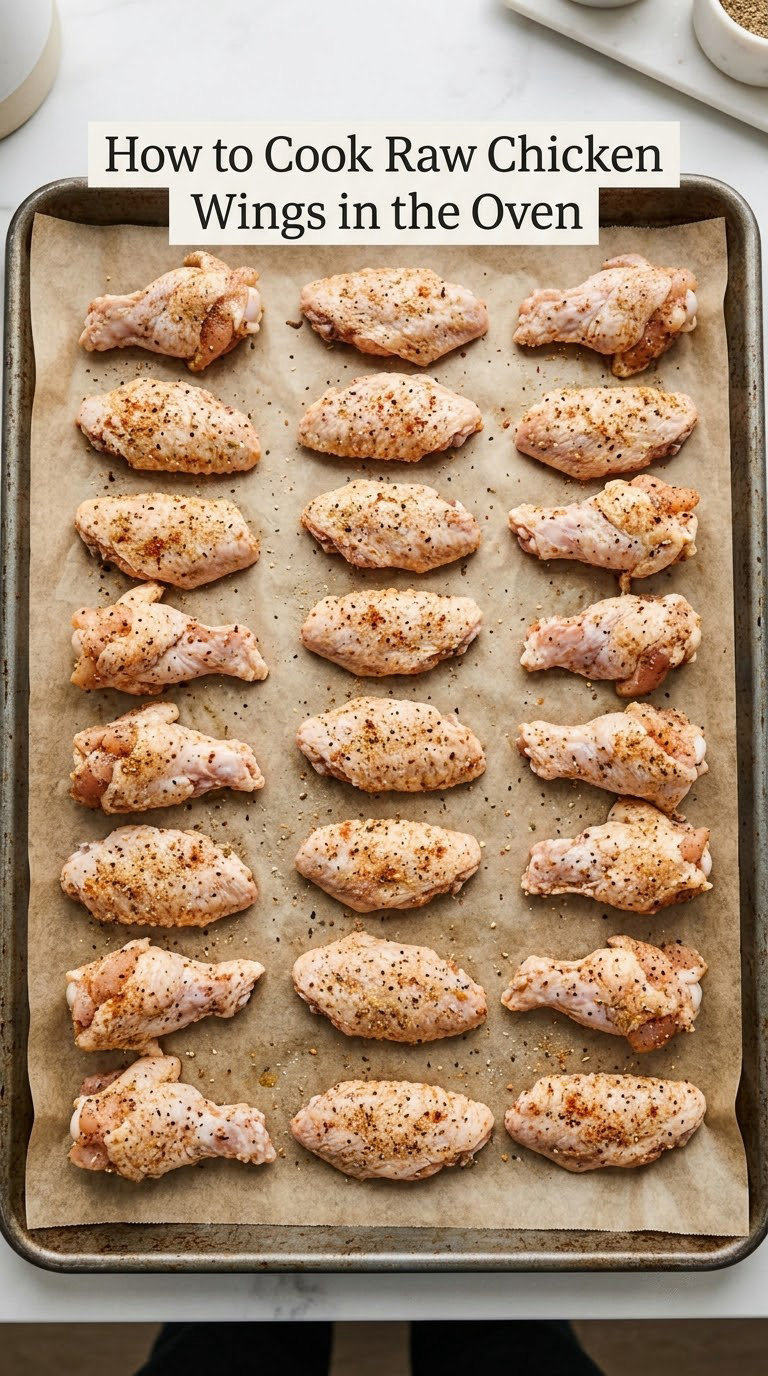
Raw wings need three things before they go in: dry skin, space, and a hot pan. Follow the steps in order and 425°F (218°C) will do the rest.
- Preheat the oven to 425°F (218°C) and set a heavy rimmed baking sheet inside to heat with it.
- Pat the wings dry with paper towels until the skin feels tacky, not damp. Wet skin steams instead of browning.
- Season with salt and whatever rub you like. If you are using baking powder, this is the moment: about 1 teaspoon of aluminum-free baking powder per pound of wings, mixed into the dry rub.
- Toss with a light coat of oil so the skin has something to brown. Skip the oil if your rub is sugary.
- Arrange in a single layer on the hot sheet, skin side down, with a finger’s width between pieces. Two racks at once is fine if your oven runs even.
- Bake 45-60 minutes, turning every 15-20 minutes so both sides crisp.
- Check the thickest part of a wing with an instant-read thermometer. It should read 165°F (74°C) minimum, and closer to 175-180°F (79-82°C) for the best texture.
- Rest 5 minutes on the sheet, then sauce or serve.
For seasoning ideas and a sauce timing that does not undo the crisp skin, my oven baked chicken wings recipe goes into more detail on flavor.
What Temperature to Cook Frozen Chicken Wings in the Oven?
Frozen wings cook at the same 425°F (218°C); only the time changes. Bake them from frozen and add 10-15 minutes over the thawed times listed above, so 55-75 minutes is a realistic range.
Two precautions matter here. Set them on a lightly greased sheet, since frozen skin sticks harder, and do not thaw them on the counter. Moving them to the fridge overnight is safer and works fine for a party plan made a day ahead.
Check the temperature at the 40-minute mark so you are not surprised. The meat is dense around the bone and the last stretch is where wings usually finish.
How to Get Crispy Chicken Wings Without Burning Them
Crisp skin comes from dry surface, rendered fat and airflow, not from sauce. Six habits do most of the work.
- Dry the skin properly. Paper towels, then a short rest uncovered in the fridge if you have time.
- Use aluminum-free baking powder. It raises the skin’s pH so proteins do not tighten as it cooks. Baking soda does the same thing but leaves a soapy taste.
- Use a wire cooling rack over a rimmed sheet. Air circulates under the wings and the rendered fat drains away instead of pooling.
- Give each wing space. Touching wings steam each other. One sheet that is not crowded beats two sheets that are.
- Cook at 425°F (218°C) and add the sugar later. Barbecue glazes and sweet dry rubs burn above 400°F, so use the rub now and the sugary sauce after baking.
- Finish under the broiler. Two or three minutes at broil, watched constantly, deepens color on wings that are cooked through but pale.
The two-stage bake is the version cooks reach for when they want restaurant-crisp wings. Hold the wings at 250°F (121°C) for about 30 minutes, then move them to a 425°F (218°C) oven for 40-45 minutes. The low stage drives off water slowly, and the hot stage renders and crisps without the outside overcooking. It is a longer evening, and the skin is noticeably better for it.
Convection ovens run hotter in effect than their numbers suggest. Drop the temperature by 25°F and pull the wings 20% earlier, so a 50-minute conventional cook becomes about 40 minutes.
How to Tell When Chicken Wings Are Done
Color lies. Sauce darkens long before the meat is safe, and pale wings can be perfectly done. Three visual cues help: the meat at the thickest part is no longer pink or translucent, the fat under the skin has rendered and the skin looks tight rather than loose, and the juices run clear.
The thermometer settles it. Push the instant-read into the thickest part of the meat, touching bone but not scraping it, and read it without pulling the wings out to rest first.
USDA guidance puts the safe minimum for poultry at 165°F (74°C). For eating quality, 175-180°F (79-82°C) is better, and the difference is not toughness the way people fear. Those extra ten degrees are what push collagen and fat into gelatin and let the skin crisp. Wings pulled the instant they hit 165°F often read as dry, partly because carryover cooking continues while they sit.
So treat 165°F as the line, and 175-180°F as the target.
Can You Cook Pre-Cooked Chicken Wings in the Oven?
Yes, and reheating is much quicker than cooking from raw. Set the oven to 375°F (191°C), arrange the wings in a single layer, and bake 20-25 minutes, turning once, until the skin crisps and the thickest part of the meat reaches 165°F (74°C).
Reheat only what you plan to eat within a couple of hours. Wings held warm for a game day dry out, and you cannot bring that back with a second trip through the oven.
Microwaving is the fast way to ruin skin. It heats the water inside the wing unevenly and leaves the outside leathery, so five minutes under the broiler at 400°F (204°C) does more for a batch of leftovers.
Should You Cover Chicken Wings While Baking?
Leave them uncovered. Foil traps steam, and steam is the opposite of what you want, since softened skin is how you get wings that feel rubbery instead of crisp.
There is one exception: wings brined in a salty or wet marinade, where covering the first 20 minutes at 400°F (204°C) keeps the surface from setting too hard before the meat cooks through. Uncover for the rest of the cook.
Some cooks use a light spray of nonstick cooking oil on foil rather than full coverage. That is a workable compromise for people who fight sticking, and it does not seal in steam the way a whole sheet of foil does.
Do You Need to Preheat the Oven for Chicken Wings?
Yes. A cold or slow-rising oven delays the cook, and the extra 10 minutes at a lower temperature is exactly what leaves you with pale wings.
Preheat to 425°F (218°C) for crisp skin, 400°F (204°C) as the balanced pick, or 375°F (191°C) for a gentler cook. A fully preheated oven also browns the wings faster in the last five minutes, which is often the difference between good and genuinely crisp.
Do You Need to Flip Chicken Wings While Cooking?
Turn them two or three times, mostly so the underside gets heat and the skin does not stick to the sheet. A flip at 15 minutes and another at 30 is plenty at 425°F (218°C).
Spacing matters more than flipping. Wings with air around them brown on all sides without turning, and turning a crowded pan just moves stuck pieces around. If your oven runs hot in one corner, rotate the whole sheet instead of flipping every wing individually.
A wire rack removes the need to be quite so diligent, since the underside gets airflow instead of sitting on metal.
How to Keep Wings Crispy After Baking
Crisp skin has a short window. These steps stretch it to about an hour.
- Rest on a wire rack, not on a plate or paper towel, so steam escapes instead of softening the underside.
- Hold in a single layer in the oven at 200°F (93°C) if you need a buffer, with the door cracked an inch. Do not stack them.
- Buffalo sauce after baking, never before, and toss just before serving.
- Store leftovers in the fridge for up to 3-4 days in a sealed container, lined with paper towels so the skin does not sit in moisture.
- Reheat at 375°F (191°C) for 10-15 minutes, or 400°F (204°C) for 5-8 minutes, until hot and crisp again. The oven and air fryer are the only good tools for this.
Pairings matter on game day, and my list of side dishes for chicken wings covers the celery-and-ranch end of the table.
Common Chicken Wing Mistakes and How to Fix Them
Almost every disappointing batch comes down to one of six things.
- Wings stick to the sheet. Cause: skin was damp or the sheet was cold. Fix: pat dry, preheat the sheet with the oven, and grease it lightly.
- Some wings cook through while others stay raw. Cause: crowding, or wings of wildly different sizes. Fix: one layer with space, and start checking the thickest pieces first.
- Meat is dry. Cause: pushing the cook past done to force crispness. Fix: pull at 175-180°F (79-82°C) and add baking powder, which crisps without extra heat.
- Sugar burns before the skin crisps. Cause: a sweet rub or glaze in a 425°F (218°C) oven. Fix: season with salt and savory spices for the bake, add the sugary sauce at the end.
- Skin stays pale and chewy. Cause: moisture on the surface, or a pan that never got hot. Fix: dry the wings, use a preheated sheet, and give them a two to three minute broil finish.
- Wings take forever to reach temperature. Cause: a full, crowded pan or an oven that never reaches its set point. Fix: bake in smaller batches on two racks, and verify the oven actually hits temperature with an independent oven thermometer, since an underheating oven is the usual reason wings stall before they come through.
Frequently Asked Questions
What is the best temperature for cooking chicken wings in the oven?
425°F (218°C) gives you the crispest skin because the heat renders the fat under the skin and drives off surface moisture quickly. 400°F (204°C) is a close second and more forgiving on sugary rubs. Both land raw medium wings in 45-60 minutes. Always confirm the thickest part of the meat reaches 165°F (74°C) before serving.
How long does it take to cook chicken wings at 400°F?
Raw wings at 400°F (204°C) take 45-60 minutes for medium flats and 50-65 minutes for drumettes or whole wings, turning every 20-25 minutes. Frozen wings need 10-15 extra minutes. On convection, drop the temperature by 25°F and check about 20% earlier, near the 40-minute mark.
Do chicken wings need to be flipped while baking?
Turn them two or three times so the underside gets heat and the skin does not stick, usually at 15 and 30 minutes for a 425°F bake. Flipping matters far less than spacing. Wings arranged in a single layer with air around them brown all over on their own, and a wire rack over the sheet means the bottom cooks without extra turning.
How long should frozen chicken wings cook in the oven?
Bake frozen wings at the same temperature as fresh ones, 425°F (218°C), and add 10-15 minutes, so 55-75 minutes is realistic. Set them on a lightly greased sheet because frozen skin sticks harder. Check the thickest part at 40 minutes and confirm it reaches 165°F (74°C) before serving.
Why are my chicken wings not getting crispy?
Almost always surface moisture, crowding or a sheet that was not hot. Pat the wings dry with paper towels, add about 1 teaspoon of aluminum-free baking powder per pound, arrange them in a single layer on a preheated rimmed sheet, and finish under the broiler for two or three minutes. Sugary glazes also go on after baking, never before.
Can you reheat cooked chicken wings in the oven?
Yes, at 375°F (191°C) for 10-15 minutes, or 400°F (204°C) for 5-8 minutes, until hot and crisp again. Reheat only the amount you will eat within a couple of hours, since wings held warm dry out. Avoid the microwave, which leaves the skin leathery, and check the thickest part reaches 165°F (74°C).
The Best Oven Temperature for Juicy, Crisp Chicken Wings
Use 425°F (218°C) when crisp skin is the goal, 400°F (204°C) as the balanced all-purpose temperature that rarely goes wrong, and 375°F (191°C) for a gentler cook you are not in a hurry for. Add 10-15 minutes for frozen wings, and always verify 165°F (74°C) in the thickest part of the meat before anyone eats.
Start tonight with 425°F, wings patted dry, a single layer on a hot sheet and a turn at 15 minutes. That combination solves what temperature to cook chicken wings in the oven and most of what to do about it, all in under an hour.