
If you have been reading reverse osmosis roundups and wondering why every one of them recommends systems that cost more than a month of groceries, you are not alone. Almost nobody publishes a roundup that actually holds to the ceiling. Our job was to fix that: we ranked the best reverse osmosis systems under 300 dollars in 2026, and every system below sits inside that line.
Reverse osmosis works by pushing tap water through a semi-permeable membrane under pressure. Dissolved solids, heavy metals, fluoride, nitrates and PFAS stay behind and go down the drain, while purified water collects in a storage tank or flows straight to a dedicated faucet. It is the only residential technology that reliably drives total dissolved solids down into the single digits, which is why people who care about what is in their drinking water keep coming back to it.
The 300 dollar ceiling matters more than it sounds. Above it, the category fills up with 600 and 800 gallon-per-day tankless monsters and premium countertop dispensers that cost several hundred dollars on their own. Below it, you are choosing between three real formats: an under-sink tank system, an under-sink tankless system, and a countertop unit you plug into a wall. We covered all three, ran every candidate through a certification audit, and looked hard at what the owners actually say after living with the hardware.
A note on our testing voice before we start. We did not lab-test ten systems ourselves. Instead we cross-checked every specification against the manufacturer listing, audited every certification claim against what that standard actually covers, and mined thousands of owner reviews for the recurring complaints that never show up in marketing copy. Where an independent lab has published measurements for one of these systems, we quote those findings and name the source.
Table of Contents
Top 3 Reverse Osmosis Systems Under 300 Dollars

iSpring RCC7AK-BN
- 75 GPD
- 6 stages
- alkaline mineral stage
- NSF/ANSI 58 for whole system
- top-mount faucet


Waterdrop G2
- 400 GPD tankless
- 1:1 drain ratio
- twist-and-pull filters
- under 30 minute install
The iSpring RCC7AK-BN takes the top spot because its NSF/ANSI 58 certification is stated as covering the entire filtration system rather than a single component, and it does that with 75 gallons per day of capacity and an alkaline mineral stage that fixes the flat, acidic taste most budget RO water has. The APEC ROES-50 is the value pick for anyone who wants a decade-long track record and dual certification on a smaller footprint. The Waterdrop G2 is the one to buy if under-sink cabinet space is the problem you are actually trying to solve.
Quick Overview: Every System Under 300 Compared in 2026
| Product | Specifications | Action |
|---|---|---|
| iSpring RCC7AK-BN 6-Stage Under Sink |
|
Check Latest Price |
| APEC ROES-50 5-Stage Under Sink |
|
Check Latest Price |
 SimPure Y7P-BW Countertop UV SimPure Y7P-BW Countertop UV |
|
Check Latest Price |
 Bluevua RO100ROPOT-Lite Countertop Bluevua RO100ROPOT-Lite Countertop |
|
Check Latest Price |
| Waterdrop G2 Tankless 400 GPD |
|
Check Latest Price |
 iSpring RCC7P-AK Pumped 6-Stage iSpring RCC7P-AK Pumped 6-Stage |
|
Check Latest Price |
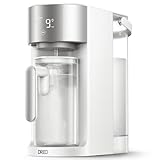 DREO RO112 Countertop DREO RO112 Countertop |
|
Check Latest Price |
 Waterdrop G5P500A 8-Stage Tankless Waterdrop G5P500A 8-Stage Tankless |
|
Check Latest Price |
 FS-TFC 100 GPD 5-Stage FS-TFC 100 GPD 5-Stage |
|
Check Latest Price |
 NU Aqua 5-Stage 100 GPD NU Aqua 5-Stage 100 GPD |
|
Check Latest Price |
How We Chose and Ranked These Ten Systems
Ranking water filters by star rating alone tells you almost nothing, because the cheapest listings attract the most speculative reviews and the highest-rated listings are often small brands with a year of history. So we built a short checklist and weighted it.
Certification coverage came first. A system that says NSF certified on the box might mean the whole system is certified to NSF/ANSI 58 for contaminant reduction, or it might mean a single housing was tested to NSF/ANSI 372 for lead-free materials. Those are very different documents. We read every certification claim against the standard it names.
Second, we compared claimed capacity to what owners actually get. Manufacturers rate gallons per day at ideal pressure and temperature. Independent testing of an iSpring RCC7 measured roughly 35 gallons per day against a 75 gallon per day claim at 48 PSI feed pressure. That gap is normal for the category, and it is the single most useful expectation-setting number in this roundup.
Third, installation burden. An under-sink system with a top-mounted faucet fastener installs from above the sink. One that needs you to work underneath a cabinet tray in a dark space with a flashlight clamped in your teeth is a different Saturday. Tankless and pumped models add an electrical requirement that tank systems do not have.
Fourth, three-year running cost. Filters, membranes and housings are where the real money goes after year one. Some brands sell generic-equivalent cartridges at a fraction of the proprietary price, and we weighted that heavily because most people own these systems for a decade, not a season.
Finally, we mined owner reviews for recurring themes rather than isolated complaints. A single reviewer complaining about a leaking fitting is noise. Sixty reviewers describing the same connector failure is a design flaw, and it changes the ranking.
1. iSpring RCC7AK-BN: Best Reverse Osmosis System Under 300 Overall
- NSF/ANSI 58 covers the entire system not one component
- Patented top-mount faucet installs from above the sink
- Transparent first-stage housing shows contaminant buildup
- Alkaline mineral stage balances pH and improves taste
- Reduces PFAS lead fluoride and arsenic
- Bulky 15.5 x 16 x 18 inch footprint in the cabinet
- No booster pump so low line pressure cuts performance
The iSpring RCC7AK-BN is the one we kept coming back to across this group. It is the alkaline version of the famous RCC7, and the difference that matters day to day is the sixth stage. Standard five-stage RO strips out everything, including the magnesium and calcium that make water taste like water. The mineral AK stage puts a little of that back and lifts the pH, which is why the water here does not have the flat, slightly acidic sip people complain about with cheaper membranes.
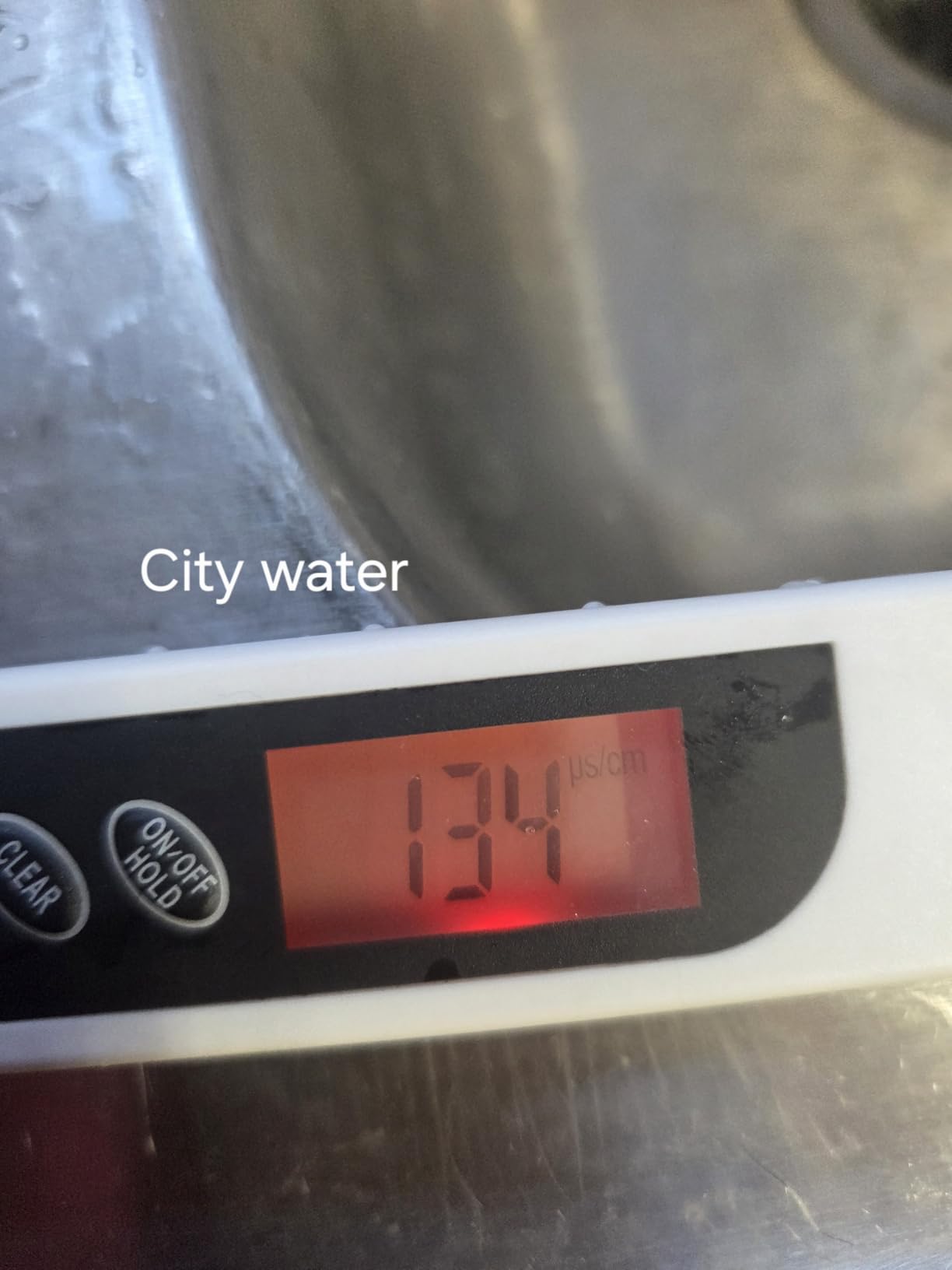
What sold us is the scope of that certification. NSF/ANSI 58 covers the entire filtration system rather than a single housing, which is a stronger claim than most competitors in this price band make. The published reduction figures cover TDS at 93 to 98 percent, PFAS at 96 to 99 percent, chlorine at 95 to 99 percent, plus asbestos, barium, cadmium, chromium, copper, fluoride, lead and selenium. It handles feed water up to 750 PPM TDS, and it runs on pressure alone with no electrical connection.
The patented top-mounted faucet fastener is the feature owners mention most, and it is not a small thing. Instead of reaching into the cabinet with a wrench, you drive the mounting post down through the faucet hole from the counter side. Installation still takes real work, but it removes the worst part. Reviewers also like the transparent first-stage housing, because sediment and carbon fines are visible and you can see when the pre-filter has done its job instead of guessing from a taste test.
That transparent housing also makes the initial flush honest. This system needs a long first flush, and if carbon fines reach the membrane too early the membrane fouls and the capacity drops for good. Watching the housing clear is the easiest way to know the flush is finished.
What you should know before you buy it
The cabinet footprint is the honest drawback. At 15.5 by 16 by 18 inches it is one of the larger bodies here, and it needs the storage tank to sit beside it. If your under-sink space is already crowded with a disposal and a dishwasher hose, measure before you commit.
The other limitation is the absent booster pump. On municipal water at 60 PSI or better it performs exactly as advertised. In a home with low incoming pressure or a long run from the meter, output drops and the waste-to-water ratio worsens. If you know your pressure is marginal, our pumped pick later in this list solves exactly that problem.
Owner feedback on the iSpring RCC7 family is heavily favorable overall, with taste and the alkaline stage as the recurring positives. One independent laboratory review of the RCC7 flagged arsenic and vanadium detected after filtration, suspected of coming from the remineralization media rather than a membrane failure, and measured roughly 35 gallons per day against a 75 gallon per day claim. That is one test on one unit, not a verdict on the design, but it is the kind of thing we would want to know if our own water came from a well.
Who it suits and who it does not
Pick this if you want the strongest certification coverage available under 300 dollars, drink a few glasses a day plus cooking water, and can give up a chunk of cabinet space. The filter sets are F4AK at six months, F9K at one year, F19K75 at two years and F28K75 at three years, so you can buy filters in longer intervals and cut the annual cost.
Skip it if you rent and cannot drill, if your cabinet space is tight, or if your household drinks more than about five gallons a day. None of those are dealbreakers, they just mean another format fits you better.
2. APEC ROES-50: Best Value Reverse Osmosis System Under 300
- Dual NSF/ANSI 58 and 372 certification
- Quick-connect fittings proven leak-free over years
- Complete install kit with tank faucet and adapters
- Handles feed water up to 2000 PPM TDS
- Supplied faucet has no air gap so an air gap device is extra
- Housing caps can crack if overtightened
- Feed adapter not compatible with non-US plumbing
The APEC ROES-50 is the one we would hand to a friend who just wants water that tastes clean and never has to think about it again. Owners replacing systems that are a decade old tell you more about the hardware than any specification sheet does.
The APEC ROES-50 carries both NSF/ANSI 58 for contaminant reduction and NSF/ANSI 372 for lead-free materials, and the supported feed water ceiling of 2000 PPM TDS is matched only by the pumped iSpring. That matters if you are on well water or on a municipal supply with heavy chloramine use. Independent testing by TechGearLab described the ROES-50 as delivering seriously clean water at half the cost of other RO models.
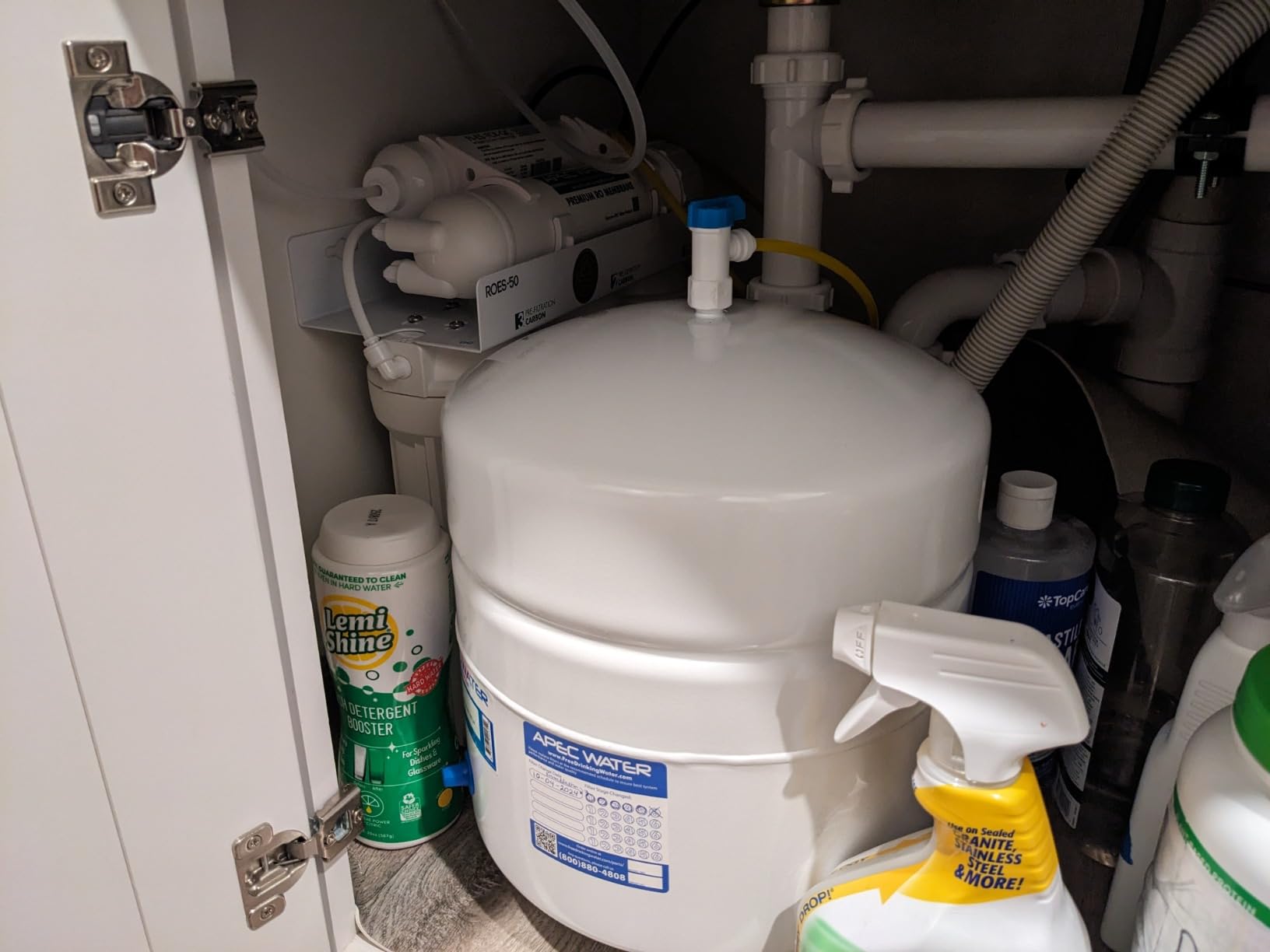
At 50 gallons per day and 0.03 gallons per minute, this is not a fast system. That is fine for drinking and cooking, and it is why owners report TDS readings in the 5 to 10 PPM range steadily rather than spiking. The body measures 15.5 by 5.25 by 17 inches, so it is tall and slim, which is often a better fit than the wide bodies in this group.
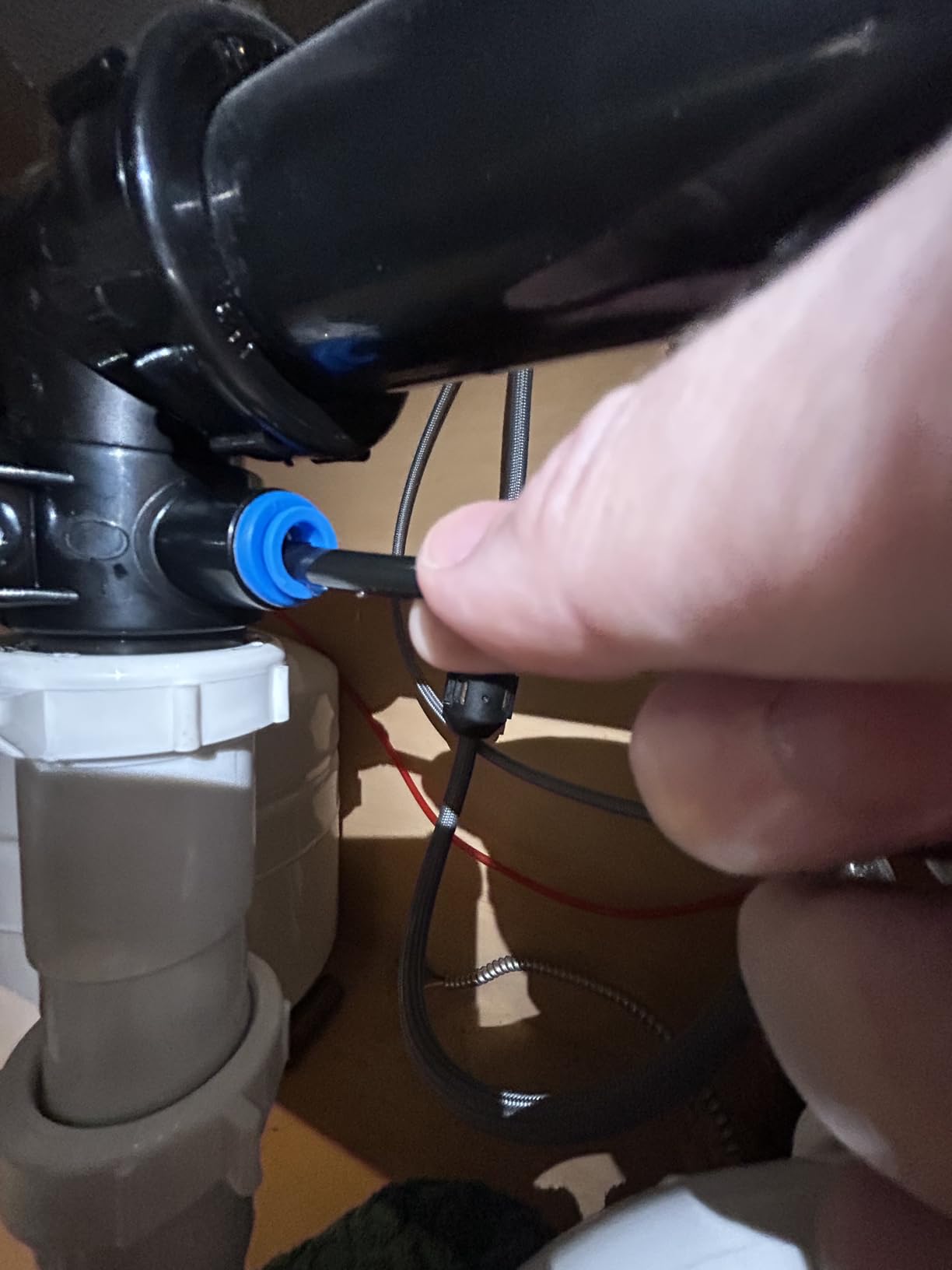
Color-coded tubing and quick-connect fittings make the install approachable, and owners repeatedly describe them as leak-free over the long term. The complete kit includes the Filter-Max-ES50 set, a brushed nickel faucet, the tank, and the installation hardware, so nothing else needs ordering.
What to check before you buy
The faucet that comes in the box does not have an air gap. In many jurisdictions a dedicated drinking water faucet is required to have one to prevent backflow contamination of the potable line, so plan for an air gap device and the extra hole it needs in the sink deck. This is the most common install complaint in the reviews.
The second recurring complaint is housing caps cracking when overtightened. It is a user error more than a defect, but it happens often enough that we would tell a first-timer to snug the caps and stop rather than lean on the wrench.
Who it suits and who it does not
This is the pick for someone on well water or high-TDS municipal supply who values certification coverage and a long service life more than speed or extra features. It also suits anyone who wants a no-electricity install and a body that fits a narrow cabinet.
It is a poor fit for a large household that wants instant flow, and for anyone outside the US with non-standard plumbing, since the feed water adapter is North American. If you want alkaline water with better taste, the iSpring above is the stronger option.
3. SimPure Y7P-BW: Best Countertop Reverse Osmosis System With UV
SimPure Y7P-BW UV Countertop Reverse Osmosis Water Filter, 5 Stage RO
- No plumbing or drilling of any kind
- UV stage adds a chemical-free disinfection step
- 4:1 pure to drain ratio wastes far less water than under-sink units
- Glass pitcher avoids storing filtered water in plastic
- Internal reservoir develops off-tastes after about a month
- Needs descaling every two to four weeks
- Room temperature dispense only and requires power
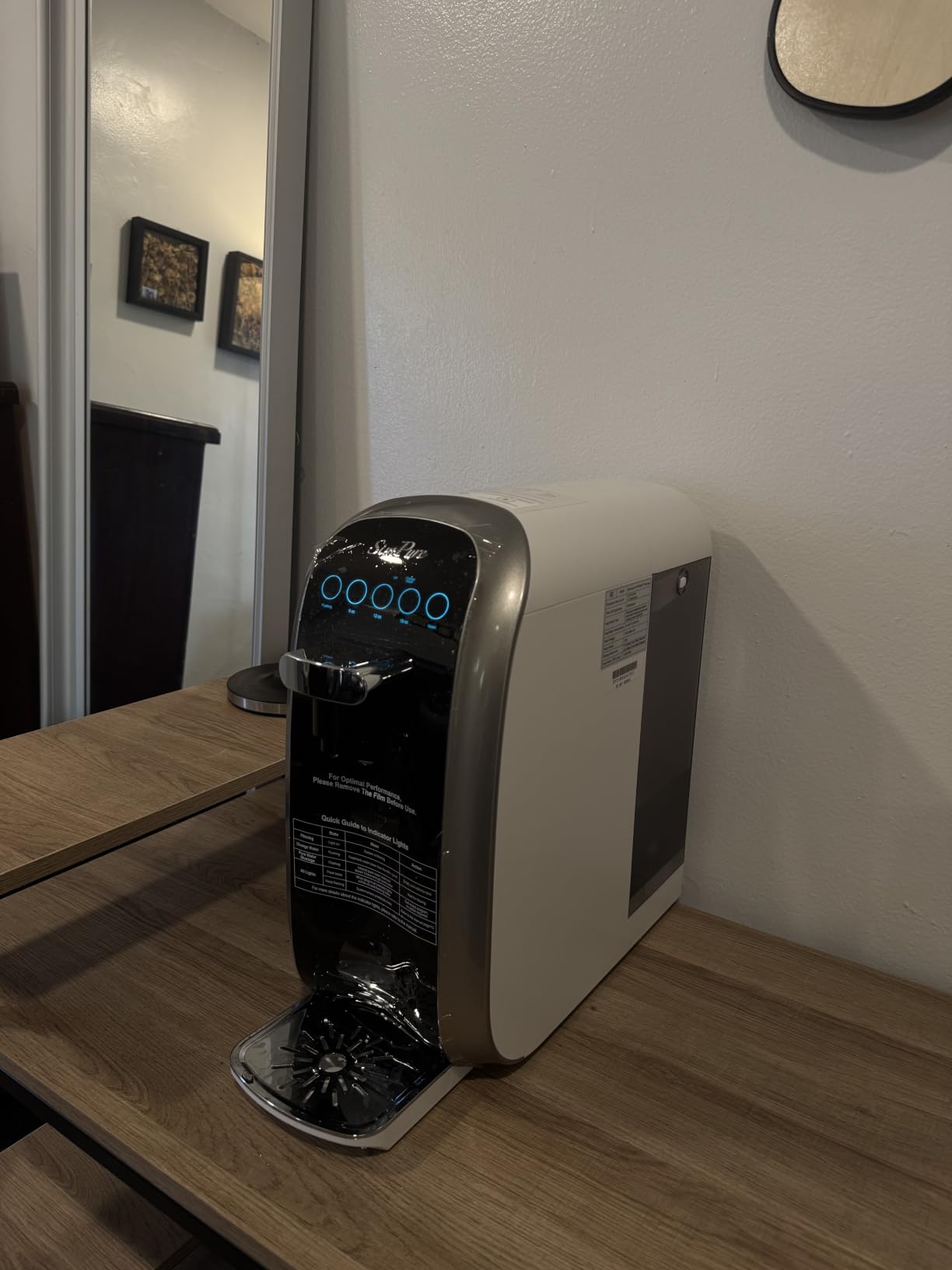
The SimPure Y7P-BW is the one to look at if you rent, if you travel between homes, or if you simply do not want a hole in your counter. It plugs into a wall outlet, you fill the rear tank, and it produces 0.0001 micron RO water with a UV stage on top. There is no installation in the plumbing sense at all.
The efficiency number is what separates it from most countertop units. A 4:1 pure-to-drain ratio means you get four cups of purified water for every cup sent down the drain, where older under-sink designs run closer to 1:3 or 1:4. SimPure rates the dispense flow at 418 GPD, which works out to about a cup in 15 seconds. The filter set covers 528 gallons.
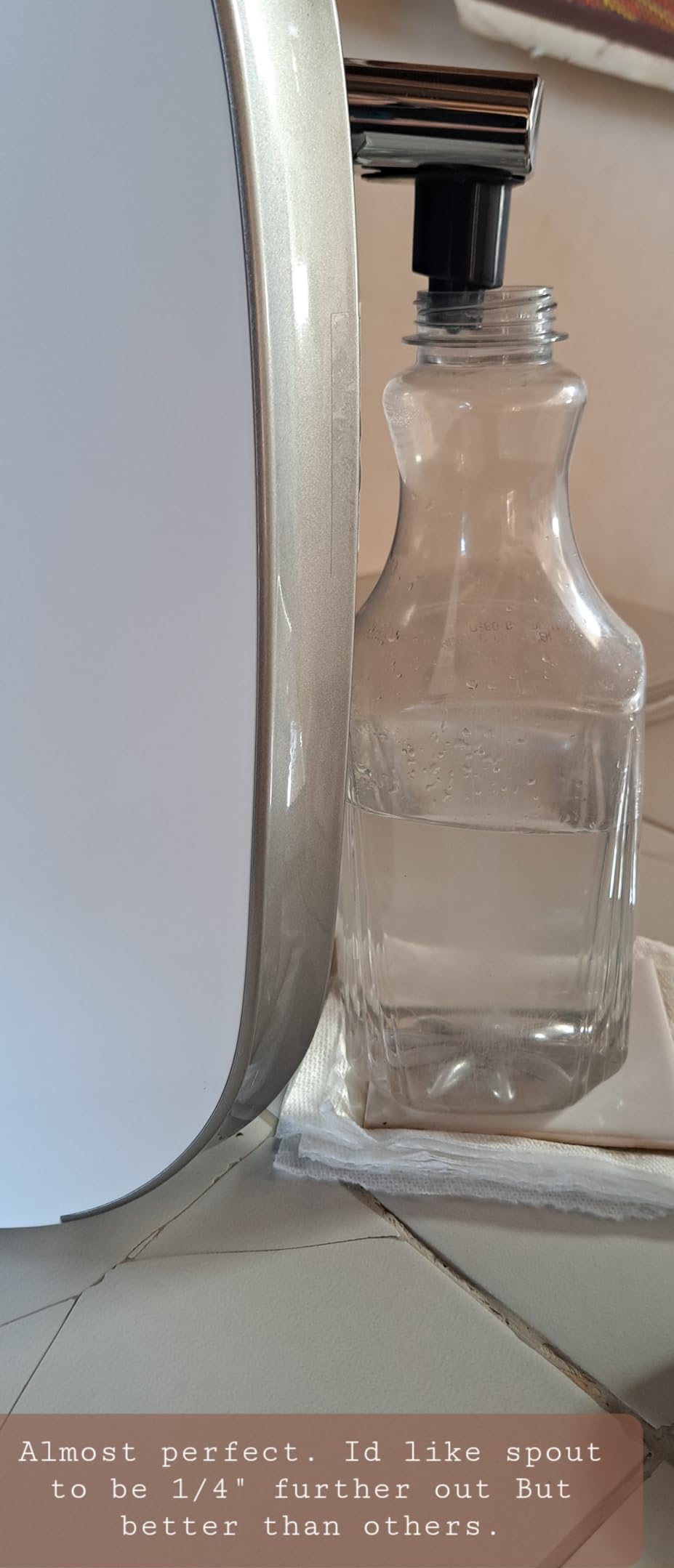
The UV stage is a genuine addition rather than a marketing line. It runs without chemicals and without by-products, which is the argument for UV in drinking water treatment, and it addresses the one thing an RO membrane does not do on its own: inactivate what got past it.
Testing is by SGS against the NSF/ANSI 58 standard, with claimed removal of 99.99 percent of more than 1000 contaminants including PFAS compounds PFOA and PFOS, heavy metals, chlorine and TDS. Owner tests commonly read 6 to 33 PPM from 100-plus PPM tap water, which is exactly the drop you are paying for.
What could go wrong
The most influential negative review on this product describes water taking on a plastic-like taste after roughly a month, traced to the internal reservoir, which is not easy for the user to clean. The 4.2 rating across more than 3,600 reviews is that complaint plus frequent descaling splitting the owners into two camps.
Plan on descaling every two to four weeks depending on your hardness, and expect a 45-minute initial flush spread across roughly five tank cycles. The instruction manual is also the weak point, with owners describing it as poorly written and inconsistently translated.
Who it suits and who it does not
It suits one or two people, renters, RV and camping users, and anyone who wants a UV stage and a glass pitcher without touching plumbing. That glass pitcher matters more than it sounds, because plastic storage tanks are a common source of off-tastes in budget systems.
It does not suit a household of four who drinks a lot of water, since the rear tank is small and refills interrupt everything. It also cannot deliver hot or cold water, and its 500 PPM feed water ceiling is lower than the APEC and iSpring models in this roundup.
4. Bluevua RO100ROPOT-Lite: Best Countertop Pick With a Glass Carafe and Display
Bluevua RO100ROPOT-Lite Countertop Reverse Osmosis Water Filter
- Borosilicate glass carafe included
- LED display tracks filter life and water quality in real time
- Selectable dispense volumes automate filling
- Compact footprint suits small counters
- Annual filter replacement means no multi-year filter supply
- WQA seal covers lead-free materials only not contaminant reduction
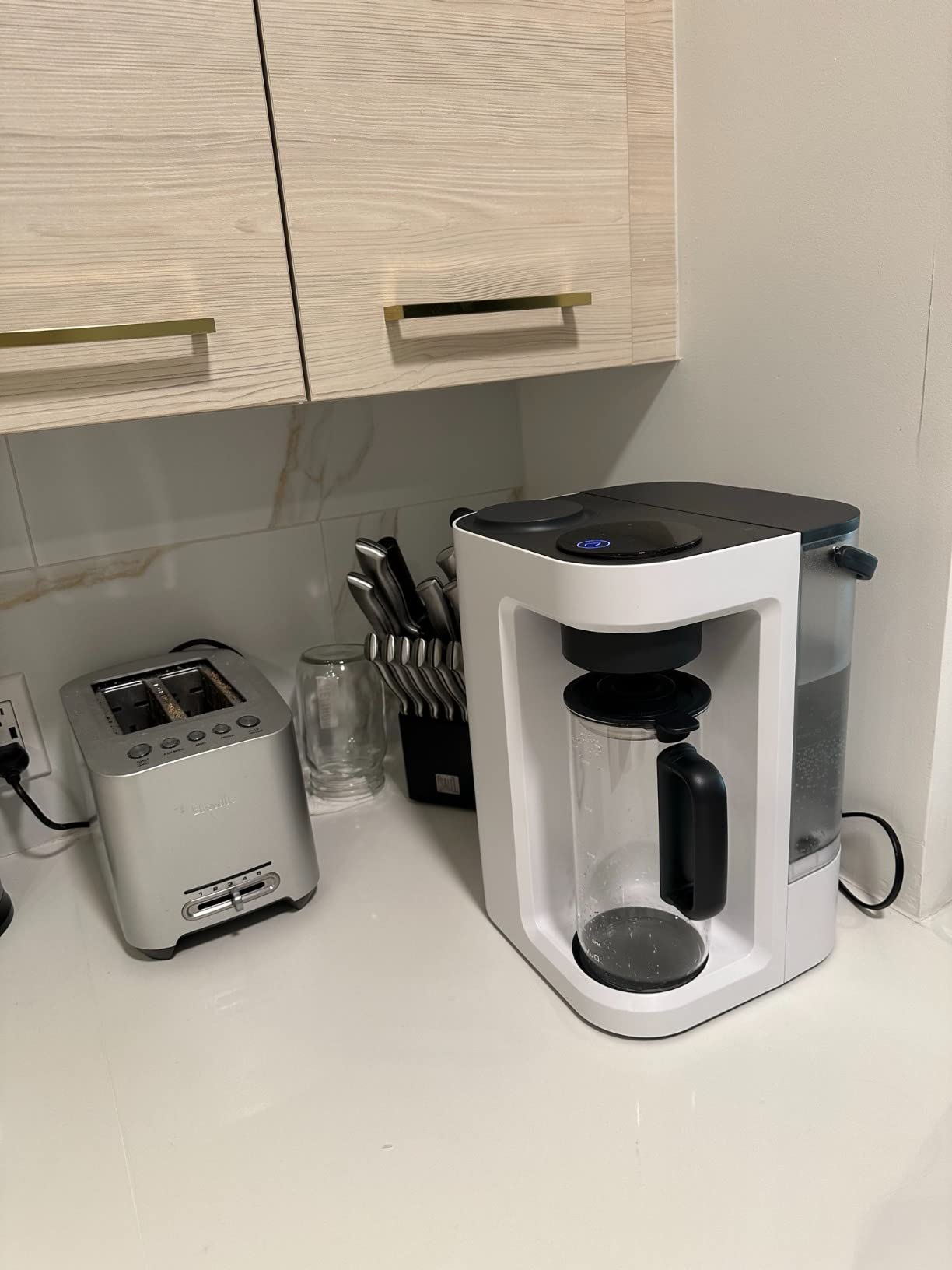
The Bluevua RO100ROPOT-Lite does two things well: it makes water in a glass carafe, and it tells you what it is doing. The borosilicate carafe is the bigger of the two wins in our view, because most countertop units store purified water in plastic and then hand you a plastic-tasting glass of it.
The LED display is genuinely useful rather than decorative. It tracks filter lifespan and monitors water quality in real time, so instead of replacing filters on a calendar and hoping, you replace them when the display says so. Dispense volumes are selectable, which automates filling and means you are not standing over the machine watching it.
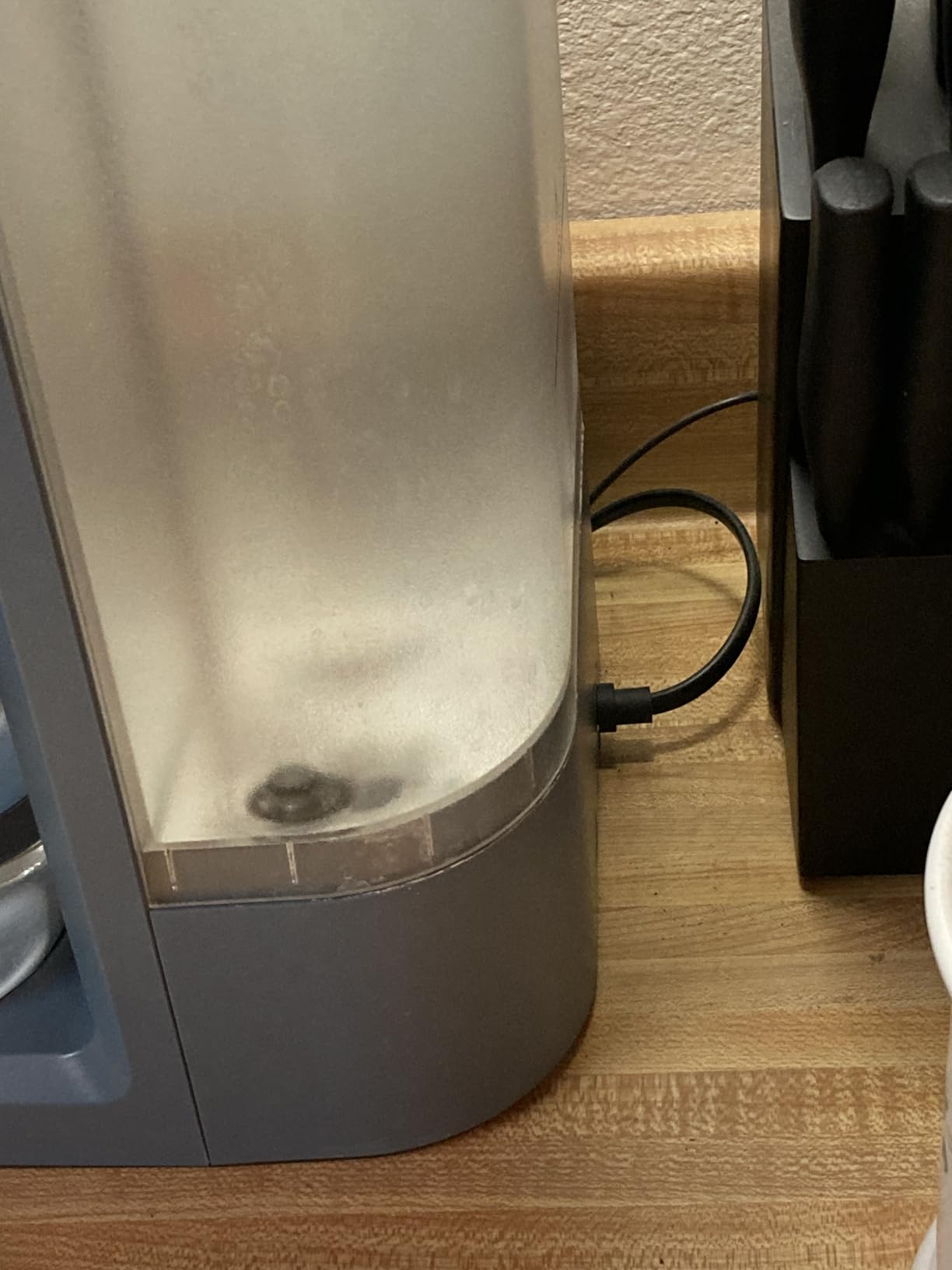
Filtration is five stages around a 0.0001 micron RO membrane, rated at 3:1 pure to waste and delivering a full carafe in under three minutes. The stated reductions cover TDS, PFOA, PFOS, chlorine, fluoride, arsenic and lead. Operating range is 41 to 100 degrees F.
The certification here needs reading carefully, and this is exactly the kind of claim our audit exists to catch. The unit is WQA certified to NSF/ANSI/CAN 372, which is a lead-free materials standard, and it is tested by SGS. The 372 seal says nothing about contaminant reduction performance. If you want a performance certification, look at the APEC or Waterdrop picks instead.
What to weigh up before buying
The replacement cadence is annual. There is no multi-year bundle of cartridges, so you are buying a fresh filter set every twelve months whether you use it heavily or not. For a two-person household that is acceptable. For a family that runs it constantly it becomes the deciding cost.
This model also lists higher than any other system in this roundup, which is not a complaint about quality. If entry cost matters more than the carafe, the DREO later in this list is the countertop option to compare against.
Who it suits and who it does not
It suits a couple or a single person on a small counter who cares about glass versus plastic and wants visible water quality data. The compact 9.7 by 9.5 by 14.1 inch body is the smallest of the countertop units here, which matters in a galley kitchen.
It does not suit anyone who needs a certified performance standard, or anyone planning to use it for more than two people.
5. Waterdrop G2: Best Tankless Reverse Osmosis System Under 300
Waterdrop G2 Reverse Osmosis System, 400 GPD Tankless RO Water Filtration
- Frees more than 70 percent of under-sink cabinet space
- 400 GPD fills a cup in about 12 seconds
- 1:1 drain ratio cuts water waste sharply
- Filters change in about 3 seconds with a twist and pull
- Installs in under 30 minutes
- Needs an under-sink electrical outlet and a drilled faucet hole
- Cannot be used during a power outage
- Not certified to NSF/ANSI 58 for contaminant reduction
The tankless format solves one problem better than anything else in this roundup: cabinet space. It is the reason most owners here give first when explaining why they bought. Waterdrop claims the design frees more than 70 percent of the under-sink volume that a conventional tank system occupies, and at 17.3 by 5.9 by 14 inches the body is slim enough to sit at the front of the cabinet.
Speed is the second argument. A 400 GPD rating works out to roughly a cup in 12 seconds, with no storage tank to recharge and no waiting for pressure to build. If you have several people drinking at once or you fill a large pitcher for meal prep, that difference is obvious in the first week.
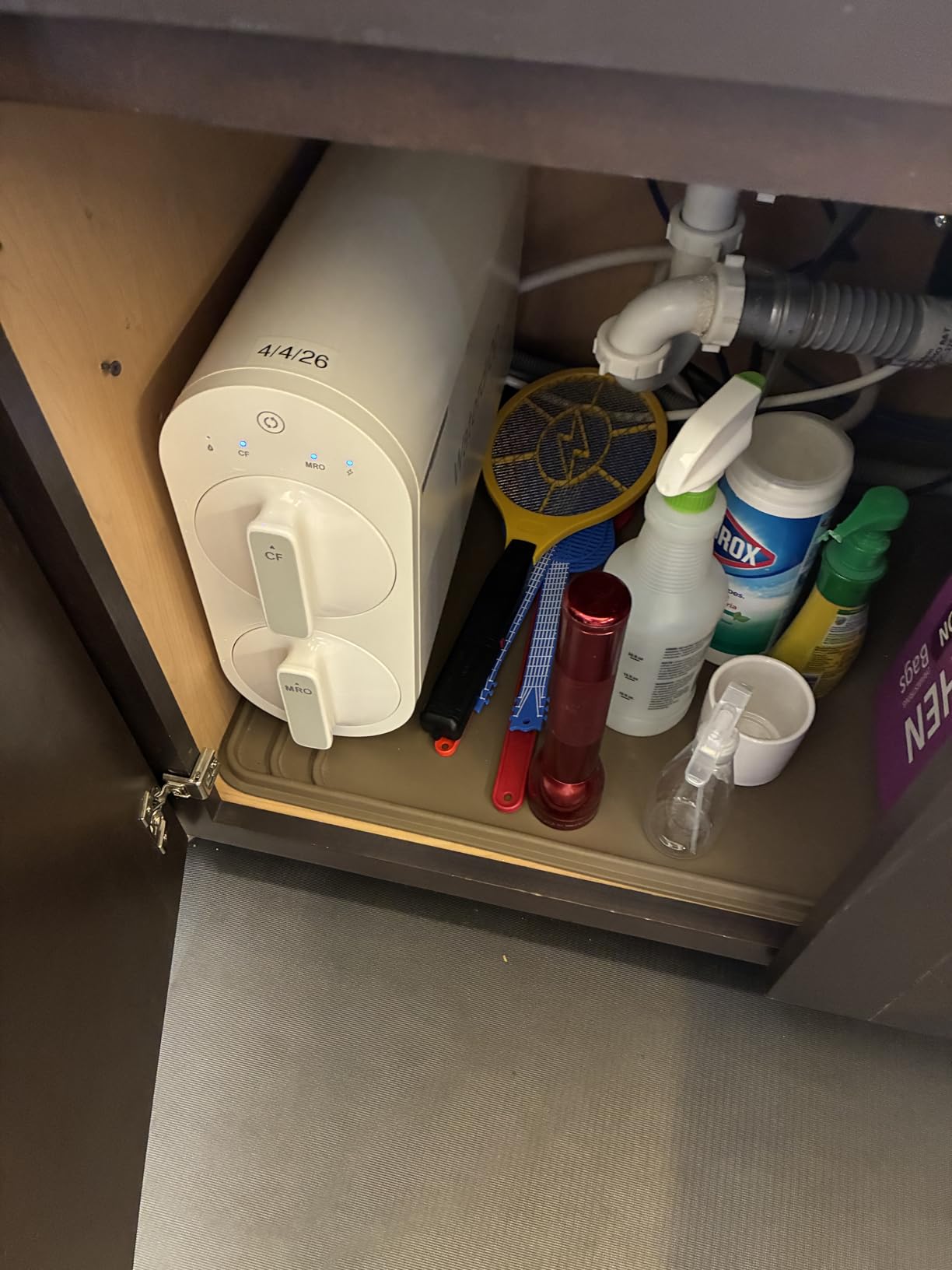
Water efficiency is the third. The 1:1 pure to drain ratio means one cup of waste per cup of purified water, which matches the FS-TFC for the best pure-to-drain ratio in this roundup, and beats the 1:3 and 1:4 ratios most tank systems run. Filtration is seven stages with a composite filter, operating from 41 to 100 degrees F, and the box includes two pre-installed filters.
Maintenance is unusually friendly. Twist-and-pull cartridges replace in about three seconds with no housing caps to crack and no wrenches involved. Owners also report lower noise than tank systems, which the airtight housing explains.
What the specification sheet does not tell you
This system is certified to NSF/ANSI 372 for lead-free materials only. It is not certified to NSF/ANSI 58 for contaminant reduction. That is a meaningful gap if you are filtering well water or chasing a specific contaminant, and it is the main reason we could not make this our top pick despite the space and speed advantages.
There are two hard requirements. You need a grounded electrical outlet under the sink, and you need to drill the countertop for the faucet. Both are dealbreakers in a rental, and the power dependency means the system stops working during an outage.
Who it suits and who it does not
It suits a household that has already drilled its counter, already has under-sink power for a disposer or dishwasher, and wants cabinet space back along with fast on-demand water. Three-second filter changes also appeal to anyone who has resented wrestling with housing caps.
It does not suit a renter, a household without under-sink electrical service, or anyone buying on certification evidence. For certified performance in a tankless body, the Waterdrop G5P500A later in this list carries both NSF/ANSI 58 and 372.
6. iSpring RCC7P-AK: Best Under-Sink System for Low Water Pressure
- Booster pump keeps flow steady in low pressure homes and cuts wastewater
- Highest average rating in the group at 4.7 with 88 percent five-star ratings
- Alkaline sixth stage removes the acidic taste
- Feed water up to 2000 PPM TDS
- Transparent first-stage housing
- Heaviest unit in the group at 20 pounds and the pump assembly takes cabinet space
- Needs a nearby electrical outlet for the pump
- Warranty is one year and only extends on registration
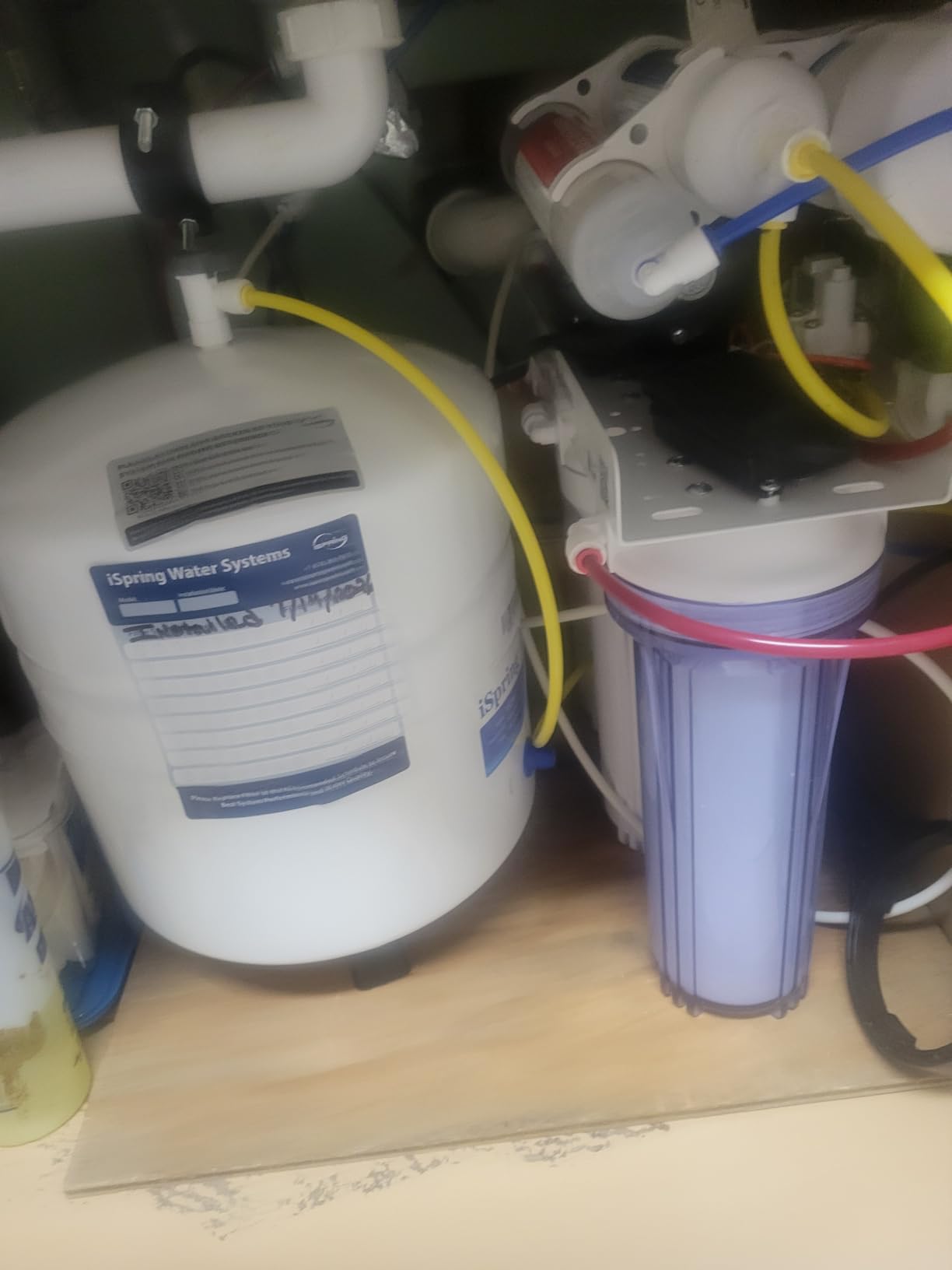
Almost every complaint we saw about budget RO systems traces back to one thing: not enough pressure. Tanks fill slowly, the faucet runs thin, and the waste ratio climbs because the membrane is working harder for less water. The iSpring RCC7P-AK solves that with an integrated electric booster pump, and it is why this unit carries the highest average rating in the group at 4.7 with 88 percent five-star ratings across more than 1,600 reviews.
The pump also reduces wastewater, which sounds like marketing until you own a system without one and watch the drain rate. Independent testing of the related RCC7 measured a booster pump improving flow by roughly 39 GPD and recovery rate by about 19 percent. That is the difference between a system you are patient with and one you are not.
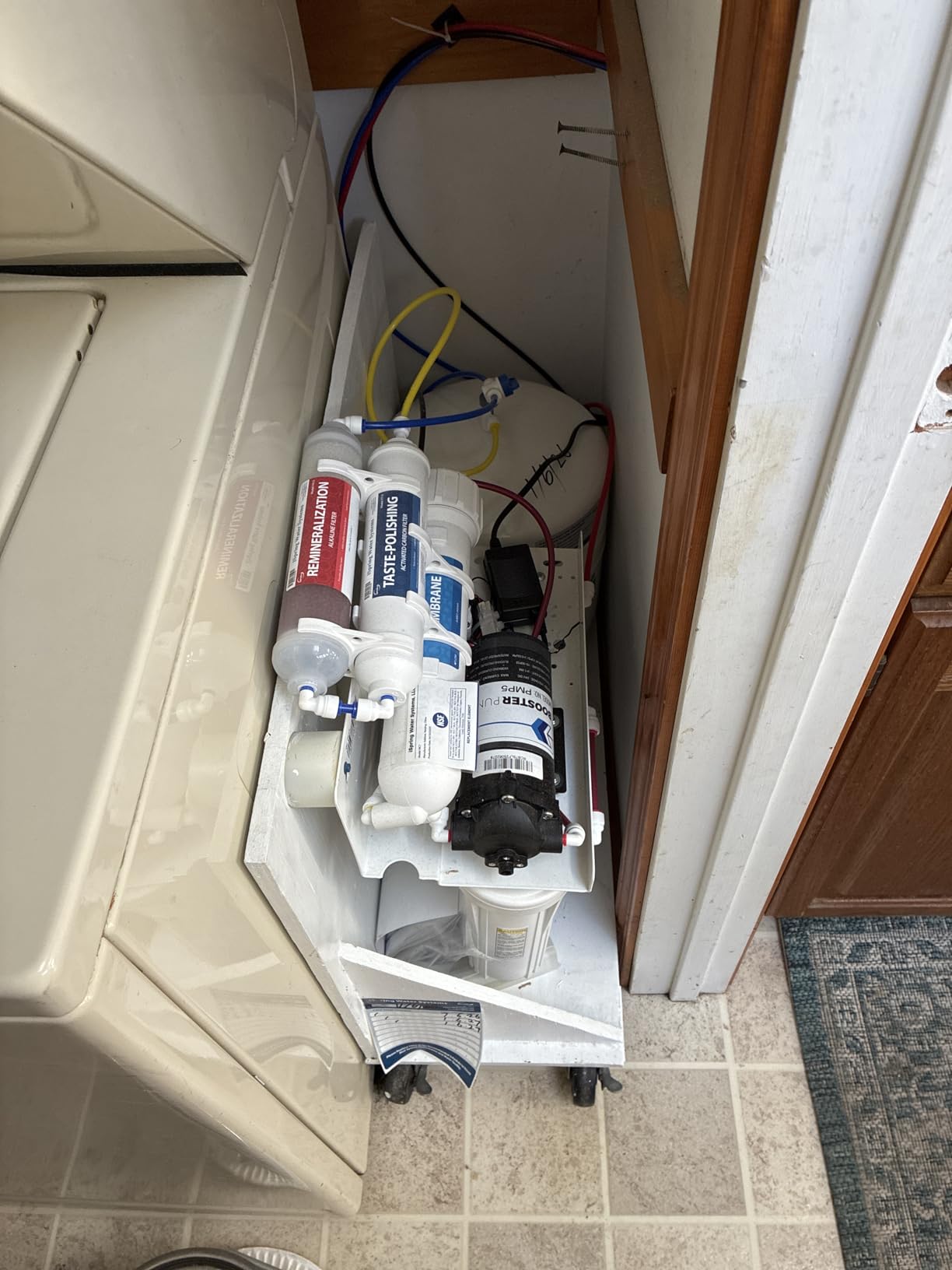
Otherwise it is the same proven architecture as our top pick: six stages, a 75 gallon per day rating, feed water up to 2000 PPM TDS, and an alkaline mineralization stage that restores calcium and magnesium and balances alkalinity against the acidic profile of a standard five-stage system. Claimed reduction covers more than 1000 contaminants with lead at 98 percent, plus chlorine, fluoride, arsenic, PFAS, asbestos, calcium and sodium.
The universal 100-240V 50/60Hz adapter means it works on varied household power, and the warranty extends when you register the unit, on top of lifetime technical support based in Atlanta.
Where it falls short
It currently lists above the ceiling we set for this roundup, and we would rather say that plainly than pretend otherwise. If your budget line is hard, this one does not fit it today, though pricing on this category moves often and the pump variant has historically sat close to the standard model.
It is also a heavy unit at 20 pounds, and the pump assembly claims cabinet space on top of the standard body at 15 by 8 by 18 inches. You need an under-sink outlet, and like any powered system it stops during an outage.
Who it suits and who it does not
It suits anyone on well water, on a long plumbing run, or in a house with marginal municipal pressure who wants the pressure problem solved once and permanently. Owners of pumped models consistently attribute their satisfaction to exactly that.
It does not suit a renter without an outlet, a household with a very small cabinet, or a buyer whose budget will not stretch past the ceiling. In that last case, check your household pressure before you decide against a pumped model, because it is the one upgrade here that reliably pays for itself.
7. DREO RO112: Best Reverse Osmosis System Under 300 for Renters
DREO Reverse Osmosis Water Filter System Countertop, RO Water Filter 112 3L
- No drilling plumbing or faucet work of any kind
- Real-time TDS meter shows raw and purified readings
- Tank plus 1.1 liter pitcher with auto-fill sensor
- Self-cleaning auto-flush of internal tubes
- Quiet operation with no reported leaks
- Dispenser sensor only fills the supplied pitcher
- Reservoir wastewater must be emptied after each use
- SGS coverage spans roughly 16 to 18 substances
The DREO RO112 is the least hands-on way into reverse osmosis water we found. It sits on the counter, plugs in, and needs no hole, no faucet, no plumber. For an apartment, a rental, a dorm, or a kitchen where you are not allowed to touch the plumbing, that removes the only real obstacle to owning RO.
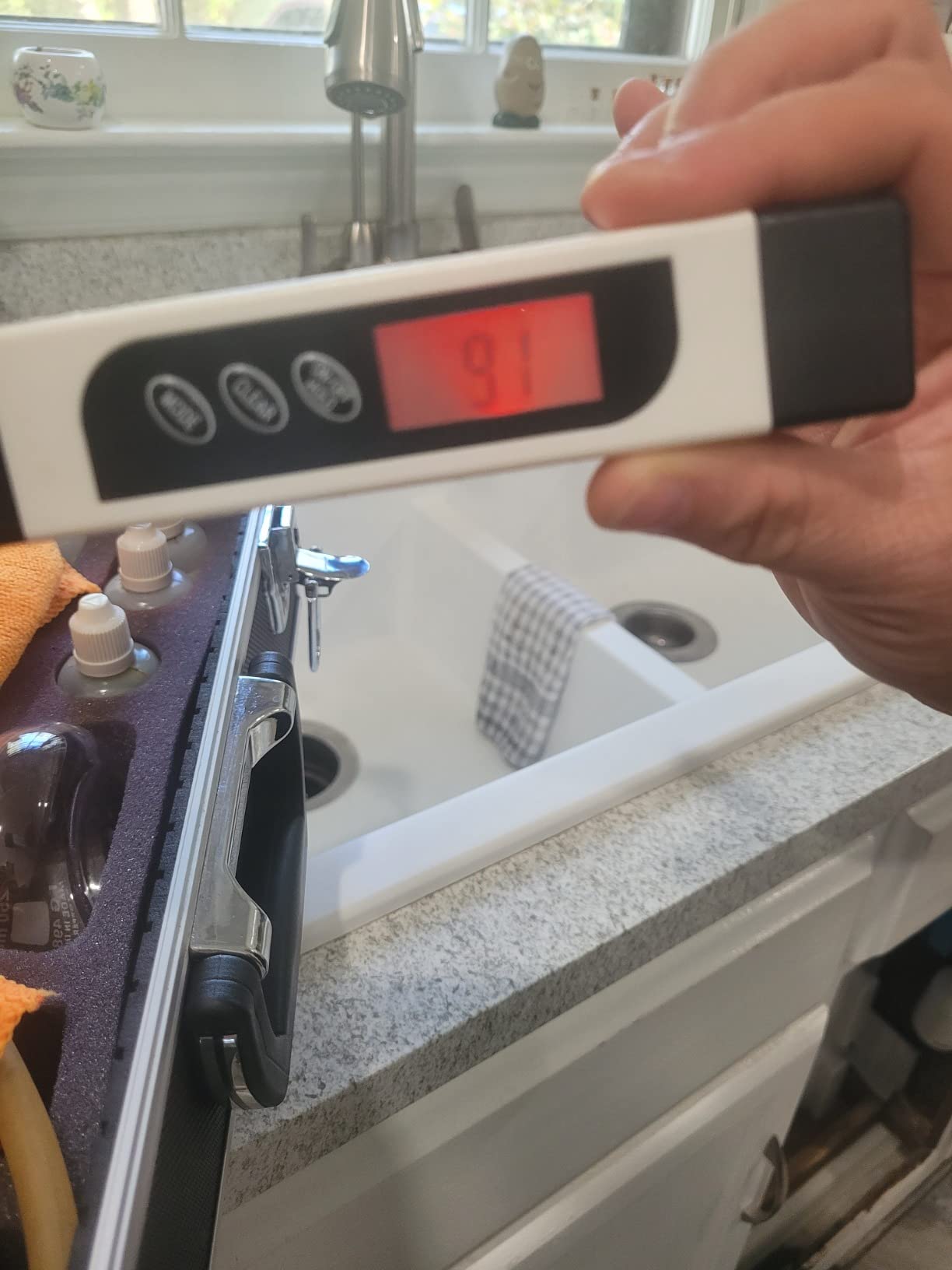
The feature that gets the most attention from owners is the real-time TDS meter. Reviewers report watching tap water at 300 to 600 PPM drop to under 15 to 30 PPM on the purified side, in real time, next to the machine. It turns an invisible process into something you can see, and it is how you know when a filter needs changing rather than guessing from taste.
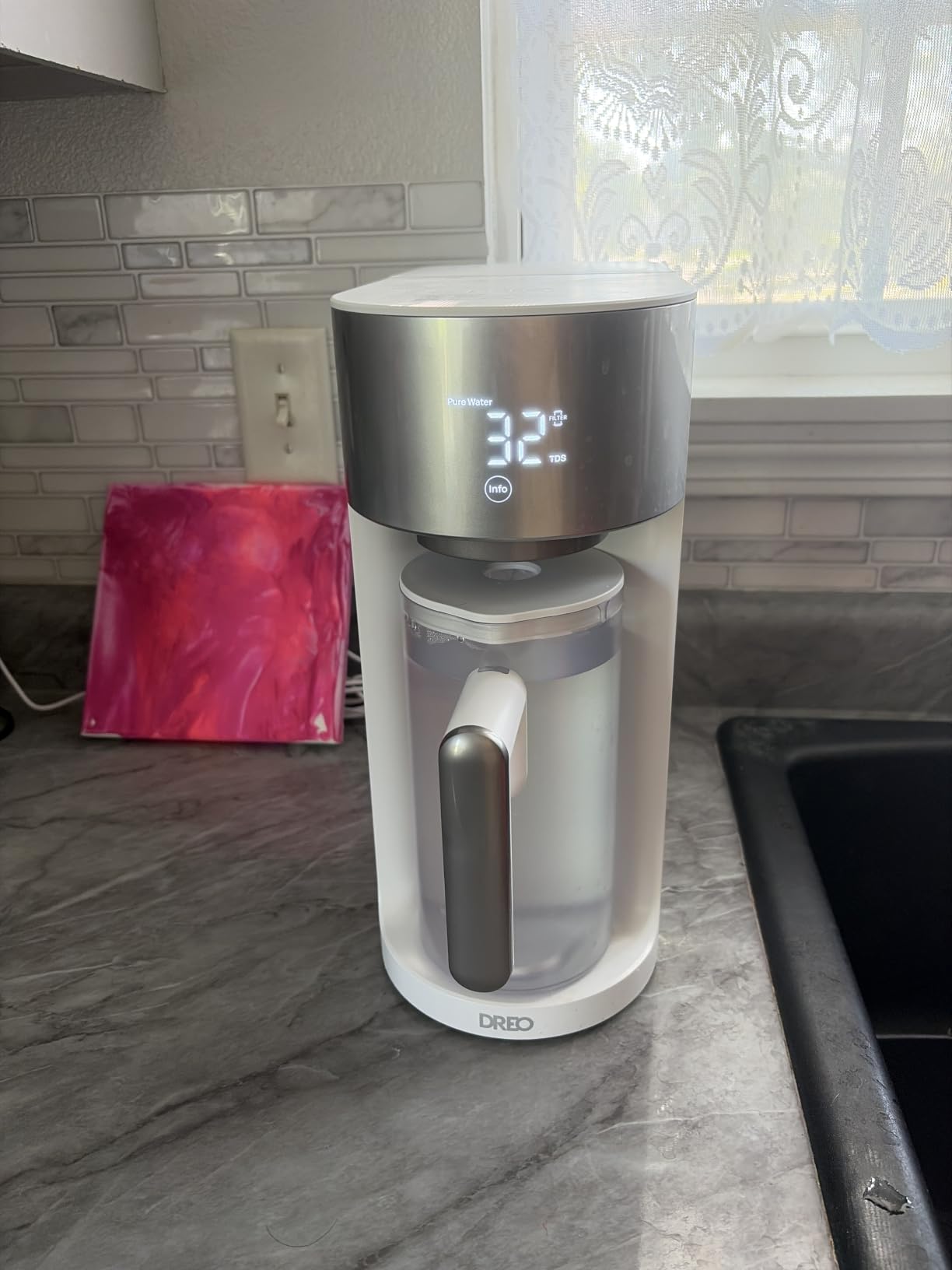
The system runs 7-in-1 RO filtration tested by SGS meeting NSF/ANSI 58 standards, with claimed removal of 99.9 percent of contaminants including PFOA, PFOS, chlorine and fluoride. The pure-to-drain ratio is 3:1, and each filter covers 265 gallons with a simple twist to install.
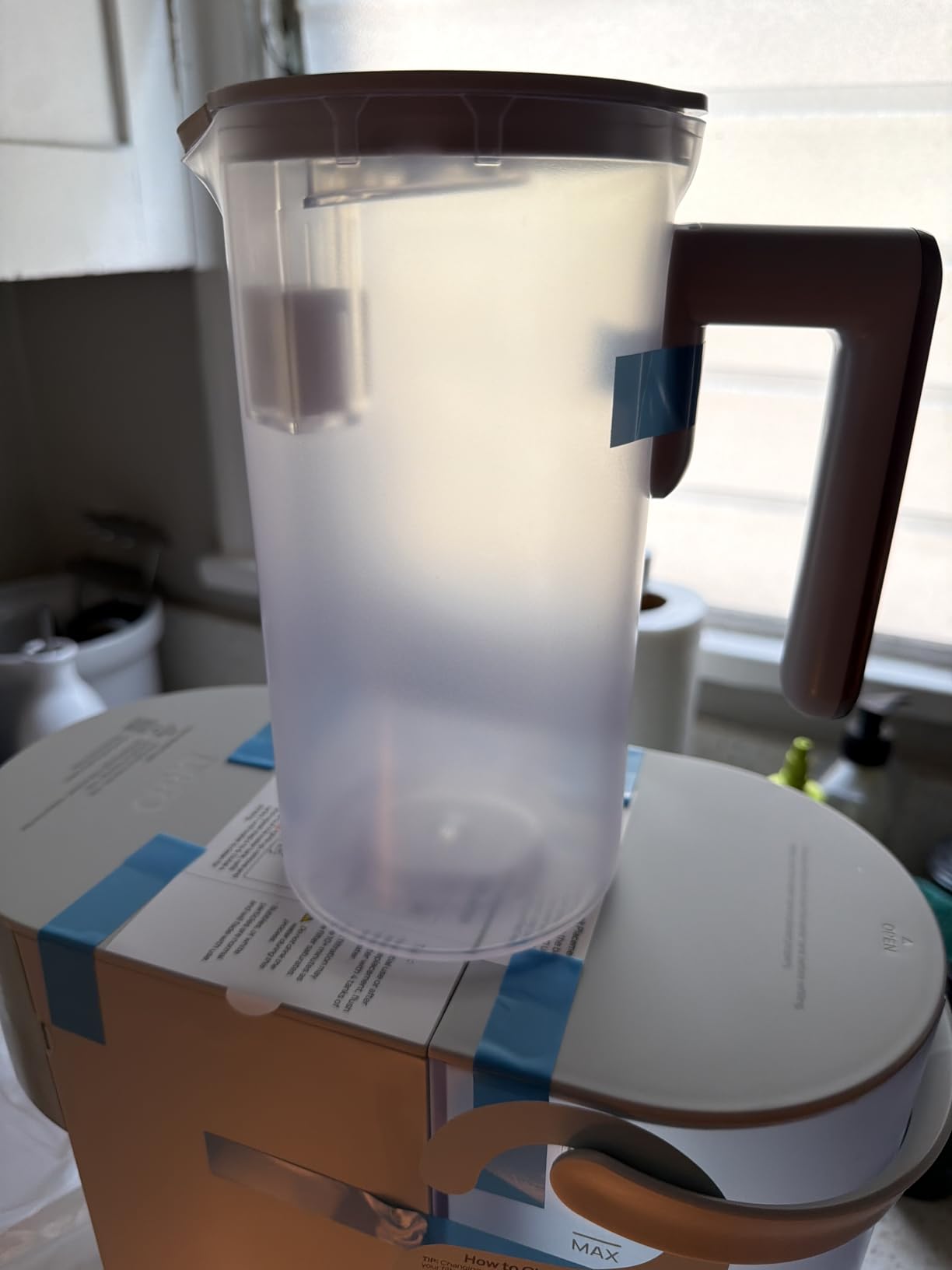
The two-pitcher arrangement is clever and quietly useful. One 1.1 liter pitcher sits in your fridge while the other refills, so you always have cold water and never juggle. An auto-fill sensor handles the pour, and the self-cleaning auto-flush clears the internal tubes.
Where the shortcuts are
The auto-fill sensor means you can only fill the supplied pitcher, not an arbitrary glass or a larger bottle. That is more annoying than it sounds until you get used to it, and it is the most common complaint in reviews alongside the reservoir wastewater that must be emptied after each use.
The SGS testing covers roughly 16 to 18 substances. That is a real test, and it is not the same breadth as the hundreds of contaminants some listings advertise. Also note that genuine replacement filters were not officially available through Amazon in Australia or the UK, which led at least one buyer to return the unit.
Who it suits and who it does not
It suits one or two people, renters, students, and anyone who wants to see their TDS drop before committing to an under-sink install. The 14.5 by 6.7 by 13.4 inch footprint also works in RVs and small offices.
It does not suit a family of four or more, since the 3 liter tank is sized for one to two people and you are refilling constantly. It also does not suit anyone who needs certified coverage across a broad contaminant list.
8. Waterdrop G5P500A: Best Under 300 System for Ice Makers and High Flow
Waterdrop G5P500A Reverse Osmosis System, 8-Stage RO Filtration, Alkaline
- Highest capacity in the group at 500 GPD filling a cup in 8 seconds
- Dual NSF/ANSI 58 and 372 certification
- Alkaline mineralization adds calcium magnesium sodium and potassium
- Connects to ice makers and refrigerators
- 2:1 drain ratio
- Requires under-sink electrical outlet
- Countertop drilling required for the faucet
- Will not run during a power outage
Everything you wish the tankless G2 above had, this one has. The Waterdrop G5P500A is an eight-stage tankless system carrying both NSF/ANSI 58 for contaminant reduction and NSF/ANSI 372 for lead-free materials, which makes it one of just two systems here with full performance certification. Buyers comparing it against systems certified only for materials report that the dual seal was the deciding factor.
Capacity is 500 GPD, filling a 6-ounce cup in eight seconds. That number matters more for ice makers and refrigerator hookups than for drinking, because a fridge ice maker can pull several gallons a day and a 50 GPD tank system will stall under it. This unit connects to ice makers and fridges through the Waterdrop XT kit.
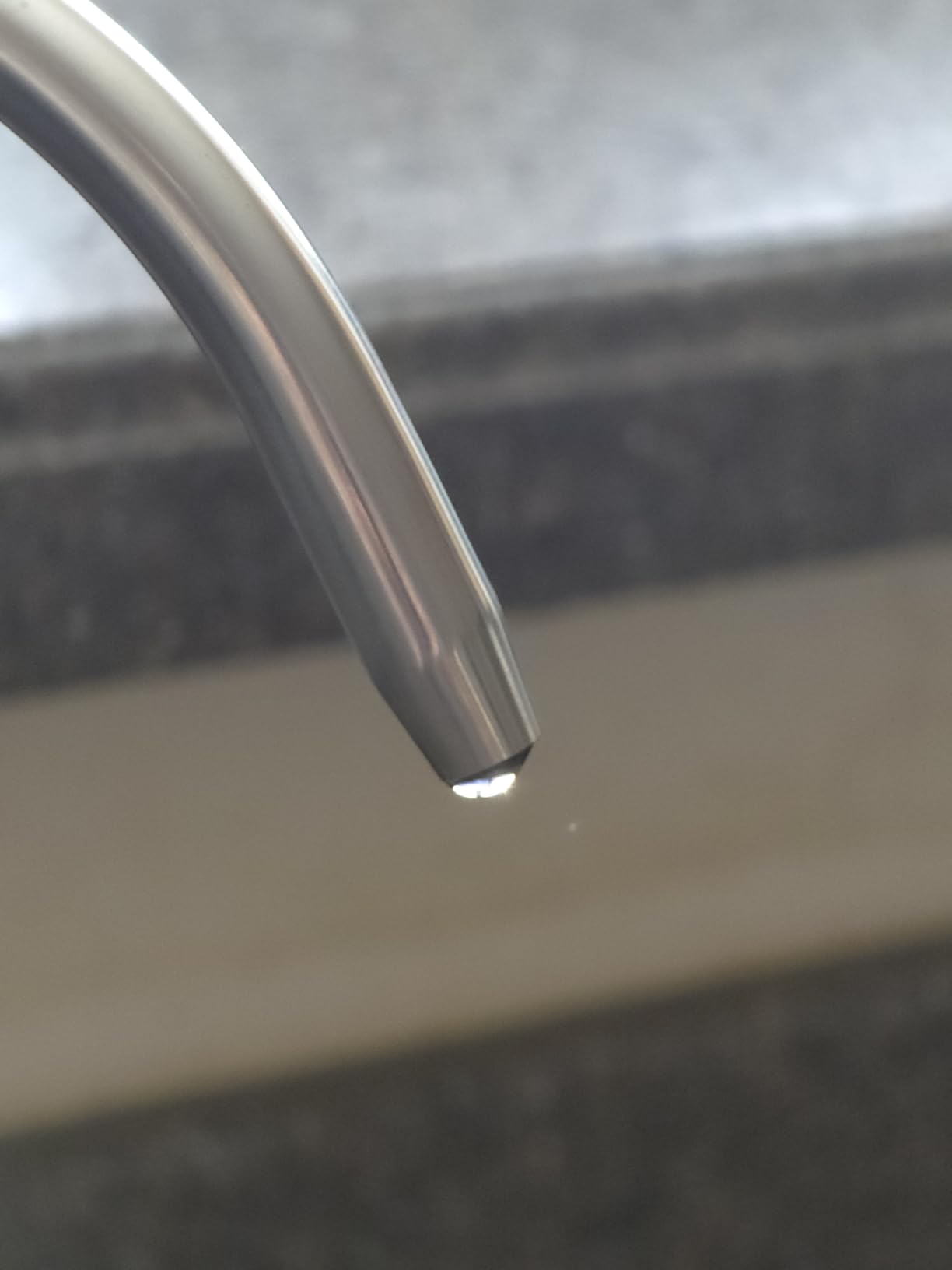
The membrane is 0.0001 micron and the alkaline mineralization stage enriches the water with Ca2+, Mg2+, Na+ and K+. So you get the flat-taste fix without giving up the speed of a tankless design, which is the usual trade-off. Filtration covers PFOA, PFOS, chlorine, lead, fluoride and heavy metals across eight stages.
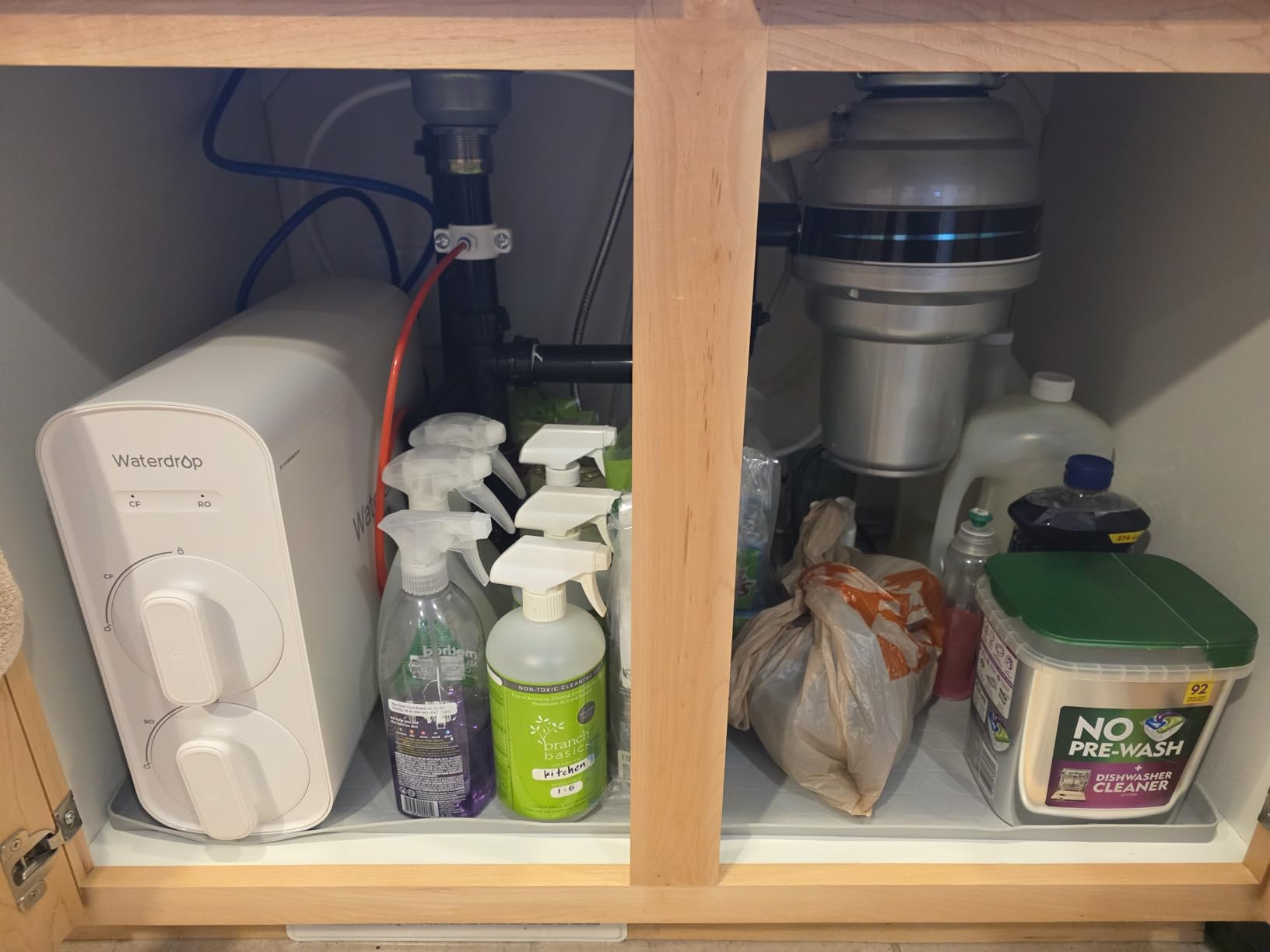
Water waste is kept to a 2:1 ratio, and the tankless format frees up to 70 percent of under-sink space. At 16.69 by 5.69 by 13.9 inches it is a slim body, though at 21.4 pounds it is heavy to lift into position.
What you give up for that performance
It needs an under-sink electrical outlet and a drilled countertop hole for the mechanical faucet, which measures 6.6 by 3.2 by 11.3 inches. Those two requirements rule it out for most renters and for any kitchen where drilling is off the table.
Like the G2, it does not operate during a power outage. A household that cares about emergency water should weigh that against the flow and certification benefits before choosing.
Who it suits and who it does not
It suits a larger household, anyone with an ice maker or refrigerator water line, and any buyer who reads certification standards before they read star ratings. The alkaline stage also makes it the better tankless option for taste-sensitive drinkers.
It does not suit a small kitchen, a renter, or a buyer who wants zero installation work. If the ice maker is the goal and the drilling is the problem, our under-sink tank pick is the simpler path.
9. FS-TFC 100 GPD 5-Stage: Budget Pick With Four Spare Filters Included
- Claimed 99.999 percent reduction across more than 1000 contaminants
- Four extra replacement filters included covering close to a year
- Compact 11.5 x 5 x 11.5 inch body fits most standard sinks
- Tool-free install in about 10 minutes
- 2 year warranty plus lifetime support
- Some included connectors reported low quality and leak prone
- Mounting brackets are flimsy
- Heavy condensation forms on the lower filter housings
The FS-TFC is the simplest way into a 100 gallon per day under-sink system, and it arrives with four extra replacement cartridges in the box, which effectively covers close to a year of filter changes before you buy anything else.
Long-term owners report consistent results, with repeated use over years producing readings in the 2 to 15 PPM range and no leaks. The compact body at 11.5 by 5 by 11.5 inches is the smallest under-sink unit here, and the tool-free install takes about ten minutes on a standard sink.
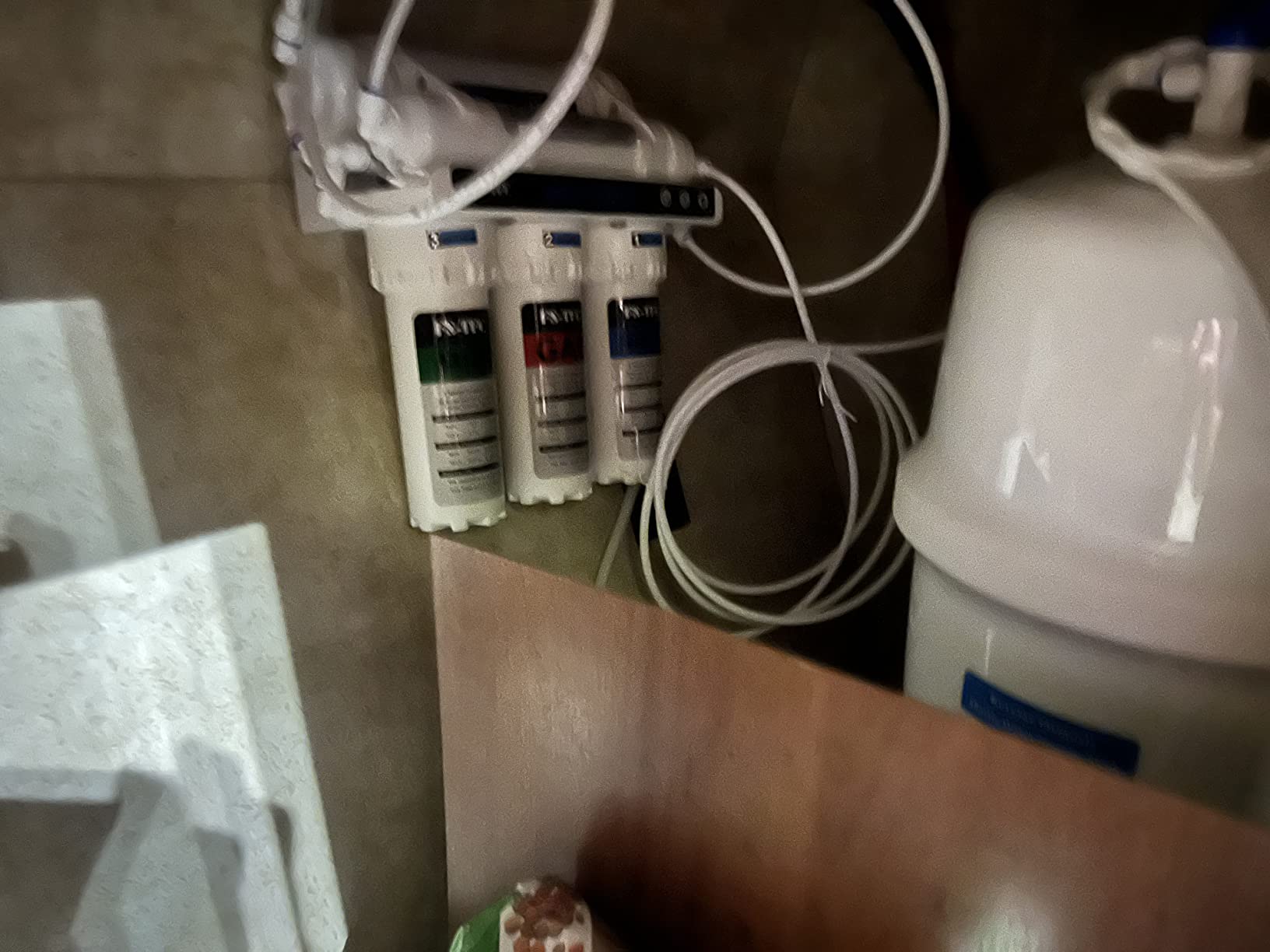
The 1:1 low drain ratio is better than typical for a tank system in this class, filtration itself needs no electricity, and the claimed reduction rate is 99.999 percent across more than 1000 contaminants including chlorine, VOCs, fluoride, arsenic, lead, nitrates and heavy metals. Full flow is listed at 18 liters per hour tested at 60 PSI, or a 200ml cup in about five seconds.
The 2-year manufacturer warranty after registration runs longer than the one-year cover on most other units we covered, and lifetime technical support comes with it.
Where owners report problems
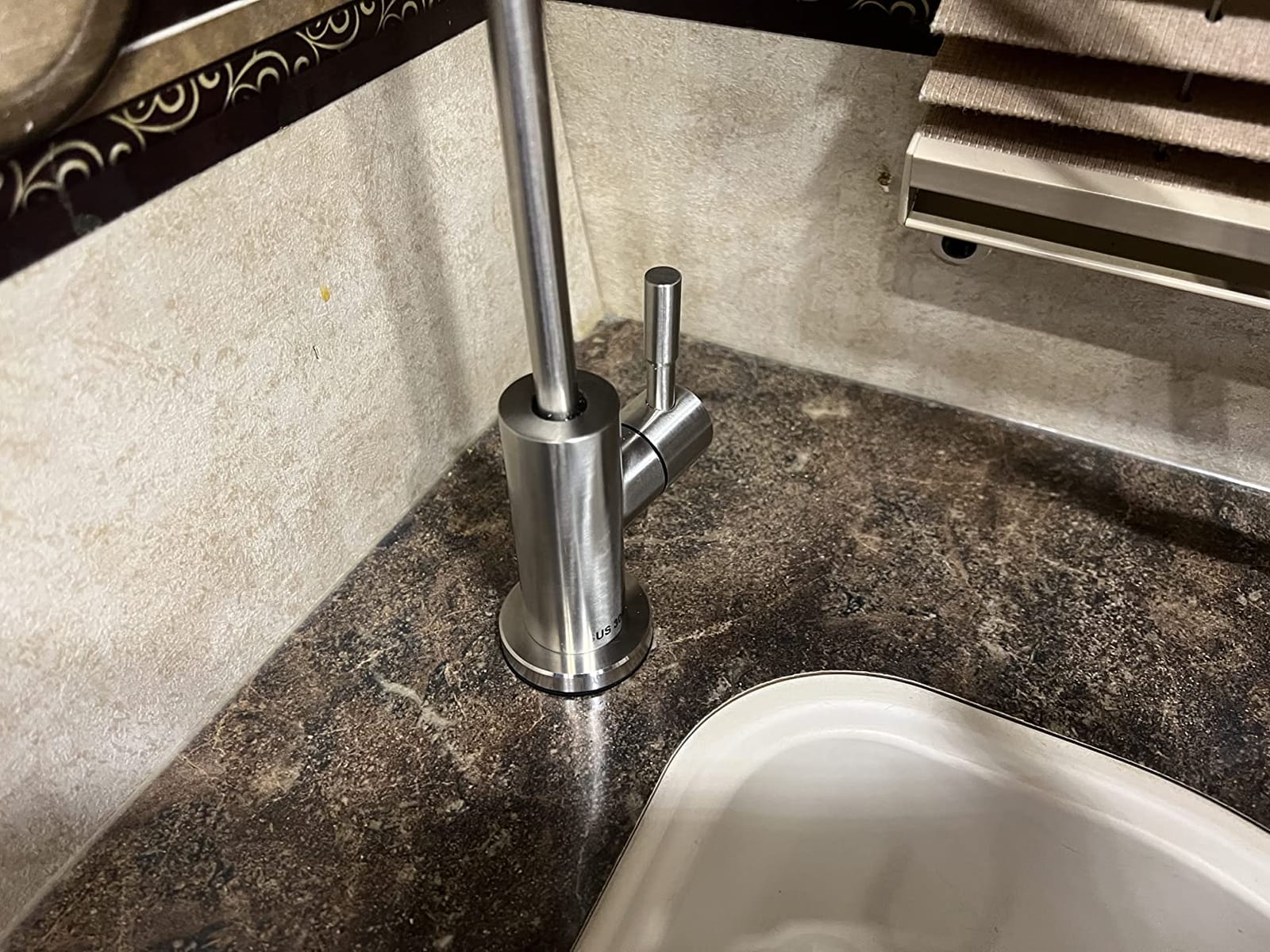
The connector quality is the recurring theme. A smaller group reports the included feed and tank connectors failing and needing to be swapped for better parts, and some have flagged the connector hardware generally as prone to leaking. If you install this, plan to have a few replacement fittings on hand and check every joint with a paper towel after the first hour.
The second complaint is condensation. It forms heavily on the lower three filter housings, and some owners end up adding a drain trough to catch it. The mounting brackets are also described as flimsy enough to need zip ties or separate mounting.
There is no alkaline sixth stage, so the water tastes closer to standard RO than the remineralized models above.
Who it suits and who it does not
It suits a first-time RO buyer on a strict budget, anyone in a tight cabinet, and households using it for well water, RVs or refrigerator hookups where the included spares are genuinely useful.
It does not suit anyone fussy about taste, anyone unwilling to inspect fittings after install, or anyone who wants the long component life of a stainless-bodied system. If connector reliability is your top concern, spend up and take the APEC instead.
10. NU Aqua 5-Stage 100 GPD: Best Warranty and Trial Period Under 300
NU Aqua 5-Stage Under Sink Reverse Osmosis Water Filter System – 100 GPD RO
- 120-day home trial plus 3 year manufacturer warranty
- 100 GPD doubles the flow of standard under-sink filters
- Complimentary PPM meter included for tracking water quality
- Color-coded tubing and quick-connect fittings
- Automatic shut-off valve failures reported within a few months
- No pump so low household pressure hurts performance
- Loose faucet handle
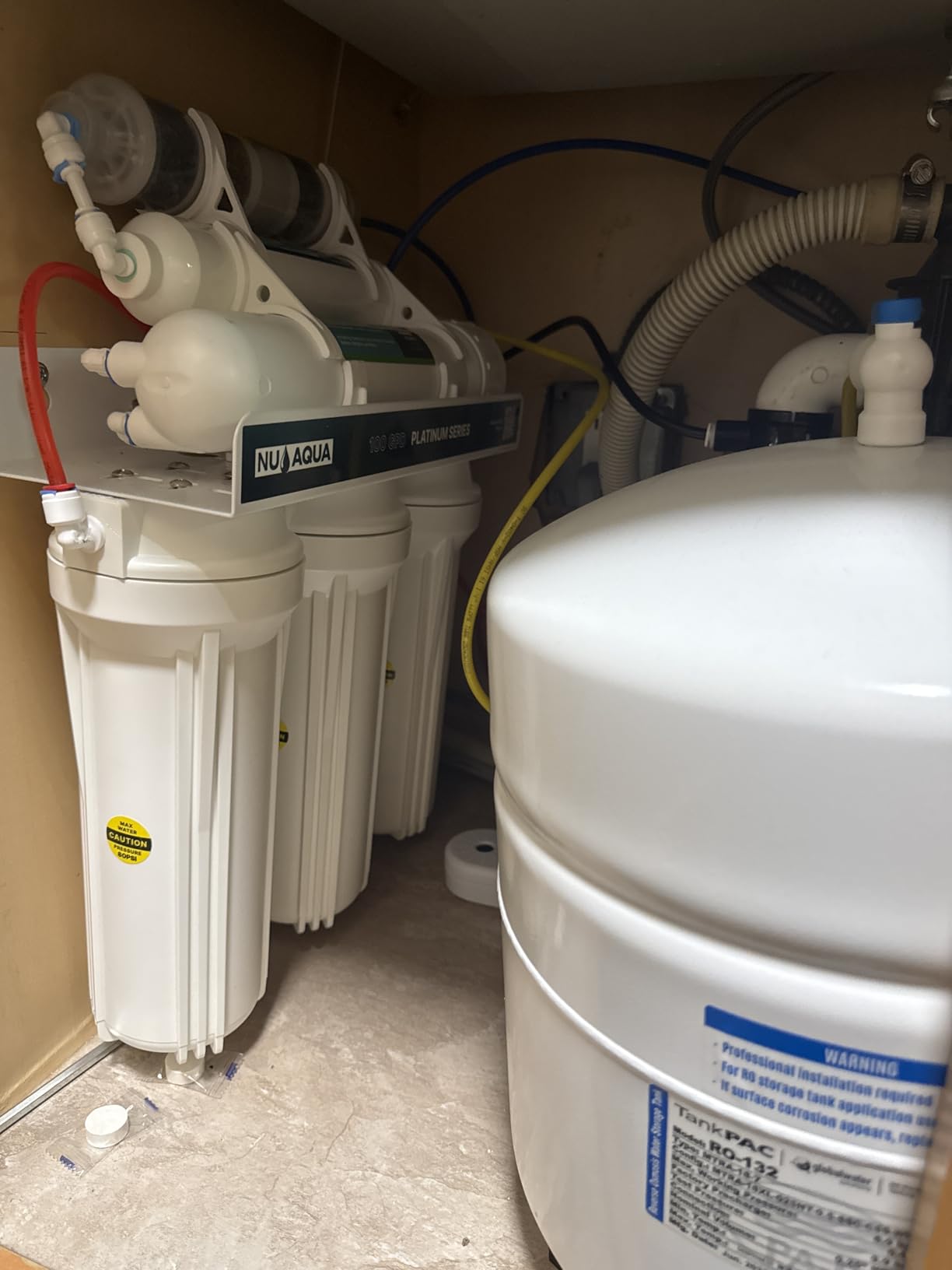
The NU Aqua is the least risky purchase in this roundup on paper. It comes with a 120-day home trial and a 3-year manufacturer warranty, and no other unit here offers a trial window anywhere near that length.
It also includes a complimentary PPM meter so you can track total dissolved solids and filter timing yourself rather than relying on taste. Several owners report catching filter changes early with that meter, and it costs nothing to use. A stainless faucet and double o-ring sealed housings add to the sense that this is better built than most plastic-bodied systems in its class.
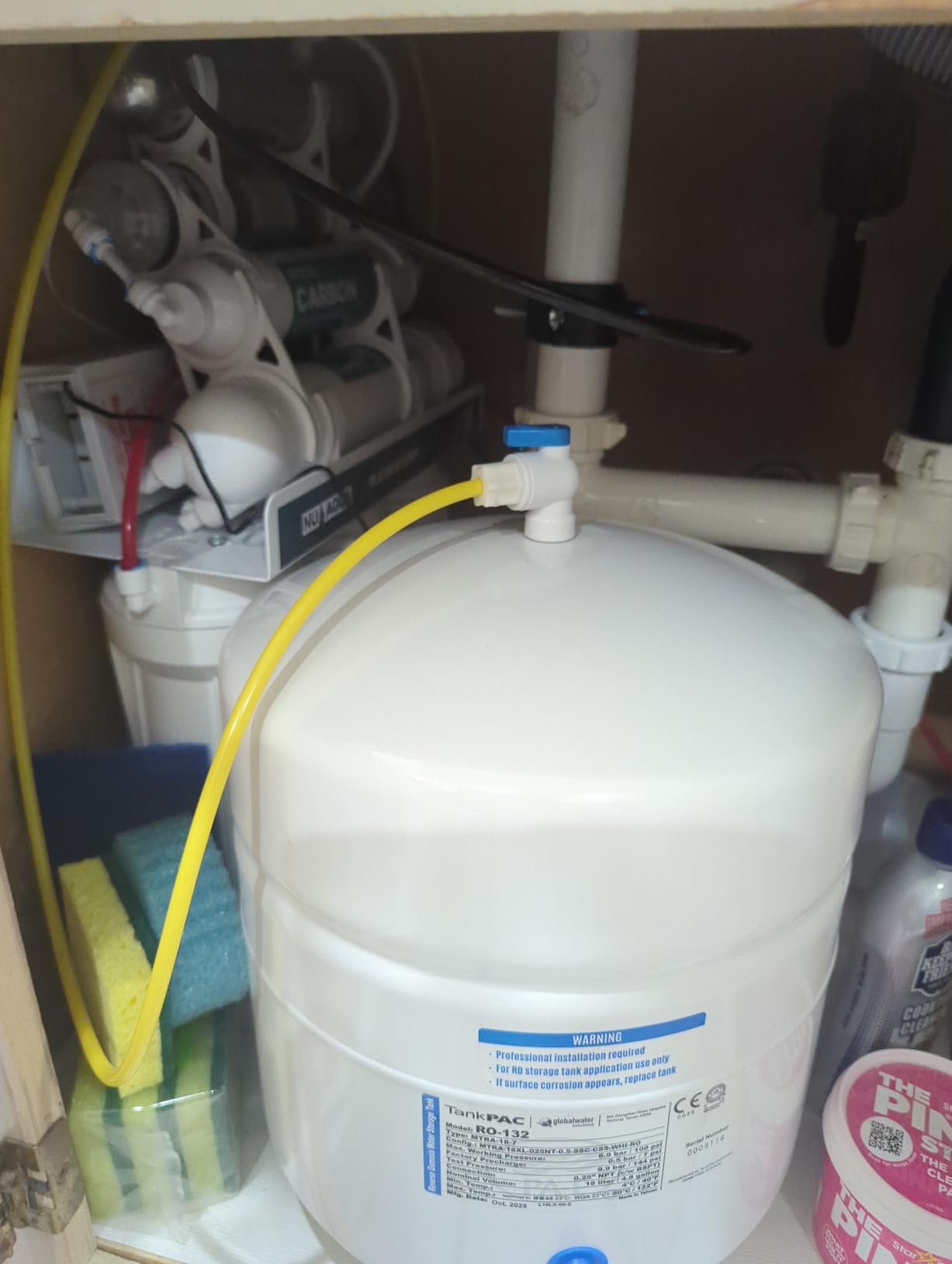
Capacity is 100 GPD, which the manufacturer positions as double the flow of a standard under-sink drinking filter. The HydraCoil membrane is claimed to deliver up to 50 percent cleaner water than competing RO membranes, and rejection is claimed at up to 99 percent across 1000-plus total dissolved solids. Installation is under an hour with color-coded tubing.
Build quality is a step up in some respects. The faucet is 100 percent lead-free stainless steel rather than plated plastic, and the filter housings use double o-ring seals. Long-term owners report years without a single leak.
The failure mode to know about
The automatic shut-off valve is the significant complaint cluster. Some owners report failures within a few months, and support knowledge on resolving them is thin. This valve is what stops the system from continuing to fill once the tank is full, so a failure means either continuous filling or no purified water.
Because there is no pump, we strongly advise testing your household water pressure before buying. Its 500 PPM feed water ceiling sits at the lower end of the group and limits it on heavy well water. Both APEC and the pumped iSpring handle 2000 PPM feed.
Who it suits and who it does not
It suits a cautious buyer who wants a long trial, a stainless faucet, and a free meter for measuring results. It also suits well water users with moderate TDS who want a longer warranty than the alternatives.
It does not suit low-pressure homes, households needing certified contaminant reduction standards, or anyone who wants alkaline water, since the alkaline sixth-stage variant draws complaints about a sulfur-like off-taste.
What to Look for in a Reverse Osmosis System Under 300
Tank or tankless: which one fits your sink
A tank system holds purified water in a pressurized vessel, so the faucet delivers a burst immediately and then slows as the tank empties. It is cheaper, simpler, needs no electricity, and has more fitting leak points. A tankless system filters on demand and never waits, wastes less water, and needs power plus a drilled faucet.
Choose a tank if you want the fewest installation requirements and drink water mostly one glass at a time. Choose tankless if your cabinet is tight, you fill a lot of water at once, or you hook up a refrigerator. Neither format is better at purification, because the membrane does that work.
Air gap faucets and the leak question
An air gap is a physical break between the purified water line and the drain, designed to stop a backflow event from contaminating your potable supply. Many jurisdictions require one on a dedicated drinking water faucet. Some budget systems come with a faucet that has no air gap, which means buying an air gap device and drilling a second hole. Leaking at the air gap is one of the most common repair jobs owners report, usually from a failed seal or a misaligned drain tube.
How to read certification marks before you buy
NSF/ANSI 42 covers aesthetic claims like taste and odor. NSF/ANSI 53 covers health-related contaminants such as lead and cryptosporidium. NSF/ANSI 58 is the reverse osmosis standard and the one that matters here. NSF/ANSI 372 certifies lead-free materials only, with no contaminant reduction claim at all. WQA Gold Seal can cover either performance or materials depending on the specific listing. Testing by SGS against a standard is a real test, but it is not a certification of the whole system.
So when a listing says certified, check which standard and whether it covers the system or one housing. Only a small minority of systems in this roundup carry nothing more than a materials seal.
APEC versus iSpring head to head
These two dominate this price band and the comparison is closer than brand reputation suggests. The APEC ROES-50 is the older, cheaper, dual-certified design with a decade of service history and a slimmer body. The iSpring RCC7AK-BN offers more capacity at 75 GPD, whole-system NSF/ANSI 58 coverage, an alkaline mineral stage for better taste, and a top-mounted faucet that simplifies install.
If certification breadth and taste decide it, iSpring wins. If proven longevity, a smaller footprint, higher feed water tolerance, and the lowest ongoing fuss decide it, APEC wins. If your water pressure is weak, only the pumped iSpring variant solves it properly.
Well water and high TDS feed
Most budget RO systems handle dissolved solids well but are not designed for iron, manganese or sulfur, which foul membranes rather than being removed by them. Well users should test their water first and consider a pre-treatment system before any membrane. Among these, the APEC ROES-50 has the highest supported feed ceiling at 2000 PPM, and the pumped iSpring matches it.
If you want whole-house treatment rather than a drinking water tap, that is a different category and a different budget, and our guide to whole house reverse osmosis systems covers what it actually involves.
Budget for filters, not just the unit
Reverse osmosis membranes and carbon blocks are consumables, and the difference between brands compounds over a decade. Generic-equivalent cartridges can cost a fraction of proprietary sets, which is a real factor when the unit itself is the cheaper purchase. Check the replacement set price before you buy, and check whether longer-life cartridges exist. Also remember the initial flush, which takes hours and should finish before the system is used.
Frequently Asked Questions
What is the best and cheapest reverse osmosis system?
The iSpring RCC7AK-BN is the best overall under 300 dollars. Its NSF/ANSI 58 certification is stated as covering the entire filtration system, it runs 75 GPD, and the alkaline mineral stage fixes the flat taste. For the lowest entry cost with spares included, the FS-TFC 100 GPD comes with four extra cartridges.
Which RO is best and cheap?
Best cheap under-sink options are the APEC ROES-50 for dual NSF/ANSI 58 and 372 certification and a decade of service history, and the FS-TFC 100 GPD for the lowest entry cost with four spare filters in the box. Both need drilling and a faucet.
What are people saying about the iSpring RCC7 reverse osmosis system?
Owners mostly praise the taste from the alkaline stage, the whole-system NSF 58 certification, the top-mounted faucet that installs from above the sink, and the transparent first-stage housing. Recurring complaints are the large cabinet footprint and the lack of a booster pump in low-pressure homes.
Which is better, APEC or iSpring?
iSpring wins on capacity, whole-system NSF/ANSI 58 coverage, alkaline taste and easier faucet installation. APEC wins on proven long-term service, dual NSF 58 and 372 certification, a slimmer 5.25 inch body and a higher 2000 PPM feed water ceiling.
Are iSpring reverse osmosis systems good?
Yes for most buyers. The RCC7 family has the largest review base in this roundup and consistent praise for taste and installation. The main cautions are the cabinet footprint, the missing booster pump on non-pumped models, and one independent lab review that detected arsenic and vanadium after filtration on an RCC7 unit, suspected from the remineralization media.
Why does my reverse osmosis faucet leak?
The usual causes are a failed base O-ring or housing seal, an over-tightened housing cap, a loose faucet mounting post, or a misaligned air gap drain tube. Check the base of the faucet first, then hand-tighten any caps you overtightened during install.
Does a reverse osmosis faucet need an air gap?
Most local codes require an air gap on a dedicated drinking water faucet to prevent backflow into the potable line. Several budget systems come with a faucet that has no air gap, so you need to add an air gap device and a second hole in the sink deck.
What is the best reverse osmosis system for installing under the sink?
For a tank system with the strongest certification, the iSpring RCC7AK-BN. For the smallest body and quickest install, the FS-TFC 100 GPD at 11.5 inches. For certified performance with no tank and the fastest flow, the Waterdrop G5P500A, which needs under-sink power and a drilled faucet hole.
Final Verdict: Our Top Pick Under 300
After working through ten systems, the iSpring RCC7AK-BN is our pick for the best reverse osmosis systems under 300 dollars as of 2026. Whole-system NSF/ANSI 58 certification, 75 gallons per day, an alkaline mineral stage that fixes the flat taste, and a top-mounted faucet that makes installation less painful than it has any right to be. Run out of cabinet space and the APEC ROES-50 is the disciplined second choice, with dual certification and a decade of owner-reported service.
If you do not want to drill anything, the SimPure Y7P-BW gives you UV, a 4:1 drain ratio and a glass pitcher for the effort of plugging it in. Read our whole house reverse osmosis guide if you are thinking bigger than a drinking tap, and check your household water pressure before you pick a system without a pump.