
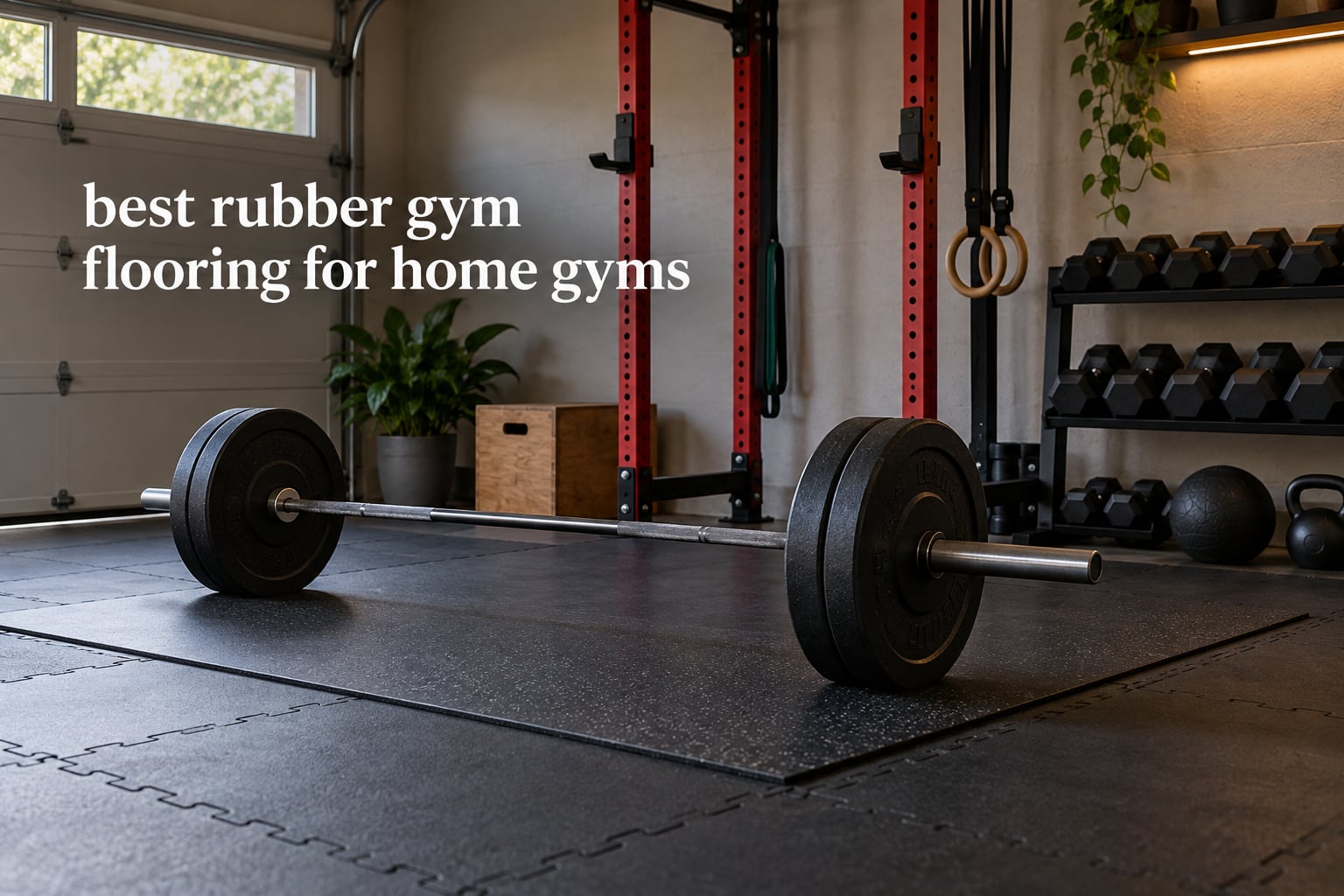
The best rubber gym flooring for home gyms is 3/8 inch (8 mm) rubber installed dry-lay, and the single best place to start is an interlocking 24 x 24 inch tile set rather than a roll. That combination is dense enough to protect concrete from dropped dumbbells, light enough to install in an afternoon without adhesive, and forgiving of a subfloor that is not perfectly level. Most people buy 3/8 inch because it is the sweet spot: thick enough to soften the blow of a 45 to 75 lb drop, thin enough that you are not fighting a rock-hard surface for footwork drills.
Thickness advice on this topic splits into two camps that rarely talk to each other. The spec-sheet camp says 3/8 inch or 8 mm, because that is what rubber gym flooring manufacturers build for residential rooms. The equine camp says 3/4 inch, because that is what horse stall mats ship in and the price per square foot looks irresistible. Both camps are right about their own product. Our test method for this 2026 roundup was to compare ten rubber flooring products on declared thickness, weight per unit, coverage, subfloor handling, odor on arrival and reported durability, then sort them by the room you actually have: a garage bay, a basement, a spare room over carpet, or a half-covered floor with a car parked on it. We last updated this guide in October of 2026.
A few things worth stating up front. Rubber is not decorative. It is a dense elastic layer that spreads the impact of a dropped weight over a wider area than bare concrete, which protects both the slab and the equipment feet sitting on it. It also dampens noise, which matters more than most buyers expect if you live downstairs from a kitchen or share a wall with a neighbor. And no rubber flooring solves a moisture problem in a basement: it is waterproof, which means water underneath it stays there.
We will cover ten picks across the three formats that make sense for home use, then a buying guide that settles the thickness question, format question, odor question and the mold question that no competitor on this topic answers. Updated for October 2026.
Table of Contents
Top 3 Picks for Rubber Gym Flooring in 2026

Fit-Lock 3/8 Inch Interlocking Tiles
- 3/8 inch thick
- 24 x 24 inch tiles
- Dry-lay interlocking install
- About 8 lbs per tile

American Floor Mats 3/8 Inch Roll
- 3/8 inch (9 mm) solid black roll
- 4 x 8 ft coverage per length
- Few seams across a small gym

IncStores 8mm Interlocking Tile Kit
- 73.47 sq ft in one kit
- Waterproof recycled rubber
- Center
- border and corner tiles
The tile set wins for most rooms because it needs no adhesive, no seam taping and no helper with a hand truck. The roll wins when your space is a clean rectangle and you want the fewest possible seams. The large kit wins when the whole training area has to be covered at once and you would rather not count tiles.
All 10 Rubber Gym Flooring Picks at a Glance in 2026
| Product | Specifications | Action |
|---|---|---|
| American Floor Mats Fit-Lock 3/8 Inch Interlocking Tiles |
|
Check Latest Price |
| American Floor Mats 3/8 Inch Solid Black Roll 4 x 8 ft |
|
Check Latest Price |
| IncStores 8mm Strong Interlocking Rubber Tiles 73.47 sq ft |
|
Check Latest Price |
 Rubber-Cal Elephant Bark 3/16 Inch Rubber Flooring Rubber-Cal Elephant Bark 3/16 Inch Rubber Flooring |
|
Check Latest Price |
 Rubber-Cal 1/4 Inch x 4 x 7 ft Recycled Rubber Roll Rubber-Cal 1/4 Inch x 4 x 7 ft Recycled Rubber Roll |
|
Check Latest Price |
 Rubber King 10 Piece 6mm Interlocking Tiles 23.5 sq ft Rubber King 10 Piece 6mm Interlocking Tiles 23.5 sq ft |
|
Check Latest Price |
 Flooring Inc 1/4 Inch Tough Rubber Flooring Roll 4 x 10 ft Flooring Inc 1/4 Inch Tough Rubber Flooring Roll 4 x 10 ft |
|
Check Latest Price |
 Mohawk Home 1/2 Inch Heavy Duty Rubber Stall Mat 2 x 3 ft Mohawk Home 1/2 Inch Heavy Duty Rubber Stall Mat 2 x 3 ft |
|
Check Latest Price |
 Playsafer Genaflex 8mm Rubber Gym Floor Roll 4 x 4 ft Playsafer Genaflex 8mm Rubber Gym Floor Roll 4 x 4 ft |
|
Check Latest Price |
 Rubber-Cal Diamond-Plate Rubber Flooring Roll 3 mm x 4 x 7 ft Rubber-Cal Diamond-Plate Rubber Flooring Roll 3 mm x 4 x 7 ft |
|
Check Latest Price |
1. American Floor Mats Fit-Lock 3/8 Inch Interlocking Tiles – The Best Overall Rubber Gym Flooring
- Dense
- commercial-gym feel that absorbs impact from dropped weights
- Seamless Fit-Lock interlock needs no adhesive and stays put
- Center
- border and corner tiles give a finished edge
- Cuts cleanly with a utility knife for vents and odd shapes
- Wipes clean with a damp cloth
- Very heavy at about 8 lbs per tile
- Strong rubber odor on arrival for some buyers
- Only 24 x 24 inch footprint so odd rooms need extra border tiles
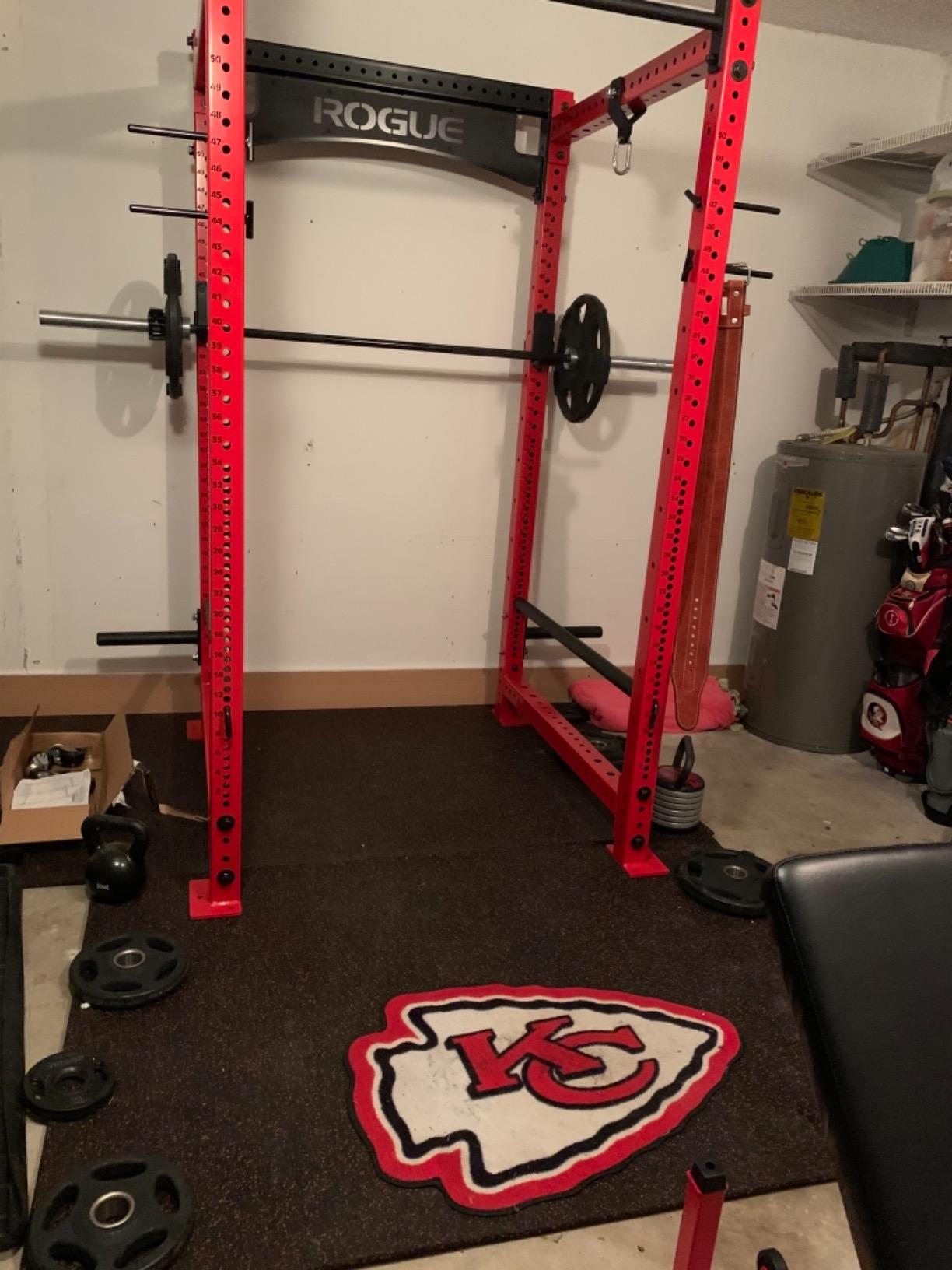
Fit-Lock is the tile set we keep coming back to, and the reason is not the number on the box. It is that the whole install is a dry-lay puzzle with no adhesive, which means a first-time installer can get a tight floor without reading an adhesive manufacturer’s instructions. The declared thickness is 3/8 inch, each tile covers 4 square feet, and the material is listed as rubber and free of PVC, lead, silicone, BPA, phthalate and latex. That last detail matters more than it sounds, because PVC-backed products are the ones people ask us to avoid in a closed garage.
Reviewers consistently describe the surface as stiff and dense rather than spongy. That is the correct feel for a room where you are dropping dumbbells, and it is the difference between a floor that absorbs a bounce and a floor that merely sits there. A dense tile returns energy gradually instead of kicking it back at you, which is what keeps a 50 lb dumbbell from feeling like an accident every time.
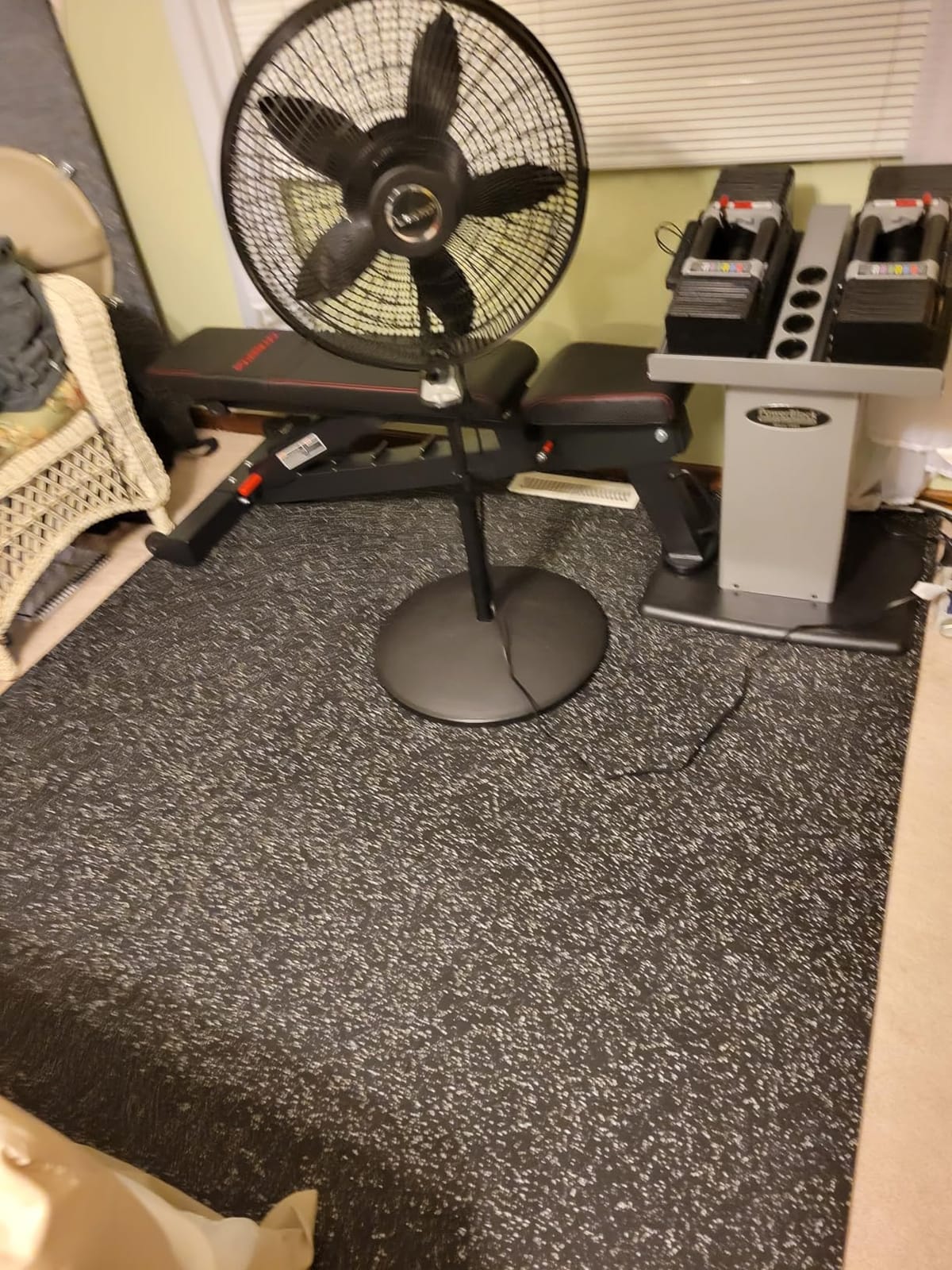
The interlock itself is the quiet hero. Owners report that the Fit-Lock edges stay locked through heavy lifts, which is the failure mode that ruins cheaper puzzle floors where a dropped weight walks the seam apart over a year. The Fit-Lock tab geometry resists that spreading force, and because the tiles are dry-lay you can lift a single damaged tile and drop a new one in rather than tearing out a whole section.
Center, border and corner tiles are stocked separately, and this is the single most useful detail in the whole catalog for real rooms. A plain field of center tiles leaves a jagged sawtooth edge wherever the floor meets a wall, which looks unfinished and catches a barbell heel. Border and corner pieces give you a straight line, and it is the difference between a floor that reads as installed and a floor that reads as puzzle-fitted.
Check the tile weight before you commit to a room
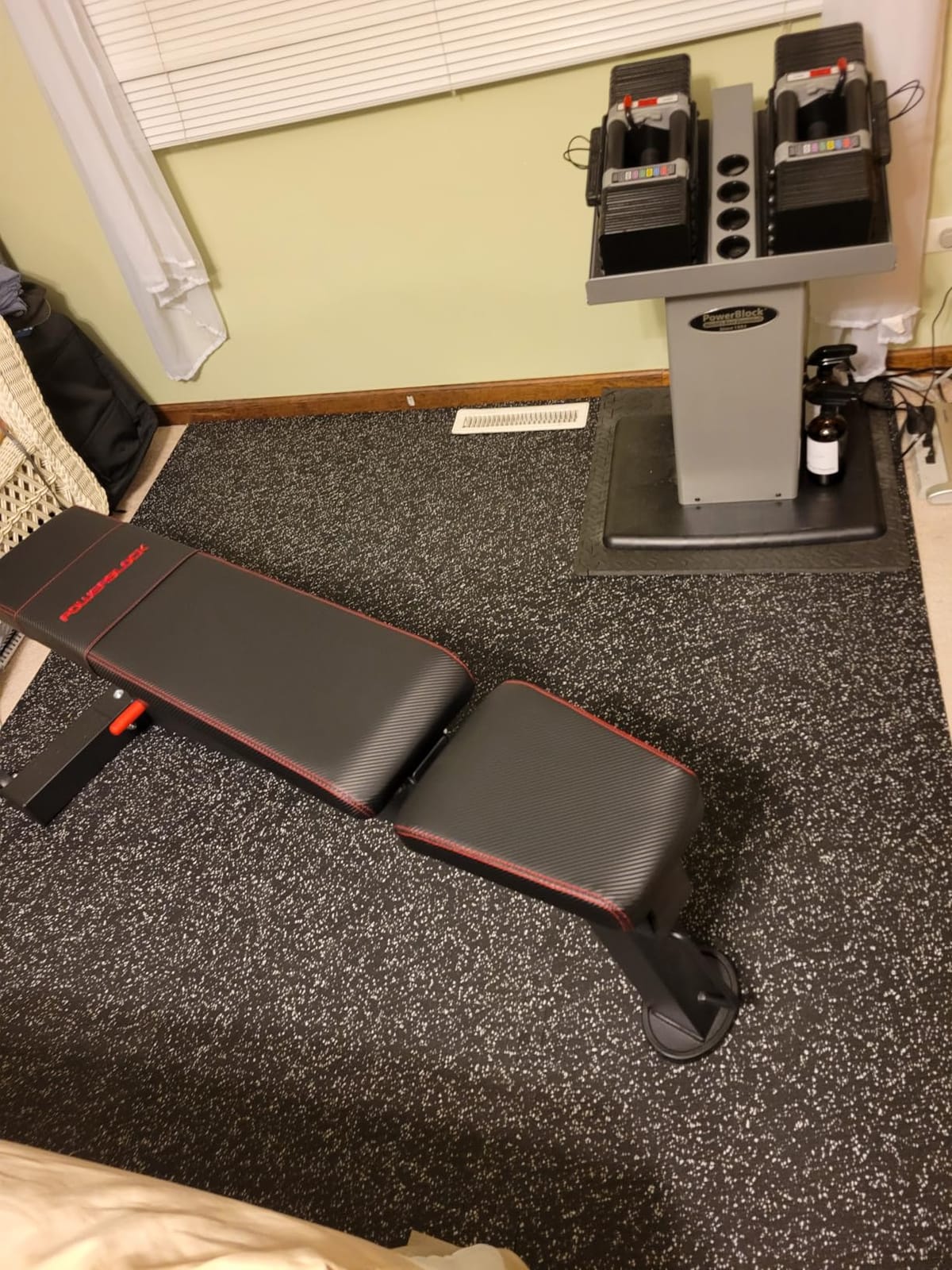
At roughly 8 lbs per tile, this is not a portable floor. A 10 x 10 foot area is about 25 tiles, which is around 200 lbs of material to move into position, and that is the reason to recruit a second person for anything larger than a single garage bay. Budget your install time as a two-person job with a helper for the first row, then the rest goes together quickly once the starting edge is straight.
The weight also rules this product out for anyone who rents and expects to take the floor with them. Tile floors are permanent in a way that roll floors are not, because you can lift a roll, carry it to a truck and reuse it elsewhere. If your situation is temporary, read the roll sections below instead.
Know what you are getting over carpet or an uneven slab
Over bare concrete this tile set behaves exactly as advertised. Over carpet, the puzzle edges have nothing to key into and the whole field can migrate under a loaded barbell, so add a thin rigid layer or restrict rubber to a defined platform zone. Over a slab that waves more than about a quarter inch across the room, edges can lift at the seams, and no amount of careful fitting fixes a slab that moves.
One more honest note on finish: the interlock lines stay faintly visible under some lighting until the tiles settle, and slight color variation between tiles is normal. Neither affects function. If a seamless appearance matters to you visually, that is a reason to prefer a roll, not a reason to skip this tile.
2. American Floor Mats 3/8 Inch Solid Black Roll 4 x 8 ft – Best Value for Clean Rectangular Rooms
- Heavy duty composition rubber that stands up to dropped weights and machines
- 3/8 inch build gives real shock absorption and vibration control
- Roll format covers large areas with very few seams
- Non-slip surface works under racks
- benches and machines
- Very heavy and awkward to maneuver without help
- Initial rubber odor can be strong and takes days to air out
- Rolls must be trimmed and seams secured
- adhesive not included
This roll is the format pick for anyone whose room is a clean rectangle. A 4 by 8 foot length laid across a garage bay produces one seam line instead of the dozens you get from a tile grid, and reviewers consistently report that the thickness and density feel close to commercial rubber rather than residential floor matting. For a full deadlift or squat zone, a continuous surface with few seams is a real functional advantage, because there is nowhere for a plate edge to catch.
The build is described as an original composition rubber fitness floor formulation at 0.375 inch, solid black, rectangular, and rated non-slip and heavy duty. That combination is the workhorse profile: dense enough to take repeated impact, matte enough to grip a barbell foot without a shoe covering, and dark enough that chalk dust and scuffing read as normal gym life rather than damage.
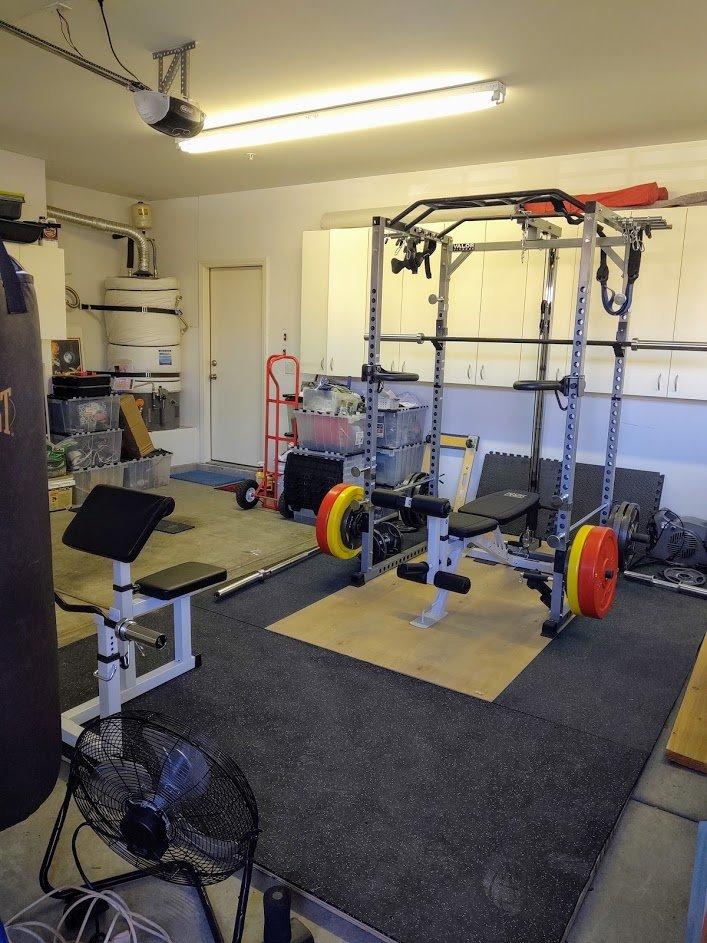
The shock absorption story is the reason people buy a roll instead of foam. A 3/8 inch elastomeric layer takes a dropped load and returns it slowly, which cuts both the noise your downstairs neighbors hear and the shock your ankles absorb during repeated floor work. Foam compresses and stays compressed. Rubber compresses and comes back, and that difference is what you feel in your joints after a session of drop sets.
Handling is the tradeoff. A roll of this size is genuinely heavy, and buyers single that out as their main friction point along with needing to trim and tape the seams. Plan on a helper and a hand truck, and unroll it in the direction of the longest wall so you are not fighting the curl.
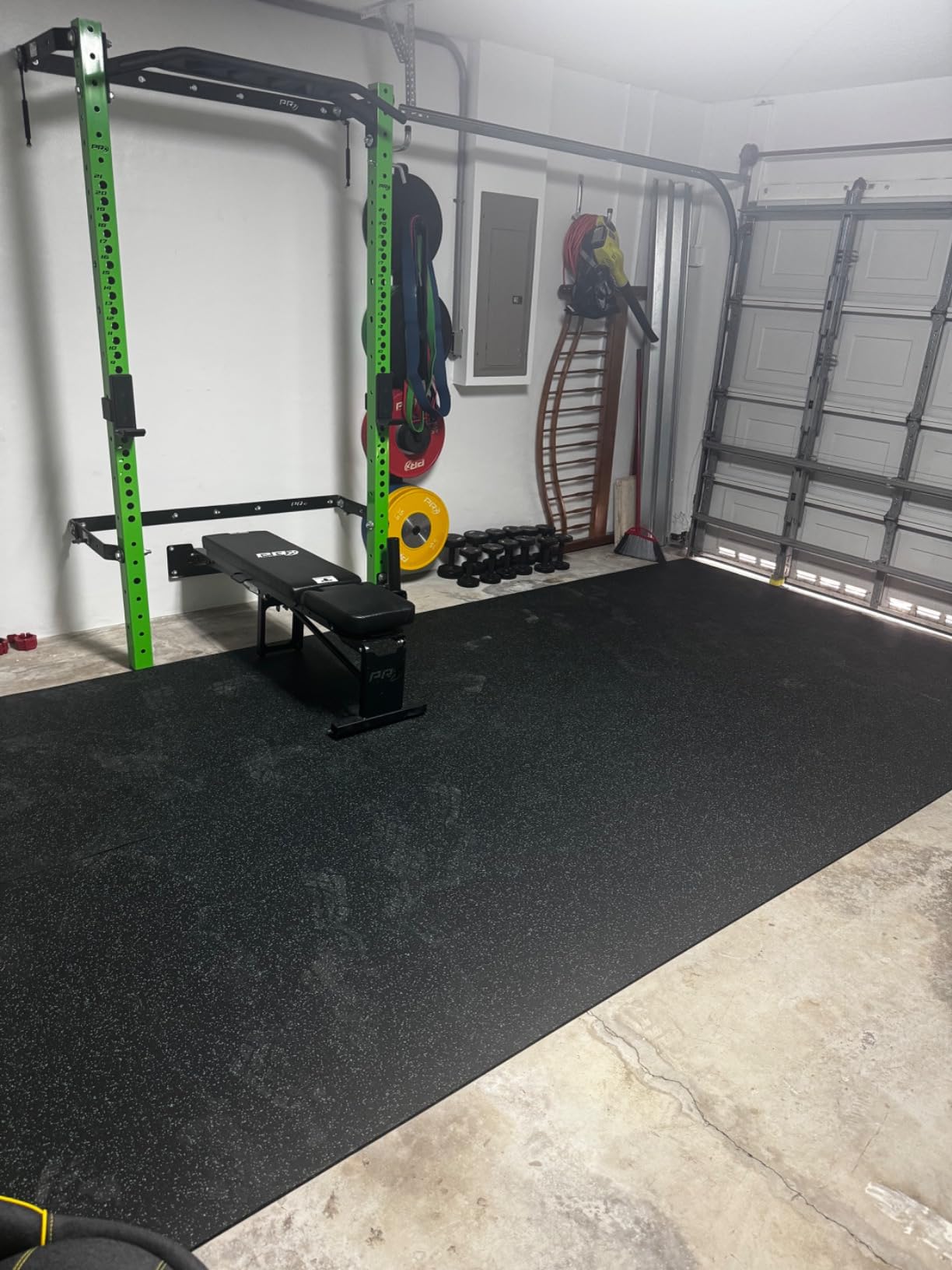
Seam planning decides whether this floor looks professional
Work out the seam count before you order. One 4 x 8 length covers 32 square feet, so a 10 x 10 foot lifting zone needs multiple lengths and therefore multiple seam lines, and a 9 x 12 foot room can often be done with three lengths and two seams. Lay the lengths out on paper first, orienting the seams away from the deadlift pull zone so nobody ever sees a line while setting up for a heavy single.
Because adhesive is not included, budget separately for urethane adhesive and a notched trowel if you want a truly permanent floor, or accept a taped and weighted dry-lay for a room that will not see a car driven over it. Loose material twists under rolling weight, and that is the failure mode to plan around.
This roll suits lifting zones more than cardio rooms
The dense, matte surface is built for free weights and racks. It is not the place for a folding cardio mat user to stand all session on bare feet if you are sensitive to texture, and it is less forgiving under a long treadmill session than a softer dedicated equipment mat. Many people solve this with a two-zone floor: rubber under the lifting area, a thinner equipment mat under the treadmill.
It is also the pick for anyone who plans to move. A roll can be lifted, carried and relaid in a new room, whereas a full tile field is a fixed installation. If you are furnishing a small room, our guide to the best home gym systems for small spaces pairs well with a partial rubber zone rather than a full-room install.
3. IncStores 8mm Interlocking Tile Kit – Best for Covering a Whole Garage Bay
- Large multi-piece kit covers a big gym area in one order
- Waterproof recycled rubber that handles weightlifting and equipment
- Center
- border and corner tiles produce a clean finished perimeter
- Slip resistance keeps benches
- treadmills and storage stable
- 8mm is thinner than 3/8 inch commercial rubber so cushioning is limited
- Large kits take planning so you do not come up short at the end
- Longer lead time than the tile and roll options
At 73.47 square feet, this kit covers more area in a single order than anything else in this guide, and that is the reason to pick it. Counting tiles for a large room is where DIY installs go wrong, because you end up one tile short and one border pack short at 11 pm. Buy the kit, open it, and lay it out. The build includes dedicated center, border and corner pieces, so the perimeter comes out straight without a single diagonal cut.
The declared thickness is 8 mm, which is essentially 5/16 inch, and it is sold as waterproof recycled rubber with slip resistance listed as the headline feature. Waterproof is a real advantage in a garage or basement where you are wiping down sweat or dealing with an occasional leak. Slip resistance is what keeps a heavy machine from walking across the floor when you load plates onto it.
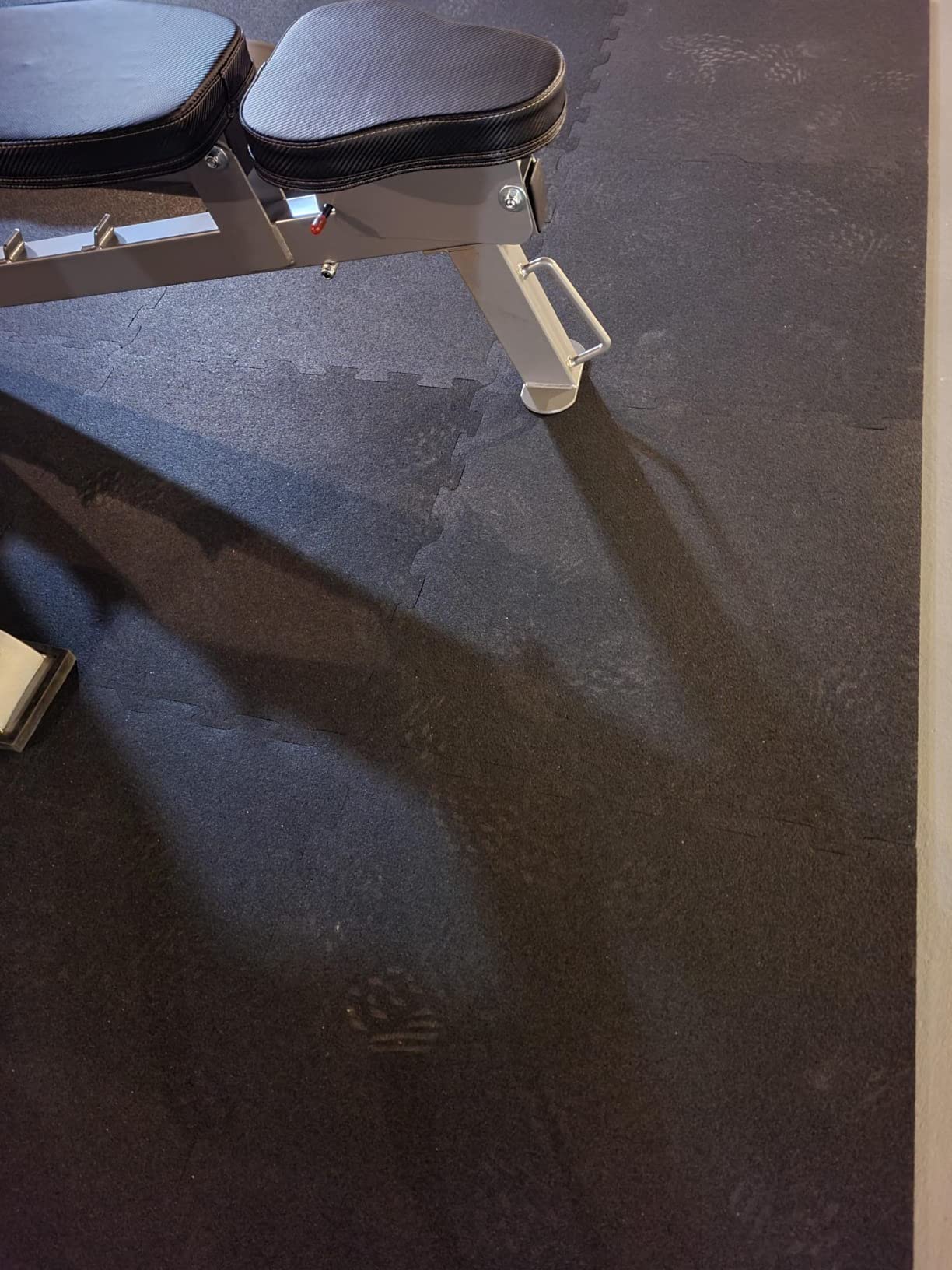
What you give up is cushioning. Reviewers are direct about this: 8mm is on the thin side compared with thicker commercial rubber, so this floor protects the surface below and your equipment feet rather than cushioning your joints. For most home gyms, that is an acceptable trade, because the biggest forces in a home gym are a body landing on feet and a plate landing on concrete, not a 400 lb bar being dropped from height.
A 73 square foot kit is the largest single order in this roundup, so the total material commitment is real and it multiplies quickly if the room grows. Buyers also mention a longer lead time. If you are fitting an install around a weekend, plan ahead rather than ordering on a Thursday.
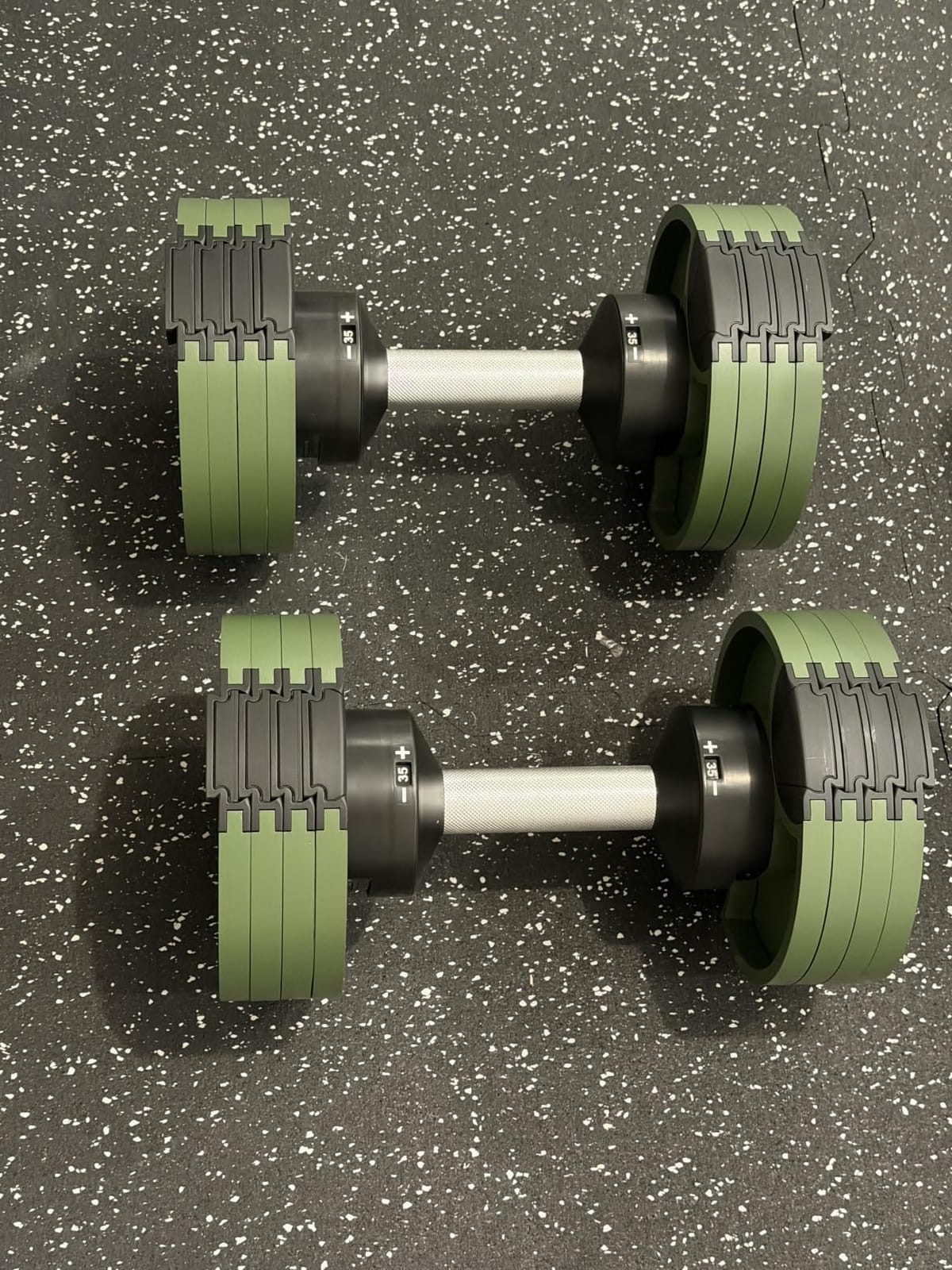
Choose this kit when coverage area matters more than depth
If your gym zone is a full-width bay and your loading is dumbbells, kettlebells, a bench and a rack, this kit covers the job in one transaction. The slip resistance under a rack matters more than most people expect, because a rack with casters on bare concrete migrates under load and can walk into a wall over a year of use.
If your training is heavy olympic lifting with frequent drops from height, step up to a 3/8 inch tile instead. Thin recycled rubber at 8mm will protect the slab, but it will not do the work of a purpose-built impact layer when a loaded bar comes down hard.
How to set the perimeter without cutting tiles all weekend
The fastest install sequence on a kit this size is borders down first, corners in, then fill the field with center tiles. Starting with center tiles means you end up with a sawtooth edge against the wall and end tiles that never quite fit, which is how people end up with a strip of trimmed scraps along two walls.
Clean the concrete first. Recommended steps are sweep, vacuum, then a damp mop with mild detergent, and no abrasive cleaner or scrubber on the surface itself. A clean slab keeps the interlock tight and prevents grit from grinding into the puzzle edges every time you step on them.
4. Rubber-Cal Elephant Bark 3/16 Inch Sheet – Best for Protecting a Garage Slab
Rubber-Cal Elephant Bark Rubber Flooring – 3/16″ x 4 ft x 8 ft, Black
- Recycled rubber rated UV and water resistant for indoor and outdoor use
- Impact protection and vibration reduction for home and commercial gyms
- Rolls out flat and trims easily without adhesive
- Six color fleck options to match the space
- Three year manufacturer warranty
- 3/16 inch is thin
- so it protects the floor more than it cushions feet
- Rough texture is uncomfortable for barefoot training
- Heavier than it looks and needs a sharp blade to cut
Elephant Bark is a floor protector, and treating it as anything else will disappoint you. At 3/16 inch with a listed weight of 31 lbs across a 96 by 48 inch sheet, it is dense and heavy for its thickness, which is exactly what you want if the job is stopping oil drips, dropped gear and foot traffic from staining a garage slab. Reviewers position it almost exactly this way, as impact protection and vibration damping rather than a training surface.
That framing is useful because it lets you spend money in the right place. If your gym is a spare room in a house, a protector sheet under a machine solves the noise and scratch problem at a fraction of the cost of a cushioned floor. If your gym is a lifting room where you drop weight daily, you need thickness, and this is not it.
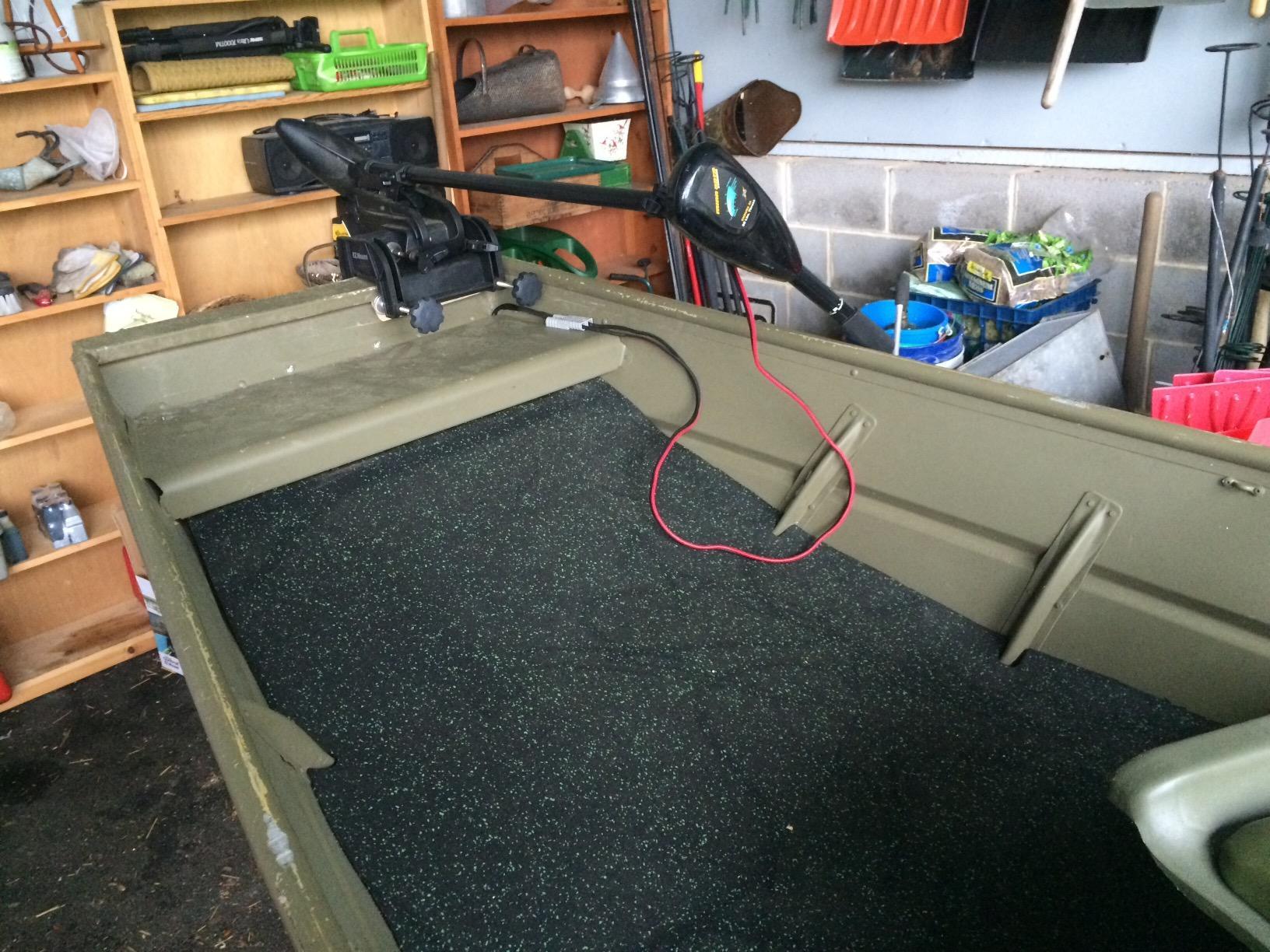
The UV and water resistance rating is the detail that separates this sheet from a foam-backed mat. You can use it on a covered patio, in a mudroom, in a kennel or under a treadmill in a damp basement, and it will not degrade the way an EVA product does when it gets wet and stays wet. The manufacturer backs it with a three year limited warranty, which is a real signal on a recycled product.
Installation is genuinely easy: roll it out and trim it. No adhesive, no trowel, no buffing. For a garage where you want a defined equipment zone, you can cut it to size in minutes with a fresh blade and a straight edge, which is faster than laying a single tile row.
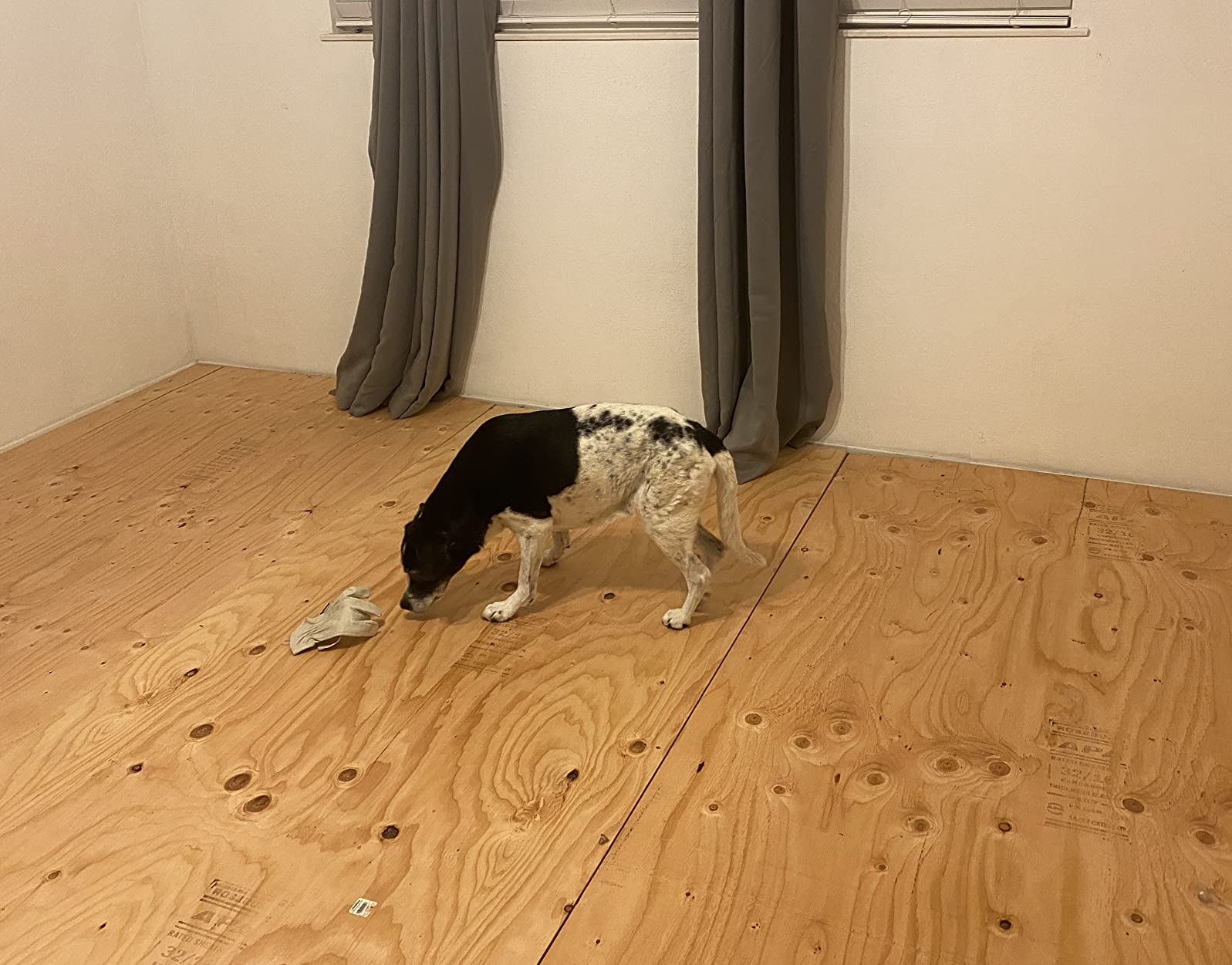
Barefoot training is the one use this sheet fails
The textured face is rough, and reviewers call that out repeatedly as uncomfortable for barefoot work. If your gym involves yoga, mobility or barefoot dumbbell circuits, put something over it, because standing directly on a rough recycled surface will bother your feet within a session. Covered, it works fine, and the texture does help grip.
The 3/16 inch thickness also means almost no shock absorption for a dropped weight. Protection and cushioning are different jobs, and this sheet does the first one well. If your concern is concrete cracking under dropped dumbbells, step up to the 1/4 inch or 3/8 inch options.
Why this is the one to buy when noise travels through the house
Vibration reduction is the strongest argument for a thin dense sheet. It will not give you the joint cushioning of 3/8 inch rubber, but a 31 lb continuous layer between a machine and a subfloor does real work on transmitted vibration, which is the sound a downstairs neighbor complains about. For a leg press or rower in a room over living space, that is the correct purchase.
Our picks for the leg press machines for home use and the best weight benches for home gyms both raise the same question: what sits under the machine feet. This sheet answers it cheaply, and it pairs well with a small zone rather than a whole-room install.
5. Rubber-Cal 1/4 Inch x 4 x 7 ft Recycled Rubber Roll – Best Dense Recycled Rubber on a Budget
Rubber-Cal Recycled Flooring 1/4 in. x 4 ft. x 7 ft. – Black Rubber Mats
- Genuine dense 1/4 inch recycled rubber that flattens out of the roll without curling
- Absorbs vibration and impact under treadmills and deadlifts
- Cuts cleanly with a sharp blade without crumbling
- Stays put under its own weight so no adhesive is needed
- Waterproof and easy to wipe clean
- Rolled lengths frequently are not cut square which leaves uneven seams
- Rough texture is uncomfortable for barefoot training
- Not the densest rubber available and thicker options feel heavier underfoot
This roll has the most reviews among the 1/4 inch recycled options and a reputation for being what it claims: 100 percent recycled rubber with high EPDM content from shredded tire rubber, at a declared quarter inch and 35 lbs. Buyers repeatedly stress that it is real dense rubber rather than foam or thin PVC, which is the single most important thing to establish on this product category. Thin, cheap rubber flooring that feels like a foam rug in a rubber-colored wrapper is common, and it is not this.
The high EPDM content is what makes it usable indoors and out, and what gives it better UV and weather resistance than a low-grade recycled sheet. For a garage or a covered outdoor training area, that is a genuine advantage over a product that will chalk and degrade outdoors.
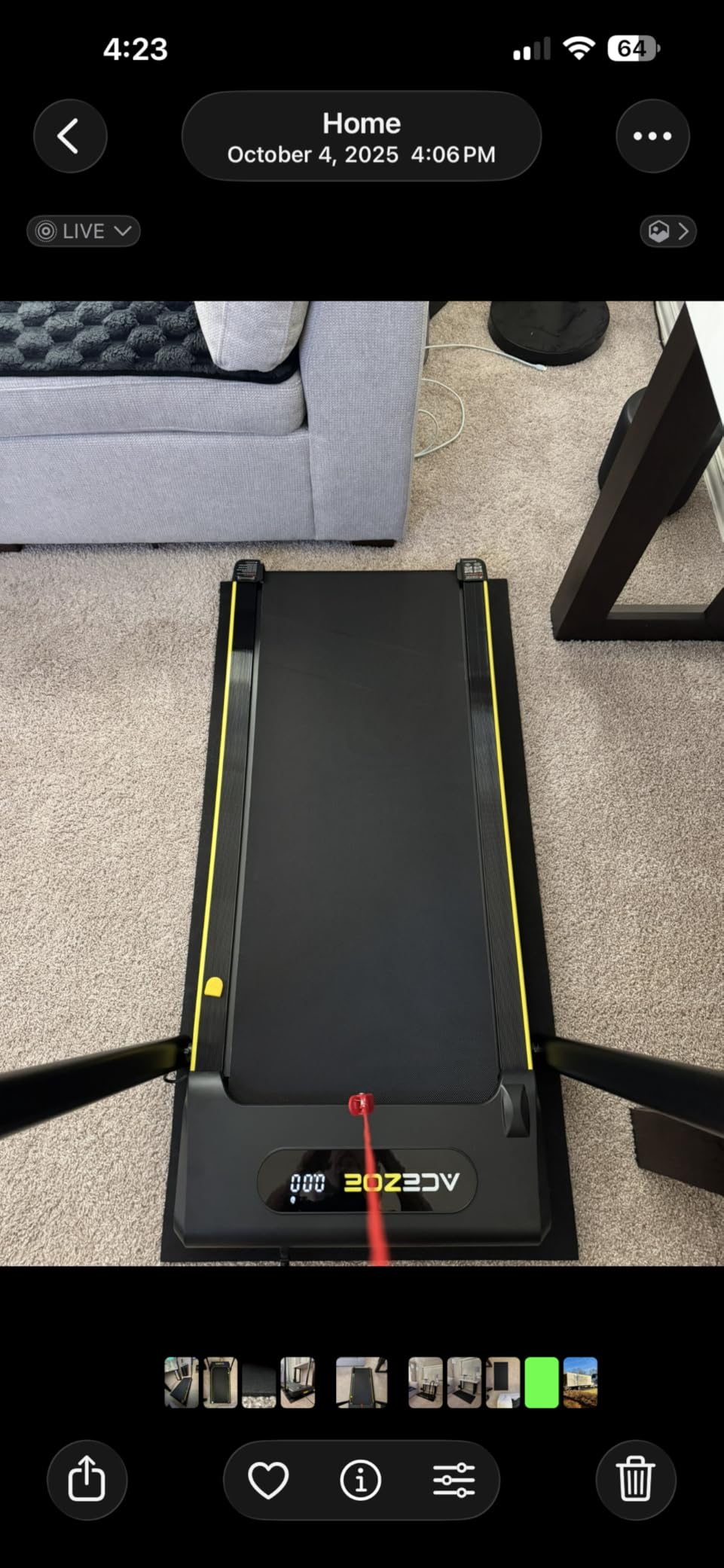
Where it earns its place is under machines and along high-traffic paths. Owners report it absorbing vibration well under treadmills and deadlifts, staying in place without adhesive because a quarter inch of dense rubber has enough dead weight to hold itself, and cutting cleanly with a sharp blade without crumbling, which matters more than it sounds when a crumb rubber product showers grit into your seams every time a bar lands.
That last detail is the difference between this sheet and an equine stall mat. Stall mats crumble into the seams and under the mats permanently because they are made to be chewed by hooves. A true composition rubber roll like this one cuts cleanly and does not shed, so your seams stay clean and your vacuum actually works.
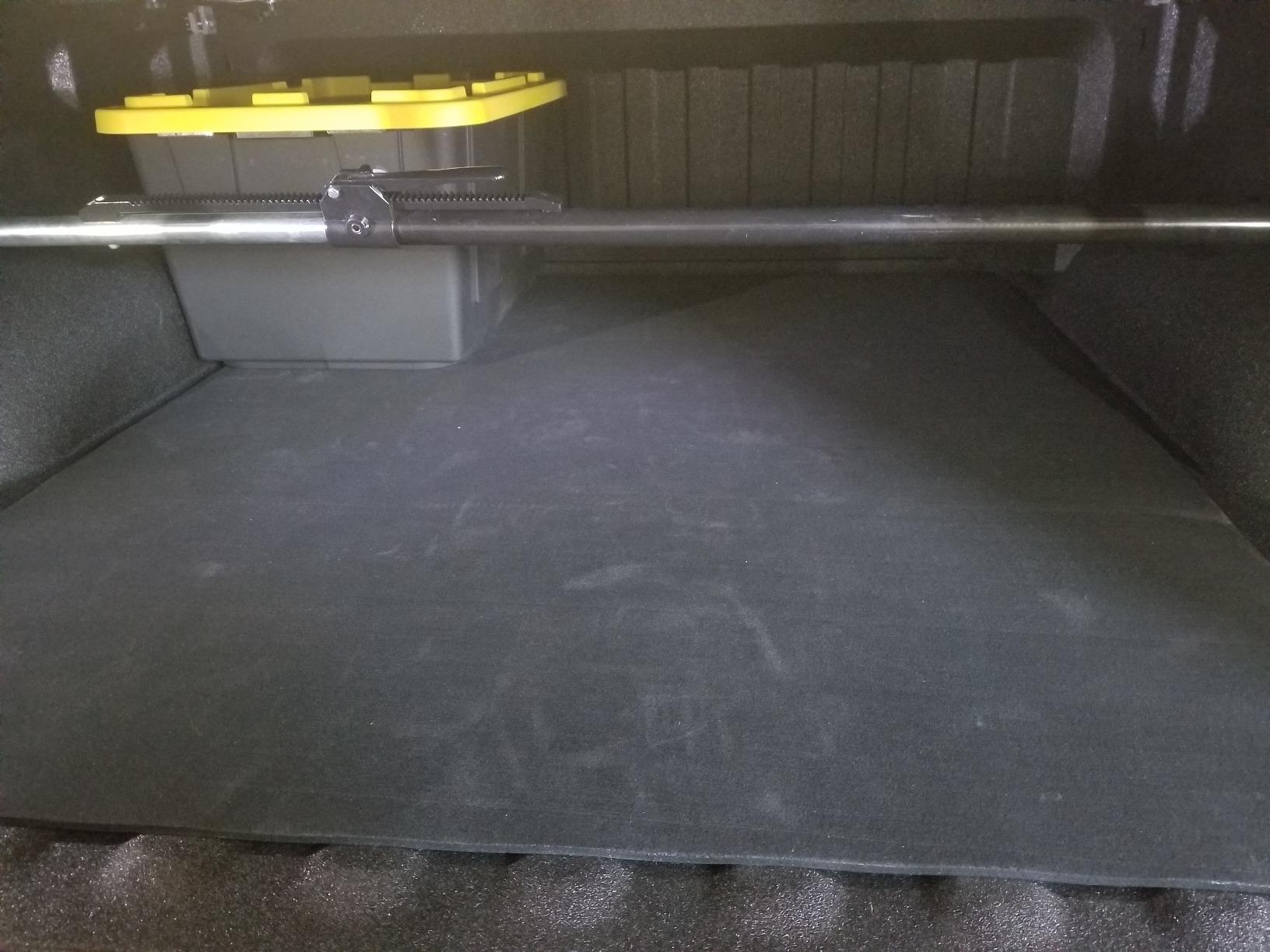
Check the edges of every roll before you plan your layout
The most repeated complaint in reviews is that rolled lengths frequently arrive not cut square, so when you butt two sheets together you get a wedge-shaped gap that nothing fixes. Inspect each roll edge before you commit to a seam location, and lay them out on the floor in the sun first if you can, because a rubber sheet that has been coiled in a box for months often relaxes and changes dimension slightly.
Plan your seams with that in mind. Where possible, run the long seam along a wall or outside your lifting zone, and leave a small expansion allowance rather than forcing sheets tight together. Rubber moves with temperature, and a floor installed at maximum tension in winter will bow in July.
Decide glue-down versus dry-lay before the first cut
Because it stays put under its own weight, a dry-lay install is defensible in a dedicated lifting room with nothing heavy rolling across it. It is not defensible if a car goes over that part of the garage. Buyers report twisting, shifting and eventual tearing of anything unadhered under vehicle weight, so treat any zone a car can reach as a glue-down zone, and buy urethane adhesive for it.
The rough surface is the other standing limitation. Barefoot work is uncomfortable on it, so plan on a thin overlay for mobility and yoga work. This is a lifting and machine floor, and it is a good one.
6. Rubber King 6mm Interlocking Tiles – Best for Low Odor and Indoor Air Quality
- FloorScore certified low-odor recycled rubber installable without ventilation
- Arrow-aligned jigsaw tabs make installation and expansion straightforward
- Anti-slip and water-resistant surface stays stable through lifts and cardio
- Interchangeable with other color sets so layouts extend or mix
- Five year limited warranty
- 6mm gives less shock absorption than 3/8 inch solid rubber tiles
- Color variation between tiles is expected and visible
- Edges can lift at seams if the subfloor is uneven
Odor is the reason to pick this set, and it is a real reason. This tile is FloorScore certified for low odor and low VOC indoor air quality, which is a third-party measurement rather than a marketing claim. Buyers with enclosed rooms make the point that this recycled rubber goes in without the weeks-long smell that stalls and many recycled sheets produce. If your gym is a spare room you also use as a living space or a basement you cannot ventilate, that certification changes the decision.
It is also made in North America from recycled tire rubber using a non-vulcanized process, with an arrow-alignment jigsaw installation and interchangeable colors. The arrow system sounds like a small detail until you have assembled a jigsaw floor with four differently shaped corner pieces and no orientation guide. These click one way, which removes the single most common install mistake.
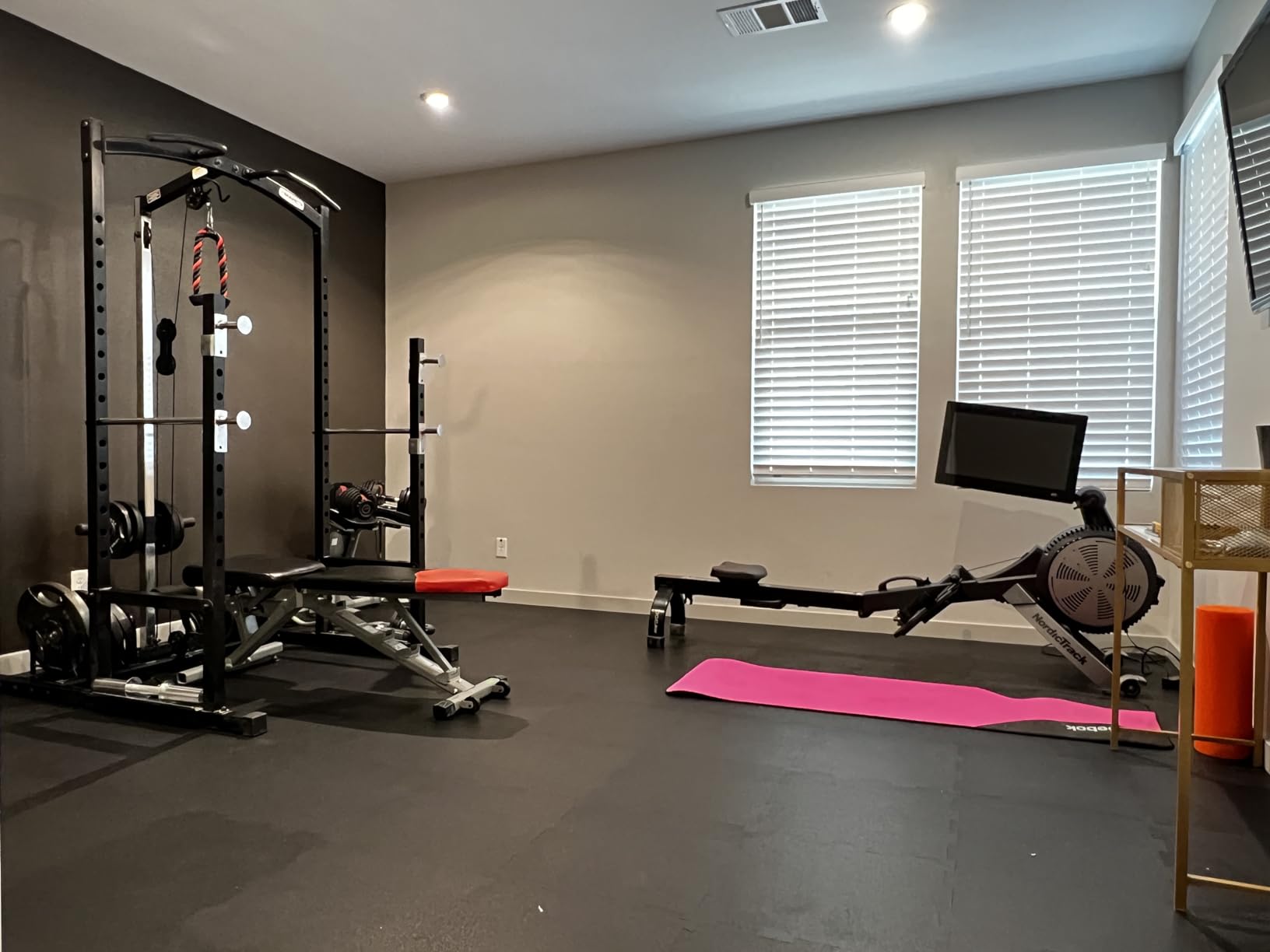
The set is 10 tiles at 19 by 19 inches, covering 23.5 square feet, declared at 6 mm thick. That is on the thinner side for a lifting zone, and it is the honest tradeoff. Six millimeters of recycled rubber will grip well, protect the surface below and absorb some vibration, but it will not give you the joint cushioning of a 3/8 inch tile when you are doing repeated floor work or dropping dumbbells from shoulder height.
What 6 mm does give you is a surface that works for a mixed room. Reviewers use it for free weights, powerlifting and yoga in the same space, and the anti-slip, water-resistant face is stable enough for a bench or a rack on top of it. The five year limited warranty is the longest warranty listed by any product in this guide, which tells you something about how the manufacturer expects it to age.
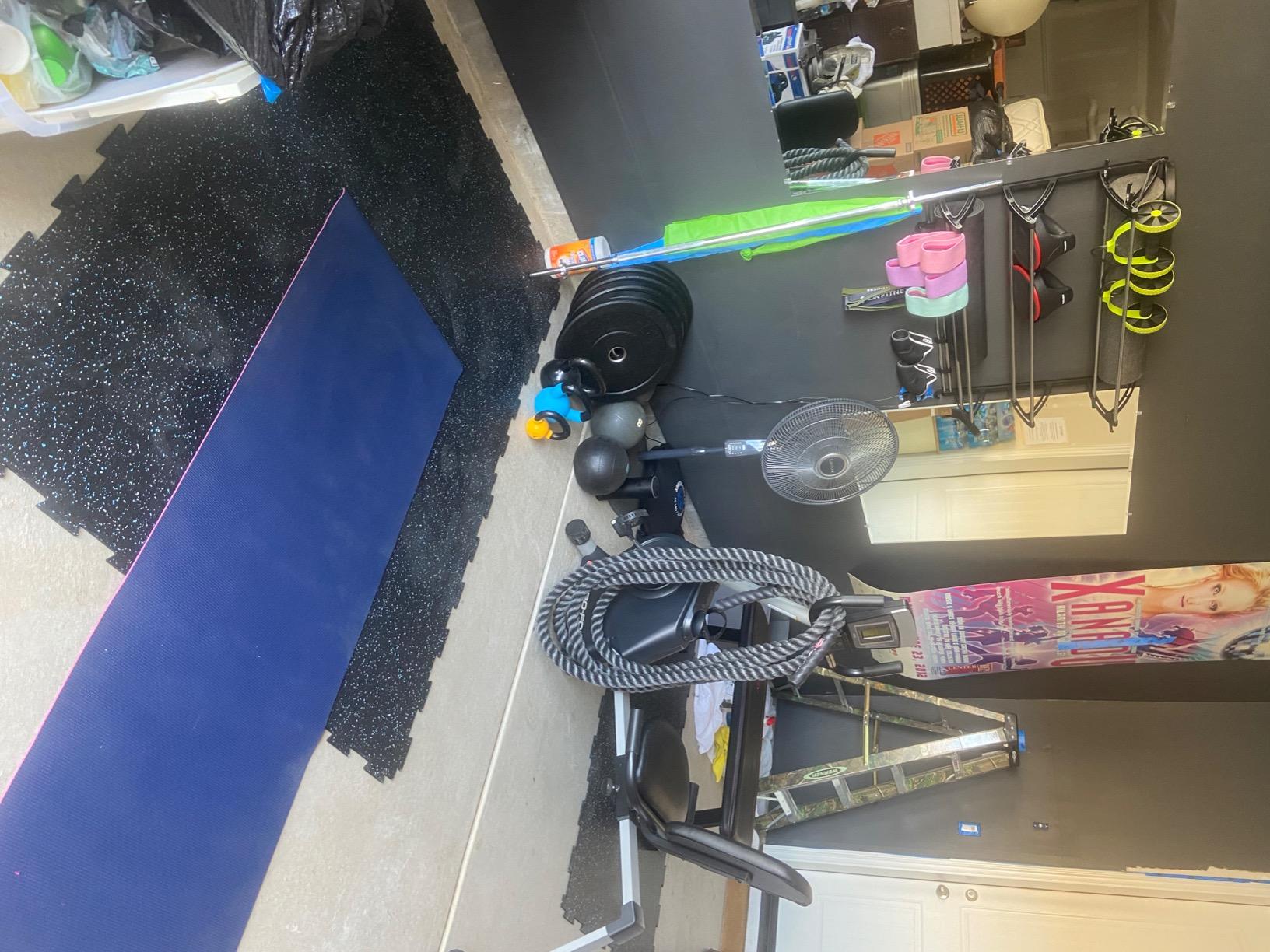
Check your subfloor flatness before you click the first tile
This is the one product in the roundup whose reviews specifically mention edge lift on uneven subfloors, and it is worth taking seriously. A thin puzzle tile has very little vertical stiffness, so any high spot in the slab becomes a point load that levers the interlock. If your floor waves, either grind the high spots down or lay a rigid self-leveling layer first.
Color variation between tiles is also expected with a flecked recycled product and is visible in a finished floor. If you want a uniform look, mix the tiles as you go from several boxes rather than finishing one box at a time, because fleck distribution varies between production runs.
Buy this for a spare room rather than a lifting room
Over carpet, a puzzle tile with these jigsaw edges is workable because the tabs interlock laterally and resist the sideways push of a barbell foot. Combined with the low-odor certification, that makes this the most realistic option here for a spare room or bedroom gym where you cannot glue down and cannot tolerate weeks of rubber smell. Our guide to the home gym systems for small spaces covers the equipment side of that room.
For heavy barbell work, choose the thicker 3/8 inch set instead. You can always cover a thin floor with a mat for cardio, but you cannot retrofit cushioning under a lifting zone without pulling the floor up.
7. Flooring Inc 1/4 Inch Tough Rubber Flooring Roll – Best for a Multi-Use Garage
- Made in USA from premium recycled rubber with a fade-resistant fleck finish
- Trims cleanly around walls
- corners and equipment for a seamless padded surface
- Slip resistance holds under treadmills
- benches and heavy deadlifts
- Moisture resistant and durable enough for horse stalls
- trailers and industrial spaces
- 1/4 inch is thin for a dedicated weightlifting floor
- Multiple rolls in a single room means taped seams to manage
- Some lighter color variants show scuffing faster than black
This roll earns its place on versatility. The same 1/4 inch recycled sheet shows up in home gyms, garages, horse stalls, trailers and industrial storage, which is a fair indicator of how tough the material is. Owners like that it cuts cleanly and lays flat, and the fade-resistant fleck finish means it looks like a floor rather than a tarp after a year of sunlight and scuffing.
The 48 by 120 inch roll is the useful number here. At 40 square feet per length, a 10 by 10 foot lifting zone is three lengths with two seams, which is a manageable seam count and the reason this format suits medium rooms better than one enormous roll you cannot get through a doorway.
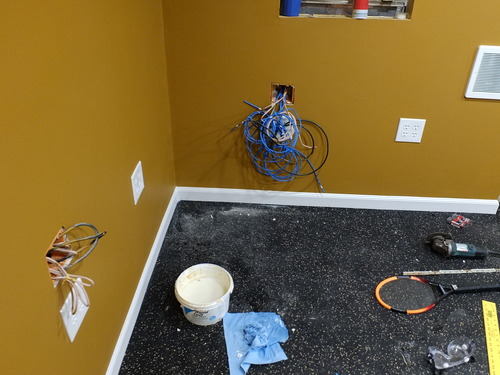
Slip resistance is the feature that matters in a multi-use garage, where the same floor takes a parked bike, a loaded dolly and a barbell drop in the same week. Moisture resistance is the feature that matters if the garage is attached to a house and you occasionally drag water in from the driveway. It is a working floor, not a luxury finish.
The lower end of this product’s 4.3 average comes from two consistent complaints: a quarter inch is thinner than purpose-built gym rubber, and lighter color variants show wear sooner than black. If you are picking color, black hides scuffing and chalk in a way that grey fleck does not, and that matters in a room where you will not be refinishing anything for years.
Plan for taped seams when more than one roll is needed
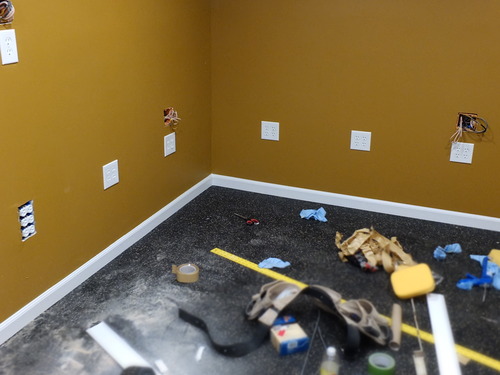
More than one roll in a room means more than one seam, and the reports are clear that a room may need multiple rolls with taped seams. Decide in advance whether you are taping or gluing. Tape is faster and fully removable, which is right for a multi-use garage. Urethane adhesive is right for a lifting zone you will never move.
To cut a clean line, chalk the cut, lay a straight board on top, and score with a fresh blade in several passes rather than one. Pushing too hard on a dull blade compresses the rubber and leaves a wavy edge that will never mate cleanly to the next length.
This is the right pick when the floor has more than one job
Few home gym rooms are purely a gym. If yours doubles as storage, a workshop, a trailer bed or a place you park a second vehicle, a tough 1/4 inch roll earns its place because it takes abuse outside the lifting zone. The narrower thickness is fine there and too thin in a dedicated weight room, so treat this as the multi-use answer rather than the lifting answer.
If the room is small enough that the gym is one corner of it, our picks for the home gym systems for small spaces will help you decide how much floor to cover at all, which is often the cheaper decision.
8. Mohawk Home 1/2 Inch Heavy Duty Rubber Stall Mat – Best for a Lightweight Thick Option
Mohawk Home Heavy Duty Rubber Stall Mat – Gym Floor- Under Dog Crate – All Purpose Utility 2’x3′ – 1/2″ Thick – Solid Texture
- Lighter and easier to handle than true horse stall mats while still cushioning dropped weights
- Very little initial odor and what remains clears within a day
- Dense textured surface that grips well for deadlifts
- Multiple sizes including 2 x 3 ft and 3 x 4 ft plus multi-packs
- Indoor and outdoor rated and hose cleanable
- Some mats arrive with a cracked interior fold from tight rolling during transport
- A minority consider the rubber less dense than true heavy duty stall matting
- The 2 x 3 ft size covers only a limited lifting area
At half an inch and about 13.4 lbs, this mat is the answer to the single most common complaint about stall matting, which is that real horse stall mats are impossible to move. You get genuine 1/2 inch thickness, thicker than any interlocking tile in this guide, at a weight most people can carry into a garage alone. For a home gym that is not a full-time commercial room, that combination is unusually practical.
Buyers report that it lays flat quickly, grips well under deadlifts, and takes dropped barbell loads without damaging concrete. The high and low backing texture is doing real work there: it gives a barbell foot purchase without a lifting strap and resists the sideways creep that a smooth surface allows.
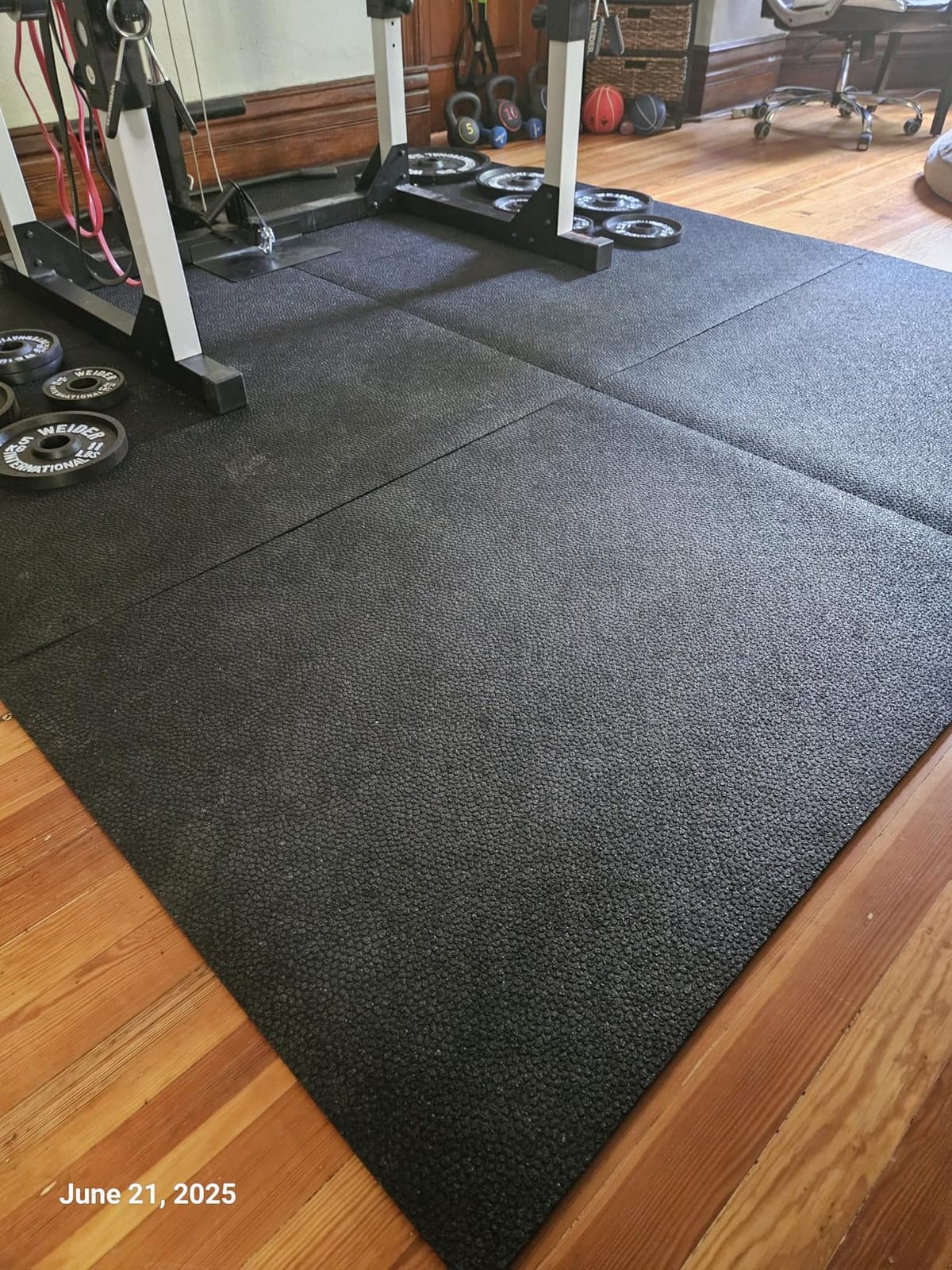
Odor is genuinely low here. Owners describe almost no smell on arrival and what little there is disappearing within a day, which is a meaningful difference from equine stall mats and many recycled sheets. For an enclosed garage with no window, that is worth real money in your decision.
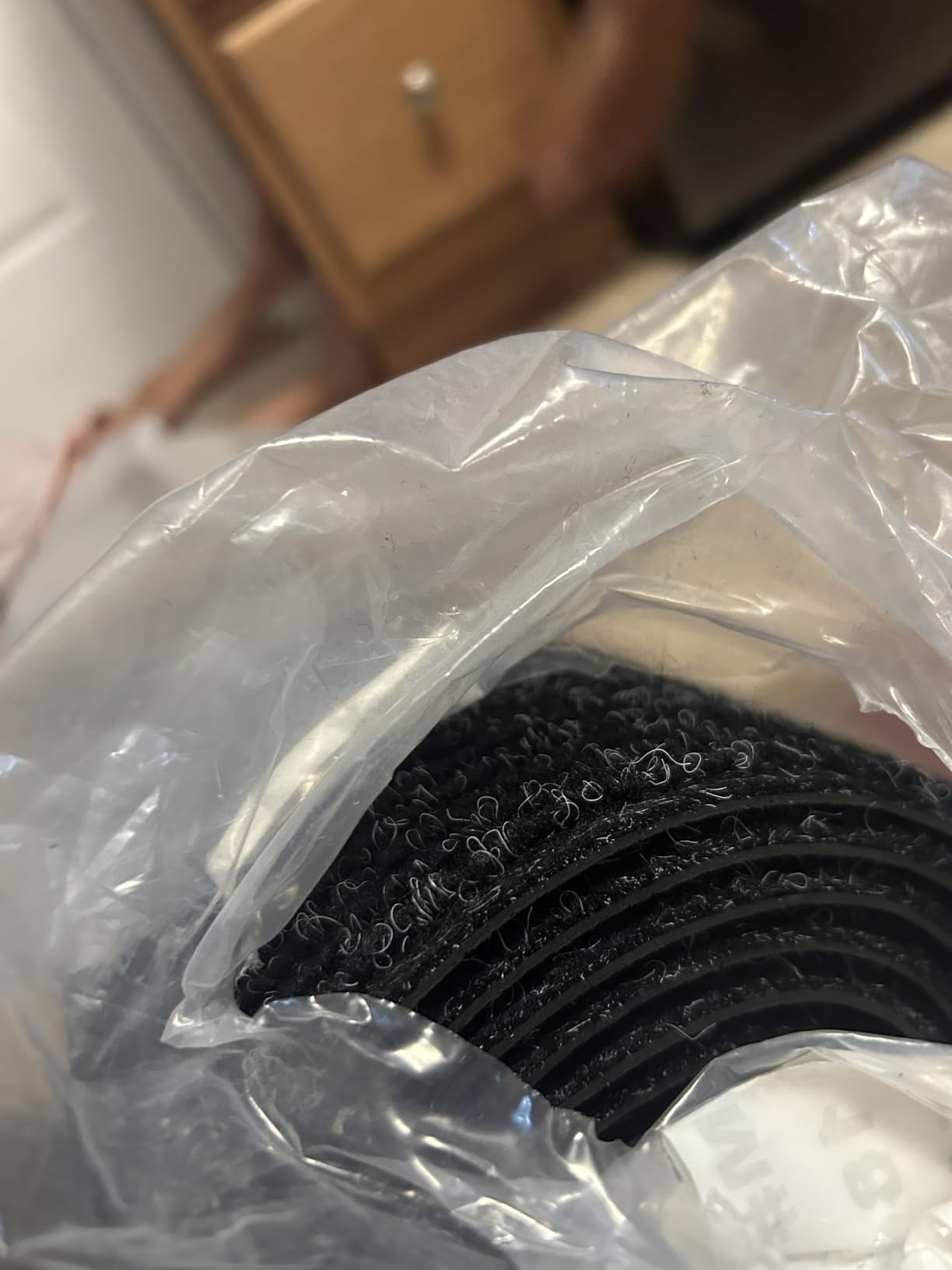
The packaging is the weak point. Several reviews describe units arriving with a cracked interior fold from tight rolling during transport, and a damaged interior crease is hard to return and hard to ignore visually even though the mat still functions. Inspect the mat the day it arrives and photograph any crease before you lay it.
Why this mat suits a light setup rather than a full weight room
Two by three feet is small, which is exactly why these mats are useful. Lay several side by side to define a deadlift platform and you have a zone that takes repeated heavy drops while the rest of your garage stays as workspace or parking. That is a sensible way to protect concrete under a barbell, and it costs a fraction of a full-room install.
The trade is coverage. A full 10 by 10 foot lifting zone at this size needs many mats, and buyers note that the 2 by 3 foot size covers only a limited lifting area. If you want the whole zone covered, the multi-pack and 3 by 4 foot sizes are the versions to shop.
Know the difference between this and a true equine stall mat
A minority of buyers think the rubber is less dense than true heavy duty stall matting, and that reaction is worth taking seriously rather than dismissing. Recycled stall mats are made from material that has to survive hooves, so they are softer, crumbly and heavier. This mat cuts more cleanly, sits lighter in your hands and carries a far weaker smell, at the cost of some deep give.
Pick stall mats if your priority is maximum cushioning per square foot and you will accept the smell, the crumb shedding and the seasonal gap movement. Pick this mat if you want half-inch cushioning you can carry, place with a hose, and can live with in a closed room.
9. Playsafer Genaflex 8mm Rubber Gym Floor Roll – Best Commercial Look for a Studio Feel
Playsafer Genaflex Rubber Gym Floor Mat, Heavy Duty Commercial Protective Gym Flooring Roll – 8mm Thick (Black, 4′ X 4′)
- Commercial fleck appearance that reads as a real gym floor out of the box
- Light recycled rubber that is easy to roll out and reposition
- Non-slip stain-resistant surface that wipes clean after sweat
- Reduces noise and vibration transfer between rooms
- 8mm is thin
- so it dampens impact more than it cushions feet
- Only 16 sq ft per roll in this variant
- so a full gym needs several
Appearance is the differentiator. This roll has the commercial fleck look that makes a garage read as a training space rather than a storage space, and buyers single that out as the first thing they noticed. If your gym doubles as a room other people see, that matters more than it would in a dedicated training space.
It is also light for a rubber roll at about 28 lbs for 16 square feet, and that is not a small thing. Lighter rolls roll out faster, reposition without a second person, and can be taken up and moved when you need the floor for something else. The surface is listed as non-slip, stain-resistant and wipe-clean, which is the correct specification for sweat, chalk and spilled drinks.
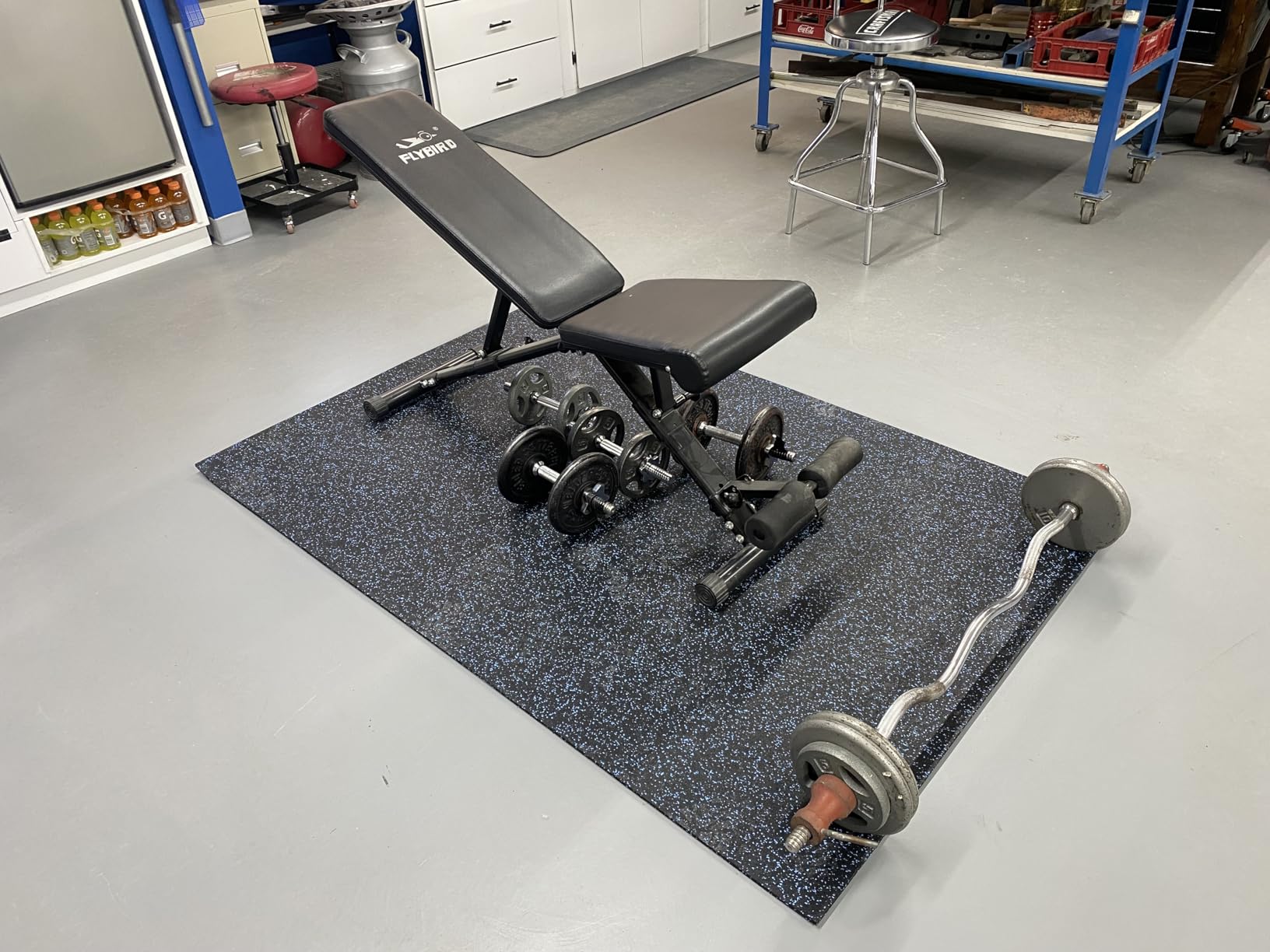
Noise and vibration reduction is the other repeated positive, and it is a genuinely useful feature in a room where you care about what the next room hears. An 8 mm recycled layer between equipment and a subfloor takes the edge off repeated impact transfer, which is the sound that travels through joists rather than through air.
This is also the smallest review base here, at 118 ratings, so treat the consensus more cautiously than the products with a thousand-plus reviews. Buyers point to the thin 8 mm profile as the main limitation, and to the 16 square foot roll size as a practical constraint.
Understand what an 8 mm layer protects and what it does not
Eight millimeters dampens impact far more than it cushions feet. That is the honest one-line summary, and reviewers arrive at it independently. It will protect a subfloor from drips, scuffing and equipment feet, and it will take the sharp edge off noise, but it will not soften a jump or a drop the way a 3/8 inch layer does.
So decide what the floor is for before you buy. Under a rowing machine, a treadmill or a bike in a spare room, 8 mm is enough. Under a lifting zone where weights come down hard, buy thickness. If you want both, this works well as the room-wide layer with a thicker platform zone on top of it.
Plan the order count before you commit to this format
Each roll covers 16 square feet, so a 100 square foot gym needs seven. That is a meaningful number of seams for a dry-lay material, and it is the practical reason this is a better fit for a studio look in a finished room than for a full bare-slab garage gym.
For a garage gym where looks matter less than function, the 3/8 inch roll or tile set will cover more per unit and absorb more per square foot. Buy this one when the appearance of a flecked commercial floor is part of the reason you are building the room.
10. Rubber-Cal Diamond-Plate Rubber Roll 3 mm – Best Budget Protector for Small Zones
Rubber-Cal Diamond-Plate Rubber Flooring Roll – 3 mm x 4 ft x 7 ft Roll – Black
- Diamond-plate texture gives strong grip on wet or slick surfaces
- An affordable way to protect a floor from drips and dropped gear
- Installs quickly with double-sided tape and no specialist tools
- Resists common liquids and limits mold and mildew growth
- Thousands of ratings on a proven design
- 3mm is the thinnest option here and offers almost no cushioning
- Needs adhesive or tape to stay flat
- which is not included
- Edges can curl if not secured
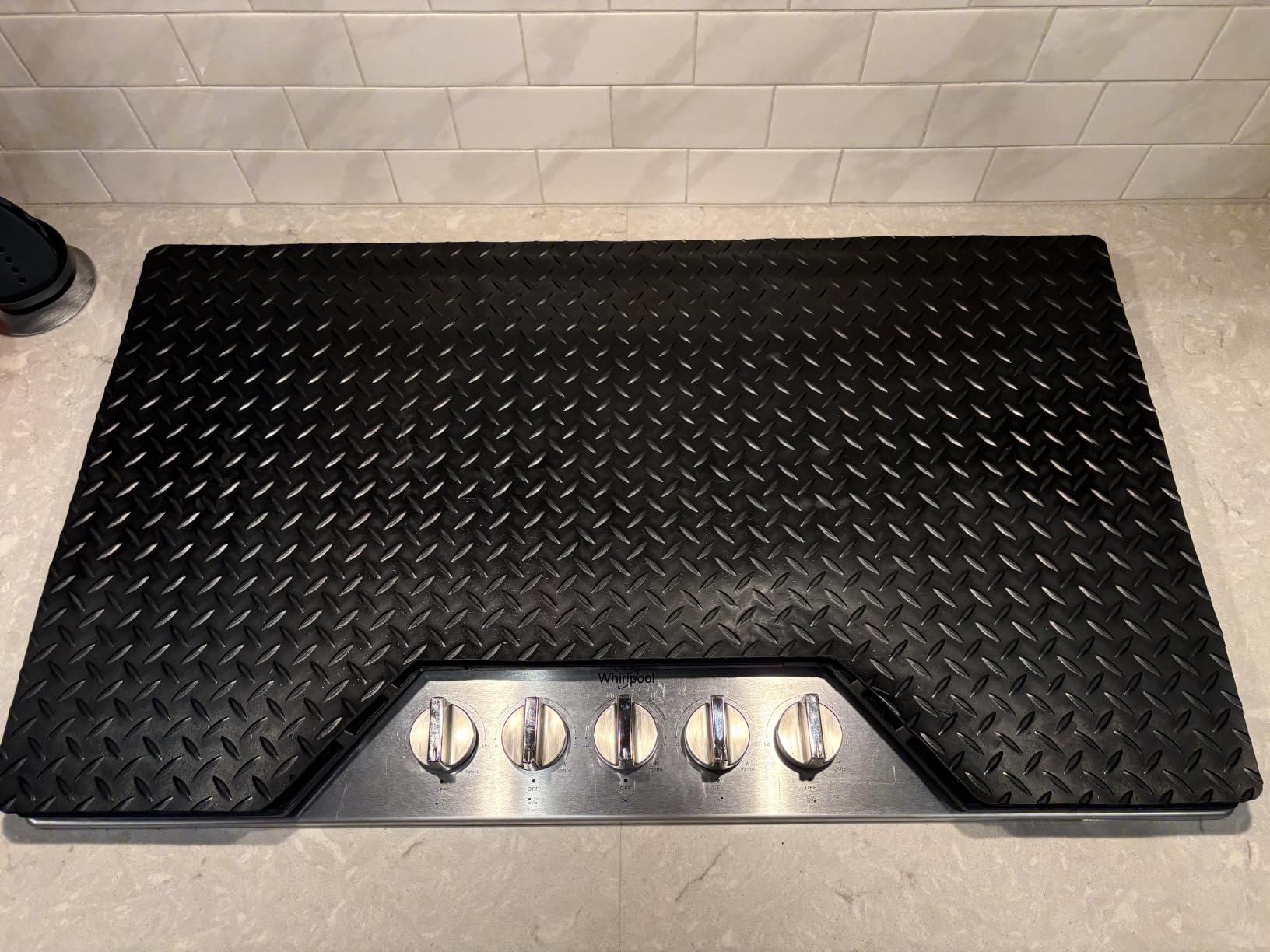
With more than four thousand ratings, this is the most proven product in the guide, and the consensus is unusually consistent about what it is: a dependable budget protector rather than a cushioned training floor. Buyers like the diamond-plate traction, the tape-down install with no specialist tools, and the ability to stop garage or gym floor staining. It resists common liquids and limits mold and mildew growth, which makes it genuinely useful in a damp corner.
Three millimeters is the whole conversation. It protects the surface below and it grips, and it does essentially nothing for shock absorption. Buyers treat it as a runner mat, a treadmill mat, a non-slip utility mat, which is exactly the list of suggested uses the manufacturer gives.
That is not a criticism. The mistake is expecting a lifting floor from it, because at 3 mm a dropped dumbbell reaches the slab with nearly all of its force. Under a treadmill, a bike, a rowing machine or a set of dumbbells that you set down rather than drop, it does a real job.
Two practical notes from reviews. Edges can curl if the material is not secured, so tape or adhere the perimeter and do not leave a corner free. And the adhesive is not included, so factor double-sided tape or urethane adhesive into the job before you start.
Use this under cardio equipment, not under free weights
The suggested use list on this mat includes treadmill mats, non-slip mats and gym mats, and following it is the correct decision. A treadmill or rower is a static load moving in place, which is exactly the situation where a thin protective layer earns its cost. Free weights are dynamic impact loads, which is where 3 mm runs out of material.
If your budget stretches to it, the smart move is to pair a thin protector under cardio equipment with a thicker rubber platform zone under your lifting area. Our picks for the best power racks for home gyms are worth checking on floor footprint before you decide how many square feet of thick rubber you actually need.
Buy this when the real goal is stopping stains and moisture
It resists common liquids and limits mold and mildew growth, which makes it the right answer for a basement corner that stays damp, a garage bay where a car drips in winter, or a spot under an appliance. That is a genuine problem with a cheap fix, and solving it with a 3 mm mat is far more sensible than buying thick flooring that solves a problem you do not have. If your rubber budget also needs to cover a bar top at home, our roundup of rubber bar mats for home bar countertops covers that separately.
Be realistic about permanence though. It is a runner, not a floor, and in a year or two the edges will need attention. If you want something you install once and forget, move up to the 1/4 inch options instead.
What Thickness of Rubber Gym Flooring Do You Need?
3/8 inch, or 8 mm, is the right default for most home gyms. That is the thickness manufacturers design residential rubber flooring around, and it is enough to absorb the impact of dumbbells, kettlebells and moderate barbell drops while staying firm enough for footwork. Go thicker when you regularly drop heavy weight onto the floor or want a genuine deadlift platform, and go thinner only when you need floor and noise protection rather than cushioning.
- 1/4 inch (6 mm) – light cardio, stretching, machine zones, and floor protection over concrete. Handles very light drops. This is the practical minimum for a gym floor.
- 3/8 inch (8 mm) – the most popular home gym choice. Good for general fitness, moderate weights and machine rooms. Our default recommendation.
- 1/2 inch (12 mm) – needed if you regularly drop weights around 100 lb, or run a home CrossFit-style room with lots of floor work.
- 3/4 inch (19 mm) – intense use and dedicated deadlift platform construction. This is where the equine camp and the spec-sheet camp meet.
- 1 inch (25 mm) – heavy olympic lifting and permanent platforms. Rarely a sensible home purchase and very heavy to move.
The confusion most buyers hit is that thickness availability depends on format. Rubber rolls are commonly sold at 1/4 inch and 3/8 inch, and genuine 3/4 inch rolls are rare and extremely heavy, so if you want equine thickness you are working with mats or tiles. Interlocking tiles span the full range from a quarter inch to a full inch. That single fact explains most of the contradictory thickness advice you will read online: the experts are describing rolls, and the budget crowd is describing mats.
Compounding the confusion, the two camps are both right within their own format, and neither is right for your room. The rule that reconciles them is simple. Buy thickness based on the heaviest load you will drop and how often you drop it, not on which camp you trust.
Rubber Tiles vs Rubber Rolls vs Horse Stall Mats
Tiles install fastest and move in modules. Rolls produce the fewest seams and the smoothest continuous surface. Stall mats are the cheapest route to cushioning per square foot, at the cost of smell, weight, crumbling seams and seasonal gap movement. If your priority is appearance and noise control, choose a roll. If your priority is a weekend install without adhesive, choose tiles. If your priority is protecting concrete under a barbell on the least possible spend, choose mats.
- Interlocking tiles – dry-lay, no adhesive, modular replacement, easy to trim. Heavier per square foot and you will see the interlock pattern.
- Rubber rolls – typically 4 ft wide by 25 to 50 ft, cut and usually glue-down. Few seams, marginally better noise and vibration damping, and much harder to move once cut.
- Horse stall mats – recycled rubber equine mats, usually 3/4 inch and 4 x 6 ft. Cheapest cushioning, high odor on arrival, dimensionally inconsistent, crumble into seams, and expand and contract seasonally.
Two failure modes to plan around. Interlocking edges can separate over time, and edges can curl if the subfloor is not level or if extreme weight is repeatedly dropped in the same spot. Rolls are less flexible once cut, so patching is more complicated and moving means starting over. Neither is a dealbreaker; both are reasons to check your subfloor before you buy.
Rubber vs Foam: When Foam Is Genuinely Fine
Foam is the right answer more often than rubber roundups admit. High-density closed-cell foam tiles compress by design and rebound, which is exactly what you want for yoga, stretching, Pilates, core work and light cardio in a spare room. If your entire training footprint is a body on the floor, rubber is overkill on both budget and comfort.
Foam fails in two specific ways. It compresses permanently under static heavy load, so a machine leg or a rack base will bottom it out over time, and interlocking foam edges tear when a loaded barbell walks a seam. It also compresses under body weight while you use it, which is fine for a sit-up and wrong for a heavy deadlift platform.
The other trap is listings described as rubber top with EVA foam. Check whether the product is full-thickness rubber or a thin rubber skin bonded to a foam core. A 3/8 inch product listed as foam-backed may have a fraction of that as actual rubber, and the thickness in the listing will tell you which it is.
Odor, Mold and Basement Gyms
Yes, mold can grow under rubber flooring, and the reason is not a defect in the rubber. Rubber flooring is waterproof, which means it seals the surface. If your slab is damp and you seal it, the moisture underneath stays where it is and gives mold exactly what it needs: a warm, dark, wet surface with no airflow. One community forum ran a formal advisory claiming mold was found in essentially every home gym regardless of mat type, which is an exaggeration in degree but correct in principle.
The fix is not the flooring. Test the slab before you install, run a floor moisture meter or tape a plastic sheet to the concrete and leave it overnight to see if condensation forms. If you get condensation, solve the drainage or the dehumidifier first. Then leave a gap at the room perimeter, avoid running the rubber wall to wall, and pull up a section annually to look. In a basement with a known leak, choose a product rated for damp areas and expect to inspect it.
Odor is the more common complaint and the more manageable one. The strength of the smell on arrival correlates with how recently the product was manufactured, not with quality, so pre-aged material genuinely smells less. A realistic timeline is a few days of airing in a ventilated space for many recycled products, and longer for fresh equine stall mats, where users often report a week or more.
A de-skunking routine that actually helps: unroll the material outdoors or in a garage with the door open, hose it down if the manufacturer permits wet cleaning, leave it in direct sun for a day, then bring it inside. Bunch the material loosely rather than leaving it tightly rolled, because a tight coil traps the smell in the center. If you are buying specifically for a smell-sensitive room, look for a FloorScore certified low-odor product rather than trying to air out the strongest option available.
One more warning that most roundups skip. Anything not adhered to the floor twists under a parked car and eventually tears. If your gym shares a garage with a vehicle, treat every square foot the car can reach as a glue-down zone, and never drive over loose-lay material regardless of how thick it is.
Installation: Dry-Lay vs Glue-Down
Dry-lay is right for interlocking tiles in a dedicated lifting room with nothing rolling across them. It needs no adhesive, no trowel and no buffing, and a single damaged tile can be lifted and replaced. Glue-down is right for rolls in any room a car or a heavy dolly can reach, because loose material shifts under rolling weight. A 3/8 inch roll that has twisted once will never lie flat again, and that is the point where people end up pulling up a whole floor.
Subfloor decides as much as format does. Concrete is ideal: sweep, vacuum, mop with mild detergent, check for high spots, and let it dry fully. Carpet needs a rigid layer or a tile with a stay-lock foot profile, because a flat-bottom tile will rock on a soft surface. Hardwood and tile accept glue-down material well. Tile floors should be checked for movement before you bond to them, since a floating tile that flexes will take the adhesive with it.
Do not underestimate handling. A 4 ft by 25 ft roll at 3/4 inch can weigh more than 150 lbs, and rolls generally run far heavier than the packaged weight suggests once you factor in the whole order. Freight from an East Coast supplier to the West Coast can equal the price of the material itself, which is the single most common reason people abandon rolls. If that is your situation, tiles arrive in far smaller boxes and the total cost to the door is usually lower.
Cutting is straightforward if you do it properly. Chalk the line, rest a straight board on top, and score with a fresh blade in several light passes rather than one heavy one. Cutting a rubber roll in a single pass is how you compress the edge and end up with a seam that never mates. For tight cuts around vents and outlets, take the tile out of the wall and cut it against the opening rather than trying to scribe a shape on the floor.
What Not to Buy
Avoid these five combinations, all of which show up regularly in buyer complaints.
- Foam tiles under a barbell or machine. Foam bottoms out under static load and its interlocking edges tear when a loaded bar walks a seam. Use rubber for anything you drop or anything with steel feet.
- Flat-bottom rubber tiles over carpet. Without feet or a rigid underlayer, the field migrates under load and the interlock works loose. Use a stay-lock profile or put rubber on concrete.
- Any rubber in a room with an unresolved moisture problem. Waterproof flooring seals in damp. Fix the water first.
- Loose-lay material anywhere a car or heavy dolly drives. It twists, then tears. Adhere every square foot a vehicle can reach.
- Rubber-top-with-EVA-foam tiles described by thickness alone. A rubber skin over a foam core gives you a fraction of the stated rubber depth. Check the material breakdown, not just the number.
The pattern across all five is the same: buying a flooring format before deciding what the floor has to do. Answer the dropped-weight question, the parked-car question and the moisture question first, and the product choice usually makes itself.
Frequently Asked Questions
What is the best rubber flooring for a home gym?
The best rubber flooring for a home gym is 3/8 inch (8 mm) rubber installed dry-lay, and the best format for most rooms is an interlocking 24 x 24 inch tile set. Tiles need no adhesive, install in an afternoon and can be replaced one piece at a time. Choose a roll instead if your room is a clean rectangle and you want the fewest seams, and choose 1/2 inch or thicker only if you regularly drop heavy weight onto the floor.
What thickness of rubber gym flooring do I need?
For most home gyms, 1/4 inch (6 mm) is the practical minimum, 3/8 inch (8 mm) is the best general choice, 1/2 inch (12 mm) is right if you regularly drop weights around 100 lb, and 3/4 inch (19 mm) or 1 inch (25 mm) are for dedicated deadlift platforms. Note that thickness availability depends on format: rolls are commonly sold at a quarter inch and 3/8 inch, while interlocking tiles are offered across the full range.
Are rubber tiles or rubber rolls better for a home gym?
Tiles are better if you want a dry-lay install with no adhesive, an easy weekend project and modular replacement. Rolls are better if your room is a clean rectangle and you want the fewest seams, the smoothest continuous surface and marginally better noise and vibration damping. Rolls are much heavier to move and harder to patch once cut, so they suit a permanent room rather than a temporary one.
Can mold grow under rubber flooring?
Yes, but the rubber is not the cause. Rubber flooring is waterproof, so it seals the surface. If the slab beneath is damp, sealing it traps the moisture and creates the warm, dark, wet conditions mold needs. Test the slab before installing by taping a plastic sheet to the concrete overnight and checking for condensation. Fix drainage or add a dehumidifier first, and inspect under the flooring annually.
Can I use horse stall mats for my home gym?
Yes, and they are the cheapest route to thick cushioning per square foot. The trade-offs are significant: strong odor on arrival that can take a week or more to air out, dimensions that vary between mats leaving visible gaps, crumbling that sheds grit into the seams, and seasonal expansion and contraction that opens and closes those gaps. Pick stall mats for a lifting platform zone, and choose composed rubber rolls or tiles for a room you want to live with.
Conclusion: The Best Rubber Gym Flooring for Home Gyms in 2026
Our pick for the best rubber gym flooring for home gyms is the American Floor Mats Fit-Lock 3/8 inch interlocking tile set, because 3/8 inch is the correct default thickness and a dry-lay tile install is the one most people can actually finish. It is dense, it locks under load, and it needs no adhesive and no seam taping.
Match the format to the room and you are done. Clean rectangle and you care how it looks: take the 3/8 inch roll. Whole bay to cover at once: take the 8mm multi-piece kit. Spare room with no ventilation: take the low-odor 6mm tiles. Machines and noise rather than lifting: take a thin 1/4 inch sheet. Barbell platform on the least spend: take half-inch stall mats. Treadmill corner only: take the 3 mm diamond-plate runner.
Whatever you choose, fix the moisture question before you seal the floor, glue down every square foot a vehicle can reach, and measure your seams on paper before you cut. Those three steps separate an install that still looks good in five years from one you are replacing in two.