
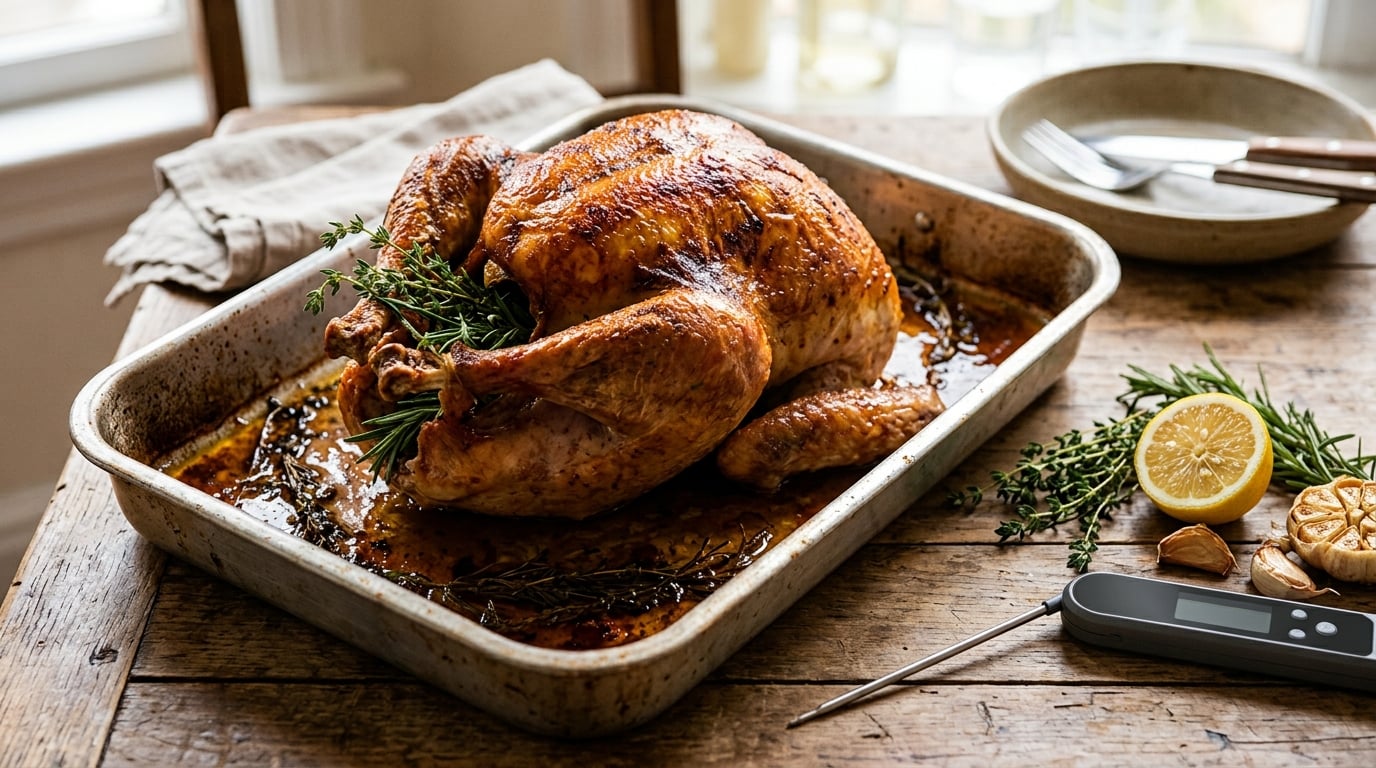
How long to cook a turkey per pound? Plan on 13 minutes per pound for an unstuffed bird and 15 minutes per pound stuffed at 350°F (177°C), then use a thermometer instead of the clock to decide when it is done. The safe internal temperature is 165°F (74°C) in the thickest breast and the innermost thigh, with 20 to 30 minutes of rest before carving.
That formula is a scheduling tool, not a stop signal. Two ovens set to 325°F rarely run identically, and a broad 14-pound bird cooks at a different rate than a tall 14-pound bird. Charts disagree because they assume different things. Use the number to plan the afternoon, then let your thermometer end the debate. Updated for 2026.
Table of Contents
How Long to Cook a Turkey Per Pound
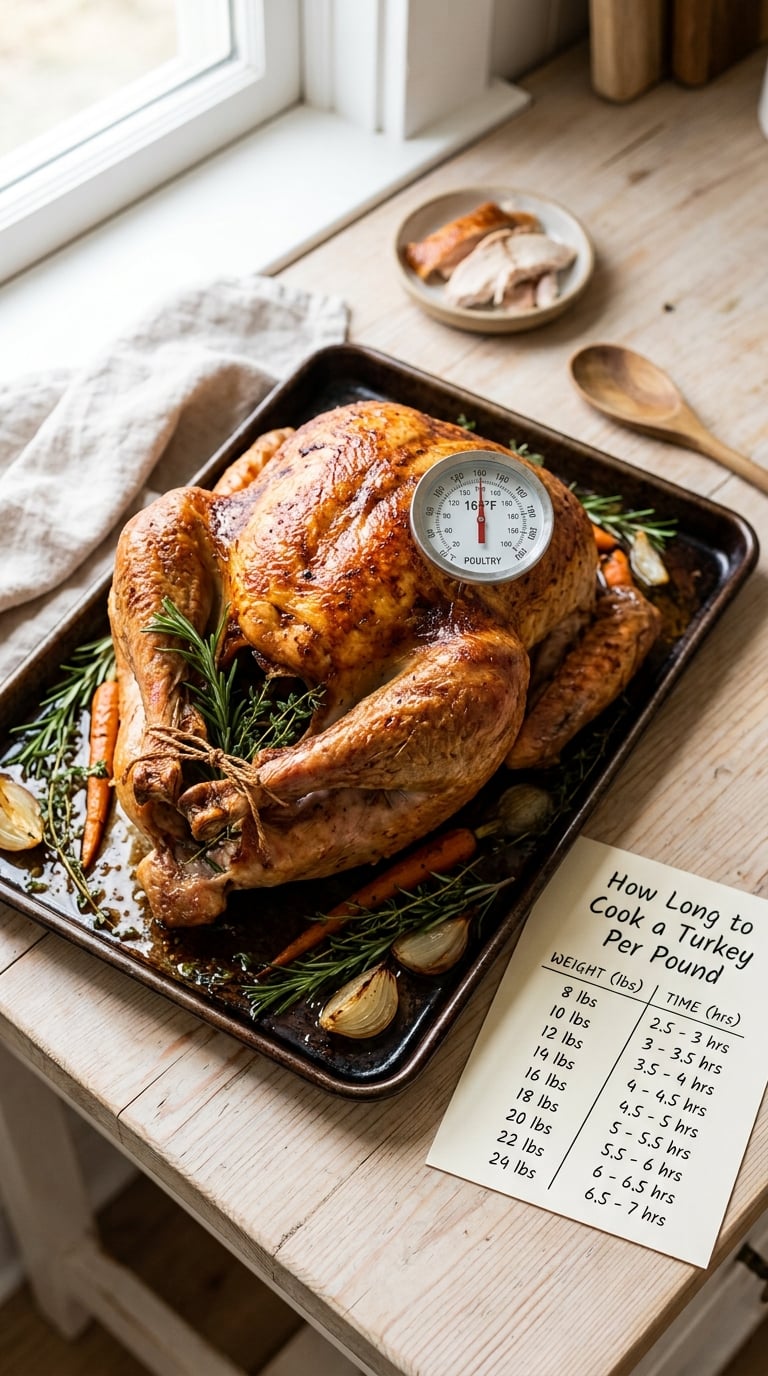
Here is the short version, and the only three rules that matter. Multiply the bird’s weight by the per-pound rate for your oven temperature. Check the temperature early rather than at the very end. Rest the bird before you carve it.
- Unstuffed, 350°F: 13 minutes per pound
- Stuffed, 350°F: 15 minutes per pound
- At 325°F: add 2 to 3 minutes per pound to the 350°F estimate
- At 375°F: subtract 1 to 2 minutes per pound
- At 400°F: subtract roughly 3 minutes per pound, and watch the skin
- Safe internal temperature: 165°F (74°C) in the breast, thigh, and any stuffing
- Rest before carving: 20 to 30 minutes for a small bird, up to 45 minutes for a large one
So a 12-pound unstuffed turkey at 350°F gets roughly 2 hours and 36 minutes. At 325°F, which is the default on most printed charts, add about half an hour and you are looking at just over three hours.
These per-pound rates assume one turkey at a time, a room-temperature bird, an oven that actually holds temperature, and a pan that lets air move around it. A frozen bird, a stuffed bird, or two birds sharing a rack all break those assumptions.
Turkey Cooking Times by Weight
This chart gives whole unstuffed and stuffed birds, with a 165°F (74°C) target in every row. The 325°F column matches the numbers on most grocery-store and butterball-style labels. The 350°F column is tighter and gives you skin color more opportunity to develop.
| Turkey weight | Unstuffed at 325°F | Stuffed at 325°F | Unstuffed at 350°F | Stuffed at 350°F | Target temp |
|---|---|---|---|---|---|
| 8 lb | 2 hrs 45 min | 3 hrs | 2 hrs 30 min | 2 hrs 45 min | 165°F |
| 10 lb | 3 hrs 15 min | 3 hrs 30 min | 2 hrs 45 min | 3 hrs 10 min | 165°F |
| 12 lb | 3 hrs 30 min | 3 hrs 45 min | 3 hrs 15 min | 3 hrs 30 min | 165°F |
| 14 lb | 3 hrs 45 min | 4 hrs | 3 hrs 30 min | 3 hrs 45 min | 165°F |
| 16 lb | 4 hrs 15 min | 4 hrs 30 min | 3 hrs 45 min | 4 hrs | 165°F |
| 18 lb | 4 hrs 30 min | 4 hrs 45 min | 4 hrs 15 min | 4 hrs 20 min | 165°F |
| 20 lb | 4 hrs 45 min | 5 hrs | 4 hrs 30 min | 4 hrs 40 min | 165°F |
| 22 lb | 5 hrs | 5 hrs 15 min | 4 hrs 45 min | 5 hrs | 165°F |
| 24 lb | 5 hrs 15 min | 5 hrs 30 min | 5 hrs | 5 hrs 10 min | 165°F |
For metric kitchens, 35 to 40 minutes per kilogram is the working range. A 5 kg bird lands near 3 hours, a 7 kg bird near 3 hours 45 minutes, and a 9 kg bird near 4 hours 30 minutes at 325°F. Some Australian and UK charts use 40 minutes per kilogram, which is on the generous side and errs toward a drier bird if you actually cook to the full number.
Which Cooking Method Should You Use?
Conventional roasting is the default and the one the chart above covers. A whole bird on a rack in a roasting pan at 325°F or 350°F, basted if you like, is the method the timings were built around.
Breast-only roasting suits a weeknight or a small table. A 2 to 3 pound boneless breast at 350°F takes about 45 minutes to an hour; a 4 to 8 pound bone-in breast runs roughly 1 hour 30 minutes to 3 hours 15 minutes. Smaller birds and roasts heat faster than a whole turkey with the legs acting as a heat sink, so the 13-minute rule overestimates here.
Spatchcocking, or butterflying, flattens the bird so the breast and legs finish at the same time. It cuts cooking time by roughly 25 to 30 percent and solves the dry-breast problem. A 14-pound spatchcocked turkey at 400°F is usually done in about 2 hours.
Slow roasting at 250°F to 275°F gives the breast a fighting chance because everything cooks gently. Plan on 25 to 30 minutes per pound and start checking the temperature an hour earlier than usual, since a cooler oven is easier to overshoot on the low end.
A countertop roaster oven is another good option when you want the main oven free. I pulled a comparison of the best electric roasters for turkey before buying one, and the pattern matched what I would otherwise do by hand: set it to 325°F, set a probe in the thigh, and stop trusting the dial.
How to Calculate Turkey Cooking Time
Turn the chart into a real schedule with these steps. If a step does not apply to your bird, skip it and move on.
- Find your bird’s weight on the label, and decide stuffed or unstuffed. If you will stuff it, use the stuffed column and start from the top of that range.
- Pick the oven temperature. Use the 325°F or 350°F column that matches your oven. Cooking at 400°F is fine, but subtract 3 minutes per pound and start checking early, because the skin colors long before the thighs are done.
- Add 50 percent for a frozen bird. A frozen turkey needs at least half again the thawed cooking time, plus a defrost phase in a cool oven before you turn the heat up.
- Convert cooking time to total time by adding thawing, seasoning, the 20 to 30 minute rest, and about 20 minutes to slice and serve.
- Set a reminder for the last third of the cook time rather than the end. That is when you start checking, not when you start panicking.
- When you are ahead of schedule, take the bird out and let it rest covered. Carryover cooking keeps working, and a turkey held 30 to 60 minutes at 200°F to 225°F loses far less moisture than one that overcooks in the oven.
If you are behind schedule, raise the oven temperature rather than skipping checks. A turkey that is behind at the two-hour mark will not be rescued by cranking the dial to 450°F, and you will scorch the outside before the thighs catch up.
How to Roast a Turkey Safely
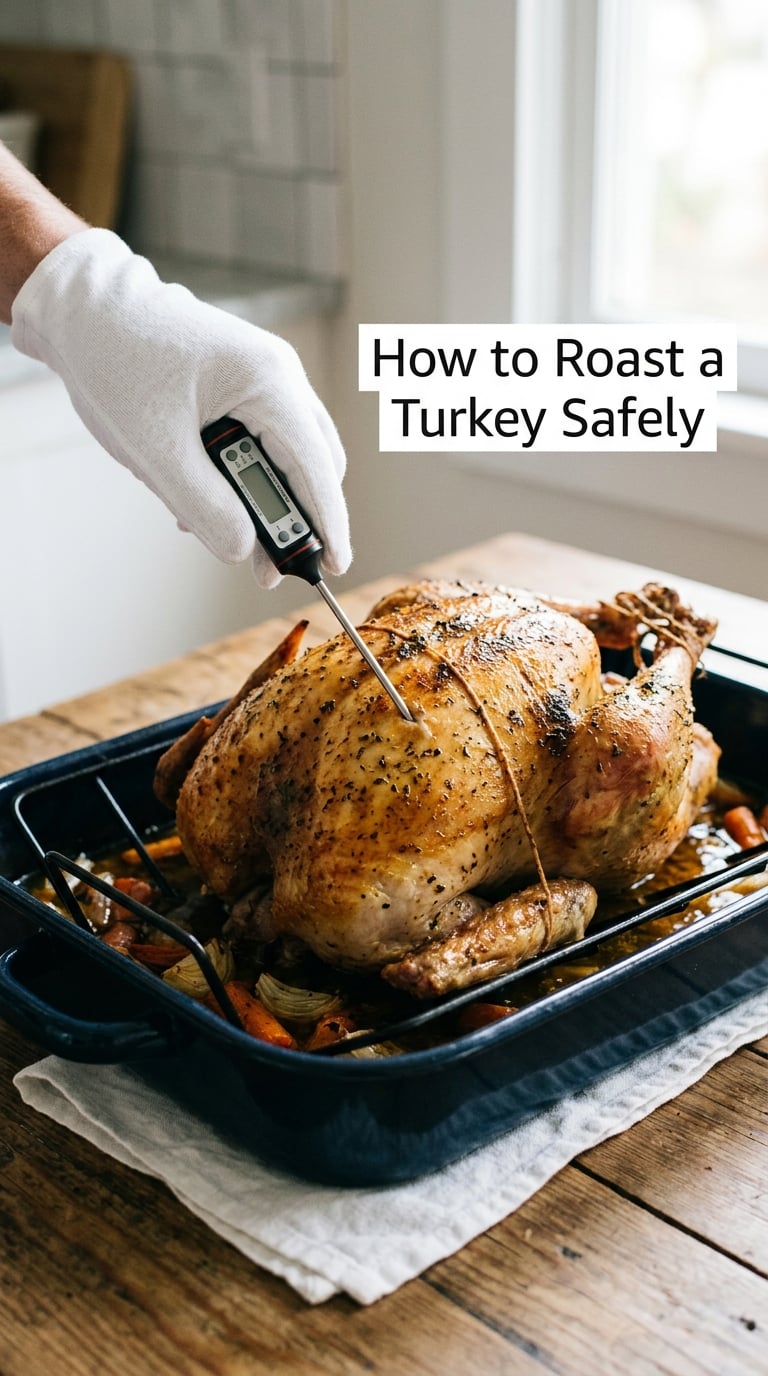
Roasting a turkey safely is mostly a matter of order. Thaw, season, roast, check early, verify, rest. Here is the sequence I use.
- Thaw fully. A turkey cooked from solid takes roughly 50 percent longer, and the outer meat spends that time in the food safety danger zone.
- Remove the giblet package from the cavity. Leaving it in means you cannot season inside, and it adds a little mass to cook through.
- Pat the skin dry with paper towels, then season inside and out with salt, pepper, herbs, and butter under the skin if you like. Dry skin is the single biggest factor in getting it crisp.
- Set the oven to 325°F or 350°F and let it preheat fully. Put the bird on a rack in a roasting pan, breast up, thighs tucked loosely.
- Roast uncovered for the first 20 minutes, then tent loosely with foil if the breast is browning faster than you want. Uncover for the last 30 to 40 minutes so the skin dries out and crisps.
- Start checking temperature during the last third of the estimated time rather than at the very end.
- Verify 165°F (74°C) in the thickest part of the breast and in the innermost thigh and wing, making sure the probe tip does not touch bone. Stuffing must also reach 165°F.
- Rest 20 to 30 minutes before carving, loosely covered. The internal temperature keeps climbing during the rest, and the juices redistribute into the meat.
Adding a cup of water or stock to the roasting pan is optional. It prevents drippings from scorching on the pan, and it gives you drippings for gravy. A little liquid under the bird also slows the cooking slightly, so add it only at the start and keep the amount modest.
How to Thaw a Turkey Without Cooking It
Never thaw a turkey on the counter. The outer meat enters the danger zone long before the center thaws. The safe rule for how long to defrost a turkey is roughly one day in the refrigerator for every 4 to 5 pounds.
Refrigerator: 24 hours per 4 to 5 pounds. A 12-pound bird needs about three days. Put it in a pan or a box to catch drips.
Cold water: 30 minutes per pound in a sealed bag, submerged in cold tap water, changing the water every 30 minutes so it stays cold. A 12-pound turkey needs six hours. Cook it immediately after.
Microwave: 2 to 3 minutes per pound on the defrost setting, for a maximum of about six minutes per pound. Cook the turkey straight away, because microwave thawing starts cooking the edges.
Small frozen turkey breasts thaw in a flash. A 3 pound breast needs about an hour and a half in cold water, or 6 to 9 minutes in a microwave followed by immediate cooking. A breast is also the one turkey cut that is genuinely reasonable to cook from frozen, since the piece is thin enough to finish the job quickly once the edges loosen.
Stuffed vs. Unstuffed Turkey
Stuffing adds roughly 2 minutes per pound on top of the unstuffed time, because the cavity holds heat longer and the bread absorbs moisture. That is why the stuffed column sits higher in the chart. The bigger problem is safety: the center of a stuffed bird is the last thing to reach 165°F, and it is the place food poisoning actually happens.
Cooking stuffing in a separate dish is the safer route and the one I recommend for a first bird. Bake the stuffing alongside the turkey, either in its own casserole or in a loaf pan, and both items are done around the same time. The turkey breast also stays more moist when it is not sharing an oven with a cavity full of bread.
If you do stuff the bird, use a recipe that is already cooked, like a well-seasoned cornbread or sausage dressing. Raw egg and raw poultry fat in stuffing push the center even further behind schedule and add real risk.
How to Tell When a Turkey Is Done
Color is a poor test. A turkey can look deeply browned and still be undercooked near the bone, and pale skin on a brined bird can be fully done. Popping juices and the give of the breast are not much better. Weight is irrelevant once it is in the pan.
A thermometer is the only reliable answer. Push an instant-read thermometer into the thickest part of the breast without touching bone, then into the innermost thigh where the femur meets the body. Both need to hit 165°F (74°C) for food safety. Check a wing too if the bird is large, since that joint runs cool and dries out first.
For a moister bird, pull the turkey at 155°F to 160°F and let carryover cooking finish the job during the rest. The internal temperature will climb on its own as the hot center cooks the surrounding meat. This is the technique that separates a dry bird from a good one, and it is why the rest is not optional.
Plan a generous leftover dinner. I usually have leftover turkey recipes ready to go, and a big bird gives you more of them than any other holiday roast.
Common Turkey Cooking Mistakes
Starting frozen. The fix is to plan the thaw earlier, or use the frozen-bird method: a defrost phase at 200°F to 250°F until the outside loosens, then a cooking phase at 300°F to 325°F, adding about 50 percent to the normal time.
Trusting the chart to the minute. The fix is to check early. Start probing at two-thirds of the estimated time, not at the end, so you know the trend.
Checking only the breast. The thigh is the slowest-donating part of the bird. If the breast is done and the thigh is not, the bird is not done.
Probing into bone. Bone conducts heat and will read high, which is how people take a turkey out early. Slide the probe in from the side and keep the tip in the meat.
Overfilling the roasting pan. A crammed pan blocks airflow and drops the oven temperature. Use a pan that leaves clearance on all sides, and cook one bird at a time.
Skipping the rest. A turkey carved straight out of the oven dumps its juices on the board. Wait 20 to 30 minutes, longer for a big bird.
Stuffing a bird without planning the extra time. Use the stuffed column, push toward the longer end of the range, and confirm the stuffing center hits 165°F (74°C) before pulling anything.
Frequently Asked Questions
How long does a turkey take to cook at 350°F?
At 350°F, plan on 13 minutes per pound for an unstuffed turkey and 15 minutes per pound for a stuffed one. A 12-pound unstuffed bird needs about 3 hours 15 minutes, and a 20-pound bird needs about 4 hours 30 minutes. Treat those numbers as a schedule, not a stop signal. Check the breast and thigh with a thermometer and pull it at 165°F, then rest it 20 to 30 minutes before carving.
Do you need to thaw a turkey before cooking it?
Yes, for the best results. A fully thawed turkey cooks evenly and predictably; a frozen one takes at least 50 percent longer and spends extra time in the danger zone. Allow about 24 hours per 4 to 5 pounds in the refrigerator, 30 minutes per pound in cold water with the water changed every 30 minutes, or 2 to 3 minutes per pound in a microwave. Cook immediately after microwave or cold-water thawing.
Where is the best place to check a turkey’s temperature?
Check two spots. The first is the thickest part of the breast, and the second is the innermost thigh where the femur meets the body without touching bone. Both must reach 165°F (74°C) for food safety, and any stuffing must reach the same temperature. In a large bird, check the wing joint too, since it runs cool and tends to dry out before the rest is done.
Can I cook a stuffed turkey at the same time as an unstuffed turkey?
Only if your oven can handle two birds with air moving around them, which most home ovens cannot. Two birds on the same rack block airflow, drop the oven temperature, and push both birds past the safe temperature zone. A second bird adds roughly the weight-based time of the first. If you need to cook two, spatchcock both and cook them on two racks at 400°F, or cook them on consecutive days.
How long should a cooked turkey rest before carving?
Rest the turkey for 20 to 30 minutes if it weighs under 14 pounds, and 30 to 45 minutes for anything larger. Keep it loosely covered so the skin does not steam. Resting lets the internal temperature climb through carryover cooking and lets the juices settle back into the meat instead of running out onto the cutting board.
How long does cooked turkey last in the refrigerator?
Cooked turkey keeps for 3 to 4 days in the refrigerator at or below 40°F (4°C), whether it is whole, sliced, or shredded. Refrigerate it within two hours of carving. For longer storage, freeze portions in airtight bags or containers for up to three months, and reheat them in the oven or microwave until steaming hot all the way through.
A Juicy Turkey Starts with the Right Plan
Find the weight on the label, pick the 325°F or 350°F column that matches your oven, and use the stuffed or unstuffed time as your schedule. If the bird is frozen, add half again the time and give it a low-temperature defrost phase first.
Then put your trust in the thermometer, not the clock. Check the breast and the innermost thigh at 165°F (74°C), pull the bird a touch early if you want it especially juicy, and rest it 20 to 30 minutes before carving. That sequence is the whole answer to how long to cook a turkey per pound, and it leaves you with leftovers worth turning into a leftover turkey casserole the next day.