
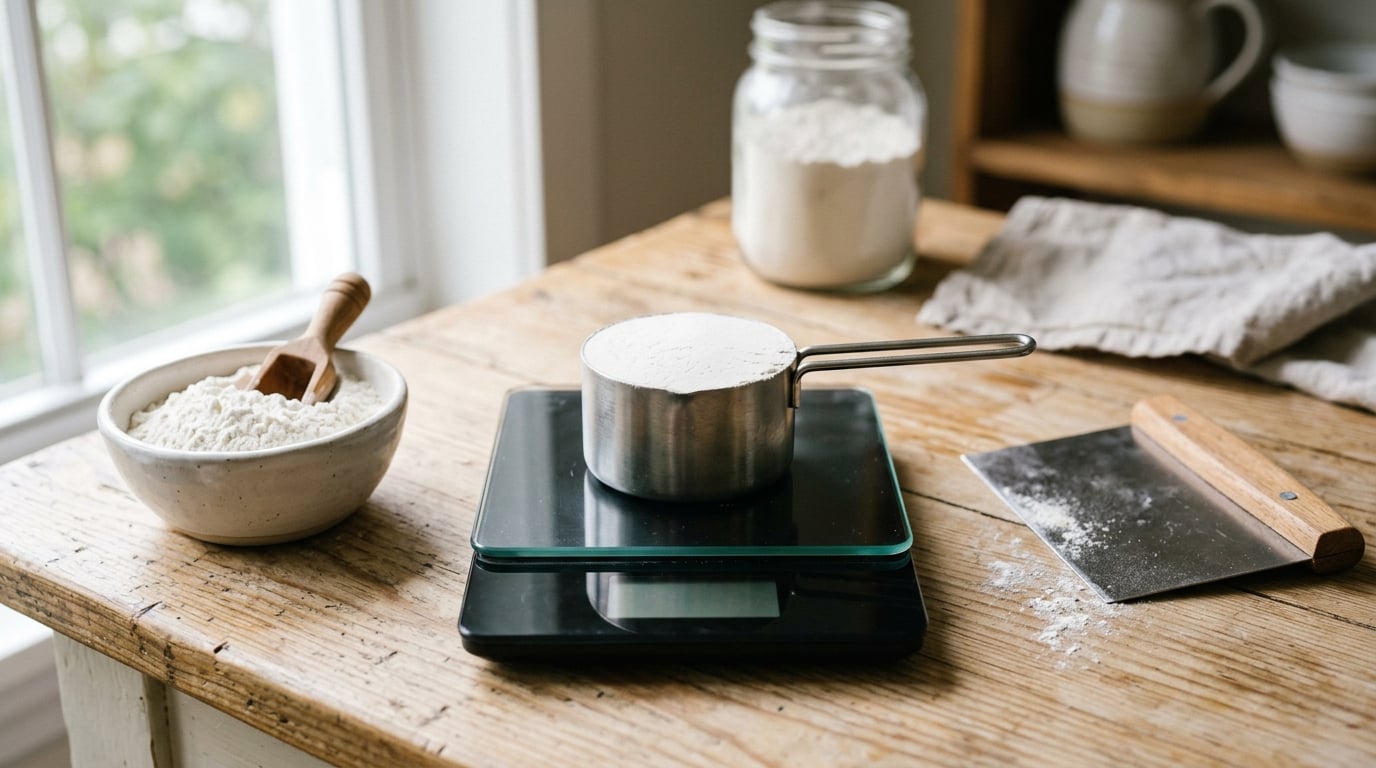
If you only need one number: one US cup of all-purpose flour weighs about 4.25 ounces (120 grams), spooned in and leveled. That is a dry weight, not the 8 fluid ounces a cup holds for liquids. And no, 8 ounces of flour is not 1 cup. It is closer to 1 and 7/8 cups, which is where a lot of dense, heavy bakes come from.
I have bounced between cups and my scale for years, and the honest truth is that both work once you stop switching halfway through a recipe. Pick one system, stay in it, and the flour-to-liquid ratio that baked recipes depend on holds where it should.
This guide covers what a cup of flour actually weighs by flour type, why sources disagree about it, and how to measure it so you get the same number twice.
Table of Contents
How Many Ounces in a Cup of Flour?
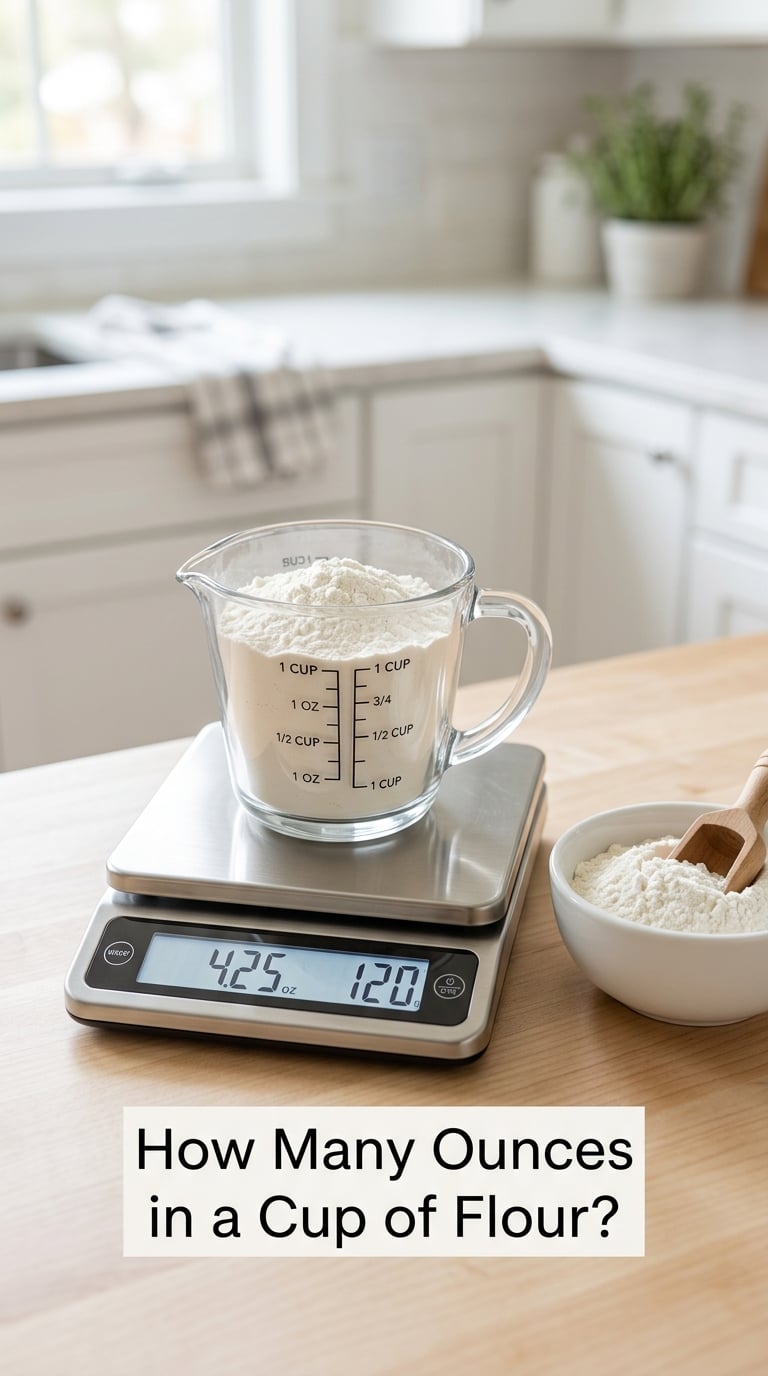
The short answer is 4.25 ounces, which is 120 grams, for one level US cup of all-purpose flour. Bread flour, whole wheat and self-rising all land within a few tenths of an ounce of that. Cake flour, pastry flour and the nut flours sit noticeably lighter.
Here is where the number comes from. One ounce equals 28.3495 grams, and one cup of all-purpose flour is defined by weight charts as 120 grams. So 120 divided by 28.3495 gives 4.233 ounces, which rounds to the 4.25 ounces you see printed on flour charts everywhere. Nothing mysterious: it is a gram figure converted to ounces.
The catch is that a cup is a volume, not a weight. It is a container measurement, and how much flour settles into that container depends on the flour, the weather, and how firmly you packed it. Treat 4.25 ounces as the conversion to reach for, not as a physical law.
Flour Cup-to-Ounce and Gram Conversions at a Glance
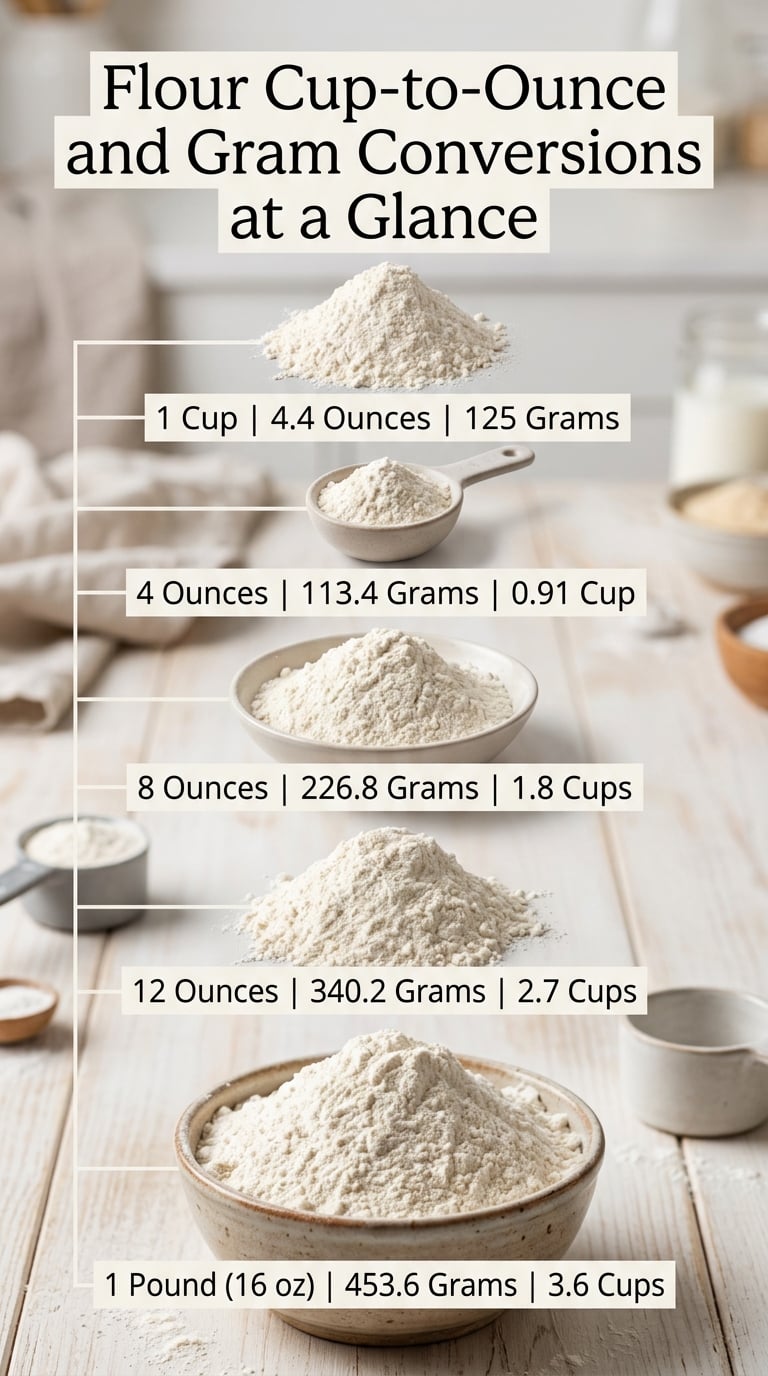
These are the numbers for all-purpose flour, spooned and leveled. I keep a printed copy of this one taped inside a cabinet door, which is the single most useful thing in my kitchen.
| All-purpose flour | Cups | Dry ounces | Grams | Tablespoons |
|---|---|---|---|---|
| 1 tablespoon | 0.0625 | 0.27 | 7.5 | 1 |
| 1/4 cup | 0.25 | 1.06 | 30 | 4 |
| 1/3 cup | 0.33 | 1.42 | 40 | 5.3 |
| 1/2 cup | 0.5 | 2.13 | 60 | 8 |
| 1 cup | 1 | 4.25 | 120 | 16 |
| 2 cups | 2 | 8.5 | 240 | 32 |
| 3 cups | 3 | 12.75 | 360 | 48 |
| 4 cups | 4 | 17 | 480 | 64 |
| 1 pound (16 oz) | 3.75 | 16 | 454 | 60 |
Now the direction most sites skip. If a recipe gives you ounces and all you have is a measuring cup, this is the table to use.
| Dry ounces | Cups of all-purpose flour | Grams |
|---|---|---|
| 1 oz | about 1/4 cup | 28 |
| 2 oz | about 1/2 cup | 57 |
| 4 oz | about 1 cup, minus a spoonful (0.94) | 113 |
| 6 oz | about 1 2/5 cups (1.41) | 170 |
| 8 oz | about 1 7/8 cups (1.88) | 227 |
| 12 oz | about 2 4/5 cups (2.82) | 340 |
| 16 oz (1 lb) | about 3 3/4 cups (3.76) | 454 |
So the two questions the forums keep asking collapse into one line: 8 ounces of flour is roughly 1 and 7/8 cups, never a single cup. A 2-pound bag holds about 7 1/2 cups, and a 5-pound bag about 18 3/4. If you want the working for pounds and cups, I did that one separately in how many cups are in a pound.
Why Flour Weight Changes by Type
Flour is not one substance with one density. The weight per cup shifts with what the mill left in and how the grain was processed.
- Whole wheat and whole-grain flours keep the bran and germ, which are lighter and airier than the endosperm. Despite looking darker and denser, a cup usually weighs slightly more, around 4.5 ounces.
- Bread flour is milled from hard wheat with a higher protein content and is finely ground, so it packs tight: roughly 4.5 ounces per cup.
- Cake flour is milled from soft wheat and often treated with a small amount of starch. Expect about 4 ounces.
- Pastry flour goes lighter still, near 3.75 ounces, because the extra starch keeps it from developing gluten.
- Almond, coconut and oat flours are not wheat at all. They are light and often clumpy, around 3 ounces per cup, and they cannot be substituted cup for cup.
If you want a table to print, the one below covers everything most home bakers keep on hand.
| Flour type | Grams per cup | Ounces per cup | Cups in a 1 lb bag |
|---|---|---|---|
| All-purpose | 120 g | 4.25 | 3.75 |
| Self-rising | 120 g | 4.25 | 3.75 |
| Bread | 127 g | 4.5 | 3.55 |
| Whole wheat | 128 g | 4.5 | 3.55 |
| Gluten-free all-purpose blend | 128 g | 4.5 | 3.55 |
| Cake | 113 g | 4 | 4 |
| Coconut | 113 g | 4 | 4 |
| Pastry | 106 g | 3.75 | 4.25 |
| Almond | 85 g | 3 | 5.3 |
| Oat | 85 g | 3 | 5.3 |
How to Measure Flour Accurately
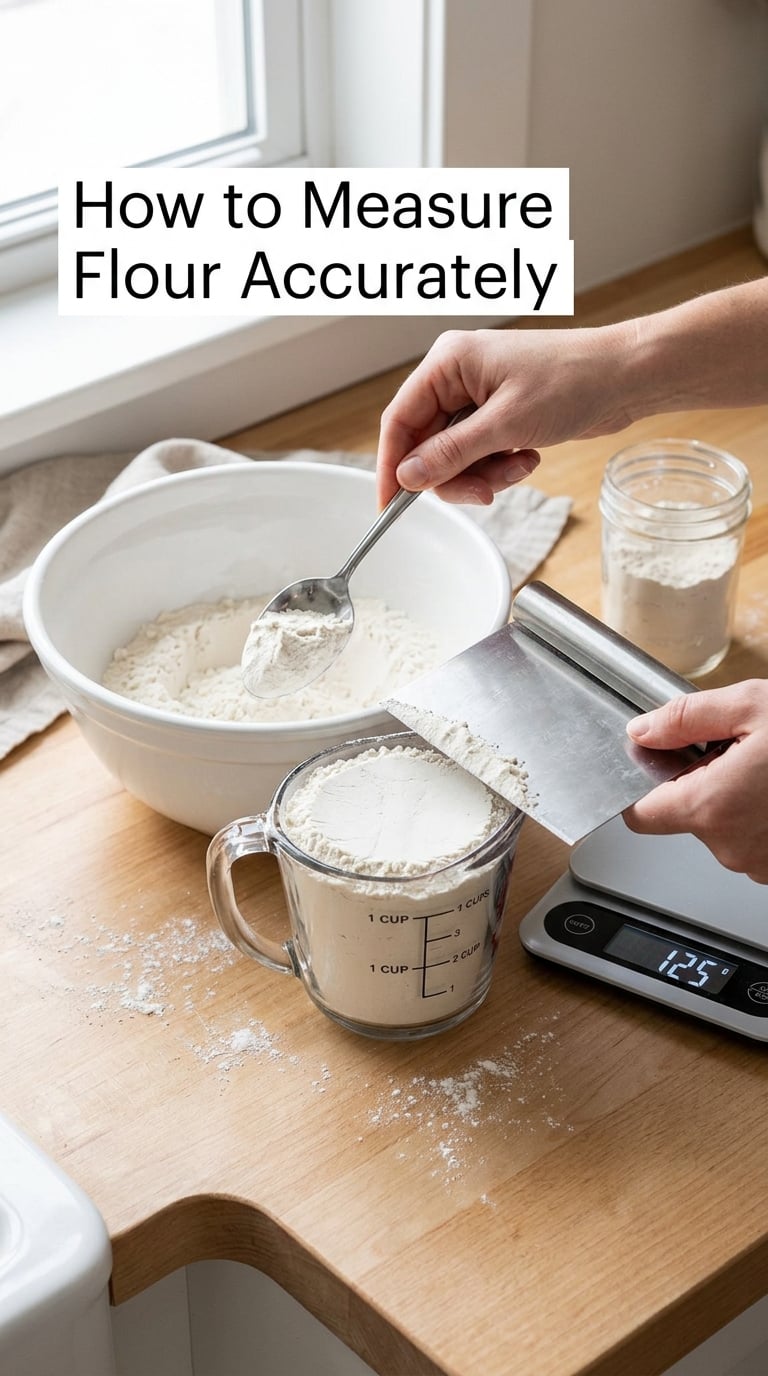
Measuring by weight takes three steps and removes the guesswork entirely. It is the only method I trust for bread dough, and once you own a cheap scale it is also the fastest.
- Put the scale on a hard, level surface and turn it on. A scale on a soft towel or a sloping counter reads high or low every time.
- Zero the bowl you are weighing into, if you are not weighing straight onto the scale. This is the step people skip, and it is why their weight is short by the bowl’s own weight.
- Add flour in small amounts until you hit the number, holding the bowl close to your face so you are looking straight down at the display rather than at an angle.
Measuring with cups takes a little more care, and the method that works is called spoon and sweep.
- Use a dry measuring cup for flour, never a liquid one. A dry cup is wider and shorter, with a rim high enough that flour does not mound above it.
- Spoon the flour in rather than dipping the cup into the bag. Scooping drops in a packed cup, and packed flour is the single biggest reason a home cup measurement runs heavy.
- Level the top with the back of a knife or a straight-edge scraper, sweeping from one side to the other in one motion.
- Do not press, tap, or compact the flour after leveling, and lift the cup gently. A thump on the counter settles flour and adds weight to the same volume.
- Whisk or sift first if the flour has been sitting and packed down in the bag, or if the recipe calls for sifted flour.
One note on tools: any dry measuring cup in the 1-cup to 2-cup range works. The volume matters far more than the brand or the material, and I keep a cheap one in a flour tin like these stackable canisters so the flour is decanted and loose when I scoop.
US Cups, Fluid Ounces, and Weight Ounces Are Not the Same
Here is the part that trips up almost everyone new to baking. A US cup holds 8 fluid ounces, or 240 mL, because it is a measure of space. An ounce of flour is a measure of weight, and flour is light enough that 240 mL of it does not weigh 8 ounces. It weighs about 4.25.
That gap is why treating flour like a liquid ruins a recipe. Pouring in 8 ounces when the recipe wants 1 cup nearly doubles the flour, and the dough or batter goes tight, dense and dry in the oven.
The bridge most recipes actually use is the tablespoon. One cup of flour is 16 tablespoons, so 1 tablespoon is about 0.27 ounces, 1/4 cup is 4 tablespoons or about 1.06 ounces, and a half cup is 8 tablespoons or about 2.13 ounces.
Metric cooks should also know that a metric cup is 250 mL, not 240. Fill a 250 mL metric cup with all-purpose flour and you get closer to 125 grams, or about 4.4 ounces. Small difference, enough to matter in a lean bread dough.
And 250 grams is not 1 cup. At 120 grams per cup, 250 grams is a little over 2 cups, so a British recipe calling for 250 g of flour is asking for roughly twice what a US recipe means by a cup.
Why Every Site Gives a Different Number
If you search this question you will find 4.25 ounces, 4.4 ounces, 4.5 ounces, 5 ounces and even 5.2 ounces. Nobody is hallucinating. They all measured a cup, and they all measured it differently.
The big split is between two techniques. Dip and sweep fills the cup by scooping and knocking the excess off with your hand or a knife. Spoon and sweep builds the cup up with a spoon, which leaves the flour looser and lighter. Averaged across a room full of people, those two methods produce genuinely different numbers, because every person in the experiment is a variable.
That reasoning is exactly what the Milk Street test kitchen gave when it settled on 130 grams per cup, about 4.5 ounces, for consistency across its recipes, and called Cook’s Illustrated’s 5 ounce figure a bit of an outlier in its own testing. A Milk Street forum thread on the question is worth reading if the disagreement bothers you, because it lays out the method rather than just the result.
The rest of the spread comes down to flour brand, humidity and how long the flour sat. King Arthur Baking’s ingredient weight chart, the reference most bakers recognize, lists all-purpose at 120 grams or 4 1/4 ounces. Life Out of Bounds lists 5.2 ounces, which you can reproduce easily by dipping a heaping cup and pressing it down.
My rule: use 4.25 ounces or 120 grams for a cup of all-purpose flour, and know that any recipe measured by cup is carrying a tolerance of about 10 percent anyway.
Common Flour Measuring Mistakes and How to Fix Them
- Scooping and packing the cup. A dipped, tapped cup can hold 15 to 20 percent more flour than a spooned one. Fix: spoon it in, and level with a knife.
- Leaving air pockets. Under-filling by a spoonful throws the ratio the other way. Fix: use a second spoon to level, and check the cup from the side.
- Using a liquid measuring cup for flour. The narrow shape holds about a third less, and the reading at the top is for fluid ounces. Fix: dry cup, or a scale.
- Confusing weight ounces with fluid ounces. Treating 1 cup as 8 ounces nearly doubles your flour. Fix: a cup of all-purpose flour is 4.25 ounces, full stop.
- Weighing above the bowl. Flour left on the scale or on the counter is flour that never made it in. Fix: weigh over the bowl, and use the tare button.
- Not leveling the cup. A rounded or mounded top adds roughly 10 grams. Fix: one straight sweep with a bench scraper or knife back.
One more that is not a technique problem: switching systems mid-recipe. Half the weight method, half the cup method, and the ratios no longer mean anything. Finish a recipe the way you started it.
Frequently Asked Questions
How many ounces of flour are in one US measuring cup?
One US cup of all-purpose flour weighs about 4.25 ounces, which is 120 grams, when it is spooned into the cup and leveled off. Bread flour and whole wheat flour are slightly heavier at around 4.5 ounces, while cake flour is lighter at about 4 ounces.
How many grams are in one cup of all-purpose flour?
One US cup of all-purpose flour is 120 grams. That figure is the basis for most published weight charts, and it converts to 4.25 ounces using the standard 28.3495 grams per ounce. If you want 250 grams, that is a little over 2 cups, not a single cup.
Should flour be packed or lightly filled when measuring by cup?
Spoon the flour in and level it off, never press or pack it. A dipped and tapped cup can hold 15 to 20 percent more flour than a spooned cup, and that difference is enough to make cookies spread and bread dough tight.
Are fluid ounces and weight ounces the same for flour?
No. A US cup holds 8 fluid ounces by volume, but flour packed into that same cup weighs only about 4.25 ounces. Fluid ounces measure space, weight ounces measure mass, and for a light dry ingredient like flour the two numbers are far apart.
Is weighing flour more accurate than measuring it with a cup?
Yes. A digital scale removes packing, air pockets and leveling as variables, so the same recipe gives the same result every time. Most bakers use cups because a recipe was written that way, and that is fine, as long as you stay consistent within a single recipe.
The Best Flour Measurement for Reliable Baking
Use 120 grams, or 4.25 ounces, as the standard conversion for one US cup of all-purpose flour. That is the figure most weight charts agree on, and it is the one to write at the top of your own conversion card.
When accuracy matters, weigh it. Sourdough, laminated pastry and anything where the ratio is the recipe will tell you immediately that 4.25 ounces was right. And if you like working with fresh whole grain, the hand grain mills I rounded up are worth a look, since home-milled flour is denser and shifts the per-cup weight a little.