
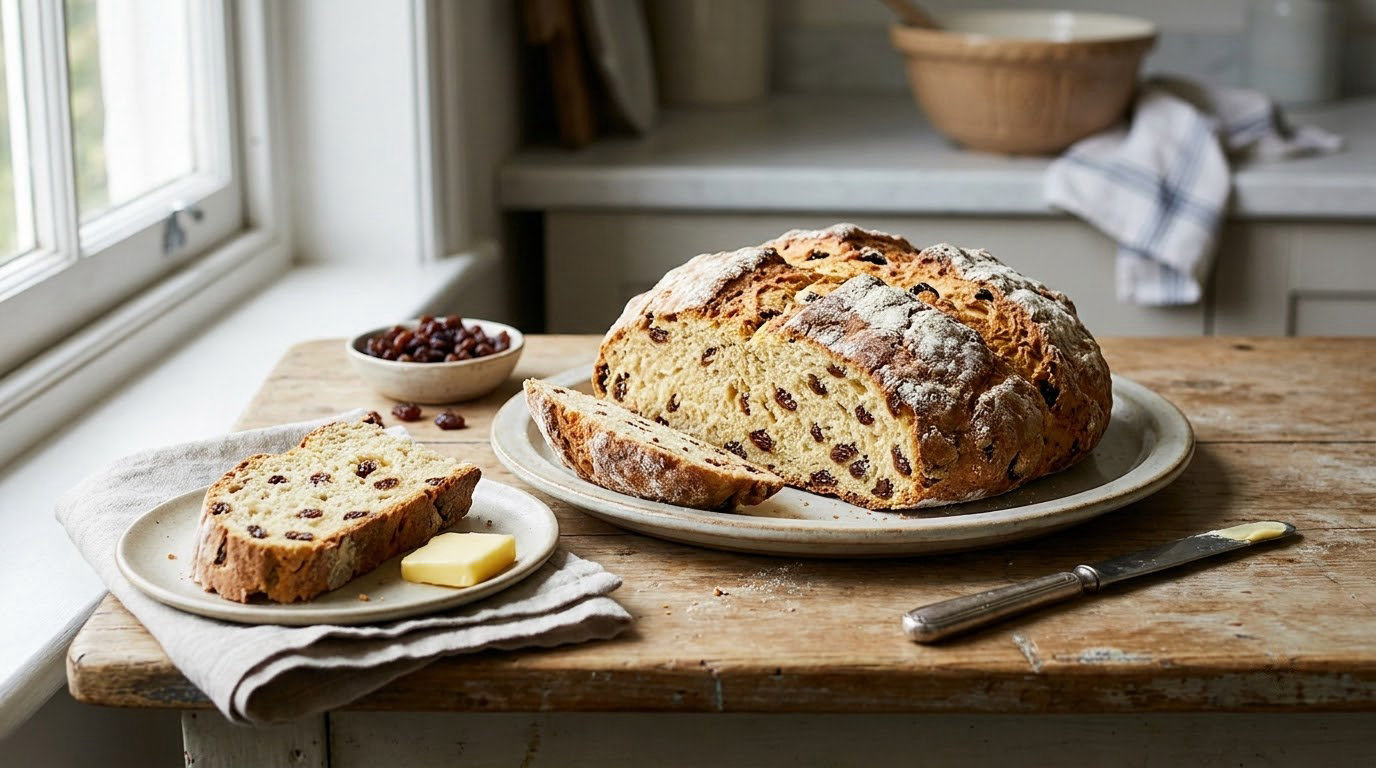
Irish soda bread with raisins is the loaf I make when I want a warm, buttery bread on the table in under an hour, with no yeast and no kneading. It uses simple pantry staples, comes together in one bowl, and bakes into a round loaf with a crackly golden crust and a tender, sliceable crumb dotted with plump raisins.
My version leans slightly sweet and includes an egg and a little butter, which puts it in the American home-baking camp rather than the spartan four-ingredient loaf from rural Ireland. Either way, the chemistry is the same: cold buttermilk reacts with baking soda the moment it meets the flour, and the loaf rises in the oven instead of on the counter. If you have ten minutes to stir and forty to bake, you can have this on the cooling rack before lunch.
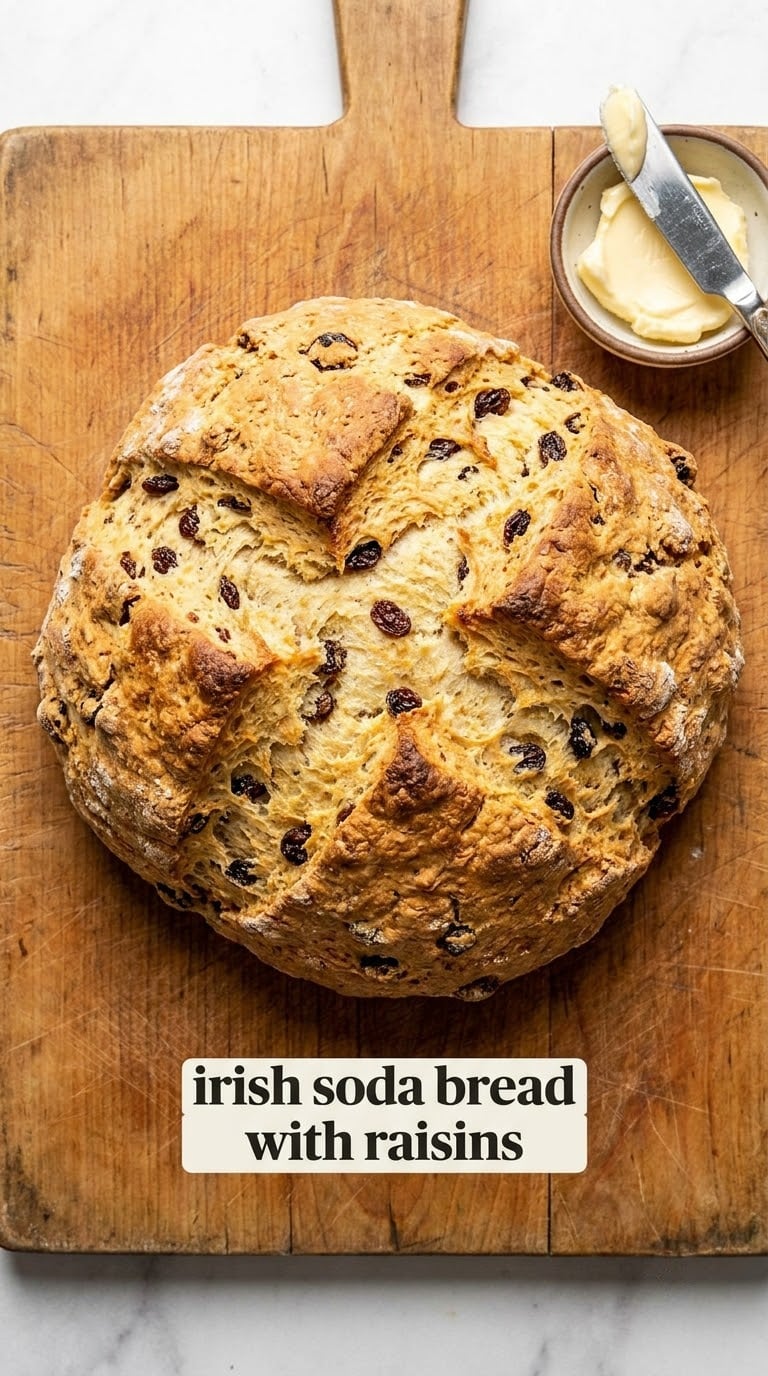
Table of Contents
Why This Irish Soda Bread With Raisins Works
- The buttermilk and baking soda give a quick, even rise without yeast or proofing, so the bread bakes in one shot from stirred dough to finished loaf.
- Cold butter cut into the flour creates tiny pockets that melt in the oven, giving you a soft, sliceable crumb under a crusty, golden top.
- There is no kneading. You stir just until a shaggy dough forms, which keeps the crumb tender instead of tough.
- Plump raisins get tossed in flour before mixing, so they stay evenly suspended through the dough rather than sinking to the bottom.
- A deep cross scored on top lets heat reach the center, so the middle bakes through at the same time the crust turns brown.
Ingredients for Irish Soda Bread With Raisins
- 4 cups (480 g) all-purpose flour, plus more for dusting
- 1/3 cup (65 g) granulated sugar
- 1 teaspoon salt
- 1 teaspoon baking soda
- 2 teaspoons baking powder
- 4 tablespoons (56 g) cold unsalted butter, cut into small pieces
- 1 cup (150 g) raisins (dark or golden both work)
- 1 large egg
- 1 3/4 cups (420 ml) cold buttermilk, plus 1 tablespoon for brushing
- 2 tablespoons melted butter, for brushing the top
The flour gives structure, and the small amount of sugar feeds the raisins and helps the crust brown. Baking soda reacts with the buttermilk for the lift, while the baking powder adds a little extra insurance so the loaf rises evenly in a home oven. If you do not have buttermilk, stir 1 tablespoon of white vinegar or lemon juice into 1 3/4 cups of whole milk and let it sit for five minutes before using. Swap the raisins for dried cranberries if you like a little tartness, or use half raisins and half golden raisins for a prettier loaf.
Equipment
You will need a 9-inch (23 cm) round cake pan, a cast-iron skillet, or a Dutch oven. A large mixing bowl, a pastry cutter or two forks, and a pastry brush for the butter wash round it out. If you bake often, a bench scraper makes clean-up faster, but a large knife works fine.
How to Make Irish Soda Bread With Raisins
- Preheat the oven to 375°F (190°C). Grease a 9-inch round cake pan or a 10-inch cast-iron skillet with a thin layer of butter, then dust with flour. For a Dutch oven, preheat it empty while the oven heats.
- In a large bowl, whisk the flour, sugar, salt, baking soda, and baking powder until evenly combined. Getting the leavening evenly distributed is what gives a uniform rise.
- Cut the cold butter into the dry ingredients with a pastry cutter or your fingers until the mixture looks like coarse crumbs with a few pea-sized pieces of butter still visible. Cold pieces are what create the flaky, tender crumb.
- Toss the raisins with a teaspoon of flour in a small bowl, then stir them into the flour mixture so they are evenly coated. The flour coating keeps them suspended in the dough instead of sinking to the bottom.
- In a separate cup, whisk the egg into the cold buttermilk. Pour the wet mixture into the dry ingredients and stir with a wooden spoon just until a shaggy, slightly sticky dough forms. Stop the moment the flour disappears; overmixing makes a tough loaf.
- Turn the dough onto a lightly floured surface, pat it into a round about 7 inches across and 2 inches tall, and transfer it to the prepared pan. Use a sharp knife to score a deep X across the top, going at least halfway down into the loaf. The X is not just for looks; it lets heat reach the center.
- Bake for 40 to 50 minutes, until the crust is deep golden and a tester inserted into the center comes out clean. The loaf should sound hollow when you tap the bottom. If you use an instant-read thermometer, the center should read 200°F (93°C). If you are curious about the science behind that number, our What Temperature to Bake Bread At guide walks through it.
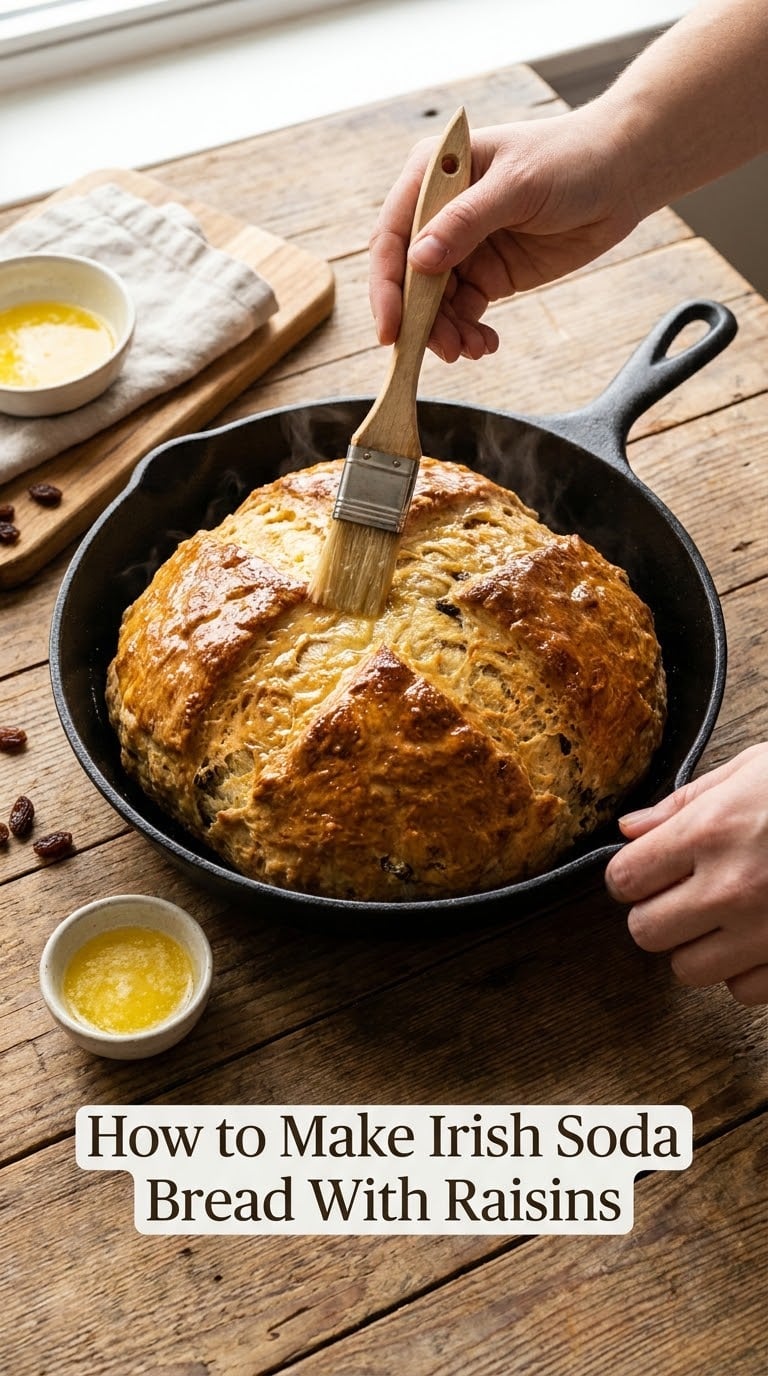
- Brush the hot loaf with the melted butter as soon as it comes out of the oven, then let it cool in the pan for 10 minutes before turning it onto a wire rack. Cooling briefly in the pan lets the crumb set so slices hold together.
Tips for Success
- Keep the butter and buttermilk cold. Warm ingredients melt the butter into the flour before the oven, which gives a cakier, denser texture instead of a tender crumb.
- Do not overmix once the buttermilk goes in. Stir only until you no longer see dry flour; a few streaks are fine.
- Soak the raisins in hot water for 10 minutes, then drain and pat dry before folding them in. They plump up and stay juicy in the finished loaf instead of turning leathery.
- Score deeply. A shallow score leaves a thick, gummy center; the X should sink at least halfway into the loaf.
- Trust the tap test. When the loaf sounds hollow, it is done. If it feels heavy or quiet, give it another 5 minutes.
- For a convection oven, drop the temperature to 350°F (175°C) and start checking for doneness 5 minutes early; the fan browns the crust faster.
Variations
- Orange and currants: add the zest of one orange to the dry ingredients and swap the raisins for currants. The orange oil perfumes the crust.
- Cinnamon sugar: add 1 1/2 teaspoons of ground cinnamon to the dry mix and increase the sugar to 1/2 cup for a cozier, almost coffee-cake flavor.
- Brown butter: brown the butter first, chill it back to solid, then cut it in. You get a deeper, toffee-like note without changing the method.
- Gluten-free: substitute a 1:1 gluten-free flour blend that contains xanthan gum, and add an extra tablespoon of buttermilk. The loaf will be a touch more delicate but still sliceable.
- Smaller loaf: shape the dough into a 6-inch round and bake in a smaller pan for 30 to 38 minutes, checking at 30.
Storage, Make-Ahead and Reheating
Wrapped in a clean kitchen towel or stored in a paper bag, Irish soda bread with raisins stays fresh for about 2 days at room temperature. In an airtight container or zip-top bag, it keeps for up to 5 days in the fridge. For longer storage, slice the cooled loaf, wrap the slices in plastic wrap, and freeze them in a freezer bag for up to 2 months; thaw at room temperature or pop a frozen slice straight into the toaster.
To reheat, place slices on a baking sheet in a 325°F (160°C) oven for 8 to 10 minutes, or warm a whole loaf at 300°F (150°C) for about 15 minutes. For a complete rundown on bread shelf life, our guide on how long homemade bread lasts on the counter is worth a read, and if you want to stock the freezer, the how to freeze bread so it stays fresh guide covers the wrapping method in detail.
What to Serve With It
- A thick slab of cold salted Irish butter and a strong cup of tea, the classic way.
- Sharp aged Cheddar with sliced apples and a small glass of hard cider.
- Lemon curd or cream cheese and honey for a sweeter breakfast plate.
- Alongside a bowl of beef stew or split pea soup, where the bread soaks up the broth.
- Toasted the next morning with butter and a pinch of flaky salt.
Frequently Asked Questions
Do you need eggs in Irish soda bread with raisins?
No, eggs are not required in Irish soda bread with raisins. The classic Irish loaf uses only flour, baking soda, salt, and buttermilk, and many home bakers still skip the egg. The egg in this version adds a little richness and helps the crumb hold together, so you can leave it out and add an extra two tablespoons of buttermilk if you prefer a more traditional texture.
Can I use regular milk instead of buttermilk in Irish soda bread?
Yes, you can use regular milk if you recreate buttermilk’s acidity. Stir one tablespoon of white vinegar or lemon juice into one and three-quarter cups of whole milk, let it sit for five minutes, then use it as directed. The acid is what reacts with the baking soda, so plain milk on its own will not give the same lift and you may end up with a denser loaf.
Why is my Irish soda bread with raisins dry or crumbly?
A dry or crumbly Irish soda bread with raisins usually comes down to one of three things: overbaking, too much flour, or overmixing. Spoon and level your flour rather than scooping, stop stirring as soon as the flour disappears, and pull the loaf when a tester comes out clean and the center reads 200 degrees F. Soaking the raisins in hot water first also keeps them from drawing moisture out of the crumb.
How do you know when Irish soda bread with raisins is done baking?
Look for a deep golden crust, a tester that comes out clean from the center, and a hollow sound when you tap the bottom of the loaf. For a more precise check, an instant-read thermometer inserted into the center should read 200 degrees F. Most loaves are done between 40 and 50 minutes, but ovens vary, so start checking at the 40-minute mark.
How long does Irish soda bread with raisins stay fresh?
Wrapped in a kitchen towel or stored in a paper bag, Irish soda bread with raisins stays fresh for about 2 days at room temperature. In an airtight container it keeps for up to 5 days in the fridge, and sliced and frozen in a freezer bag it stays good for up to 2 months. Reheat slices in a 325 degree F oven for 8 to 10 minutes, or toast them straight from frozen.
Conclusion
Irish soda bread with raisins is the kind of bake that rewards a little patience with a lot of flavor. Mix it, score it, brush it with butter, and you have a warm loaf on the table before the kitchen has even cooled down. If you are making it for the first time, follow the timing in step 7 and trust the tap test; the loaf will tell you when it is ready.