
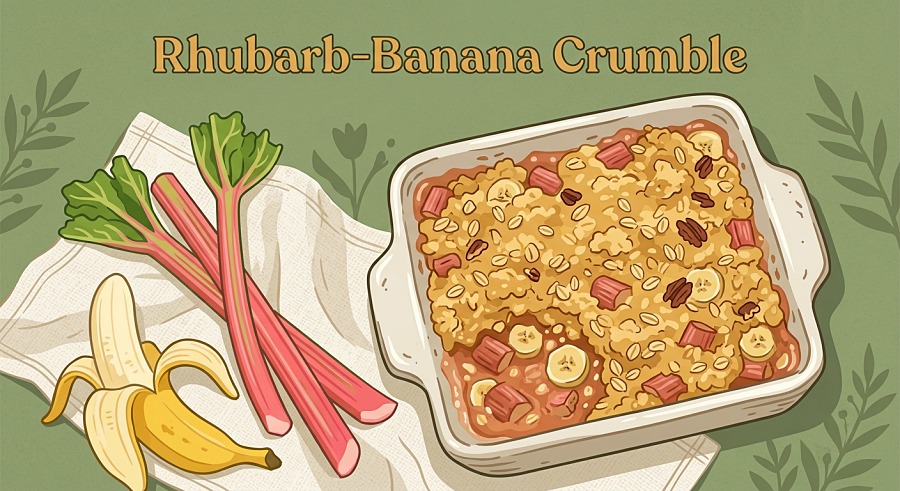
If there’s one farmers’ market bundle I cradle home like a newborn, it’s a tied-up bunch of bright pink rhubarb. After baking with it for over a decade, my favourite way to use it isn’t strawberry-rhubarb pie — it’s this rhubarb-banana crumble recipe. The bananas caramelize into toffee while the rhubarb stays tangy under a buttery brown sugar oat topping that makes guests text you the next morning.
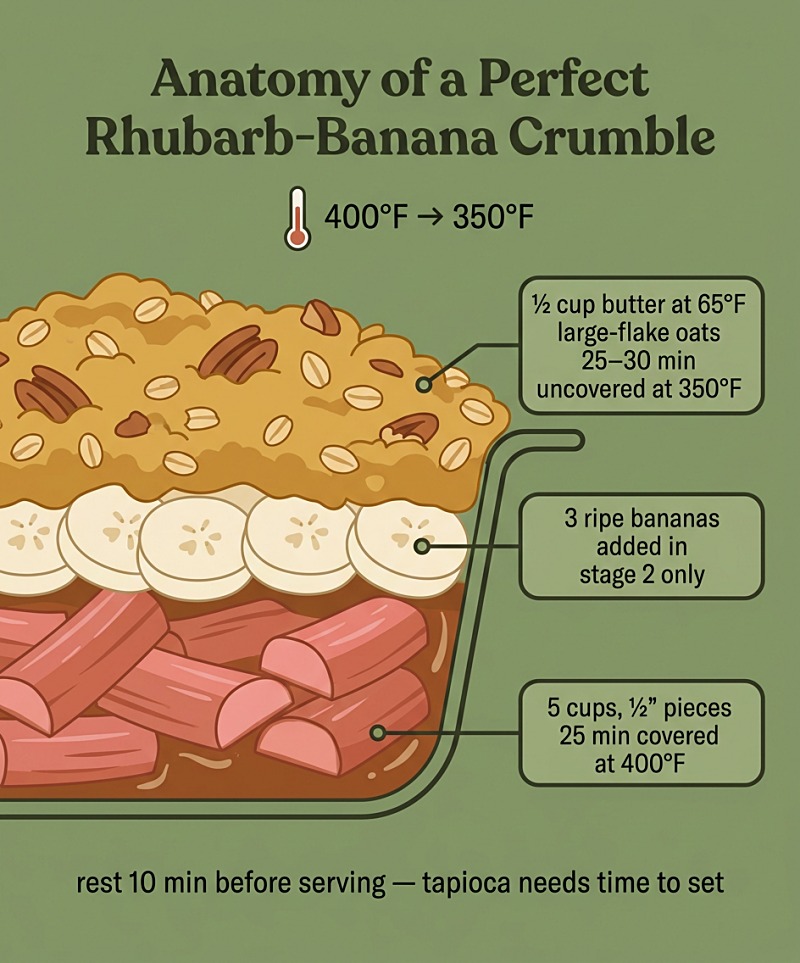
Rhubarb-banana crumble is a baked dessert pairing tart rhubarb stalks with sliced ripe bananas, brown sugar, and a buttery oat-pecan streusel. Bake the rhubarb covered at 400°F for 25 minutes, then add bananas and crumble topping and bake uncovered at 350°F for another 25 minutes until golden and the filling bubbles thickly at the edges.
I first stumbled on the rhubarb-banana pairing in an old Canadian Living cookbook years ago. Mind = blown. Now, in September of 2026, it’s still the dessert I make every single time rhubarb shows up at the market — and after countless tweaks, this version is the one I’d put my name on.
Table of Contents
Rhubarb-Banana Crumble at a Glance
| Detail | |
|---|---|
| Prep time | 15 minutes |
| Cook time | 50 minutes |
| Total time | 1 hour 5 minutes |
| Servings | 6–8 |
| Difficulty | Easy |
| Calories | ~320 per serving |
| Cuisine | North American / Canadian |
Why This Rhubarb-Banana Crumble Works
Three things make this version different from every other rhubarb crumble out there:
- Brown sugar instead of granulated. Brown sugar carries molasses, which adds a slight acidity and depth that plain white sugar simply can’t touch. With bananas (which already contain natural sugars and pectin), the molasses helps everything caramelize into something almost butterscotch-like in the oven.
- Tapioca, not cornstarch, as the thickener. Tapioca starch thickens at a lower temperature than cornstarch, holds its body through freeze-thaw cycles, and gives fruit fillings a bright, glossy finish instead of cornstarch’s matte, opaque set. According to baking-science guides, tapioca starch absorbs liquid before it reaches a boil, which is exactly what you want when you’re trying to avoid a soupy crumble.
- A two-stage bake. Covering the rhubarb at 400°F for the first 25 minutes lets it soften without the topping burning. Dropping the temp to 350°F for the second bake browns the crumble slowly without overcooking the fruit underneath.
Ingredients & Substitutions
For the rhubarb-banana filling
- 5 cups fresh rhubarb, chopped into ½-inch pieces (about 1¼ lb / 600 g of trimmed stalks)
- 3 ripe bananas, sliced into ½-inch coins
- ½ cup packed brown sugar (light or dark — dark gives more molasses depth)
- 2 tbsp instant tapioca (or 1½ tbsp cornstarch as a same-day substitute)
- 1 tsp pure vanilla extract
- ½ tsp ground cinnamon
- ⅛ tsp freshly grated nutmeg
- Pinch of fine sea salt
For the brown sugar oat crumble
- ½ cup unsalted butter, softened to cool room temperature
- 1 cup packed brown sugar
- 1 tsp ground cinnamon
- ½ cup all-purpose flour
- 1 cup large-flake (old-fashioned) rolled oats — not quick oats; they go to mush
- ¼ cup pecans, finely chopped (walnuts or sliced almonds work too)
A few notes on swaps
- Frozen rhubarb works beautifully. Thaw it overnight in a sieve set over a bowl, drain off the released liquid, and pat dry before measuring. Frozen rhubarb releases extra water — bump the tapioca up to 2½ tbsp.
- Bananas: use ones with a yellow peel and just a few brown spots. Fully blackened bananas turn slimy in the oven; under-ripe ones taste starchy.
- Gluten-free: swap the flour for a 1-to-1 GF blend and use certified gluten-free oats. Several readers have made this version successfully and loved it.
- Dairy-free: firm vegan butter (the stick kind, not soft tub spread) works in place of dairy butter.
Equipment You’ll Need
- 8-inch square baking dish (about 2 qt / 2 L) — or a 9-inch round pie plate or 1.5-qt oval gratin
- Two mixing bowls
- Sharp knife and chopping board
- Measuring cups and spoons
- A fork or pastry cutter for the topping
- Aluminum foil
How to Make Rhubarb-Banana Crumble (Step by Step)
1. Preheat and prep the dish
Heat the oven to 400°F (200°C). Lightly butter or spray an 8-inch square baking dish.
2. Make the crumble topping first
In a medium bowl, whisk together the brown sugar, cinnamon, flour, and oats until evenly combined. Add the softened butter and use a fork (or your fingertips) to work it into the dry ingredients until you have moist, pebbly clumps — somewhere between coarse sand and rough gravel. Stir in the chopped pecans. Set the bowl aside.
Pro tip: if your kitchen is warm and the topping starts to look greasy, pop the bowl into the fridge for 10 minutes before sprinkling. Cold crumble = clumpier, crunchier topping after baking.
3. Mix the rhubarb filling
In a large bowl, toss the chopped rhubarb with the brown sugar, tapioca, vanilla, cinnamon, nutmeg, and a pinch of salt. Don’t add the bananas yet. Bananas hate being baked at 400°F covered — they go to slush. They join the party in stage two.
Pour the rhubarb mixture into the prepared baking dish, cover tightly with foil, and bake for 25 minutes until the rhubarb has just started to release its juice and turn tender at the edges.
4. Add bananas, drop the temp, top with crumble
Pull the dish out of the oven and turn the temperature down to 350°F (175°C). Carefully remove the foil — there will be steam. Arrange the banana slices in an even layer on top of the soft rhubarb.
Sprinkle the crumble topping evenly across the surface, covering the bananas right to the edges. Don’t pack it down; gentle clusters bake up crispier.
5. Bake uncovered until golden and bubbling
Return the dish to the oven, uncovered, for another 25–30 minutes, or until the crumble is deep golden brown and the filling bubbles thickly at the edges. If your topping is browning too quickly, tent loosely with foil for the last 10 minutes.
6. Rest before serving
Let the crumble rest on a wire rack for at least 10 minutes before serving. This is non-negotiable — that resting time lets the tapioca finish thickening, otherwise you’ll get a runny scoop. Twenty minutes is even better if you can manage the willpower.
5 Pro Tips From a Decade of Making This
- Soften the butter, don’t melt it. Melted butter gives you a smooth, almost cookie-like topping. Cool, soft butter (about 65°F / 18°C) gives you proper crumble clumps with crunch.
- Don’t skip the foil-cover stage. Pre-cooking the rhubarb under foil keeps the bottom of the topping from going pale and soggy. It’s a small step that changes the whole texture.
- Use quick-cooking tapioca, not pearl tapioca. Pearl tapioca won’t fully dissolve — you’ll find chewy white beads in your filling. Bob’s Red Mill instant tapioca is widely available and reliable.
- Salt the topping. That tiny pinch of salt in the crumble (some recipes leave it out) is what makes the brown sugar taste rich rather than just sweet.
- Let the bananas show themselves. Slice them ½ inch thick, not paper-thin. Thin slices disappear into the rhubarb; thick coins keep their identity and turn into pudding-soft caramel pockets.
Variations to Try
- Rhubarb-Banana-Strawberry Crumble: swap 1 cup of the rhubarb for 1 cup of halved strawberries. Reduce the brown sugar in the filling to ⅓ cup since strawberries are sweeter.
- Rhubarb-Banana-Ginger Crumble: add 1 tsp grated fresh ginger or ½ tsp ground ginger to the filling. Pairs beautifully with the molasses notes from the brown sugar.
- Coconut topping: swap ¼ cup of the oats for unsweetened shredded coconut. Toasts to gold and adds a tropical lift to the bananas.
- Citrus brightener: add 1 tsp orange zest to the filling. It really lifts the rhubarb without competing with the banana.
- Chocolate-banana version: stir 2 tbsp of cocoa powder into the topping and add a small handful of chocolate chips before baking.
Make-Ahead, Storage & Freezing
This crumble is one of the most freezer-friendly desserts in my repertoire. Here’s the cheat sheet:
| Method | How long | How to use |
|---|---|---|
| Topping ahead | Up to 1 week in fridge / 3 months in freezer | Sprinkle directly from cold onto fruit |
| Filling prepped (unbaked) | 24 hours in fridge | Hold the tapioca until bake day so it doesn’t pre-set |
| Fully baked, leftovers | 3–4 days in fridge, covered | Reheat 20 sec/portion in microwave or 10 min at 350°F |
| Frozen, unbaked | 3 months | Defrost overnight in fridge, bake as directed |
| Frozen, baked | 2 months | Thaw overnight in fridge, reheat covered at 325°F for 20 min |
According to The Kitchn’s freezer guide for rhubarb, freezing actually breaks down rhubarb’s cell walls and concentrates its flavour — which means a crumble baked from frozen rhubarb in the dead of winter often tastes more rhubarb-y than the one you made in June.
What to Serve It With
Warm crumble with something cold on top. That’s the rule.
- A scoop of melty vanilla bean ice cream — the classic and what I’d reach for first
- Lightly whipped, barely-sweetened cream
- Cold pouring custard (very British, very correct)
- Crème fraîche thinned with a splash of milk
- Greek yogurt for breakfast leftovers — yes, this counts as breakfast
A Note on Rhubarb Safety (Read This Before You Bake)
Just the stalks. Always. The leaves of the rhubarb plant contain high levels of oxalic acid and possibly anthraquinone glycosides — both can cause vomiting, diarrhea, kidney issues, and in rare extreme cases, much worse. The U.S. National Library of Medicine confirms that only the stalk is safe to eat. If your rhubarb arrives with leaves attached, slice them off at the base and toss them — don’t compost them into a bed where pets or kids might graze.
Trim about ½ inch off the cut end of each stalk before chopping. If your rhubarb is late-season and the outer skin feels stringy, you can peel it lightly, but most home cooks (myself included) skip this step.
Common Mistakes & How to Fix Them
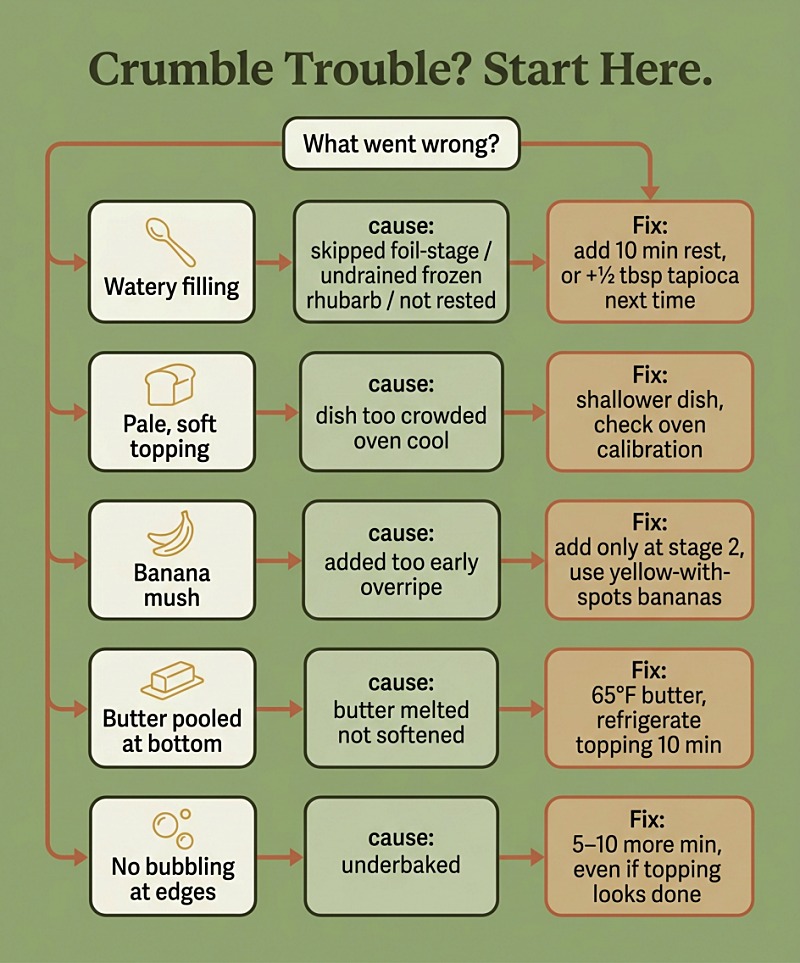
My filling is watery. You either skipped the foil-on first bake, used frozen rhubarb without draining, or didn’t rest the dish long enough after baking. Tapioca needs time to set as the dish cools. Add 10 more minutes of resting before serving.
My crumble topping is pale and soft. The dish was probably crowded — too much filling for the pan. Use a wider, shallower dish so the topping has airflow. Also check your oven calibration; an oven running 25°F cool will leave you with a sad, beige crumble.
My bananas turned to mush. Either the bananas were too ripe (heavily blackened) or they got added in step 1 and baked under foil at 400°F. Bananas only join at the second-bake stage.
The topping pooled into a layer of butter at the bottom. Your butter was melted instead of softened. Next time, use butter just barely yielding to a thumb-press — about 65°F.
The fruit didn’t bubble at the edges. Underbaked. The bubbling is your visual cue that the tapioca has activated. Give it another 5–10 minutes, even if the topping looks done.
Frequently Asked Questions
Can I make this rhubarb-banana crumble ahead of time?
Yes — and it actually tastes better resting at room temperature for an hour after baking than served piping hot. You can also assemble the unbaked crumble (rhubarb filling and topping in the dish, foil on) and refrigerate it for up to 24 hours before baking. Add 5 minutes to the covered first-bake time if going straight from the fridge.
Can I use frozen rhubarb for this recipe?
Absolutely. Thaw it overnight in a colander set over a bowl and drain off the released liquid before measuring. Frozen rhubarb gives off significantly more juice than fresh, so bump the tapioca from 2 tbsp to 2½ tbsp.
Can you freeze rhubarb-banana crumble after baking?
Yes, but the bananas suffer slightly in texture — they go a little softer on reheat. For best results, freeze the unbaked, fully assembled crumble (without bananas) for up to 3 months, then add fresh banana slices when you bake from frozen. Defrost in the fridge overnight first.
What’s the best thickener for fruit crumbles — tapioca, cornstarch, or flour?
For freezer-friendly fruit fillings, tapioca wins. It holds up through freeze-thaw cycles where cornstarch tends to break down, and gives that bright, glossy look you want under a crumble. Cornstarch is fine for same-day baking. Flour works in a pinch but produces a duller, slightly cloudy filling. Substitution ratios: 2 tbsp tapioca = 1½ tbsp cornstarch = 3 tbsp flour.
Why is my rhubarb crumble bitter?
Two likely causes: not enough sugar to balance rhubarb’s natural acids (especially with very green, late-season stalks), or you accidentally included a sliver of leaf material. Always trim leaves cleanly at the stalk base and taste-test your filling mix before baking.
Can I make this rhubarb-banana crumble gluten-free?
Yes — this recipe converts beautifully. Use a 1-to-1 gluten-free flour blend in place of all-purpose, and certified gluten-free rolled oats. The tapioca thickener is already naturally gluten-free.
How long does rhubarb season last?
According to the USDA Agricultural Marketing Service, fresh rhubarb is most heavily marketed January through August, with peak quality in late spring and early summer. Most field-grown rhubarb peaks April through June, depending on your region.
A Last Word
If you take one new dessert into your rotation this season, please let it be this rhubarb-banana crumble recipe. The combination is unexpected, the technique is forgiving, and the leftovers — eaten cold from the fridge with a spoon, no judgment — might actually be better than the first night. Bake it warm, serve it with vanilla ice cream, and watch the dish empty out.
If you try it, I’d love to hear how it goes — leave a comment below or tag your photos so I can see your gorgeous pink-topped masterpiece.
Happy baking. ❤️