
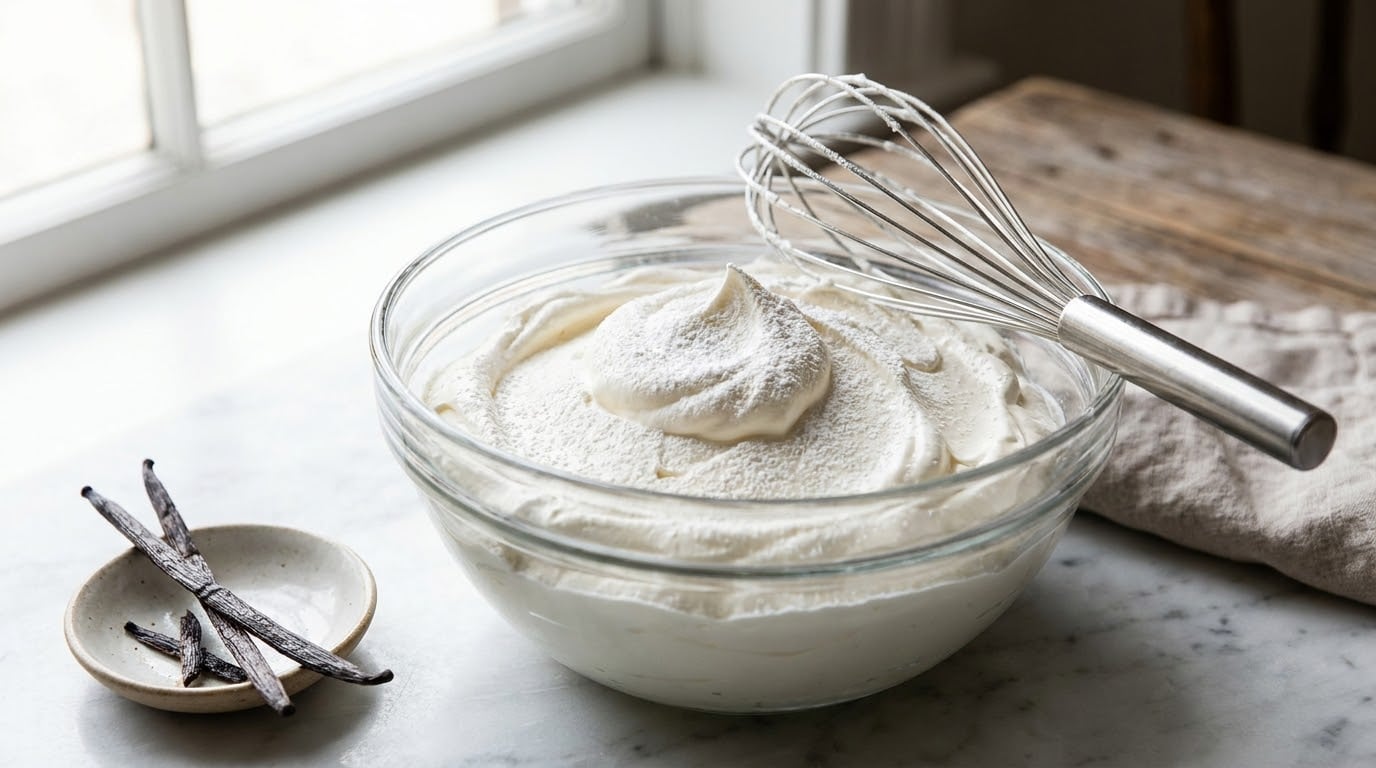
A good stabilized whipped cream frosting recipe is the difference between a cake that looks tidy for an hour and one that still looks freshly frosted after a full day in the fridge. Plain whipped cream deflates, weeps, and slides within a couple of hours, but a properly stabilized version pipes like buttercream, holds sharp peaks for decorating, and stays sliceable for days. The trick is one extra step and a tiny amount of the right helper, and the whole thing takes about 10 minutes once you have done it twice.
This version uses unflavored gelatin because it is the most reliable method I have tested across hot kitchens, long drives, and wedding-tier cakes. I also include a cream cheese method below for anyone who wants a softer, tangier frosting without gelatin. Both are forgiving, both use pantry ingredients, and both beat the waxy, over-sweet look you get from most bakery frosting.
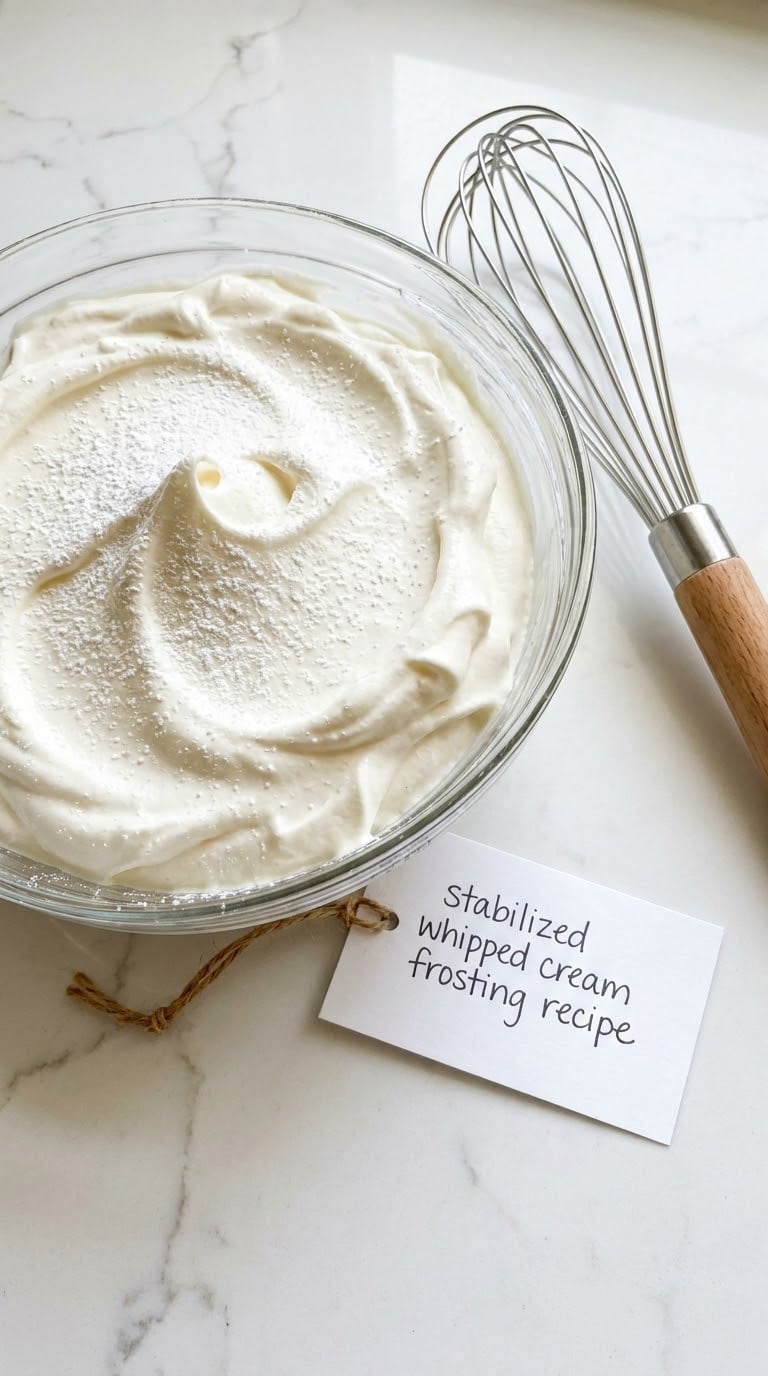
Table of Contents
Why This Recipe Works
Stabilized whipped cream frosting works because a small amount of gelatin (or another stabilizer) sets up a soft protein network that holds the air bubbles and fat globules in place. Once the cream is whipped to stiff peaks and the gelatin cools into that network, the frosting stops weeping and stops deflating. It is the same idea as a chiffon cake or a panna cotta, just much softer so it still tastes like whipped cream.
- Cold everything. A chilled bowl and chilled whisk are non-negotiable. I keep mine in the freezer for 15 minutes before I start. Warm equipment is the single biggest reason peaks refuse to stiffen.
- Powdered sugar, not granulated. Powdered sugar contains a small amount of cornstarch, which helps stabilize, and it dissolves instantly so the frosting stays smooth.
- Medium-stiff peaks, not just stiff. You want a peak that holds its shape with just the very tip curling. Past that, the cream turns grainy and eventually separates into butter and buttermilk.
- Bloomed gelatin added in a slow stream. Whisking the bloomed gelatin into the cream while it spins prevents lumps and gives even stability throughout.
Ingredients
This base recipe makes about 4 cups of frosting, enough to fill and frost an 8 or 9 inch layer cake, or to generously frost 18 to 24 cupcakes. The gelatin version is listed first because it is the most stable. The cream cheese swap is in the section right after.
- 2 cups (480 ml) cold heavy whipping cream, at least 36 percent butterfat
- 1/3 cup (40 g) powdered sugar, sifted
- 1 teaspoon pure vanilla extract
- 1/4 teaspoon fine sea salt
- 1 teaspoon (about 4 g) unflavored gelatin
- 2 tablespoons cold water
Heavy cream: Go for the highest fat percentage you can find, ideally 36 percent or higher. Ultra-pasteurized cream whips fine but takes a bit longer. Avoid anything labeled “whipped topping” or “light cream” because it will not hold shape no matter what you add.
Powdered sugar: Sifting prevents little lumps that refuse to dissolve. If you want a pure white frosting for a wedding cake, use clear vanilla extract instead of the brown kind.
Gelatin: Plain, unflavored gelatin from the baking aisle. One teaspoon is enough for 2 cups of cream. Vegetarians can swap in agar agar (use 1/2 teaspoon bloomed in 3 tablespoons of water, simmered 2 minutes) or follow the cream cheese method below.
Dairy-free option: Use two 13.5 ounce cans of full-fat coconut cream, chilled overnight so the solid cream separates from the liquid. Skip the gelatin and add 1/2 teaspoon cream of tartar instead. Whip only the solid cream.
Equipment
You do not need much, but the right tools do matter. A stand mixer is easiest, a hand mixer works just as well, and a food processor is my third favorite for an ultra-thick result that needs no stabilizer at all.
- Stand mixer with whisk attachment, or a hand mixer, or a food processor
- Medium metal bowl, chilled in the freezer for 15 minutes
- Small saucepan or microwave-safe dish for blooming the gelatin
- Rubber spatula for scraping the bowl
- Instant-read thermometer (only if using the gelatin method, to check the cream is below 80°F / 27°C before adding the gelatin)
A chilled metal bowl matters more than people think. Glass works too if it has been in the freezer. Plastic does not chill well enough, so skip it for this recipe.
How to Make Stabilized Whipped Cream Frosting
Plan about 15 minutes from start to spreadable frosting. The active work is closer to 5 minutes, the rest is waiting for things to chill.
- Chill the bowl and whisk. Put the metal bowl and the whisk attachment (or beaters) in the freezer for at least 15 minutes. If your kitchen runs hot, do 30 minutes.
- Bloom the gelatin. Sprinkle the 1 teaspoon of gelatin over 2 tablespoons of cold water in a small dish. Let it sit for 5 minutes until it looks like soft applesauce. Then warm it gently, either 5 to 10 seconds in the microwave or over very low heat on the stove, just until it liquefies. Set aside to cool slightly.
- Whip the cream to soft peaks. Pour the cold cream into the chilled bowl. Whip on medium speed until it thickens and you can see trails behind the whisk, about 1 to 2 minutes.
- Add sugar, vanilla, and salt. With the mixer running, sprinkle in the sifted powdered sugar, then the vanilla and salt. Keep whipping on medium until you reach medium peaks, where the tip of the peak just barely curls over.
- Stream in the gelatin. Reduce the mixer to low. Slowly pour the cooled liquid gelatin down the inside of the bowl in a thin, steady stream. This takes about 15 seconds. Do not dump it in all at once or it will clump.
- Whip to medium-stiff peaks. Increase the speed back to medium and whip for another 20 to 30 seconds, just until the frosting holds a peak that stands straight with the very tip drooping. Stop right there. If the cream looks dry or you see little flecks of butter, you have gone too far.
- Use right away or chill. The frosting is ready to spread or pipe. Use it within 10 minutes for the smoothest finish, or cover and refrigerate up to 24 hours. Give it a 10 second re-whip on low if it softens in the fridge.
Gelatin Method
The gelatin method above is the gold standard for stability. Gelatin sets up a soft protein web that holds for 24 hours in the fridge and 2 to 3 hours at room temperature without weeping. It is the method I use for wedding cakes and any cake that needs to travel. The only thing to watch is making sure the gelatin has cooled to below 80°F (27°C) before you add it, otherwise it can deflate the cream on contact. An instant-read thermometer takes the guesswork out.
Cream Cheese Method
If you want a tangier, denser frosting and you do not want to use gelatin, swap the gelatin and water for 4 ounces (113 g) of full-fat cream cheese, softened to room temperature. Beat the cream cheese alone for 1 minute until smooth, then add the cold cream, powdered sugar, vanilla, and salt. Whip everything together until medium-stiff peaks form, about 3 minutes total. This version tastes like the filling of a no-bake cheesecake and holds its shape for about 12 hours in the fridge, slightly less at room temperature than the gelatin version.
Tips for Success
These are the fixes I have leaned on the most after making this frosting for birthday cakes, holidays, and a few too many hot summer weddings.
- If the cream deflates: It was either too warm going in (the cream, the bowl, or the room) or you over-whipped it. Chill everything for 20 minutes, start over with fresh cream, and stop at medium peaks.
- If the frosting tastes flat: You forgot the salt. A quarter teaspoon of fine sea salt makes the cream taste more like itself and cuts the sweetness.
- If the frosting wept on the cake: The cake was probably still warm when you frosted it, or the frosting was under-stabilized. Always cool the cake completely and use the full amount of gelatin called for.
- If peaks will not hold: You are stopping at soft peaks by mistake. Soft peaks fall over the second you lift the beater. Keep going until the peak stands up with only the tip drooping.
- If the gelatin clumps: It was either added too fast, or it had not fully liquefied when you added it. Always bloom, fully melt, cool to lukewarm, then stream in slowly.
- If you went past stiff peaks: The cream is grainy and starting to look like soft butter. Add 2 to 3 tablespoons of fresh cold cream and gently fold it in by hand. Sometimes you can rescue it.
Variations
Once you have the base down, you can flavor a batch in almost any direction. All of these add-ins are measured per 1 cup of finished frosting, so you can scale up or down.
- Chocolate: Sift in 2 tablespoons of unsweetened cocoa powder with the powdered sugar, or fold in 2 ounces of cooled melted dark chocolate at the end. Tastes like a lighter version of chocolate ganache.
- Citrus: Add 1 teaspoon of finely grated lemon, orange, or lime zest plus 1/2 teaspoon of the fresh juice. Skip the zest if you want a smooth, kid-friendly citrus frosting.
- Espresso: Dissolve 1 teaspoon of instant espresso powder in the vanilla before adding. Pairs beautifully with chocolate cake or a tiramisu layer cake.
- Dairy-free coconut: Use two chilled cans of full-fat coconut cream in place of the heavy cream, swap the gelatin for 1/2 teaspoon cream of tartar, and skip the cream cheese method. Whip only the thick part from the top of the cans.
Storage, Make-Ahead and Reheating
Stabilized whipped cream frosting is one of the best make-ahead frostings out there. You can make the base a day in advance, or freeze finished frosting for almost a month.
- Refrigerator: Up to 24 hours before whipping, you can keep the bloomed gelatin and the cold cream in separate containers. Once whipped and frosted onto a cake, the frosting holds well in the fridge for 3 to 4 days. Cover the cake loosely with a cake dome or a sheet of parchment, not plastic wrap which sticks.
- Freezer: Piped rosettes and finished frosted cakes both freeze well. Place the uncovered cake in the freezer until the frosting is firm, about 1 hour, then wrap in plastic and foil. Use within 1 month. Thaw overnight in the fridge.
- Room temperature: The gelatin version can sit out for 2 to 3 hours without weeping or sliding, which covers most events. The cream cheese version is closer to 1.5 hours. Anything longer, refrigerate.
- Re-whipping: If the frosting softens or weeps a bit in the fridge, re-whip on low for 10 to 15 seconds. Do not re-whip more than once or it can turn grainy.
What to Serve It With
This frosting is made for soft, tender cakes and creamy desserts. It does not play well with very dry cakes because they will drink the moisture from the frosting, but with anything moist and tender it is a dream.
- Layer cake. The classic use. Fill and frost a vanilla, chocolate, or lemon layer cake. This strawberry shortcake version is a great starter recipe.
- Cupcakes. Pipe generous swirls on top. The frosting holds its shape through transport in a cupcake carrier.
- Ice cream pie. Use it as a softer, fresher-tasting topping for any no-churn or store-bought ice cream pie.
- Hot cocoa or strawberry shortcake. Dollop a generous spoonful on top of either instead of plain whipped cream. The plain whipped cream base for this is in the classic whipped cream recipe on the site.
Frequently Asked Questions
How long does stabilized whipped cream frosting hold its shape?
The gelatin version holds medium-stiff peaks for 3 to 4 days in the refrigerator and 2 to 3 hours at room temperature without weeping or sliding. The cream cheese version is slightly softer, closer to 12 hours in the fridge and 1.5 hours at room temperature. For best results, frost the cake the same day you plan to serve it.
Can I make stabilized whipped cream frosting the day before?
Yes. Whip the frosting up to 24 hours ahead, store it in a covered container in the fridge, and give it a 10 to 15 second re-whip on low before using. The gelatin method is the most forgiving for make-ahead, holding its body and shape overnight. Frosted layer cakes keep well in the fridge for 1 to 2 days before serving.
Why is my whipped cream frosting runny and how do I fix it?
A runny frosting almost always means the cream was too warm, the peaks were under-whipped, or the gelatin was not bloomed and fully melted before being added. Fix it by chilling the bowl and cream for 20 minutes, starting over with fresh cold cream, and stopping the mixer at medium-stiff peaks. If using gelatin, make sure the liquid has cooled to below 80°F (27°C) before streaming it in.
Can you freeze stabilized whipped cream frosting?
Yes, both the gelatin and cream cheese versions freeze well for up to 1 month. Pipe rosettes onto a parchment-lined sheet and freeze until solid, then transfer to a freezer bag. Thaw in the fridge for 1 to 2 hours before serving, or use frozen rosettes directly on top of a hot drink where they soften on contact.
What is the best stabilizer for whipped cream frosting?
Unflavored gelatin is the most reliable stabilizer for whipped cream frosting. It holds shape for days in the fridge, tolerates room temperature events, and does not change the flavor. For a vegetarian swap, agar agar works but sets firmer. For the easiest method with no extra ingredients, use 1 tablespoon of instant vanilla pudding mix per cup of cream.
Once you have a stabilized whipped cream frosting recipe you trust, the whole dessert calendar opens up. A frosted cake can sit through a long dinner party, a sheet cake can survive the car ride to a potluck, and cupcakes hold their piped swirls long enough to look pretty on a dessert table. Start with the gelatin method since it is the most forgiving, then try the cream cheese version the next time you want a tangier frosting. Either way, taste it on a spoon before it ever touches the cake. A good batch should taste like fresh, cold, lightly sweetened cream with a clean vanilla finish, and a peak that holds a full minute after you dip the spoon back in.