
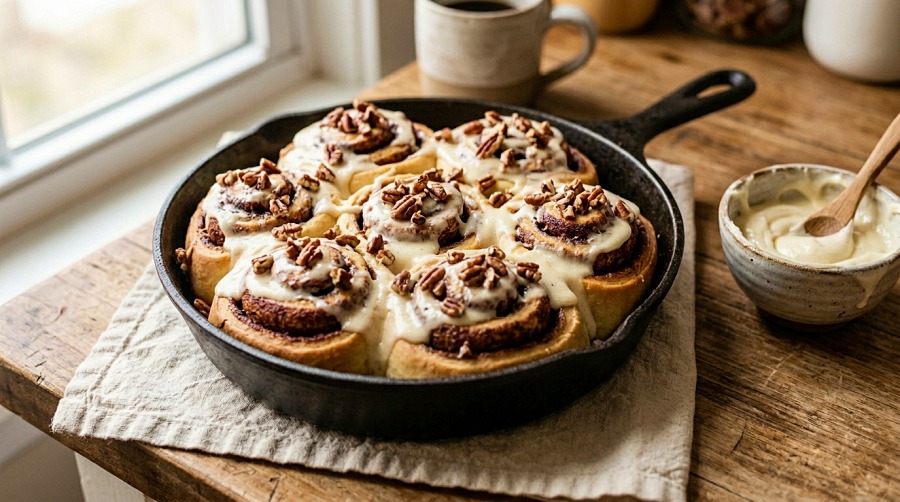
Some Saturdays only call for one thing, and that thing is a pan of warm cinnamon buns coming out of the oven. The problem is that most recipes leave you with a dozen rolls and a household of two, which means three days of staring at them on the counter as they slowly go sad. This small batch cinnamon buns recipe solves the math: six soft, ooey-gooey rolls, scaled down to a single 8-inch pan, fresh enough to eat in one sitting.
I have been making cinnamon buns since long before Cole and I bought our place in Vancouver, and the one truth I keep coming back to is that a smaller batch almost always tastes better. The yeast is fresher, the filling is more generous per roll, and you actually finish them while they are still warm. If you have ever pulled twelve buns out of the oven and watched four of them stiffen up by Monday morning, you already know what I mean.
Table of Contents
Small Batch Cinnamon Buns Recipe at a Glance
A small batch cinnamon buns recipe makes 4 to 6 rolls instead of the usual dozen, using around 1 cup of flour, a half packet of instant yeast, and a single egg yolk to keep the hydration right. Total time runs about 2.5 hours, most of which is hands-off rising. Bake at 350°F for 20 to 22 minutes until deep golden, then finish with cream cheese frosting while the rolls are still warm in the pan.
| Detail | Spec |
|---|---|
| Prep time | 25 minutes |
| Rise time (combined) | 1 hr 45 min |
| Cook time | 22 minutes |
| Total time | 2 hr 30 min |
| Servings | 6 buns |
| Difficulty | Intermediate |
| Approx. calories | 385 per bun (with frosting) |
| Cuisine | American |
Below you will find the exact ratio I use after a few years of testing, two finishing options (cream cheese frosting and a maple bourbon glaze), an overnight method for fresh buns at breakfast, and the small fixes that turn a flat batch into the tallest, fluffiest rolls you have ever pulled out of a pan.
Why This Small Batch Cinnamon Buns Recipe Works
There are three reasons this recipe works at half scale where a lot of scaled-down cinnamon roll recipes fall flat.
One egg yolk, not a whole egg. When you halve a standard 12-bun recipe and toss in a whole egg, the dough comes out wet and slack. Using just the yolk keeps the fat and richness while protecting the hydration. The dough stays soft and pillowy without slumping when you roll it.
Warm milk, not hot. Yeast wakes up between 105°F and 115°F and starts dying past about 130°F. I use an instant-read thermometer when I can be bothered, and a clean wrist when I cannot. If the milk feels like warm bathwater, you are in the safe zone.
Soft butter for the filling, not melted. This is the number one thing I see people get wrong. Melted butter runs out of the roll the second you cut it and pools at the bottom of the pan. Softened butter, beaten with the brown sugar into a paste, stays put and gives you those clean, swirly layers.
Ingredients
A note before you start: pull the egg, butter, milk, and cream cheese out of the fridge at least 30 minutes before you bake. Cold ingredients fight the yeast and make the dough seize.
For the dough
- 1 cup (130g) all-purpose flour, plus 1 to 2 tbsp extra if needed
- 2 tbsp granulated sugar
- 1¼ tsp instant yeast (about half a standard 7g packet)
- ¼ tsp fine salt
- ¼ cup (60ml) whole milk, warmed to about 110°F
- 2 tbsp unsalted butter, softened
- 1 large egg yolk, room temperature
For the brown sugar filling
- 3 tbsp unsalted butter, softened (almost spreadable, not melted)
- 1/3 cup (65g) packed dark brown sugar
- 1 tbsp all-purpose flour (this keeps the filling from running)
- 1½ tsp ground cinnamon
- ¼ tsp vanilla extract
- ¼ cup toasted pecans, chopped (optional)
For the cream cheese frosting
- 2 oz full-fat cream cheese, softened (about ¼ of an 8-oz block)
- 2 tbsp unsalted butter, softened
- ¾ cup (90g) powdered sugar
- ½ tsp vanilla extract
- Pinch fine salt
- 1 to 2 tsp milk if needed to loosen
For the maple bourbon glaze (alternative finish)
- ½ cup (60g) powdered sugar
- 1½ tbsp pure maple syrup
- 1½ tsp bourbon (or warm water)
- Pinch of salt
Honest notes on swaps
- Whole milk vs 2%. Whole gives the richest dough. 2% works fine. Skim makes a leaner, slightly drier roll. It works, but you can taste the difference.
- Bread flour vs all-purpose. Bread flour adds chew. I use all-purpose for cinnamon buns every time because I want tender, not bready.
- Active dry yeast. Use 1½ tsp active dry. Sprinkle it into the warm milk with a pinch of sugar and let it sit for 8 to 10 minutes until foamy before continuing. If it never foams, the yeast is dead and you need a new packet.
- What to do with the leftover yeast. Pour the rest of the packet into a small jar, seal tight, and stash it in the freezer. Yeast keeps for months that way. I have used freezer-stored yeast more than a year out without a problem.
Equipment You Will Need
You do not need much, but the pan matters more than people think.
- 8-inch round cake pan, 8×4 loaf pan, or 8-inch cast iron skillet
- Stand mixer with dough hook, or a large bowl and clean hands
- Rolling pin
- Bench scraper or a sharp serrated knife (or unflavored dental floss)
- Instant-read thermometer (optional but helpful)
- Parchment paper
The 8-inch pan is the key. A 9×13 leaves the buns sitting alone and they bake into hard little knots instead of soft, pull-apart rolls. You want them just barely touching, which is what gives them the soft sides.
How to Make Small Batch Cinnamon Buns
Step 1: Mix the dough (10 minutes)
In the bowl of your stand mixer with the dough hook attached, whisk together the flour, sugar, instant yeast, and salt. (If you are using active dry yeast, proof it in the warm milk first as noted above.)
Pour in the warm milk, softened butter, and egg yolk. Turn the mixer to low and let it combine for about a minute. The dough will look shaggy and uneven.
Bump the speed to medium and knead for 5 to 6 minutes. You are looking for a smooth, soft ball of dough that pulls cleanly away from the sides of the bowl. It should feel tacky when you poke it but not stick to your finger. If it is sticking to the bowl, add flour 1 tbsp at a time until it pulls away.
Tip the dough onto a lightly floured counter and knead by hand for one more minute. It should feel like a soft, smooth pillow.
Step 2: First rise (60 to 90 minutes)
Lightly grease a clean bowl with oil or butter. Drop the dough in, turn it once so the top is greased, and cover with a clean tea towel or plastic wrap. Set it somewhere warm and let it rise until doubled, usually 60 to 90 minutes depending on your kitchen.
My favorite trick: turn the oven on to its lowest setting for two minutes, then shut it off completely. Place the bowl inside with the door closed. The residual warmth is perfect.
Step 3: Make the filling (5 minutes)
While the dough rises, beat the softened butter, brown sugar, flour, cinnamon, and vanilla together with a hand mixer or a fork until smooth and spreadable. It should look like dark sandy frosting. Set aside at room temperature.
If you are using pecans, toast them in a dry skillet over medium heat for 4 to 5 minutes, shaking often, until they smell nutty. Chop and set aside.
Step 4: Roll, fill, and shape (10 minutes)
Punch the dough down gently and turn it out onto a lightly floured counter. Roll it into a rectangle roughly 10 inches by 8 inches and ¼ inch thick. Try to keep the corners squared off, which gives you evenly sized rolls.
Spread the cinnamon filling all over the surface in an even layer, leaving about a half-inch border along one long edge (the side furthest from you). This bare strip is how the roll seals shut. Sprinkle on the pecans if using and press them gently into the filling so they stick.
Starting from the long edge closest to you, roll the dough away from you into a tight log. Pinch the seam shut.
Slice the log into 6 even rolls. For clean cuts, slide a piece of unflavored dental floss under the log, cross it over the top, and pull. The floss cuts through without smashing the dough.
Step 5: Second rise (30 to 45 minutes)
Line your 8-inch pan with parchment and arrange the rolls cut-side up, leaving small gaps between them. Cover loosely and let them rise in a warm spot for another 30 to 45 minutes, until they look puffy and have filled in the gaps.
While they rise, heat the oven to 350°F (175°C).
Step 6: Bake (20 to 22 minutes)
Bake the rolls in the center of the oven for 20 to 22 minutes, until the tops are deep golden brown and the centers feel set when you press gently. If the tops are darkening too fast at the 15-minute mark, tent the pan loosely with foil.
For doneness, the internal temperature should hit 190°F to 200°F if you are using a thermometer. Underbaked cinnamon buns are gummy in the middle, and there is no fixing it after the fact.
Step 7: Frost while warm (5 minutes)
Let the rolls cool in the pan for 5 to 10 minutes. They should be warm but not hot, because hot rolls melt the frosting straight through.
For the cream cheese frosting, beat the softened cream cheese and butter together for two full minutes until completely smooth, scraping down the sides as you go. Add the powdered sugar a couple of spoonfuls at a time, then the vanilla and salt. Beat for another minute until fluffy. If it feels stiff, add milk a teaspoon at a time.
Spread generously over the warm rolls and serve.
For the maple bourbon glaze, whisk the powdered sugar, maple syrup, bourbon, and salt together until smooth and pourable. Add warm water a few drops at a time if it needs loosening. Pour over the rolls.
5 Pro Tips for the Best Small Batch Cinnamon Buns
- Weigh the flour if you can. A cup of flour can range from 120g to 150g depending on how you scoop. At half scale, that variance is enough to throw the whole dough off. 130g is the sweet spot for this recipe.
- The butter on the dough should yield to a fingerprint but not melt onto it. If it is greasy or oily-looking, it is too soft and will fight the gluten. Cold butter, on the other hand, will leave streaks.
- Do not skip the flour in the filling. That single tablespoon thickens the brown sugar as it melts and stops it from leaking out the bottom of the pan into a hard caramel layer.
- Tent with foil at the 15-minute mark if you have a hot oven. The tops of cinnamon buns brown faster than the centers cook. Foil saves you from burnt tops and gummy middles.
- Frost while warm, eat warm. Cinnamon buns are at their absolute best within 30 minutes of leaving the oven. The cream cheese frosting half-melts into the warm tops and that is exactly what you want.
Easy Variations
- Classic pecan or walnut. Use the recipe as written with toasted nuts in the filling.
- Orange cinnamon. Add 1 tsp orange zest to the dough and another teaspoon to the cream cheese frosting. Bright and bakery-style.
- Chocolate chip cinnamon buns. Sprinkle 3 tbsp mini chocolate chips over the filling before rolling. The chocolate melts into the swirl.
- Apple cinnamon. Toss ½ a small peeled apple, diced very small, with 1 tsp cinnamon sugar and scatter over the filling. Skip the pecans.
- Brown butter glaze. Brown 2 tbsp butter until it smells nutty, cool slightly, and whisk into ¾ cup powdered sugar with 1 tbsp milk and ½ tsp vanilla. A simpler, more grown-up finish than cream cheese.
Storage, Make-Ahead, and Freezing
Room temperature. Cover the pan with foil or transfer to an airtight container. They keep for 2 days, though the cream cheese frosting is best refrigerated past day one for food safety.
Refrigerator. Up to 4 days, covered. Warm for 12 to 15 seconds in the microwave before eating.
Freezer (baked, unfrosted). Wrap individually in plastic, then foil. Freeze for up to 2 months. Thaw overnight at room temp, warm in a 300°F oven for 8 minutes, then frost.
Overnight rise method (the breakfast hero). Shape the rolls and place them in the prepared pan as in Step 4. Instead of letting them rise on the counter, cover tightly with plastic wrap and refrigerate overnight (up to 16 hours). In the morning, pull the pan out and let it sit at room temperature for 45 minutes to 1 hour while the oven preheats. Bake as directed. This is how I make these whenever we have weekend guests, and they hit the table about an hour after I wake up.
Freeze unbaked. Shape the rolls, place in the pan, cover tightly, and freeze. The night before you want them, transfer to the fridge to thaw, then proof at room temp for 1 to 1.5 hours in the morning and bake. Adds maybe 3 minutes to the bake time.
Serving Suggestions
These rolls do not need much company, but a few things make them a proper breakfast spread. Strong coffee or hot tea is non-negotiable. A side of oven-baked bacon handles the salty-sweet balance perfectly. If you want a fuller weekend breakfast, a slice of easy banana bread on the same plate works beautifully alongside.
If you love yeasted breakfast pastries, the same dough technique here is what powers our coffee cinnamon twists, and the proofing principles carry directly over to perfect yeast doughnuts. Once you have nailed one enriched dough, the rest fall into place. For a fruit-forward swap on a similar idea, apple cinnamon pop tarts scratch the same morning craving with a fraction of the rise time.
Frequently Asked Questions
Can I make small batch cinnamon buns the night before?
Yes, and this is the easiest method for fresh-baked rolls at breakfast. Shape the rolls in the pan, cover tightly, and refrigerate overnight. In the morning, let them sit at room temperature for 45 to 60 minutes while the oven heats, then bake as directed.
Why didn’t my cinnamon buns rise?
The most common culprit is dead yeast or milk that was too hot. Yeast dies above 130°F, and a lot of stovetops or microwaves overshoot quickly. The second most common reason is a cold kitchen. Below 65°F, yeast slows way down. Find a warmer spot or use the warm-oven trick from Step 2.
Can I make the dough by hand without a stand mixer?
Absolutely. Mix the ingredients in a large bowl with a wooden spoon until shaggy, then turn out onto a floured counter and knead by hand for 8 to 10 minutes until smooth and elastic. The dough will be sticky at first. Resist adding too much extra flour.
What is the best pan for a small batch of cinnamon buns?
An 8-inch round cake pan or an 8-inch cast iron skillet. Both keep the buns close enough to touch as they rise, which gives you soft sides and tender pull-apart rolls. An 8×4 loaf pan works in a pinch but the middle bun will be tall and the end ones squat.
How do I know when they are done baking?
Visually, the tops should be deep golden brown and the dough between the rolls should look set, not glossy. If you have a thermometer, the center of the middle roll should read 190°F to 200°F. Underbaked rolls feel doughy and squish flat under a knife.
Why are my cinnamon buns dry?
Two main reasons: too much flour in the dough, or overbaking. Weigh your flour if you can, and start checking the buns at the 18-minute mark. Once the tops are golden and the centers are set, pull them out.
Can I use puff pastry instead of yeast dough?
You can make a quicker version with puff pastry, but it is a different pastry entirely. Puff pastry cinnamon swirls are flaky and crisp, not soft and pillowy. They take 25 minutes start to finish. Worth trying for a fast craving, but it does not replace the real thing.
How long do cinnamon buns last at room temperature?
Frosted with cream cheese, I would not push them past one day on the counter. The dairy in the frosting is the issue. Wrap and refrigerate for days 2 through 4, or skip the frosting and they will keep for 2 days covered at room temperature.
A Few Final Notes
This small batch cinnamon buns recipe is the one I default to whenever the craving hits and I do not want a counter full of leftover rolls. Six buns is exactly the right amount for two adults and a couple of small hands reaching in for a piece. If you stretch them, you can get eight slightly smaller buns, but I find six is the size that delivers the right ratio of filling to dough in every bite.
Cinnamon buns are one of those bakes where the kitchen smells almost as good as the eating. By the time the second rise finishes and the pan slides into the oven, the whole house starts to smell like yeast and warm sugar, and there is honestly no better way to start a slow Saturday morning. If you make this small batch cinnamon buns recipe, leave a rating and a comment below to let me know how it turned out. I love hearing how your bakes go, especially the small tweaks you make for your own kitchen. And if you want to come back to this one later, save it to Pinterest so it is there next time the craving hits.
Happy baking.