
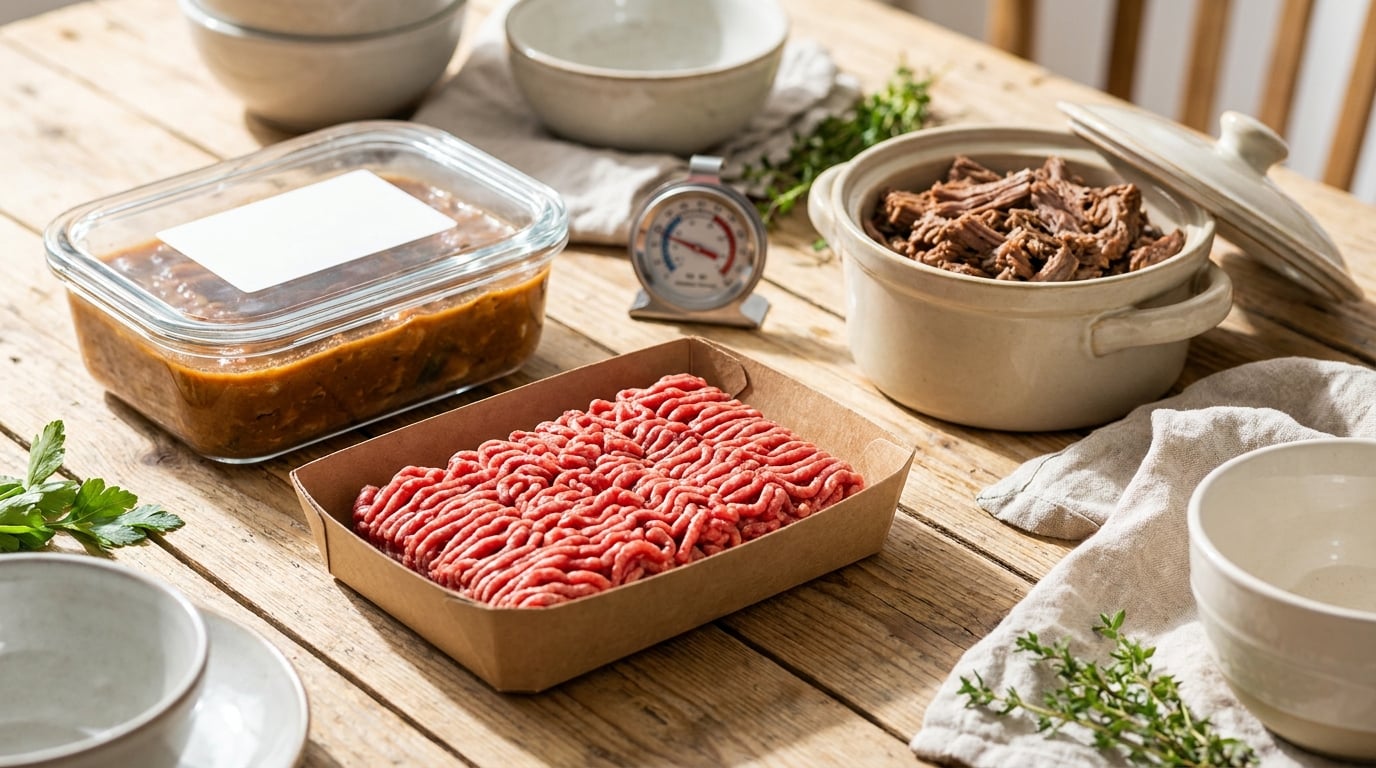
How long does ground beef last in the fridge? Raw ground beef keeps in the refrigerator for 1 to 2 days, and cooked ground beef keeps for 3 to 4 days, according to USDA FoodKeeper guidelines. Ground beef stays safe for 3 to 4 months in the freezer at 0°F (-18°C), as long as it stays frozen solid. If you won’t cook it within two days, freeze it the night you get home.
That two-day window surprises people. A whole steak gets three to five days in the same fridge, and the reason ground beef does not is simple: grinding spreads every bacterium on the surface of the meat through the whole mass. The clock also starts when the package is opened at the store, not when you unpack it at home.
Table of Contents
How Long Does Ground Beef Last in the Fridge? — At a Glance
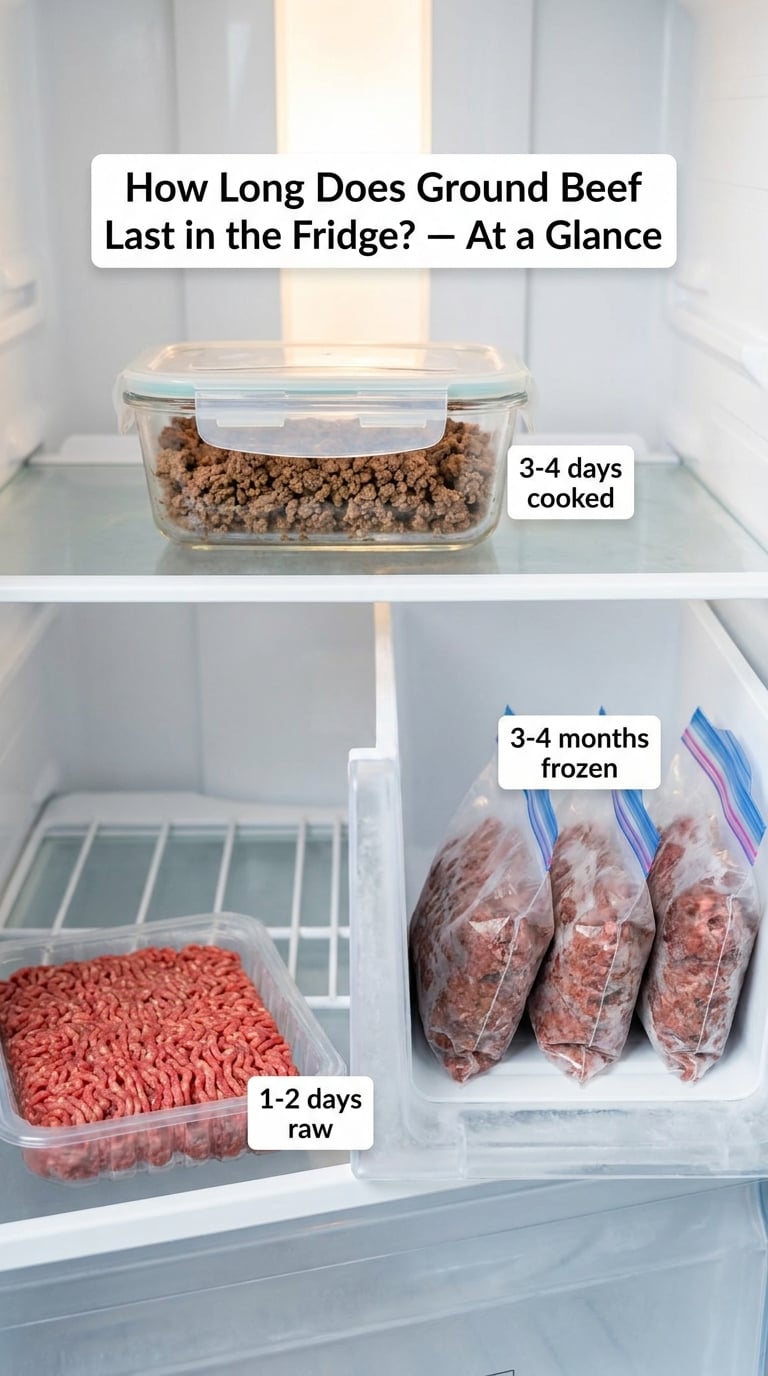
Here is the whole timeline on one page. Everything assumes your refrigerator holds 40°F (4°C) or colder and the meat stays in continuous cold storage the entire time.
| Ground beef form | Fridge at 40°F (4°C) | Freezer at 0°F (-18°C) | Pantry |
|---|---|---|---|
| Raw ground beef, unopened | 1 to 2 days from the package date | 3 to 4 months for best quality | None, not safe to leave out |
| Raw ground beef, opened and rewrapped | 1 to 2 days from opening | 3 to 4 months | None |
| Cooked ground beef and taco meat leftovers | 3 to 4 days after cooking | 3 to 4 months | None |
| Ground beef thawed in the refrigerator | 1 to 2 days after thawing | Safe to refreeze if thawed in the fridge | None |
| Whole beef steaks, chops and roasts, for reference | 3 to 5 days | 4 to 12 months depending on cut | None |
Two columns in that table get read wrong most often. First, there is no pantry time for ground beef at all, so a pack left on the counter is not a shortcut, it is a countdown. Second, the freezer numbers are quality windows, not a cliff: beef stays safe frozen indefinitely at 0°F, but past the recommended window the texture and flavor fade.
What to do on each day after you buy it
This is the part that settles most arguments at the dinner table.
- Day 0, the day you buy it: decide right now whether you’ll cook it. If it’s a two-pound pack and you need a pound, split it and freeze the second half before it goes in the fridge.
- Day 1: still good. Cook it tonight, or freeze it tonight.
- Day 2: the last comfortable day. If it’s been sitting since purchase, cook or freeze now.
- Day 3: past the USDA window. Discard raw ground beef.
- Day 4 and beyond: discard. The smell may not be strong enough to warn you, which is exactly the problem with relying on your nose alone.
If you bought a family-size pack and it came from a butcher counter cut to order, the same 1 to 2 days applies. The pack being bigger doesn’t buy it more time in the fridge; the freezer is where volume belongs.
Raw vs. Cooked Ground Beef Storage Times
Cooking buys ground beef a few extra days, not endless ones. Cooked beef can sit out only until you cool it, and once refrigerated, the 3 to 4 day leftover window applies whether you browned it for tacos or simmered it into a pot of chili.
What cooking does not do is reverse spoilage. Beef that has already grown dangerous bacteria cannot be rescued by heating it hard, because the heat you need for food safety, 160°F (71°C) for ground beef, does not reliably kill every toxin already present. Smelling fine and tasting fine both fail as safety tests here.
Start your count from the moment that matters to the beef in your hand, not the date printed on the tray.
- Bought it today: the count runs from the purchase date, because the package date at the store has already been ticking.
- Cooked it tonight: the count restarts from cooking time, and you get 3 to 4 days.
- Took it out of the freezer this morning: the count restarts from the thawing date, and you get 1 to 2 days. It does not get 3 to 4 months back.
Meat that sat on the counter for three hours then went back in the fridge has not reset its clock. Bacteria grew during those three hours, and putting it back in the cold only slows further growth from wherever it already is.
How to Store Ground Beef Safely in the Fridge
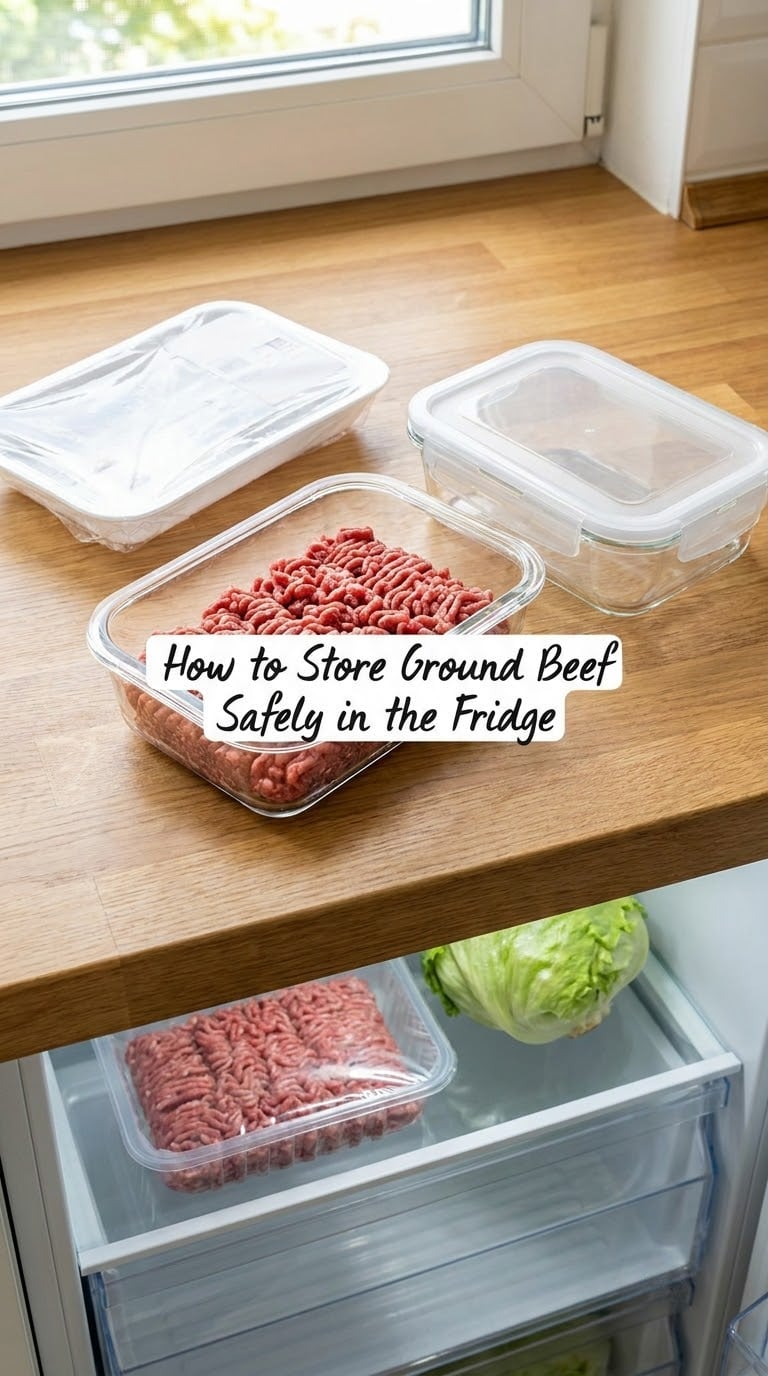
Four steps cover almost everything.
- Get it cold fast. Shop for ground beef last, put it straight in the coldest part of the car, and get it into the fridge when you get home. On a warm day, a bag of beef in a parked car for an hour burns through the window you’re trying to protect.
- Split the bulk. Open the package at home, press out the portion you’ll cook this week into a sealed container, and push the rest flat into a freezer bag or airtight box. Squeeze the air out, label it with today’s date, and put the freezer portion away now.
- Skip the drip pad. The absorbent pad in a supermarket tray keeps meat from sliding, but it also holds liquid against the meat. Move the beef to a clean sealed container or the lowest shelf on a plate so juices don’t sit in a puddle.
- Keep it low, keep it cold, keep it out of the door. Raw ground beef goes on the lowest shelf, in or under ready-to-eat food, so a leak cannot drip onto the cooked stuff. The door is the warmest, most swingy part of a fridge, so it holds condiments, not raw meat.
Set a fridge thermometer on the middle shelf and check it once a month. If it reads above 40°F (4°C), cut every time in this article roughly in half, and get the appliance fixed. Plenty of households discover their kitchen has been running warm for years, which explains a lot of beef that smelled off after a single day.
Can You Freeze Ground Beef to Keep It Fresh?
Yes, and for most households freezing is the whole answer to the two-day problem. Raw ground beef keeps its best quality for 3 to 4 months in a freezer at 0°F (-18°C), and cooked ground beef holds about the same window.
Beyond that, the beef doesn’t become dangerous. Freezing stops growth rather than killing what’s there, so a pack left for a year frozen solid is still safe to cook, just drier and blander. Quality declines gradually while safety holds, which is the opposite of how the fridge works.
Freezer packaging does most of the work.
- Vacuum-sealed or tightly sealed airtight tubs hold up best.
- Freezer bags rolled flat after pressing out the air work nearly as well and stack neatly.
- Loose foil and thin plastic wrap let air in, and you get freezer burn: white or greyish dry patches, papery texture, and flavor that tastes faintly of the freezer. It’s a quality problem, not a safety one.
- The original store tray is fine to freeze, but add a layer of freezer bag or wrap because the tray alone lets more moisture escape.
Portion it into what you actually cook. Ground beef comes in one-pound-plus clumps, and a frozen brick that takes 30 minutes in hot water to break apart is how a week of planned beef turns into a week of skipped beef.
How to Thaw Ground Beef Safely
Thawing is a growth event, so the cold has to stay continuous. Three methods work, and they’re ranked by how well they suit a planned meal.
Refrigerator, 24 hours per pound. Put the sealed package on a plate on the lowest shelf. It’s the slowest, it’s mess-free, and it’s the only method where refreezing is allowed, so it’s the right pick when you bought ahead.
Cold water, about 30 minutes per pound. Keep the beef sealed, submerge it in cold tap water, and change the water every 30 minutes. Cook it straight away. Warm water speeds things up and starts the growth you are trying to avoid.
Microwave, 2 minutes per pound on high. This is the fastest option and the least forgiving, because the edges start cooking before the center thaws. Use it for tonight’s dinner, not for beef you’re saving.
Thawing on the counter is out. The outer layer sits in the 40°F to 140°F (4°C to 60°C) danger zone while the center is still ice, and those bacteria double fast once they’re warm. If you’ve already done it, don’t repeat the habit, and don’t refreeze it.
How to Tell if Ground Beef Has Gone Bad
Check in this order, and treat the first two as stop signals rather than a scoring system.
- Smell. Fresh ground beef has almost no aroma. Sour, tangy, putrid, or ammonia-like means discard. Cooked beef should smell like cooked beef, not like a locker.
- Texture. Ground beef should be slightly sticky from its own fat and nothing more. Slimy, tacky, or forming a film means bacteria have moved past the safe window.
- Color. Bright cherry red is freshest, and a greyish-brown interior is normal. That color is myoglobin reacting with oxygen, exactly what happens to a cut of beef left on the counter, and it has nothing to do with safety.
- Packaging and mold. Leaking, swollen, or puffed plastic means something is growing inside, and mold on raw meat is always a discard.
- Time. Over the limit with everything else unclear means discard anyway.
Two honest caveats about that list. Smell is a useful alarm and a poor guarantee, because Listeria and some other organisms produce no odor you can detect. And if your fridge is running warm, a pack can go off inside two days, which is a fridge problem, not a beef problem.
Conversely, a grayish-brown patty that smells clean and feels tacky-but-normal is just oxidized. Many cooks throw out perfectly good beef over color alone. Cooking kills bacteria on the surface, but it’s still the only thing standing between you and what’s grown inside.
How to Reheat Cooked Ground Beef Safely
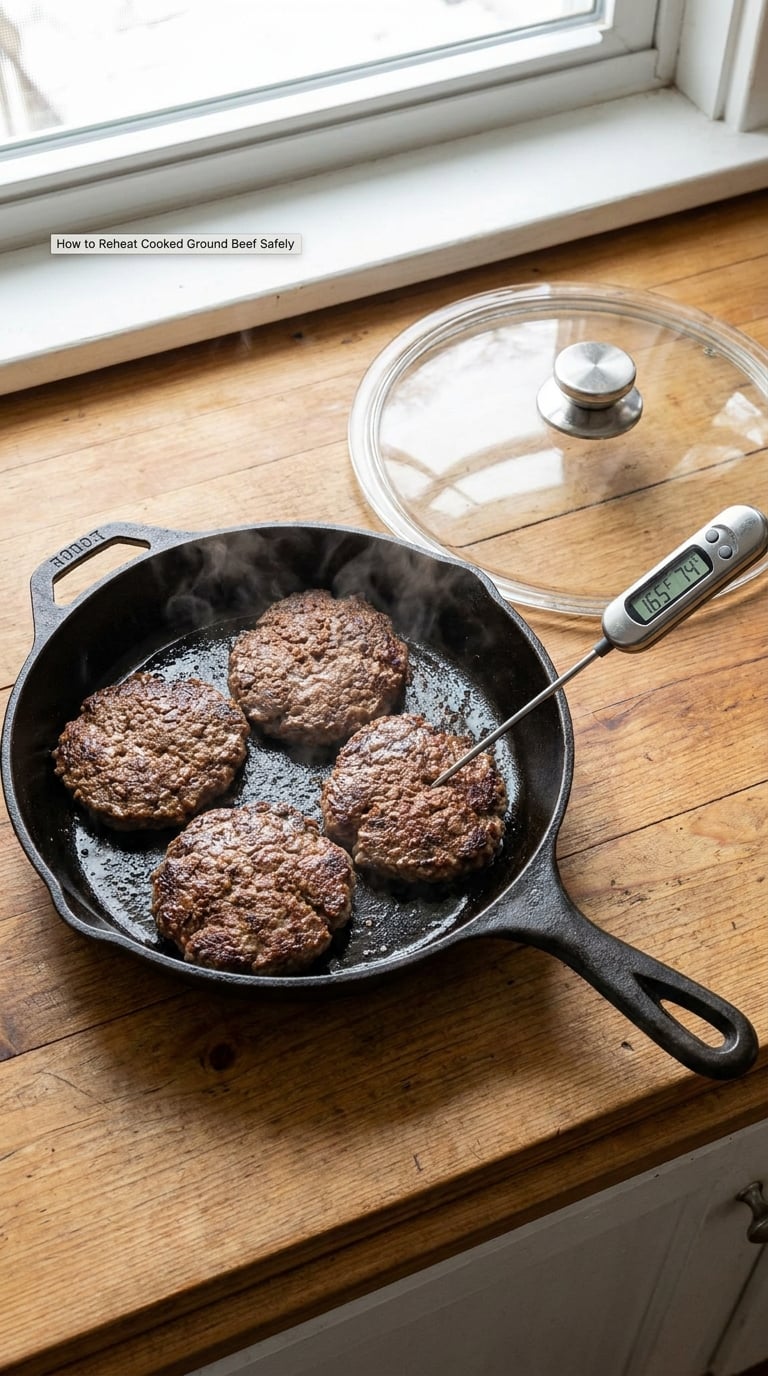
Reheating brings leftovers to 165°F (74°C) and holds it there for 15 seconds. Cooked-from-frozen beef goes to the same 165°F, while raw ground beef still has to reach 160°F (71°C) in the pan.
The method matters more than people expect. Covering the pan traps steam and heats the food evenly, so a splash of water with the lid on works well for taco meat in a skillet. Stir or turn the meat partway through, since the middle of a pile heats last and the edges dry out first.
In the microwave, use a shallow dish rather than a bowl, cover it loosely, and stir halfway. Two minutes at full power will take a large portion from fridge-cold to steaming in the middle while the edges turn rubbery.
Only reheat the portion you’re eating. Repeatedly warming a tray and putting it back is what turns a safe day-three leftover into a problem, and it also dries the meat out fast. Cool the rest within two hours of cooking and get it covered into the fridge.
Common Ground Beef Storage Mistakes
Storing raw beef above ready-to-eat food. Move it to the lowest shelf. One leaking tray ruins a whole shelf of cut fruit or cooked rice.
Trusting the use-by date after freezing. A date printed on a tray describes the window after thawing, not after a year in the freezer. The 3 to 4 day post-thaw count restarts every time the beef leaves the cold.
Thawing on the counter to save time. Overnight on the counter is the single most common shortcut, and it’s the one that produces real food poisoning. Overnight belongs in the fridge.
Reheating the whole tray every time. Pull out one serving, heat it to 165°F (74°C), and leave the rest cold. A microwave-safe covered container does this faster than any skillet.
Marinating indefinitely. Ground beef in a marinade in the fridge is raw ground beef in the fridge, so it gets 1 to 2 days, not extra days for being covered in sauce. Acidic marinades change flavor and texture, not the safety clock. A dry rub is the same story.
Leaving the grocery bag on the counter while you unpack the rest of the groceries. Forty-five minutes of warm kitchen is forty-five minutes the beef spends above 40°F (4°C). Unpack the meat first.
Frequently Asked Questions
Does the use-by date on ground beef mean it must be thrown away after that date?
No. Sell-by, best-by, and use-by labels on fresh beef are quality and rotation guidance for the store, not a safety expiration. The practical rule is the 1 to 2 day fridge window after purchase, and 3 to 4 days for cooked ground beef. If a pack is past its date but well inside those limits, has been refrigerated at 40F or below, and shows no spoilage signs, it is generally fine. If you are depending on a date label as your only rule, you are gambling rather than deciding.
Can ground beef be marinated in the refrigerator for several days?
Keep it to 1 to 2 days, same as plain raw ground beef. Marinades change the flavor and the surface texture of the meat, and acid can make the surface look firmer or paler, but they do not stop bacteria like Salmonella, E. coli, or Listeria from growing underneath. That is why you still cook the inside to 160F (71C) rather than judging doneness by the marinade. A dry rub behaves the same way: a seasoning step, not a safety step.
How long does ground beef last in the fridge after it has been thawed?
One to two days, counted from the moment it leaves the freezer. A thawed pound of ground beef does not get its original shelf life back, and a pack thawed in the refrigerator is the one case where refreezing is allowed. If it sat on the counter to thaw, treat it as a higher risk case rather than a refreeze candidate. Cook thawed beef promptly, and if you are not ready, freeze it again while it is still cold.
Can I refreeze ground beef that was thawed in the refrigerator?
Yes, if it was thawed in the fridge, stayed at 40F (4C) or below, and has not been left at room temperature. That is the one safe refreeze case. Meat thawed in cold water or the microwave should be cooked right away, and meat thawed on the counter should be discarded rather than refrozen, because the surface spent hours in the 40F to 140F danger zone. Refreezing is always safest on quality when the beef is still cold and solid.
Why does ground beef look brown or gray when it is still safe to eat?
That color is oxidation, not spoilage. The pigment myoglobin reacts with the oxygen that reaches the meat, which turns the surface greyish-brown, and ground beef browns faster than a whole steak because grinding exposes far more surface area. If the beef still smells clean, the juices are clear rather than cloudy, and the texture is normal, it is safe to cook. Sour odor, slimy texture, and cloudy or yellowish juices are the signs that matter, not color.
Is ground beef safe if it smells fine but has a slippery texture?
Discard it. Smell catches a lot but not everything, because some harmful organisms produce no odor a person can detect. A surface that feels slimy, tacky, or sticky beyond its own natural stickiness means bacterial growth has moved well past the point where any cooking is trustworthy. Feel the meat before you cook it, and skip the fridge. Also check your fridge temperature, because a kitchen running above 40F (4C) is the usual reason good beef turns slimy early.
Bottom Line
How long does ground beef last in the fridge? One to two days raw, three to four days cooked, and three to four months in the freezer for the best quality. Cooked ground beef belongs in the refrigerator for no more than two hours before it gets covered and chilled, and reheat leftovers to 165°F (74°C).
When you’re not sure, decide in this order. Check whether it’s raw or cooked, count the days since purchase, cooking, or thawing, then look for odor and texture rather than color. Over the limit means discard, no matter how it smells.
If the beef is waiting to become dinner, the [ground beef noodle casserole](https://thesweetandsimplekitchen.com/best-ground-beef-and-noodle-casserole-recipe/) is an easy way to use up a pound, and the [Korean ground beef bowls](https://thesweetandsimplekitchen.com/easy-korean-ground-beef-bowls-recipe/) take about 20 minutes.
For batch cooking on a weeknight schedule, the [sweet potato dinner recipes with ground beef](https://thesweetandsimplekitchen.com/sweet-potato-dinner-recipes-with-ground-beef/) and the [crockpot beef recipes for busy weeknights](https://thesweetandsimplekitchen.com/crockpot-beef-recipes-for-busy-weeknights/) both freeze well. If you want to swap the protein, the [one pan ground turkey dinner ideas](https://thesweetandsimplekitchen.com/one-pan-ground-turkey-dinner-ideas/) follow the same fridge rules. And for more on which proteins keep and which don’t, see [how long cooked chicken lasts in the fridge](https://thesweetandsimplekitchen.com/how-long-cooked-chicken-last-in-fridge/).