
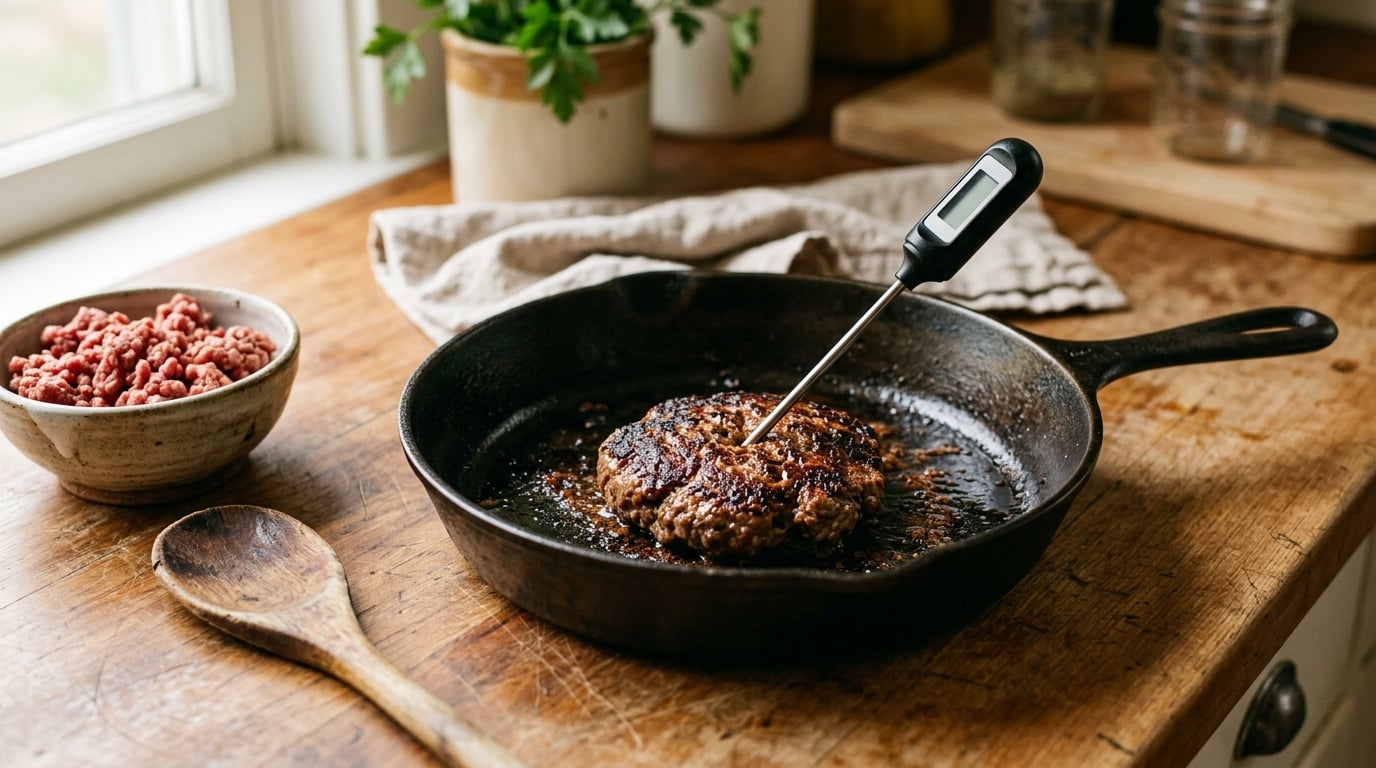
What temperature is ground beef done at? Ground beef is done at an internal temperature of 160°F (71°C), measured with a food thermometer at the thickest part of the patty, loaf, or pile of crumbles. The USDA Food Safety and Inspection Service set that number, and it applies no matter how you cook the beef or what you do with it afterward. Color is not a reliable doneness test, so the thermometer is the tool that settles the question.
I know that sounds blunt, but the pink-in-the-middle panic shows up in nearly every cooking forum I read, and the answer is almost always the same: pull out the thermometer, not the fork.
Burger night is the week this comes up most, and so is meatloaf season, chili season, and the night you brown a pound of beef for tacos. Different dishes, same target. Here is how to hit it, how to check it, and what to do when the beef still looks pink at the finish line.
Table of Contents
What Temperature Is Ground Beef Done At?
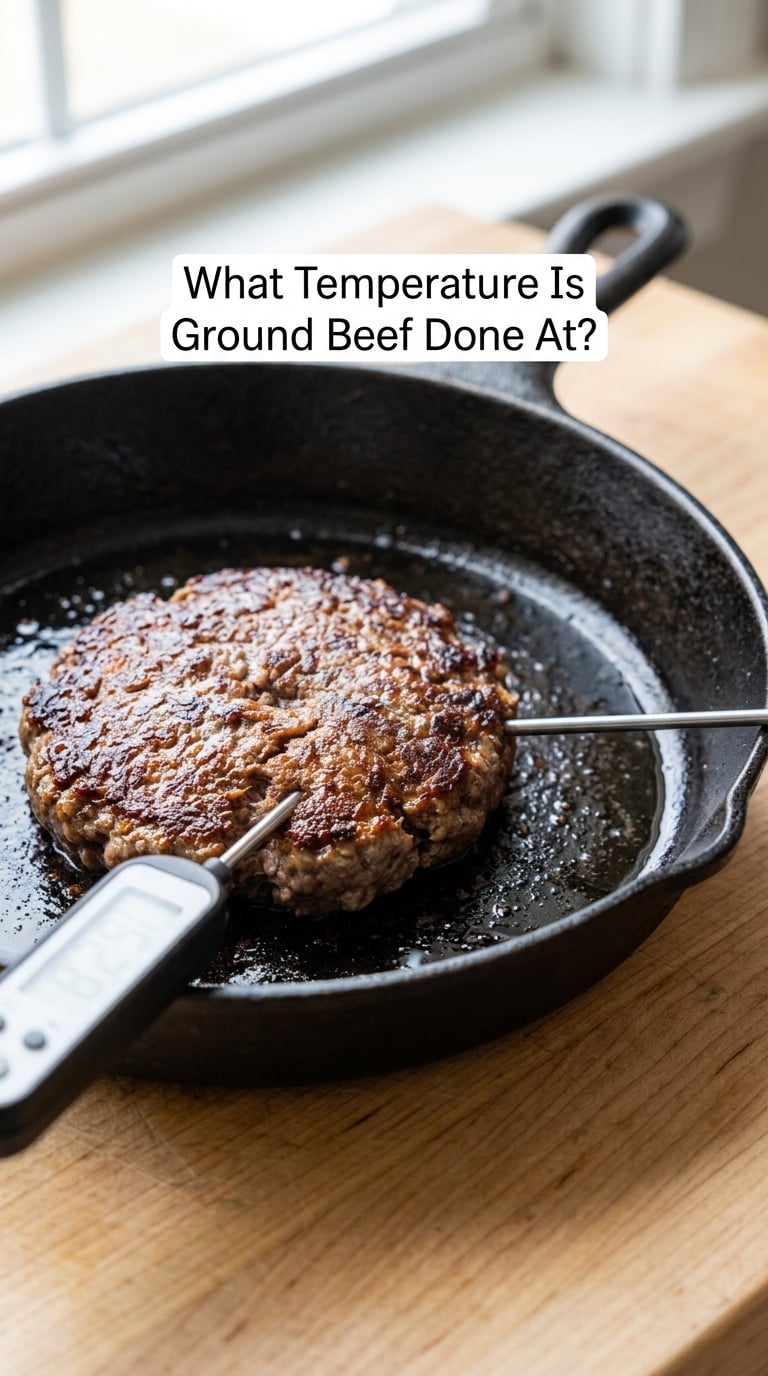
Ground beef is done at 160°F (71°C) internal, straight from USDA guidance. Take the reading in the thickest part of the meat, away from the pan, the bone, or a lump of fat, and let the meat sit for a couple of minutes after cooking so the heat settles.
That is the whole rule. It holds for a plain smash burger, a thick homemade patty, meatballs, meatloaf, taco filling, chili, spaghetti sauce, sausage, and a pan of crumbles. It also holds for ground turkey and ground chicken, which the USDA puts a little higher at 165°F (74°C).
Two things people get wrong. The first is using the 145°F (63°C) figure from steak as their target, which is fifteen degrees too low for anything that has been ground. The second is cooking far past 160 out of fear, which is how a good burger turns into a hockey puck.
Color is the other trap. A piece of beef can be brown on the outside and still be undercooked in the middle, and it can hit 160°F while still carrying a faint pink in the very center. Only a thermometer tells you what you actually need to know.
USDA Safe Ground Beef Temperatures by Dish
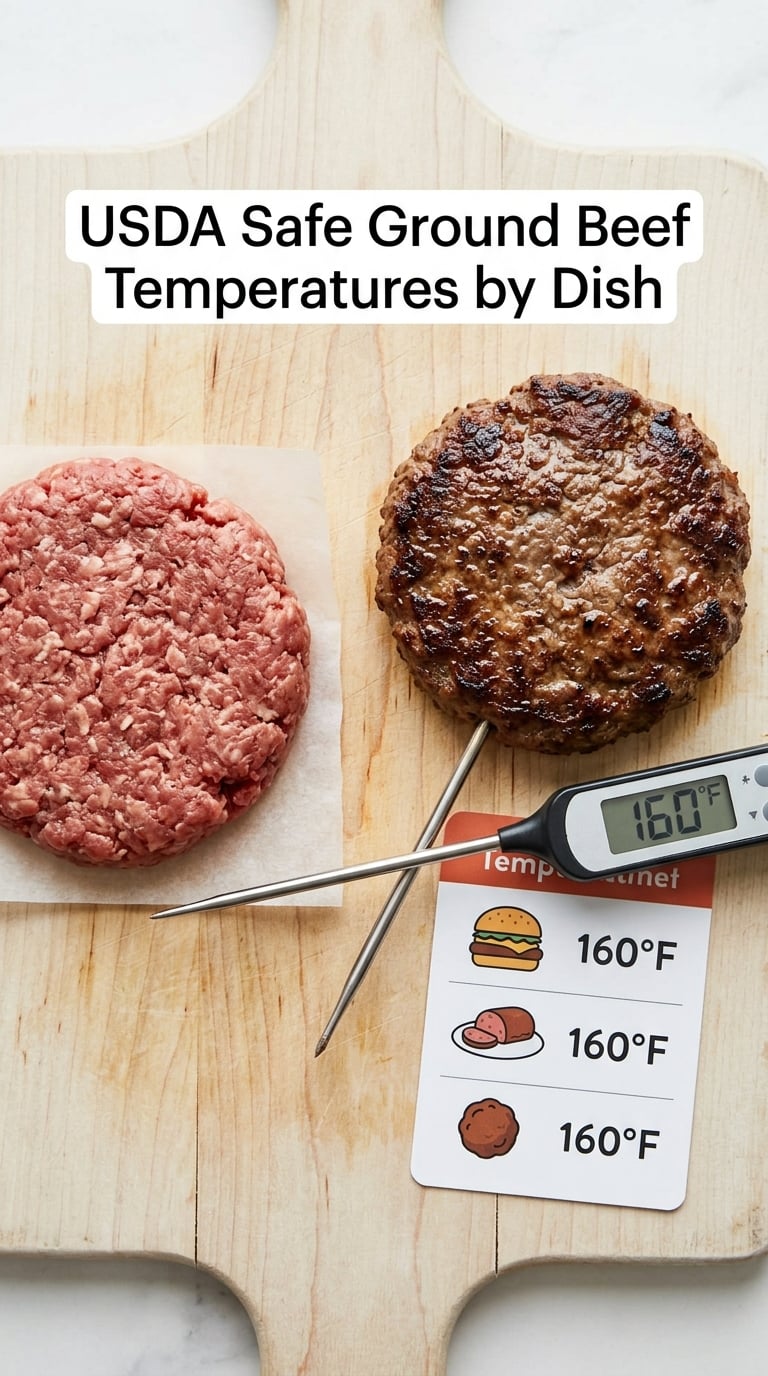
Every dish below lands on the same minimum, so you can cook by the row that matches what is in your pan. The differences are in shape, thickness, and how much heat the form can take.
| Dish | Safe Internal Temperature | Where to Probe | Rest Before Serving |
|---|---|---|---|
| Hamburgers and patties | 160°F (71°C) | Side of the patty, thickest point | 2 to 3 minutes |
| Meatballs and kofta | 160°F (71°C) | Center of one meatball | 3 minutes |
| Meatloaf | 160°F (71°C) | Center of the loaf, not the crust | 3 to 5 minutes |
| Taco filling and beef crumbles | 160°F (71°C) | Sampled from several spots in the pan | 2 minutes |
| Chili | 165°F (74°C) for a bubbling pot | Spoonful from the middle, meat included | 5 minutes |
| Spaghetti sauce and bolognese | 165°F (74°C) for a long simmer | Sauce and meat together, not the oil on top | 5 minutes |
| Beef sausage | 160°F (71°C) | Thickest part, away from the casing | 3 minutes |
| Stuffed peppers and shells | 160°F (71°C) | Straight into the filling | 3 minutes |
| Ground turkey or ground chicken | 165°F (74°C) | Thickest part of the crumbles | 3 minutes |
Chili and long-simmered sauces sit at 165°F in my table because they hold a boil for a while, which drives off the remaining risk in a pot that never gets crowded. Ground beef in those dishes still passes the moment it hits 160°F, and the extra simmer is a bonus, not a requirement.
For a full rundown of the numbers people ask me about most, my Korean ground beef bowls recipe starts with crumbles in a hot skillet, and the ground beef and potato recipes roundup covers the oven and slow cooker routes.
Why Ground Beef Needs 160°F and Not 145°F
Grinding a piece of beef is a mechanical way of moving bacteria off the surface and into the interior. A whole steak keeps most of its microorganisms on the outside, where a hard sear can deal with them. Ground beef has none of that advantage, because E. coli O157:H7 and Salmonella get dragged through the whole batch as the blade works.
That is the entire reason the USDA number is higher. The bacteria are not only on the outside, so the center of the patty has to reach 160°F and hold there, not just brown.
| What You Are Cooking | Safe Internal Temperature | Where Bacteria Live | Rest Time |
|---|---|---|---|
| Ground beef (burgers, crumbles, meatloaf, sausage) | 160°F (71°C) | Distributed throughout the meat | 2 to 5 minutes |
| Whole beef steaks, chops, and roasts | 145°F (63°C) | Mostly on the surface | 3 minutes |
The risk lands hardest on children, pregnant people, adults over about 65, and anyone whose immune system is weakened. For everyone else, undercooked ground beef is an unpleasant gamble rather than a certain outcome, which is why 160°F is worth the thirty seconds it takes to verify.
You may see arguments online about cooking a large single mass of beef to a much lower temperature for a long time. Some of that reasoning applies to whole-muscle dry aging and sous vide, where a hot surface acidifies the outside. It is not USDA guidance for ground beef, and this kitchen does not present it as one.
Can Ground Beef Still Be Pink at 160°F?
Yes, and it is more common than most people expect. Beef gets its color from myoglobin, the protein that holds iron in muscle. Myoglobin does not turn off when the meat reaches temperature, so a patty can measure 160°F in the center and still show a faint rosy tint where the fat was, especially if the beef was fresh, if it came from a grass-fed animal, or if it contains a lot of added fat.
Two other things shift the color. Cured meats with added nitrite hold a pink shade at full doneness. And a recently frozen patty that thawed in the fridge can cook unevenly, so the color varies from the outside in while the temperature is doing its job correctly.
What you should not do is use color to decide. A brown crust tells you the Maillard reaction happened, which is flavor, not safety. Brown on the outside with pink in the very center of a thick patty can still be undercooked, and a gray-brown uniform interior at 160°F is completely safe.
Rest the patty for two or three minutes and slice or press it open. The interior should be uniformly cooked through with no raw-looking pockets, and the thermometer reading is what confirms it. That combination, color plus number, ends the argument for good.
How to Check Ground Beef Doneness with a Thermometer
The technique takes about fifteen seconds once you stop flinching at the skinny probe. Here is the sequence that works every time.
- Pick a thermometer you can read in two seconds. An instant-read digital model is the one to buy for stovetop work.
- Find the thickest part of the beef, away from the pan wall, the bone, the casing, and any pooled fat.
- Push the probe into that thickest part, entering from the side for anything thin so the tip stays in the middle of the meat.
- Keep the probe still until the reading stops climbing. Instant-read thermometers need a few seconds, and moving them gives you a false low number.
- Read the number, then check one more spot. Irregular shapes like a meatloaf or a pile of crumbles can hide a cold corner.
- Wipe the probe with hot soapy water before and after every use, and never put it back in the meat.
Where to put the probe in a thin burger patty
Insert from the side. Push the tip in through the edge and stop in the middle of the patty, never all the way through the top, and never deep enough to touch the pan. A straight-down insertion in a thin patty reads the crust and gives you a number that is too high, which is how people talk themselves into a dry burger.
Which kind of thermometer to use
| Type | Speed | Accuracy | Best For |
|---|---|---|---|
| Instant-read digital | 3 to 5 seconds | High | Patties, meatballs, crumbles, anything on the stovetop |
| Leave-in probe | Reads continuously | High | Meatloaf, roasts, thick batches in the oven |
| Infrared surface reader | Instant | Surface only | Quick surface checks, not doneness decisions |
An infrared gun measures the surface, so it cannot tell you what is happening in the center of a patty. It is a nice sanity check on how hot your pan or grill is, and a poor substitute for a probe. If your thermometer has not been used in a while, test it in ice water, which should read close to 32°F (0°C), before you trust it on dinner.
Ground Beef Cooking Times for Burgers, Meatballs, and Meatloaf
Times are useful for planning and for recognizing that something is going wrong. They are never the doneness test. Thickness, pan size, how full the pan is, and your stove all move these numbers several minutes in either direction.
| Dish | Method | Starting Point | Finish When |
|---|---|---|---|
| Thin smash patties | Cast iron skillet, medium-high | 2 to 3 minutes per side | 160°F (71°C), typically a few seconds early on the second side |
| Thick homemade patties | Skillet, medium heat | 5 to 6 minutes per side | 160°F (71°C) |
| Burgers on a grill | Direct heat, lid closed | 4 to 5 minutes per side for a thick patty | 160°F (71°C) in the thickest spot |
| Meatballs | Oven, 400°F (205°C) | 18 to 22 minutes | 160°F (71°C) through the center of one meatball |
| Meatloaf, 2 pound loaf | Oven, 350°F (175°C) | 55 to 70 minutes | 160°F (71°C) in the center, not near the crust |
| Taco filling | Skillet, medium-high, broken up | 8 to 10 minutes | 160°F (71°C) in several spots, no standing liquid |
| Chili | Slow cooker, high | 3 to 4 hours | Thickened and bubbling, 165°F (74°C) at the center |
| Beef crumbles for a casserole | Oven, 425°F (220°C) | 12 to 15 minutes | 160°F (71°C), edges starting to crisp |
The ground beef noodle casserole is a good example of why the crumbles row matters. Brown the beef to 160°F first, then let the casserole time take care of the rest. Building raw crumbles straight into a casserole and cooking them buried is how you end up with chewy bits in the middle.
If you are cooking at altitude, water boils below 212°F, so a simmer is genuinely cooler. Expect chili and long-simmered sauces to take closer to the upper end of these ranges, and lean on the thermometer rather than the clock.
How to Make Ground Beef Look Done Without Overcooking It
Most dry ground beef is overcooked, not undercooked. Once the thermometer reads 160°F, the safety work is finished, and every extra minute is pure moisture loss.
Brown in batches. A crowded pan drops the temperature, the meat steams instead of sears, and the cooking time stretches out, which is a roundabout way of overcooking. Two pounds of beef fits in two skillets far better than one soggy pile.
Watch the liquid rather than the clock. Ground beef gives up water as it cooks, and when the pan looks dry and the crumbles have changed from pink to brown, you are close. Clear juices running into a still-pink center is a signal to keep going, not a signal to serve.
Know your fat. Regular ground beef carries enough fat to stay juicy on its own. Lean 93% is leaner, so mixing in a little extra fat, or keeping the meat slightly underdone at pull-off time, keeps the texture in range. A little olive oil in the pan does the same job without diluting the flavor.
Rest before you serve. Two to three minutes in a warm spot lets the juices redistribute instead of running out onto the board. A patty pulled straight off the grill and sliced immediately loses more moisture than one that sat for a moment.
If you like using carryover cooking, pull thin patties at 155°F to 157°F and let them finish on a warm plate, arriving at 160°F before anyone eats. The same trick on a meatloaf is worth ten degrees or more because the loaf holds heat far longer than a patty. Either way, the number at the moment of eating is 160°F.
How to Store Raw Ground Beef Before You Cook It
Temperature rules matter before the heat ever comes on. Keep raw ground beef at 40°F (4°C) or below in the coldest part of the fridge, which is usually the back of the bottom shelf rather than the door.
Plan on one to two days in the refrigerator for a fresh package. Freeze it on a flat tray first if you need to portion it, then move the frozen logs into a bag or container so nothing sticks together.
Keep raw beef away from ready-to-eat food. Use a separate cutting board, wash hands with hot soapy water after handling, and wipe down counters and knobs, because bacteria move from the wrapper and the tray to everything you touch next.
Cooked ground beef keeps three to four days in the fridge, sealed. Cool it in shallow containers so it chills fast, and reheat leftovers to 165°F (74°C) until steaming hot all the way through.
Common Ground Beef Cooking Mistakes
Judging by color alone
The most common error, and the one most likely to go the wrong way in either direction. Color is affected by myoglobin, curing agents, and the beef’s age. Take a reading instead, then use color as a supporting cue.
Probing the surface or straight through the top
Both read the crust. Insert from the side and stop in the center of the thickest part, and for a meatloaf check the middle rather than the end where the loaf has set.
Believing clear juices mean done
Juices run clear before the center has fully heated, particularly in a thick patty. The juices are a good secondary signal, never the primary one.
Crowding the skillet
When the pan is full, the meat sits in its own steam, browns poorly, and takes far longer. Cook in batches. A hot pan is what gives you the crust that people are chasing in the first place.
Running the burner too high
A screaming-hot pan burns the fat and the outside of the patty while the middle lags. Medium to medium-high gives an even cook and a better tasting result.
Skipping the rest
Serving immediately means serving the juices on the board. Two to five minutes is enough.
Borrowing steak numbers for ground beef
145°F belongs to whole cuts. Ground beef stops at 160°F, and if you are buying a blend of beef and turkey, the poultry figure of 165°F is the one that governs.
Frequently Asked Questions
Is ground beef safe to eat at 160 degrees?
Yes. The USDA sets 160°F (71°C) as the minimum safe internal temperature for all ground beef, measured with a food thermometer in the thickest part of the meat. That covers burgers, meatballs, meatloaf, taco filling, chili, sausage, and crumbles. It is a minimum, not a maximum, so a reading of 160°F or higher means the meat is safe to eat, and resting a few minutes afterward keeps it juicy.
Can ground beef still be pink at 160 degrees?
Yes, and it is safe. Beef gets its color from myoglobin, which does not change when the meat reaches temperature, so the center of a patty can read 160°F and still show a faint rosy tint, especially with fresh or grass-fed beef or added fat. Nitrite-cured meat stays pink too. What matters is the thermometer reading and a uniformly cooked interior, not the color you see after resting.
Will meat cook at 160 degrees?
Yes. Cooking happens as the meat absorbs heat, and 160°F is hot enough to set proteins, firm the texture, and kill pathogens such as E. coli O157:H7 and Salmonella. Thick forms like meatloaf keep rising in temperature after they come off the heat, often by ten degrees or more, while a thin patty climbs only a few degrees during its rest. Take the reading, then let the meat sit before you slice it.
Should ground beef be cooked to 165 degrees?
Not required. 165°F (74°C) is the USDA minimum for ground poultry, not ground beef, and 160°F (71°C) is the correct target for beef. Many cooks reach 165 out of fear of pink and end up with dry meat. If a long simmer in chili or spaghetti sauce pushes the temperature to 165°F, that is fine, simply because the dish holds heat for a long time. The number that matters is 160°F or above.
What temperature is a 160 hamburger?
A hamburger that has reached 160°F (71°C) in its thickest part is fully cooked and safe to eat. Insert an instant-read thermometer from the side of the patty and stop the tip in the center so it never touches the pan. Restaurants serve burgers that look pinker than 160°F because they use a different standard and different equipment. At home, the thermometer reading is the rule that keeps you and your family safe.
How long should I rest ground beef after cooking?
Two to three minutes is enough for burgers, crumbles, and sausage. Give meatballs and stuffed peppers about three minutes, and a meatloaf three to five so the center finishes cooking. During the rest, carryover cooking adds roughly three to five degrees in a thin patty and ten degrees or more in a thick loaf. If you pull a patty at 155°F to 157°F, it must reach 160°F before it is served.
The Safe Temperature to Remember
One number, one tool. What temperature is ground beef done at? 160°F (71°C), read with a food thermometer in the thickest part of the meat, then a short rest before you serve it.
Keep that on hand for dinner and you can cook every ground beef dish on this site without second-guessing the color. If you also cook pork, my pork temperature guide covers the 145°F figure for whole cuts and where ground pork fits.