
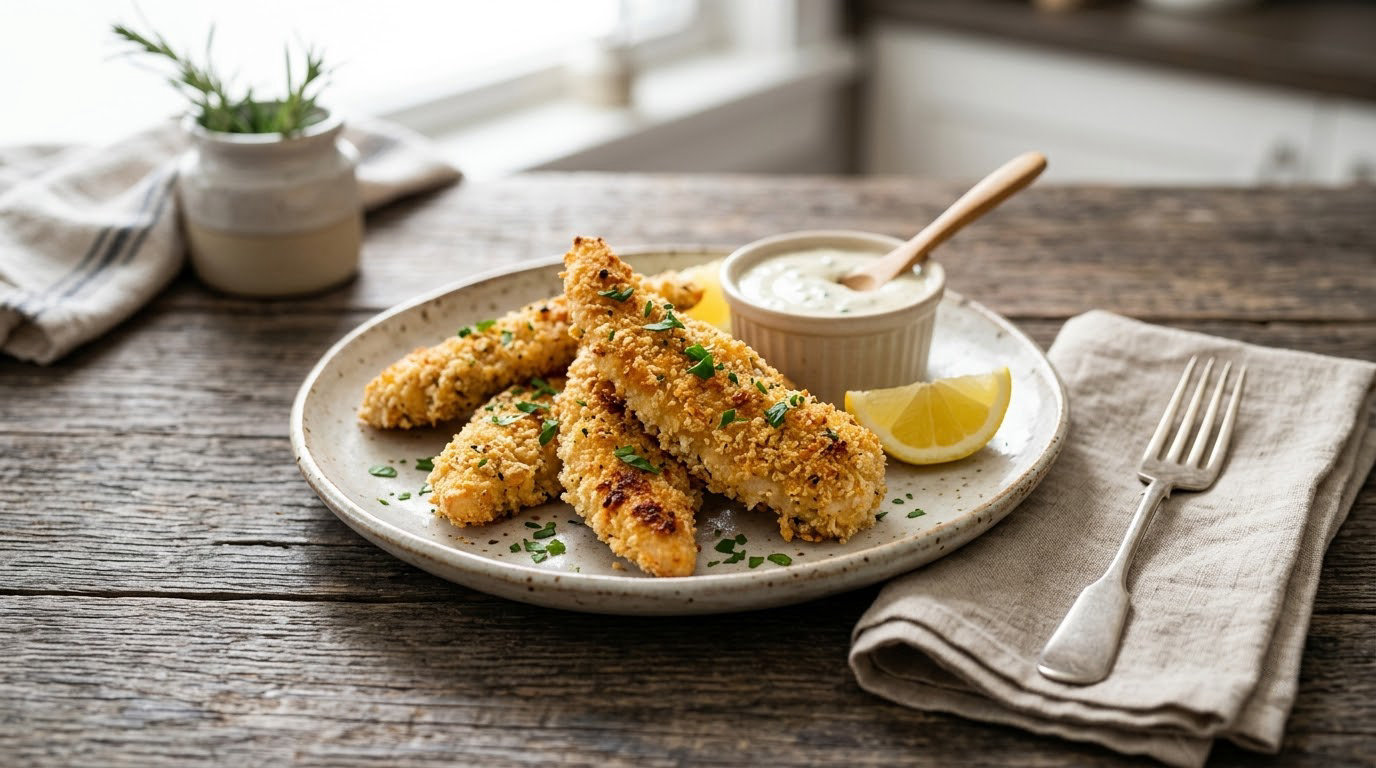
What temperature to bake chicken tenders at? Bake them at 400°F (204°C) for 15 to 20 minutes. That is the dependable all-purpose number: the breading turns golden, the tenderloins cook through evenly, and the window between juicy and rubbery is wide enough for a home oven. Push the oven to 425°F (219°C) when you want extra crunch and can watch the pan closely, or drop to 350°F (177°C) if you are cooking unbreaded meat and want gentle heat.
Whichever temperature you pick, time is only an estimate. Pull the tenders when an instant-read thermometer in the thickest part reads 165°F (74°C). Chicken tenderloins are among the fastest-cooking cuts of chicken, so the gap between perfect and dry is often two or three minutes wide.
This guide covers both senses of the question, because they get mixed up constantly. A raw chicken tenderloin is the small strip of meat on the underside of the breast. A chicken tender usually means that same meat cut, breaded and baked. Breading adds a layer that insulates the meat and needs extra time to crisp, so the numbers are not interchangeable.
Table of Contents
Chicken Tender Baking Temperatures at a Glance
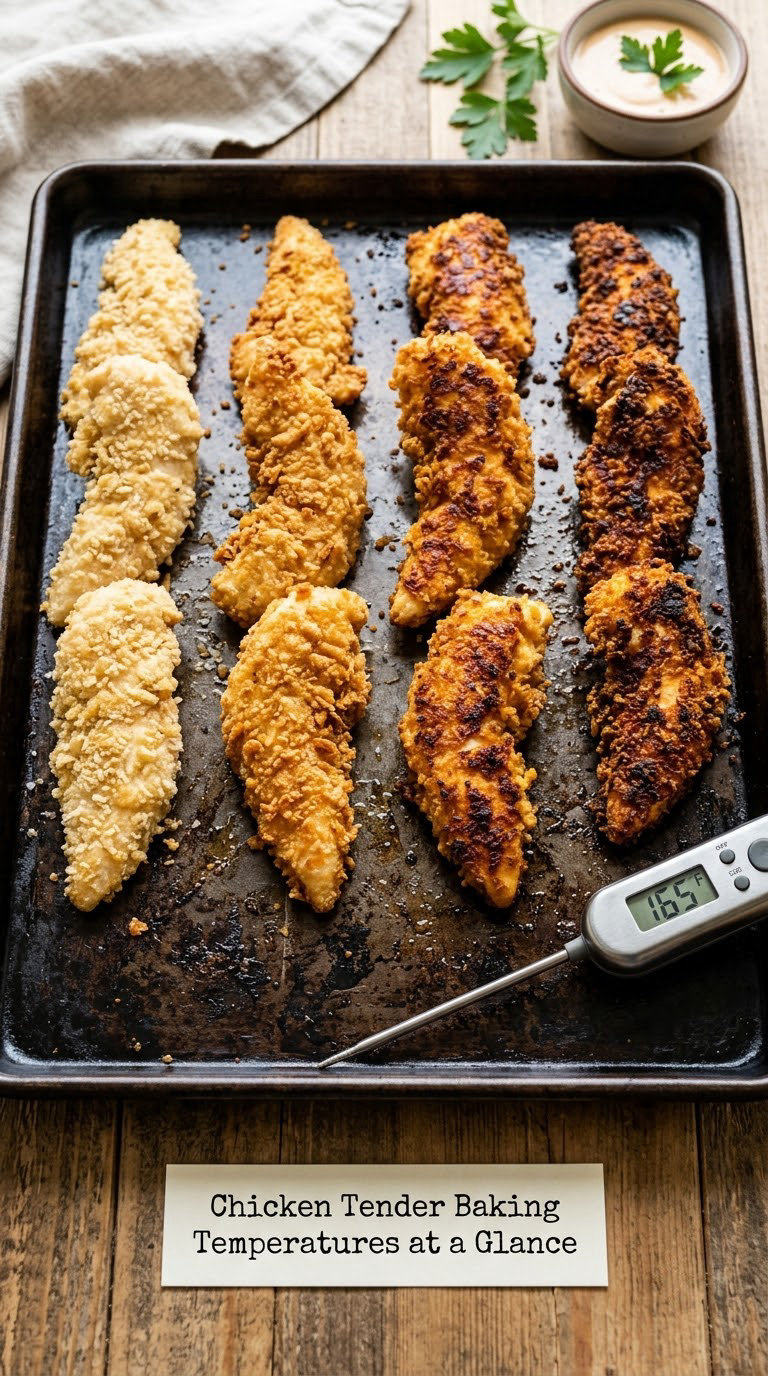
The table below is the whole answer in one place. Times assume a fully preheated conventional oven and tenderloins about three-quarters of an inch thick, spaced in a single layer.
| Oven temperature | Breaded tenders | Unbreaded tenderloins | Texture you get | Best for |
|---|---|---|---|---|
| 350°F (177°C) | 20 to 25 minutes | 18 to 22 minutes | Pale gold, softer crust, moist meat | Unbreaded meat, large batches, ovens that run hot |
| 375°F (191°C) | 18 to 22 minutes | 16 to 20 minutes | Even light browning, tender crumb | Cooks that will be sauced or sliced into wraps |
| 400°F (204°C) | 15 to 20 minutes | 12 to 15 minutes | Deep golden crumb, juicy center | The reliable default for almost any batch |
| 425°F (219°C) | 12 to 15 minutes | 10 to 13 minutes | Crisp, fast, less margin for error | Sheet-pan batches and reheating leftovers |
| 450°F (232°C) | 10 to 13 minutes | 9 to 12 minutes | Very dark edges, dry if it sits | Very thin store-bought strips only |
If you only learn one row, learn 400°F. It browns breading well without rushing the thin center, which is exactly the failure people hit at 450°F.
How Long to Bake Chicken Tenders at the Best Temperature
400°F (204°C) is the best all-purpose temperature for baked chicken tenders because it matches the food. The crumb needs real heat to turn golden and crisp, and the meat inside needs a slower rise so the center catches up before the outside burns.
Breaded tenders run 15 to 20 minutes at 400°F, and unbreaded tenderloins run 12 to 15 minutes. Start checking temperature at the 12-minute mark, because a thin strip from the freezer section can be finished before the timer says so.
What Temperature to Bake Chicken Tenders At?
Bake chicken tenders at 400°F (204°C) for about 15 to 20 minutes, adjust the time for thickness, and stop when the thickest pieces hit 165°F (74°C). Move up to 425°F (219°C) for 12 to 15 minutes when you want a darker, crunchier crust and the pieces are on the thinner side.
That 425°F option is a real choice, not a compromise. Many home cooks report juicier results from the shorter, hotter bake than from a long 350°F roast, and the crumb gets noticeably crisper. The trade is margin: at 425°F you are watching the pan, not walking away from it.
If you are working with whole chicken breast instead, the timing works out differently because the cut is much thicker. How long to bake chicken breast at 400 degrees covers that case in detail.
How Thicker or Thinner Chicken Tenders Change the Cooking Time
Tenderloins vary a lot, and that variation matters more than the oven setting. A thin strip cooked on a screaming-hot sheet pan can go from done to dry inside a single minute, so treat every time in this guide as a starting point rather than a finish line.
Thin strips, under half an inch thick, cook in 10 to 13 minutes at 400°F. Standard raw tenderloins from a whole breast, around three-quarters of an inch, run 15 to 20 minutes breaded. Thick pieces and the thicker store-bought strips can need 20 to 26 minutes, and those are the ones most often overcooked because the recipe time was written for thinner meat.
Frozen and partially frozen pieces need another 5 to 10 minutes on top of the thawed time. The center has to thaw before it can cook, so those tenders finish closer to 25 to 30 minutes at 400°F if they go in frozen.
If you want to compare doneness temperatures across meats, the same rule applies everywhere. What temperature is pork done at breaks down the safe internal targets for pork and other cuts.
How to Bake Chicken Tenders So They Stay Juicy
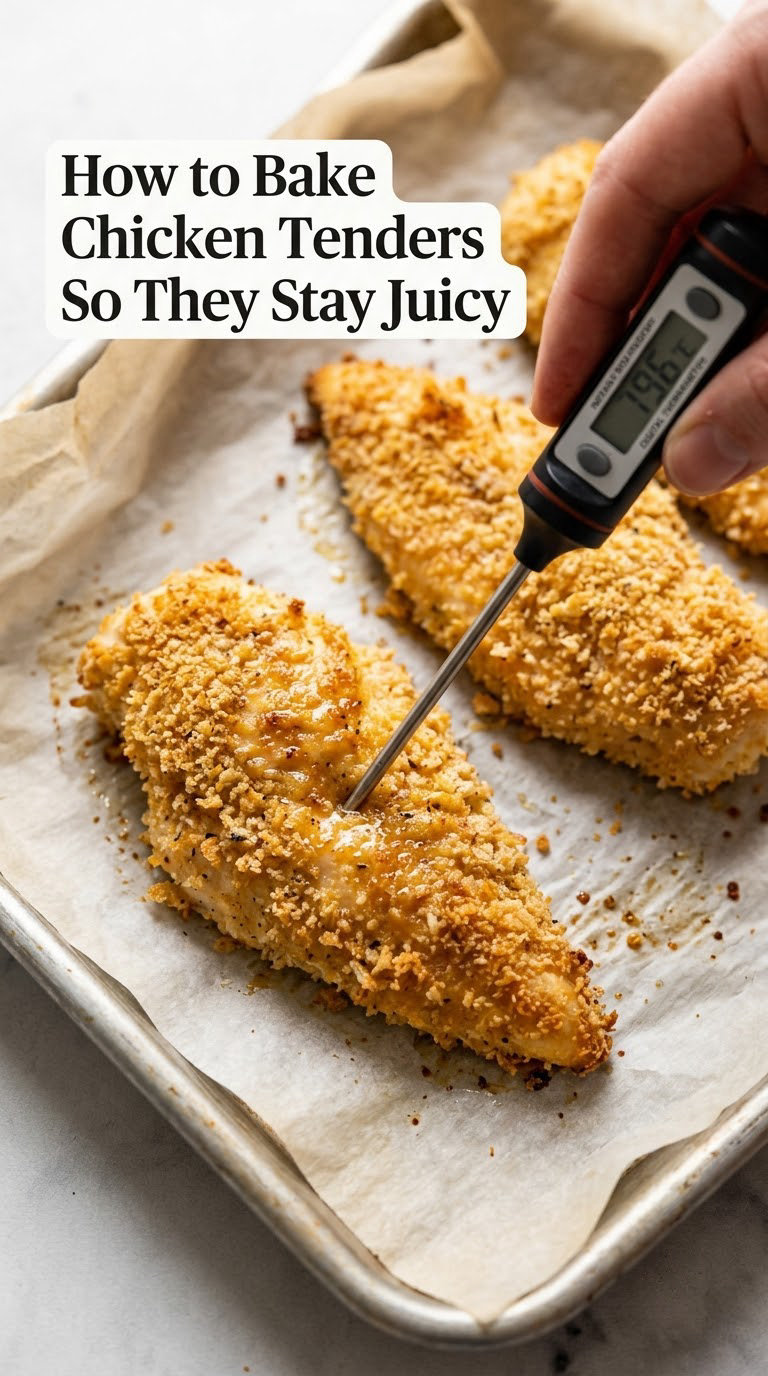
Dry chicken tenders are almost always a spacing, timing, or cutting problem rather than a temperature problem. This method handles all three.
- Preheat fully. Set the oven to 400°F (204°C) and give it a full 15 minutes at temperature. A cold oven makes the crumb pale and forces a longer bake.
- Trim and dry. Pat the raw tenderloins with paper towels. Surface moisture steams instead of browns.
- Season twice. Salt and pepper the bare meat first, then season the breading. This seasons the inside, not just the shell.
- Dredge in three steps. Flour, then egg, then seasoned panko or breadcrumbs. Press the crumbs on firmly so the coating does not slide off in the oven.
- Space them out. Leave a finger’s width between each tender. Crowding is the single most common cause of a soggy coating, because the pan traps steam instead of letting moisture escape.
- Line and spray. Use parchment or a light coating of cooking spray. A bare sheet pan sticks and tears the breading off.
- Flip once. At the halfway mark, turn each tender and give it a quick spray of oil. That second side browns as well as the first.
- Check with a thermometer. Test the thickest piece at 165°F (74°C), not the smallest.
- Rest two minutes. Let them sit on the pan before serving so the juices settle back into the meat.
Do You Need to Preheat the Oven for Chicken Tenders?
Yes. Preheating matters more for tenders than for a large roast, because the pieces are small and the bake is short. A cold or slow-heating oven spends the first several minutes pulling moisture out of the chicken while the crumb sits pale and pasty.
Once the oven reaches temperature, tenders get oven spring quickly, meaning the crumb sets and browns fast in the first few minutes. That head start is what gives you the golden exterior at 400°F without a long, drying bake.
For a convection oven, drop the temperature by 25°F (14°C) or shave a few minutes off the time. Convection cooks tenders noticeably faster because moving air browns all sides at once.
Home ovens vary a lot. If yours runs hot, drop 25°F. If it runs cool, add 25°F and start checking temperature earlier. An oven thermometer costs very little and removes the guesswork from every bake after that.
Should You Bake Chicken Tenders from Frozen?
You can bake chicken tenders straight from frozen, and it works. Expect to add 5 to 10 minutes over the thawed time, and expect less browning, because the moisture on the surface has to burn off before the crumb colors.
A middle option works better than fully frozen. If you have ten minutes, lay the frozen tenders on a towel or a rack set over a tray, mist them lightly, and let them lose their ice glaze before they go in the oven. That alone tightens up the crust noticeably.
Do not skip the thermometer with frozen pieces. This is exactly the situation where recipe times mislead you most, since a frozen center reads undercooked long before the outside burns. Check at 20 minutes and keep checking every two minutes after.
Planning a bigger dinner instead? This easy bang bang chicken bake recipe uses the same 400°F logic on a full sheet pan, so the preheat and thermometer rules carry straight over.
How to Tell When Chicken Tenders Are Done
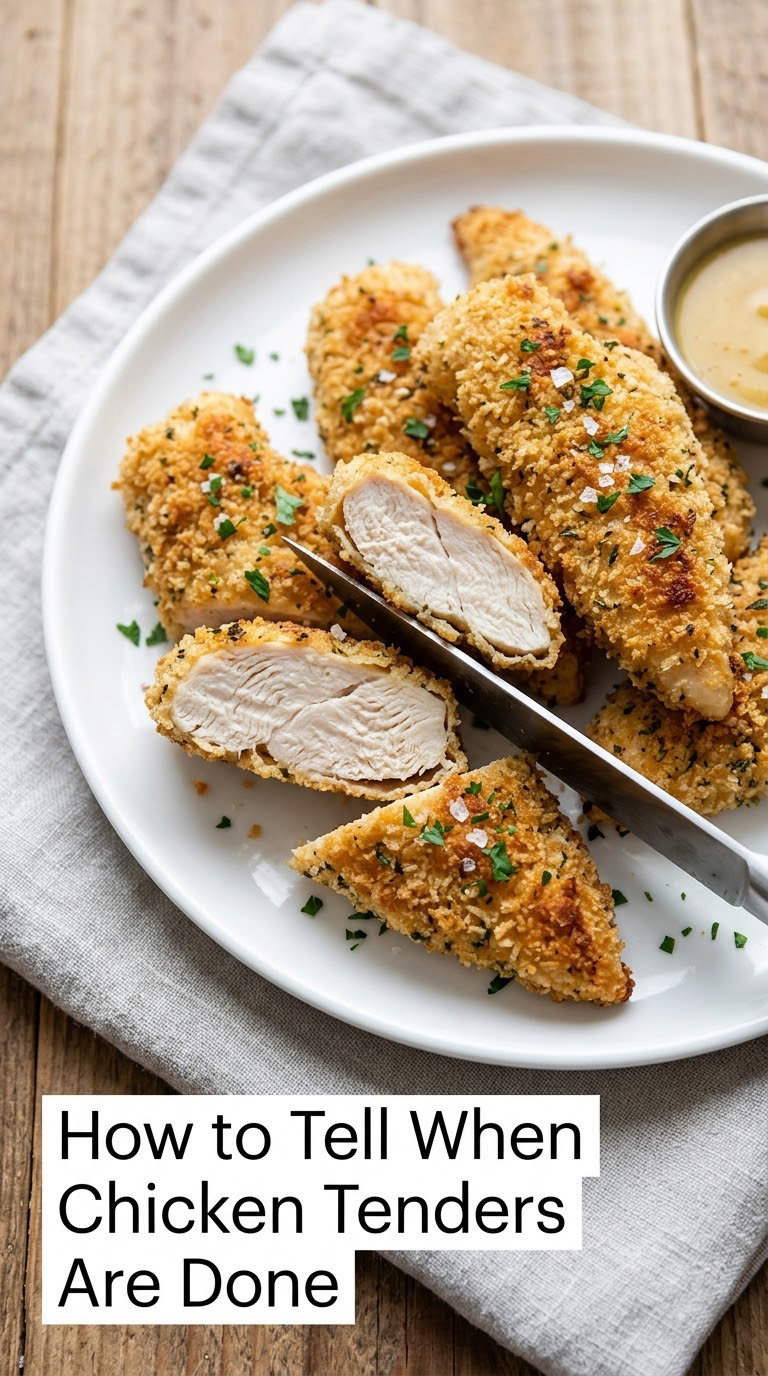
A thermometer is the only reliable test. Everything else is a hint, and on chicken those hints lie often enough to matter.
Cut into the thickest tender and look for firm white flesh all the way through, with no translucent or pink patches remaining. The juices that run out should run clear rather than pink, and a cooked tender springs back when you press it instead of feeling rubbery.
The safe internal minimum is 165°F (74°C), measured in the thickest part of the piece. There is debate about pulling tenders a touch earlier, around 160°F, since residual heat keeps cooking them during the rest and some cooks find that more moist. 165°F is the food safety standard, and carryover cooking means a piece measured at 162°F will pass through 165°F within a couple of minutes of resting.
Where you put the probe matters more than usual on a thin cut. Push it into the thickest section, not the tapered end, which will read low and make you think you need longer. On very thin tenders, check at 12 minutes instead of at the end, because the difference between readings is short and hot pans cool quickly.
Common Mistakes When Baking Chicken Tenders
Crowding the pan. The fix is one layer with space between pieces, or a second pan. Steam trapped between tenders softens the breading, and a soggy crumb is the reason most people give up on baked tenders.
Going too low. A 350°F bake is the reason for pale, limp breading. The crumb needs 400°F or above to crisp. If you want gentler heat, use it for unbreaded meat, not coated tenders.
Going too high. At 450°F the outside burns long before the thin center catches up, which leaves you with dry tenders and a dark crust. Heat the pan before it enters the oven.
Trusting the recipe time. The pan position, the number of pieces, and your oven all change the clock. Start checking temperature before the stated time ends.
Skipping the preheat. The bake gets longer, the crumb gets pale, and the meat loses more moisture than it should.
Breading without pressing. Loose crumbs fall off in the oven. Press each piece into the crumbs with your fingertips so the coating grips.
Testing tenderness by color of the crust only. A dark crust tells you nothing about the center. Cut and probe instead.
Flipping too early. Flip at the halfway mark, not at the first sign of color. Early flipping breaks the crumb before it has set.
Frequently Asked Questions
Can I bake chicken tenders at 350°F?
Yes, and unbreaded tenderloins are the best use for it. At 350°F (177°C), expect about 18 to 22 minutes for unbreaded meat and 20 to 25 minutes for breaded tenders. The trade is color: the crumb bakes to a pale gold and stays softer and cakier. Many home cooks prefer this low-and-slow result because the longer bake leaves the meat moist, especially in big batches.
How long do chicken tenders take at 425°F?
At 425°F (219°C), breaded chicken tenders take 12 to 15 minutes, and unbreaded tenderloins take 10 to 13 minutes. Flip them once at the halfway point. This is a fast, high-heat bake that gives the crispest crust of any oven temperature, but the margin for error is narrow, so start checking temperature early and pull at 165°F.
Do breaded chicken tenders need a different baking temperature?
Breaded tenders can use the same temperature as unbreaded ones, but they need more time. The coating insulates the meat and takes extra heat to turn golden and crisp, so breaded pieces run 15 to 20 minutes at 400°F while unbreaded tenderloins finish in 12 to 15. Breading also slows moisture loss, which is one reason breaded tenders stay moist at higher heat.
Why are my chicken tenders dry on the edges?
Dry edges usually mean high heat for too long, a crowded pan, or thin pieces cooking faster than the middle. Shorten the bake, space the tenders a finger’s width apart, and pull them at 165°F rather than waiting for the crust to darken further. A light spray of oil on each side also helps the crumb set faster so the meat spends less time in the oven.
Can I cook chicken tenders from frozen in the oven?
Yes. Bake straight from frozen at 400°F (204°C) for about 25 to 30 minutes, adding 5 to 10 minutes over the thawed time. The browning will be lighter because surface moisture must burn off first, so patting the pieces dry and misting them lightly before baking helps. Verify a 165°F internal temperature, since frozen pieces can read undercooked long before the outside burns.
How should I store and reheat baked chicken tenders?
Store cooked tenders in an airtight container in the refrigerator for 3 to 4 days, or freeze them in a single layer on a tray before bagging so they do not stick together, for up to 2 to 3 months. Reheat in a 375°F (190°C) oven for 8 to 20 minutes, or use 300°F (150°C) for 15 to 20 minutes to dry the surface and bring the crunch back.
Conclusion
Start here: preheat the oven to 400°F (204°C), bake breaded chicken tenders for 15 to 20 minutes with a flip at the halfway mark, and pull them when the thickest piece reads 165°F (74°C). Check temperature at 12 minutes rather than trusting the clock alone.
If you want more snap, go to 425°F (219°C) for 12 to 15 minutes and watch the pan the whole time. An instant-read thermometer is the single tool that separates good tenders from dry ones, and it takes ten seconds to use.