
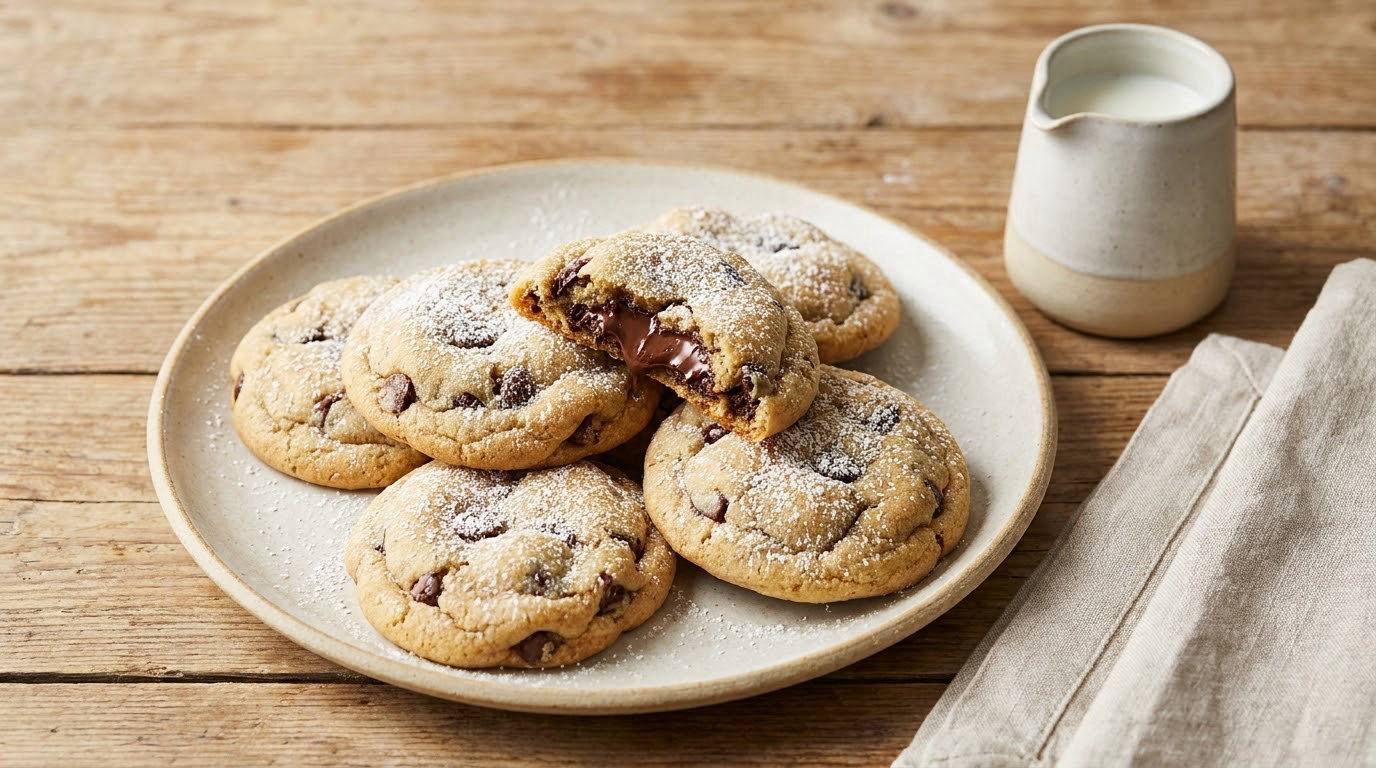
To keep cookies soft after baking, let them cool completely on a wire rack, then seal them in an airtight container at room temperature. Tuck a slice of plain white bread in with them and the cookies stay chewy for days. Most bakers lose the texture long before the flavor, and almost always the storage step is why.
I have baked a lot of cookies, and the batches that turn soft and stay soft follow the same routine every time: pull them a minute early, cool them with air moving around, and never let them sit warm in a lidded tin. Everything below is that routine, plus what to do when a batch is already gone hard.
Table of Contents
How to Keep Cookies Soft After Baking: Quick Guide
Here is the short version, in order:
- Bake 1 to 2 minutes less than the recipe says, until the edges are set and the center still looks underdone.
- Leave the cookies on the baking sheet for 5 minutes, then move them to a wire rack.
- Cool on the rack until they are no longer warm at all, usually 5 to 10 more minutes.
- Wrap each cookie tightly in plastic wrap, or place parchment between layers if you are stacking.
- Store in an airtight container at room temperature with a slice of plain white bread.
- Freeze anything you will not eat within 3 days, and thaw it at room temperature in the closed container.
That is the core method. The table below is the quick reference by cookie type.
| Cookie type | Wrapping | Container | Stays soft for |
|---|---|---|---|
| Thick chewy chocolate chip | Plastic wrap, individually | Airtight container plus a slice of bread | 3 to 5 days |
| Thin crisp cookies (sugar cookies, snickerdoodles) | Parchment between layers | Airtight tin, no bread | 5 to 7 days, keeps its snap |
| Drop cookies (oatmeal, chocolate chip) | Plastic wrap | Airtight container, bread optional | 2 to 3 days |
| Frosted or filled cookies | Single layer on parchment | Airtight container, do not stack | 2 to 4 days |
| Meringues, macarons, biscotti | No wrapping needed | Airtight container or freezer bag | 2 weeks or longer |
| Any cookie, long storage | Single layer, then sealed | Freezer bag or freezer container | Up to 3 months frozen |
What Makes Cookies Soft or Hard?
Cookies do not get hard because something happens to them. They get hard because water leaves them. A cookie is a sponge with a lot of water held in it, and that water is always trying to move toward whatever is drier around it.
That is the whole mechanism. On a plate, the open air is drier than the cookie, so the cookie dries out. In a sealed container, a soft cookie sitting next to a crisp one will still hand off water until both sides reach the same moisture level. Seal warm cookies and you add a second problem: the steam still inside them condenses on the inside of the lid, and the crumb goes gummy in patches.
Heat speeds all of this up. A kitchen at 78°F will take a batch of cookies from soft to snappy about a third faster than a cool 65°F room, which is one reason the same recipe behaves differently in July and in January.
A few ingredients change how much water a cookie can hold in the first place. More sugar means more water, because sugar dissolves in moisture and holds onto it. Fat tenderizes by coating flour proteins so they cannot bond into a tight network, and melted fat coats them even more evenly than creamed butter. Egg yolks carry fat and proteins that hold water in a way that whole eggs do not. More flour means a drier, denser crumb, and overmixing develops gluten, which is the single easiest way to turn a chewy cookie into a cracker.
How to keep cookies soft after baking: the four levers
When a batch goes wrong, the fix is almost always one of these four, in this order of impact:
- How long it baked. Two extra minutes is the difference between chewy and hard.
- How it was stored. Airtight or not, this decides what happens after hour one.
- Whether it was sealed warm. Condensation ruins the crumb inside a closed container.
- What the dough was made of. Sugar, fat, and flour ratios set the ceiling.
How long do cookies take to harden after baking?
Most cookies start losing softness in the first 15 minutes, because that is when the residual moisture inside them begins to migrate. The sharp drop happens over the first 12 hours. By day two, a badly stored batch has finished hardening, and no amount of wrapping will bring it back.
Choose a Soft Cookie Formula
Good soft cookies are a formula, not a vibe. The things that reliably support a tender center are a high sugar-to-flour ratio, melted butter, egg yolk rather than whole egg, and a spoonful of cornstarch.
- Sugar: use more sugar than the recipe calls for if you can stand it, and lean on brown sugar. The molasses in brown sugar is hygroscopic, which means it pulls water in and holds it.
- Fat: melted butter gives a softer, cakier crumb than creamed butter. Shortening produces an even softer cookie because there is no water in it at all to stiffen the batter.
- Eggs: an extra yolk adds fat and binds moisture. Using only whites gives you a cakey, drier cookie.
- Cornstarch: 1 to 2 tablespoons per cup of flour. It absorbs free moisture and leaves the center tender. Cornmeal does something similar at a smaller dose and adds a pleasant grittiness.
- Flour: do not add extra flour to make shaping easier, and weigh it if you can. A packed cup can carry 20% more than a spooned one.
- Mixing: stop as soon as the flour disappears. Overmixing is the reason many recipes with good ratios still come out hard.
- Chilling: an hour of rest in the fridge lets the flour hydrate and the butter firm up, so the cookies spread less and the ratio of soft center to baked edge improves.
If you want a starting point that already leans soft, this soft and chewy chocolate chip cookie recipe is a good baseline to adjust from.
How do bakeries get their cookies so soft?
Commercial soft cookies are not magic, they are engineered in four ways. A portion of the sugar is swapped for corn syrup or golden syrup, which is so moisture-hungry that the cookie stays tacky for days. Shortening often replaces butter, removing water from the dough entirely. The bake is short and the temperature is low, so the center barely sets before the pan comes out. And the cookie finishes on the pan, where residual heat keeps setting the base while the middle stays soft.
Stop the Cookies from Drying Out in the Oven
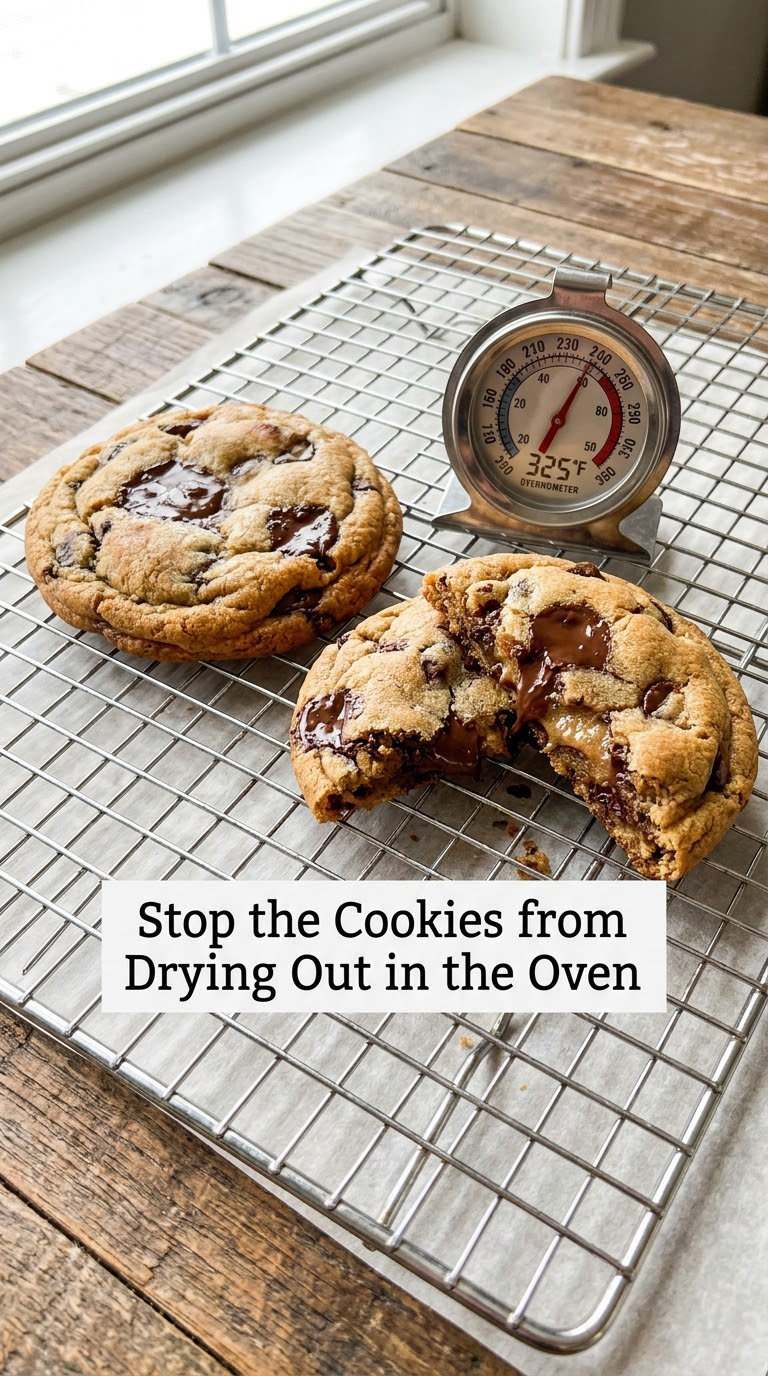
Overbaking is the most common reason a soft cookie turns out hard, and it is usually not a recipe problem. Most people pull the tray at the stated time plus two or three extra minutes because the center still looks pale, and that pale center is exactly what you want.
- Bake one to two minutes less than the recipe time, then check. The edges should be set and golden, and the center should still look slightly wet and underdone.
- Watch the sheet, not the clock. A frozen dough ball needs longer; a room-temperature one needs less.
- Size the dough balls larger than the recipe suggests if you want a softer center. A wider cookie has more edge, and edge is what dries out first.
- Lower the temperature to 325°F (165°C) for thin cookies. Small cookies often need only 5 to 7 minutes there, where a large one would sit for 10 to 12, and the shorter exposure is what keeps the middle tender.
- Use the middle rack and rotate nothing if you can avoid it. Top rack cookies brown in a patch and dry unevenly.
- Check your oven with a thermometer. Many run 25°F hot, which is the difference between a soft cookie and a crisp one at the same recipe time.
- Space them two inches apart so the edges do not bake into each other and then crisp together.
Cool and Store Cookies Without Making Them Stale
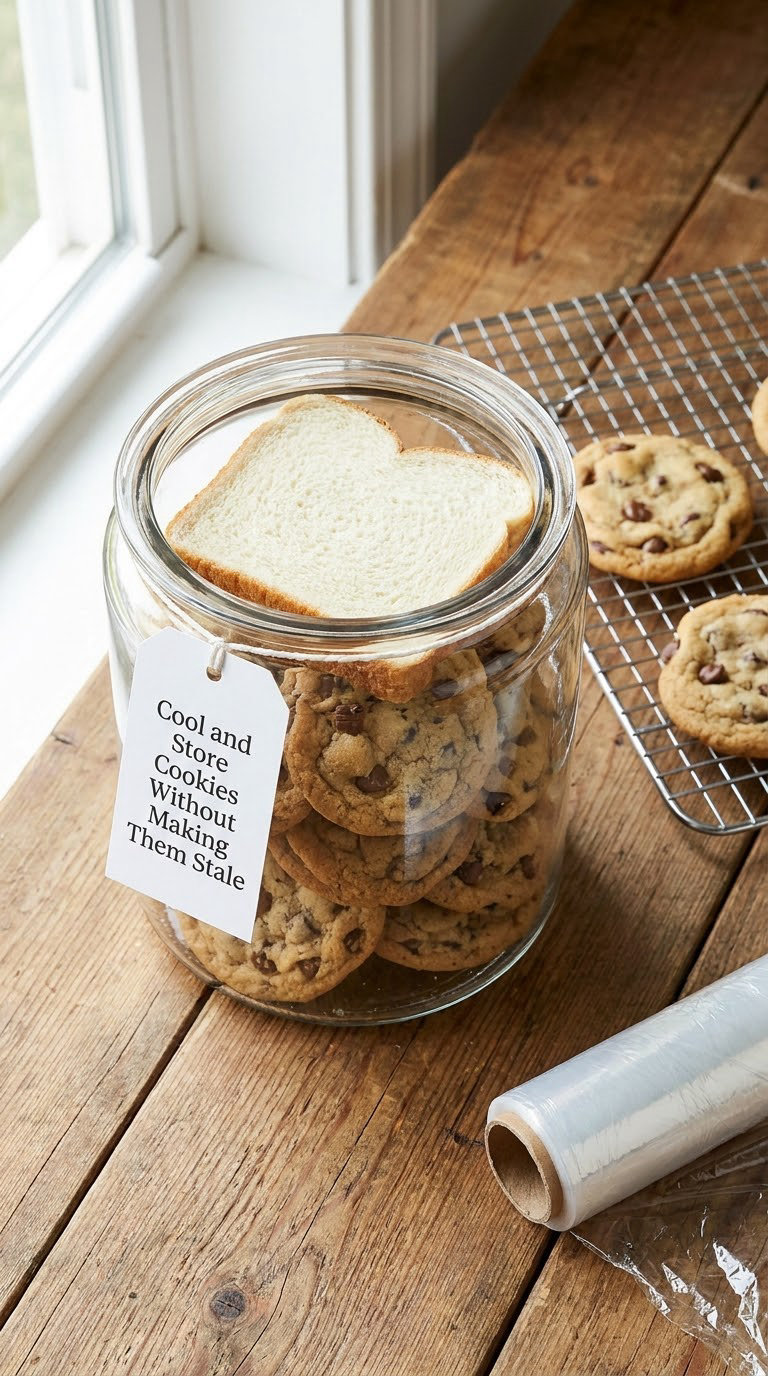
The cooling step is where good batches get ruined, and it is the step most guides skip. Steam is still inside a cookie when it leaves the oven, and sealing that steam into a container is what produces cookies that are gummy in spots and hard in others.
- Rest on the pan for 5 minutes. The cookies are firm enough to move but still cooking.
- Move to a wire rack. A flat sheet traps steam underneath and softens the bottoms for no reason.
- Cool until completely cool to the touch, 5 to 10 minutes. Test the bottom, not the top.
- Wrap while barely warm. Plastic wrap is the best tool for soft cookies because it clings and traps what little moisture is left. Wrap each one individually.
- Layer with parchment if you would rather not wrap, and always separate frosted cookies with it.
- Seal and store at room temperature in a hard plastic container with a tight lid, a glass cookie jar, a Mason jar, or a heavy zip-top bag. Press the air out of the bag first.
- Label and date it. Write the date on masking tape on the lid so you know what is oldest.
Never put a damp paper towel in the storage container. It is a fine rescue for a few minutes in the microwave, but sealed overnight it will make your cookies genuinely soggy.
Why the bread slice works, and when to skip it
A slice of plain white bread works because the cookies are wetter than the bread. Moisture migrates from the cookies into the bread, and the bread slowly re-releases it, which is why the slice goes stale first and the cookies stay soft.
Use plain white sandwich bread only. Rye, seeded, garlic, or sourdough will transfer its flavor into the cookies overnight, and dried-out bread gives the cookies nothing to draw from. Replace it every day or two.
Skip the bread when the cookies are already very moist, when you are freezing them, or in a humid climate where you need the opposite problem. A small sugar cube does the reverse job: it pulls excess moisture out of cookies that have gone soft in humid air. For long-term storage, a food-safe desiccant packet is more reliable than bread, and it will not go stale on day three.
How Long Do Soft Cookies Stay Soft?
Storage method matters more than the container’s material. Here is what to expect.
| Storage method | Thin cookies | Chewy cookies | Frosted or filled |
|---|---|---|---|
| Counter, airtight container with bread | 3 to 4 days, may soften | 3 to 5 days | 2 to 4 days |
| Counter, airtight container, no bread | 5 to 7 days, keeps its snap | 2 to 3 days | 2 to 3 days |
| Counter, heavy zip-top bag | 1 to 3 days | 1 to 2 days | 1 to 2 days |
| Fridge, airtight | Not recommended, dulls flavor | 2 to 4 days, texture flattens | 2 to 3 days |
| Freezer, sealed | 3 months | 3 months | 3 months |
| Freezer dough, baked from frozen | Bake 2 minutes longer, freshest result | Bake from frozen, add 1 to 2 minutes | Not suitable |
Thaw frozen cookies in the closed container at room temperature, never on a plate. Condensation forms on any surface exposed to air, and that is how thawed cookies turn to paste. For a warm cookie the same day, 10 seconds in the microwave does the job.
How to Revive Cookies That Have Become Hard
Reviving works because heat and moisture briefly return water to the starch, then the cookie has to cool in an airtight container to hold onto it. Warming and then leaving the cookie on a plate is why the trick seems to do nothing twice.
- Microwave, the fastest fix. Put cookies on a plate, drape a barely damp paper towel over the top, and microwave 8 to 15 seconds on medium power. Eat within a few minutes.
- Oven, the better fix. Heat to 300°F (150°C), put cookies on a baking sheet, and warm for 5 minutes. This is the method that gets you a warm-baked texture rather than a chewy rubber one.
- Toaster oven. Same temperature, 3 to 4 minutes, and it is worth watching, since the element is close.
- Stovetop. A skillet over low heat, 2 to 3 minutes per side, works for a single cookie in a pinch.
- Cool it sealed. After any of these, cool the cookie in a closed container so the moisture stays in it.
Do not use these on cookies with buttercream, ganache, or royal icing, which will melt. And never rebake cookies in the oven to fix dryness, which is how the batch ends up twice as hard.
Microwave softening times by cookie size
| Cookie | Time on medium power | Best method |
|---|---|---|
| Small snickerdoodle, 2 inch | 6 to 8 seconds | Microwave |
| Standard chocolate chip, 3 inch | 10 to 12 seconds | Microwave or 300°F oven |
| Thick, gooey cookie, 4 inch | 15 seconds, check at 10 | 300°F oven, 5 minutes |
| Slice of a thick batch cookie | 12 to 15 seconds | 300°F oven, 5 minutes |
Common Mistakes That Dry Cookies Out
Each of these is a real, recurring mistake in home baking forums, and each has a specific fix.
- Baking two to three minutes too long. Fix: pull when the center still looks underdone and let the pan finish the job.
- Cooling uncovered on the baking sheet. Fix: 5 minutes on the pan, then a wire rack so air moves on all sides.
- Storing warm cookies. Fix: wait until they are completely cool to the touch on the bottom, not just the top.
- Wrapping loosely or using a paper towel. Fix: plastic wrap, snugly, individually.
- Spooning and packing the flour. Fix: spoon and level, or weigh. This is often a bigger problem than the bake time.
- Leaving out the egg yolk, or using only whites. Fix: an extra yolk adds fat and water-binding proteins.
- An uncalibrated oven. Fix: an oven thermometer on the middle rack. If it reads high, drop the recipe temperature by 25°F.
- Overmixing the dough. Fix: mix until the flour is just gone, then stop. This is also the fix if the leavener question comes up, and baking soda versus baking powder changes browning more than most people expect.
Cookies That Are Naturally Crisp or Long-Lasting
Not every cookie should be soft. Biscotti, shortbread, crackers, meringues, and most lace cookies are meant to be crisp, and soft-storage methods will ruin them.
Give them an airtight metal tin or glass container on their own, and never add bread. Bread will make shortbread chewy in a way that tastes wrong. These cookies are also low in moisture to begin with, which is why they keep for a week or two when soft cookies cannot last five days. The same moisture logic runs in reverse for baked cakes: a soft, moist cardamom orange cake uses oil and sour cream to hold water in the crumb where a butter cookie would not.
Moisture equilibrium runs both directions. A soft cookie stored beside a crisp one dries out faster, and the crisp one goes soft and limp. Two batches, two containers.
Frequently Asked Questions
Should soft cookies be wrapped while they are hot?
No. Wrapping warm cookies seals escaping steam inside, where it condenses on the lid and on the cookies themselves, leaving them gummy in patches and hard around the edges. Let them cool on a wire rack until they are no longer warm on the bottom, then wrap. If you are in a hurry, spread them in a single layer and fan them for a few minutes so the steam can leave.
Why are my cookies soft in the middle but hard on the outside?
The edge is the part with the most surface area and the longest time in the heat, so it dries out first. It is a normal result, not a failure, and the fix is to pull the tray 1 to 2 minutes earlier, keep the dough balls larger, and leave at least two inches between cookies so the edges do not merge and crisp together. Cornstarch in the dough also softens the edge.
Do I need to refrigerate cookies to keep them soft?
No. The refrigerator dulls flavor and flattens texture, and cookies absorb fridge odors readily, so a lemon or onion in the crisper will find its way into your chocolate chip cookies. Room temperature in an airtight container is the right call for a few days. The freezer is the only cold storage worth using, and it pauses staling rather than slowing it.
Can parchment paper keep cookies soft overnight?
Parchment protects cookies from sticking and from absorbing odors, but on its own it does nothing about moisture loss, because air still reaches the cookies from above. It is a good companion to plastic wrap, and it is the right choice for frosted or filled cookies that you want to stack without the frosting sticking. For soft cookies, snug plastic wrap is what holds the moisture in.
How do I keep cookies soft without making them soggy?
Seal cookies only once they are fully cool, and use a dry container. Sogginess almost always comes from trapped steam or from a damp paper towel left in the container overnight. Wipe out the container before storing a batch, keep it in a cool room, and if your kitchen is genuinely humid, skip the bread and store a sugar cube to pull the extra moisture back out.
Does adding cornstarch make cookies stay soft longer?
Yes, indirectly. Cornstarch absorbs free moisture in the dough, which leaves the center tender and less prone to drying out, so the cookie starts softer and stays softer. Use 1 to 2 tablespoons per cup of flour, or replace 2 tablespoons of the flour with cornstarch. It will not rescue a batch that is overbaked or stored warm, and it will not stop a crisp cookie from staying crisp.
Start with the Wrapping Method
If you change one thing about how you bake, change the wrapping. Cool each cookie on a wire rack until it is completely cool, wrap it snugly in plastic wrap while it is barely warm, and store it in an airtight container at room temperature with a slice of plain white bread. That alone fixes most of the batches that turn hard overnight.
After that, tune the bake. Pull the tray 1 to 2 minutes early, weigh the flour, and add a spoonful of cornstarch. Texture still varies by cookie style, and that is the point: a chewy chocolate chip cookie and a thin sugar cookie cannot both live in the same container. If you tell me which cookie you are making and whether the problem is hardening, too much softness, or the recipe itself, I can narrow the fix down to one or two changes. Our other baking guides, updated for 2026, go deeper on the flour and leavening side of the same problem.