
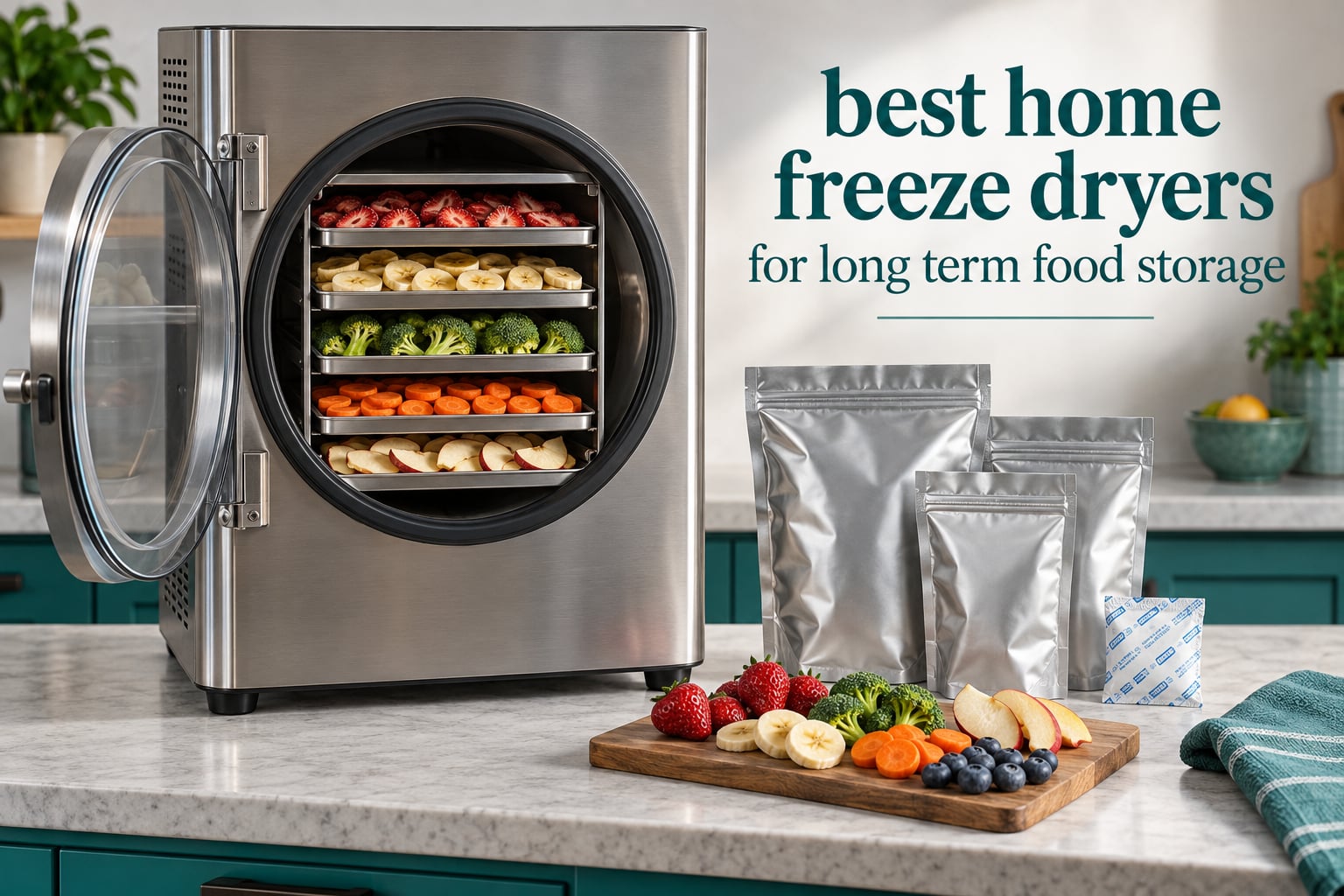
Every year the same question shows up in our inbox, usually in October, when the garden is coming in faster than the freezer can hold it: is a home freeze dryer actually worth the money, and which one should a normal household buy? This guide covers the best home freeze dryers for long term food storage we could find in 2026, with real batch sizes, cold trap temperatures, tray counts and warranty terms pulled from the manufacturer specifications of eight current machines.
I want to start with the part most roundups leave out. If you live in an apartment, have no garden, no hunting access and no surplus food, a freeze dryer is a very expensive way to make very small amounts of food. Cycles run 24 to 40 hours, the machines weigh between 108 and just over 300 pounds, and a single batch is usually consumed in weeks. The buyers who get real value from one are the people generating steady pounds of surplus: gardeners in season, hunters in the fall, families with a livestock share, and households building a multi-year food reserve after taking stock of what they would actually eat in an emergency.
Here is the short version of the method. A freeze dryer freezes food solid, then pulls the ice out under a vacuum so it turns straight into vapor without ever becoming liquid. That process is called sublimation, and the technique is called lyophilization. Because the water never passes through a liquid phase, heat-sensitive nutrients and flavor largely stay intact, and the finished food weighs a fraction of what it did going in. Sealed properly, that food stays edible for decades. This is the longest shelf life available from any home preservation method, and it is the reason people buy these machines in the first place.
We looked at eight machines across the price band, from a four-tray stainless unit with the largest body of owner feedback to a benchtop lab-class machine with the smallest batch capacity. Four of the eight list no customer ratings at all, so for those we leaned on hardware specifications and warranty terms rather than review sentiment, and we say so in every section.
Table of Contents
Top 3 Home Freeze Dryers for Long-Term Food Storage in 2026


Quick Comparison of All 8 Picks
The specs below were taken from the manufacturer listings. Since pricing in this category moves with sales and promotions, check the current figure on the product page before you commit, and treat any published price as a moving target rather than a fixed spec.
| Product | Specifications | Action |
|---|---|---|
| VEVOR 4-Tray Freeze Dryer |
|
Check Latest Price |
| Banfluxion Lab-Grade Freeze Dryer |
|
Check Latest Price |
| Blue Alpine Medium Select |
|
Check Latest Price |
 HNZXIB ZZKD -60C Freeze Dryer HNZXIB ZZKD -60C Freeze Dryer |
|
Check Latest Price |
 Camellia River Large Freeze Dryer Camellia River Large Freeze Dryer |
|
Check Latest Price |
 VarmBake 6-Tray Freeze Dryer VarmBake 6-Tray Freeze Dryer |
|
Check Latest Price |
 HNZXIB FD-05H-40 Freeze Dryer HNZXIB FD-05H-40 Freeze Dryer |
|
Check Latest Price |
 SINOPED Benchtop Freeze Dryer SINOPED Benchtop Freeze Dryer |
|
Check Latest Price |
1. VEVOR 4-Tray Freeze Dryer – Best Overall Pick for Most Households
- Only machine here with real owner volume at 48 reviews
- 304 stainless build owners call high quality
- Touch screen with programmable temperature and freeze-drying curves
- Quiet at 60 dB or under with swivel casters for moving
- Manual is widely described as inadequate with little online documentation
- Some units arrived without compressor oil and a few report oil leaks
- One owner reported the chamber not reaching the indicated temperature
This is the machine I recommend to most people, and the reason is straightforward: it is the only one of the eight with an actual body of owner feedback behind it. Forty-eight reviews is not a huge sample, but it is enough to see the pattern in both directions, and roughly half of the five-star owners talk about the same thing, which is build quality. The chamber, trays and liners are 304 stainless steel, and the high-transparency acrylic door means you can watch the entire cycle without opening anything up and dumping the vacuum.
Capacity lands at 8.8 to 13.2 pounds per batch across four trays, which is a sensible starting point for a family of three or four. The chamber is 29.92 inches deep, 21.65 inches wide and 35.04 inches high, and at 245.8 pounds you will want to plan where it lives before it arrives. Swivel casters are fitted, which matters more than they sound like they would, because moving a quarter-ton machine without them is a two-person job.
The cold trap pulls to -35C, the compressor handles cooling, and the touch screen gives you programmable temperature, preset freeze-drying curves and live process observation. Owners mention simple setup and the ability to adjust temperature and time mid-cycle, which is genuinely useful when you are learning what a particular food needs. At 1550 watts on 103 volts alternating current, it runs on ordinary household power, and the stated operating noise is 60 dB or under, which owners consistently describe as quiet enough for a home kitchen.
What you get out of a batch
With four trays, a realistic single run produces enough dried output to cover a few weeks of snacks or a meaningful addition to a pantry. Owners report good results with dog jerky, and the layer count is high enough that a tray riser setup can double the number of levels if you are willing to accept the marketing-style capacity inflation that comes with it.
The 1550W draw means a typical overnight run of 10 to 12 hours is where most of the electricity goes, and a batch that runs overnight is entirely normal for this class of machine. Budget for the fact that most owners pre-freeze their trays overnight before loading, which roughly doubles your total hands-on workflow time even though the machine is doing the work.
Where owners get frustrated
Documentation is the single biggest complaint in the reviews. Owners describe the instruction manual as inadequate and report almost no supporting material online, which means your first few batches may be more trial and error than you would like. This is exactly the machine where a spare afternoon reading forum threads is worth more than the manual.
A second group of one-star reviews centers on shipping and setup rather than performance: some units arrived without the oil needed to get the compressor running, and a few reported oil leaks once they did. One owner also reported a unit that did not reach the indicated temperature setting. None of these are common enough to sink the recommendation, but they are worth knowing about before the machine is delivered to a room where you cannot easily reach it.
2. Banfluxion Lab-Grade Freeze Dryer – Best for Deep Cold Trap Work
- Cold trap reaches -40C with 2L/s vacuum pumping
- Industrial Tecumseh/Secop compressor with anti-oil return rotary vane pump
- 7 inch HD touchscreen with preset multi-scenario curves
- Transparent chamber door with automatic defrost
- Only one review exists so there is no reliability track record to judge
- Runs 110V so no dedicated circuit needed but output depends on a single owner
This one is a lab-class lyophilizer marketed for home food use, and the specification sheet reads like equipment from a different category, which is either the appeal or the warning depending on your needs. The cold trap reaches -40C, the vacuum pumping speed is 2 litres per second, and the compressor is a Tecumseh or Secop unit driving an anti-oil return rotary vane vacuum pump at 1700 rpm. That is a genuinely serious pump.
Capacity is 11 pounds per batch on four food-grade stainless steel trays with a total area of 0.4 square metres, and the listed load ceiling is 13.2 pounds. The interface is a 7 inch high-definition LCD touchscreen with a temperature control algorithm and preset curve parameters for different scenarios, so you are not starting from a blank panel. The transparent organic glass door, automatic defrost and internal deflector plate are the details that tell you this was engineered for repeated daily cycles rather than a once-a-month hobby.
It runs 1550 watts on 110 volts, which is the same power envelope as several machines half the cost. The one verified owner rated it 5 out of 5 and said they would buy again. I would weight that single review very lightly, because one review measures novelty rather than satisfaction, and there is no pattern here to read.
Where the specification earns its keep
A -40C cold trap with 2L/s pumping speed is meaningful for anyone drying high-water-content food like garden tomatoes or berries, where the length of the cycle is usually decided by how fast the chamber can pull vapor out. Faster pull-down generally means shorter runs and less thermal exposure on the food.
The preset curve parameters also matter for a first-time buyer. Rather than guessing at a temperature profile for each food, you pick a scenario and let the algorithm run. Combined with the automatic defrost, this is the lowest-effort machine here for someone planning several batches a week rather than one a season.
What to weigh before buying
There is no owner history. With one review, a single failure mode you have never heard of, or a spare parts question, becomes a blind spot. It is also not a bare machine with a stainless box, so the hardware claims are the only real evidence available to you.
Plan for the fact that the condenser and pump work is real maintenance, and that the manual quality issue common to imported units in this category is not something the listing addresses. Budget time to find community documentation before your first batch, not after.
3. Blue Alpine Medium Select – Best Starter Bundle for Beginners
Blue Alpine Medium Select Freeze Dryer – Home Freeze-Drying Machine for Food Preservation & Long-Term Storage
- Lightest unit here at 108 pounds for a 10-15 lb batch
- Full kit included: pump
- trays
- silicone mats
- mylar bags and sealer
- Designed and built in Idaho with a heavy-duty chassis
- Standard 120V household power at 60 Hz
- No customer reviews on the listing so field performance is unverified
- One-year warranty is the shortest coverage in this group
If you are buying your first machine and the biggest risk is a pile of accessories you still need to source, this is the one to look at. The listing includes the vacuum pump, trays, silicone mats, mylar bags and an impulse sealer, which together cover the two things people forget most often: how to pull the vacuum, and how to package the finished food for storage. That kit alone removes a meaningful chunk of first-day cost and decision-making.
It is also the lightest machine in this group at 108 pounds, and the smallest footprint at 21 inches deep by 20 inches wide by 30 inches high. For a household that wants a genuine home freeze dryer rather than a garage appliance, weight and footprint are not trivial specifications. Five trays and a 10 to 15 pound batch size is a real working capacity, and it runs on standard 120V household power at 60 Hz with no electrical upgrade required.
The chassis combines food grade stainless steel, silicone rubber seals and an aluminum frame, and the manufacturer claims a 30-year shelf life for properly freeze-dried food. It is designed and built in Idaho. The warranty is one year, which is the shortest in this lineup.
Why the included kit changes the math
Packaging is the step that separates food lasting 25 years from food lasting 18 months, and it is the step people skip. Getting mylar bags, an impulse sealer and a starting supply in the same box means you can seal your very first batch correctly on day one instead of improvising with zip bags.
For a beginner, that matters more than any specification on the page. Learning the cycle is the fun part; learning that a bag sealed with residual moisture in it is a food safety problem is a lesson better learned from someone else’s mistake.
Where you are taking on risk
There are no customer reviews on this listing, which means nobody has publicly confirmed how the machine performs over a season of batches. You are buying on the manufacturer’s record and the accessory bundle rather than on owner evidence.
A one-year warranty is thin for a machine intended to build decades of food storage. If the pump, compressor or touchscreen fails in year two, the repair burden is yours. The protective move is to run as many cycles as you can in year one while coverage is active, which surfaces defects early while you are still the happy customer.
4. HNZXIB ZZKD -60C Freeze Dryer – Best Cold Trap Depth
- Coldest cold trap here at -60C reaching full cold in about 40 minutes
- Automatic 15-minute defrost with mess-free wastewater discharge
- Rated for 800+ hours of continuous operation
- 7 inch touchscreen with one-touch presets for fruit
- vegetables and pet treats
- Heaviest unit here at just over 300 pounds
- No customer reviews so the -60C and auto-defrost figures are manufacturer claims
- One-year warranty
The headline figure on this machine is the cold trap, which runs from -40C to -60C and reaches full cold in about 40 minutes. That is the deepest cold trap in this group, and it is the specification that matters most if you are drying high-moisture foods or running back-to-back batches where chamber recovery time eats your schedule.
The drying area is 0.46 square metres, the batch capacity is 8.8 to 13.2 pounds, and the vacuum side is a 4.5 CFM rotary vane pump. The listing states the unit is engineered for 800 or more hours of continuous operation, which is a longevity claim rather than a warranty, but it tells you the compressor and pump are specified for regular commercial-style duty rather than occasional hobby use.
The 15-minute automatic defrost cycle with wastewater discharge is the feature I would most want verified in person. Post-cycle cleanup is the part of freeze drying that owners complain about, and a mess-free discharge genuinely changes how often you will be willing to run a machine. The box includes the user manual, two tube clips, a vacuum pump, a vacuum hose and four trays, and the interface is a 7 inch touchscreen with one-touch presets for fruit, vegetables and pet treats.
What the deep cold trap actually buys you
Cold trap temperature governs how much water the chamber can capture efficiently. A colder trap keeps pulling vapor effectively as the load gets wetter, which is the difference between a clean finish on garden vegetables and a long cycle that stalls. For people drying large volumes of high-water produce, that headroom is the reason to care.
The one-touch food presets also lower the learning curve considerably. Instead of building a temperature and time profile from scratch, you select a food and start, which is meaningful for a first machine and for anyone adding freeze-dried meals for their family rather than for themselves.
What to confirm before you commit
There are no ratings or reviews on this listing, so the -60C figure, the 40-minute pull-down and the 800-hour claim are manufacturer statements, not verified results. That is the single biggest thing to hold in mind here.
It is also the heaviest machine in the lineup at 304.2 pounds, measuring 31.89 inches deep, 17.72 inches wide and 31.1 inches high. Two people and a dolly are not a joke at that weight. The warranty is one year, so again, run your cycles inside year one and learn the machine while it is covered.
5. Camellia River Large Freeze Dryer – Best for Big Batches
Camellia River Freeze Dryer Machine with Vacuum Pump, Large Capacity for Home Food Preservation
- Largest stated capacity here at 25 lb per cycle
- Includes pump
- sealer
- silicone mats
- mylar bags and oxygen absorbers
- Automated cycles with intuitive digital controls
- Standard 120V household power
- No customer reviews so the 25 lb figure is unverified manufacturer-stated
- No warranty term stated on the listing
- Listed height of 314 inches is almost certainly a data error so confirm dimensions
Batch size is the reason this machine is on the list, and everything else about it is secondary. It is rated at 25 pounds per cycle across five stainless steel trays, which is nearly double the batch of most of the machines here. If you are a household with a serious garden, a livestock share, or a hunting season that produces more meat than your freezer holds, capacity per cycle is the number that determines how fast you can actually build a reserve.
It pairs that capacity with a vacuum pump and an advanced refrigeration system, automated freeze-drying cycles and intuitive digital controls. The bundle is unusually complete: vacuum pump, impulse sealer, silicone mats, mylar bags and oxygen absorbers. For long-term storage that last item matters, because an oxygen absorber is what keeps the sealed bag from degrading.
It runs on standard 120V household power, which is a genuine advantage over 220V machines that may need a dedicated circuit. Unit weight is 220 pounds.
How large a batch you can realistically use
A 25 pound rating is a wet-weight figure for fresh food going in, not finished dried output. Water makes up the overwhelming majority of that weight, so plan your tray layout around what physically fits, and do not assume a full chamber of dense items such as cubed meat will dry in the same window as sliced vegetables. Dense, high-fat and high-moisture foods need their own cycles.
Five trays is a moderate number for a chamber this size, so the geometry of the load matters. Even spacing and a single layer per tray dries more evenly than stacking, and stacking a large batch is the fastest way to end up with under-dried food in the middle of the pile.
What the listing leaves unproven
There are no customer ratings or reviews, and the 25 pound capacity is a manufacturer claim. The dimension data on this listing is also suspect: the listed height reads 314 inches, which cannot be right for a 220 pound floor machine. Confirm the real measurements with the seller before you plan the space.
No warranty term is stated, which is a gap worth resolving in writing before you order. If the seller cannot tell you what covers the compressor and vacuum pump, treat that as a real risk on a machine at this price point.
6. VarmBake 6-Tray Freeze Dryer – Best Warranty Coverage
Freeze Dryer Machine Vacuum for Food Pet Snacks,Dog Treats,-40°C Cold Trap
- Longest warranty in this group at three years with truck delivery and after-sales support
- Highest tray count here at six with individual heating mats
- Deepest vacuum at 5 Pa or below with 2.2 L/s pumping speed
- Overload protection plus up to six alarm functions
- Listed as a 220V unit while most others here run 110-120V so a dedicated circuit may be needed
- No customer reviews so the vacuum and warranty figures are unverified by owners
Warranty length is usually an afterthought in this category, and it should not be. Every machine here is a long-term purchase that you expect to keep running for years, and this is the only one with three years of coverage plus truck delivery and after-sales support. If you are buying a machine you hope to still own in a decade, that is a meaningful difference and it is the reason this unit is on the list.
The hardware is also genuinely strong on paper. Six trays is the highest count in this group, each fitted with its own heating mat for even drying, in a 0.4 square metre chamber with 11 pounds per batch. The vacuum specification is the deepest in the group at 5 Pa or lower with 2.2 L/s pumping speed, and the compressor is rated at 1048W with a -40C cold trap and 60 dB or under operating noise. Trays are 304 stainless steel, 8.66 by 13.78 by 0.79 inches, with 1.6 inch tray spacing.
The safety package stands out too. There is whole-machine overload current protection plus up to six alarm protection functions, which matters more than it sounds when a machine runs unattended overnight. The inner liner is one-piece seamless 304 stainless steel with an acrylic visible door and silicone seal, and the interface is a touchscreen with eight preset food programs.
What the electrical rating means for your kitchen
This is a 220V unit at 1800 watts, where most of the others in this list run on 110 or 120 volts. That is not a dealbreaker, but it can change your install. A 1800W draw on 220V is a meaningfully heavier load than a 1550W unit on 120V, and depending on your panel you may need a dedicated circuit rather than a standard wall outlet.
Get the electrical requirement confirmed with an electrician before delivery, not after. A surprise panel upgrade is the single most expensive surprise in this entire category, and it is entirely avoidable with a five-minute conversation.
Who the extra tray count rewards
Six heated trays is the configuration that helps most when you are drying a lot of sliced vegetables, fruit or prepared meals, where even heat matters more than sheer chamber volume. Individual heating mats reduce the hot and cold spots you get on a large single-layer load, and eight preset programs cover common foods without manual profile building.
The tradeoff is footprint and mobility at 268.3 pounds. Unlike the VEVOR, this machine does not list casters, so treat it as a permanent location and plan the room around it, ideally somewhere with the electrical service to support it.
7. HNZXIB FD-05H-40 Freeze Dryer – Best for Quiet Rooms and Flexible Placement
- 10-15 lb batch capacity on four-layer 304 stainless steel trays
- 7 inch touch panel with programmable temperature and live drying curve display
- Quiet at 60 dB or under with electric defrost for easier cleaning
- Built-in swivel casters make the unit easy to move between rooms
- No customer reviews so the specification list is manufacturer-stated
- Shares a brand with the -60C ZZKD model but is a different
- less documented platform
This is the same brand as the ZZKD unit in position four, but a different machine with a different cold trap rating, and it is worth separating the two. The FD-05H-40 runs to -40C rather than -60C, and it trades the deeper cold and the auto-defrost for a lighter, more mobile design aimed at a home rather than a workshop.
Batch capacity is 10 to 15 pounds across four layers of 304 stainless steel trays, which sits at the upper end of what most home machines handle comfortably. The 7 inch touch panel gives you programmable temperature control and a real-time drying curve display, and that curve readout is the feature that helps most with the learning curve, because you can see when a batch stops pulling moisture rather than guessing from a timer.
Two details make it a good fit for a household rather than a shed. It runs on 110 volts, so it needs no electrical upgrade, and it is rated at 60 dB or under with an energy-efficient structure and electric defrost for cleaning. Built-in swivel casters mean you can move it out of the kitchen when a batch is not running, which matters more than it sounds if the machine lives near where you cook.
Why the curve display earns its place
Most under-dried batches are not caused by a bad cycle setting, they are caused by ending a cycle on a guess. Watching the drying curve in real time tells you when the rate of moisture removal flattens, which is your signal to stop rather than run a fixed extra hour. On a 24 to 40 hour cycle, that difference is real.
It also makes troubleshooting possible. If a known-good food suddenly runs slow, the curve gives you something concrete to compare instead of a vague sense that something is wrong.
What to be careful about
There are no ratings or reviews for this model, so treat the feature list as manufacturer-stated. Being the second platform from the same brand, it also has less community documentation than the ZZKD, so expect more of your own trial and error.
It shares a brand with a lab-category listing that ranks poorly, which is not a verdict on this unit but does mean the brand does not have a deep home-owner track record to lean on. Run several cycles inside the first year, while any warranty is active, and document what works for your foods.
8. SINOPED Benchtop Freeze Dryer – Easiest One-Button Cycle
- Single one-button automated cycle aimed at first-time users
- Integrated chamber and trap design shortens the sublimation pathway
- System safety lock prevents accidental changes to batch parameters
- Support by phone
- remote and on-site service
- Smallest batch here at 4 kg against a high price for the category
- No customer reviews so performance is unverified
- Listed as host machine only so accessories may need separate sourcing
This is the one to look at if the idea of programming cycles sounds like a barrier. It runs a one-button automated freeze-drying cycle, which means you load the chamber, press the button and let the machine run its profile. For a first-time buyer who wants to test whether freeze drying is for them, that is a real advantage.
The design decision I like most is the integrated chamber and trap, which shortens the sublimation pathway. In plain terms, the moisture vapour travels a shorter distance from the food to the cold trap, which is the physical reason cycles get faster. The chamber is 0.43 square metres with a 4 kg feeding capacity, which is the smallest batch in this lineup, so it is built for steady smaller runs rather than putting away a season of produce at once.
The system safety lock prevents accidental changes to status and process parameters while a batch is running, which protects a long cycle from a stray touch. Support is offered by phone, remotely, and with on-site service, which is more hands-on support than any other machine here claims.
Who this is genuinely right for
If your plan is small batches of a few foods you eat regularly, the one-button cycle means you will actually run it instead of intimidated by it. Small-batch, high-frequency use is where automation pays off, and the safety lock makes it safe to leave running while you are elsewhere in the house.
It is also a reasonable choice for someone who values the support model. On-site service removes the shipping-a-machine problem, which is one of the most common frustrations owners report with this category.
Why it is last on the list
Capacity and cost pull in opposite directions here. A 4 kg batch is the smallest figure in this lineup while the machine sits at the top of the price band, which is a hard combination to justify when your goal is building decades of food storage. You would be doing many more cycles to put away the same number of pounds.
The listing is also described as host machine only, so the vacuum pump, trays and packaging may need to be sourced separately, which adds cost and decisions to a purchase that was supposed to be simple. And with no customer reviews, the claims rest entirely on the manufacturer.
How to Choose a Home Freeze Dryer: 8 Specs That Matter
1. Ice capacity, not just tray count. The batch weight a manufacturer prints is limited by how much ice the cold trap can handle, not by the number of trays. Wet, high-water foods such as sliced tomatoes or whole berries generate far more ice than dry items like candy or herbs, so the same machine handles those two food groups very differently.
2. Cold trap temperature. The figures here run from -35C to -60C. A deeper trap pulls water out of the chamber more efficiently as a load gets wetter, which is what shortens the cycle. Cheaper machines sit at the shallow end, and you feel that as longer runs.
3. Vacuum pump specification. Pumping speed in litres per second and final vacuum pressure in pascals both matter. A deeper vacuum means more water removed per hour, and a pump rated for 800 or more hours of continuous operation is built for regular use rather than occasional batches.
4. Electrical requirements. Most machines here run on 110 or 120 volts, which means a normal outlet. One runs on 220V at 1800 watts, and a few draw enough on 120V that a dedicated circuit is sensible. Confirm the requirement with an electrician before delivery, since a panel upgrade is the most expensive surprise in this category.
5. Noise in the room it will live in. Several units here are rated at 60 dB or under, which is about as loud as a normal conversation. That is fine for a basement, utility room or garage, and worth thinking about carefully if the machine will sit in a kitchen or near a bedroom. Overnight running is normal for this category, so location matters more than most buyers expect.
6. Weight and footprint. Listed weights run from 108 pounds to just over 300 pounds. A machine under 150 pounds can move between rooms; anything over 250 pounds gets a permanent home, so measure the space and the path to it before ordering. Swivel casters are a genuine differentiator between otherwise similar machines.
7. Oil change and maintenance interval. Vacuum pumps that use oil need regular changes, and owners describe this as a recurring chore with a hidden cost. Machines with a sealed or oil-free design, and those with automatic defrost and wastewater discharge, reduce the hands-on burden considerably.
8. Warranty and brand longevity. The coverage here runs from one year to three. This matters more than it looks, because you are buying an appliance you expect to keep for a decade, and replacement parts for a discontinued brand are hard to find. Use the warranty window to run as many cycles as you can in year one while defects are still covered.
Freeze Drying vs. Canning vs. Dehydrating
Freeze drying produces the longest shelf life of any home method. Properly freeze-dried, sealed food commonly stays edible for 25 years or more, and it retains the highest proportion of its nutrients because the water never passes through a liquid phase, which is where heat damage and flavour loss happen in other methods. The cost is time, electricity and equipment.
Canning in a water bath is far cheaper and much faster, and a pressure-canned product keeps well for a year or more in a proper pantry. What it does not do is preserve food at the low weight and the nutrient and flavour profile that freeze drying does, and canning puts jars, liquid and heat into the equation.
A dehydrator is a warmer, simpler machine. Dried fruit, vegetables and jerky are excellent at this and take a fraction of the time, but the result is a different food: heavier per serving, with different texture and a shorter shelf life, and the higher operating temperature costs more of the original flavour. Our freezer storage guide covers the comparison between frozen, canned and dehydrated approaches for everyday baking ingredients.
The practical summary: dehydrate for snacks and everyday pantry goods, can for low-acid vegetables and sauces on a normal pantry timeline, and freeze dry when you want the longest possible shelf life, the lightest weight, and the least loss of what the food actually tasted like.
How to Know Food Is Fully Freeze-Dried Before You Seal It
This is the single most important section in this guide, and it is the one most competing pages skip. Sealing food that still contains moisture in an airtight mylar bag is the real risk in home freeze drying, not the machine. Under-dried food sealed in a moisture-free environment can support microbial growth, and improper home canning of low-acid vegetables is a well-documented route to botulism. A freeze dryer is not a shortcut around that caution.
Here is how to check, roughly in order of usefulness:
1. Watch the drying curve. Most machines display a live curve or a vacuum pressure trend. Moisture removal shows as a steady decline in pressure and temperature movement. When the curve flattens, moisture removal has essentially stopped.
2. Break and test a piece. Take one item from the centre of the load, the part that dries last, and break or snap it. Properly freeze-dried food should snap cleanly and crumble rather than bend, feel leathery or compress between your fingers.
3. Test for softness in thick items. A whole pepper or a thick cube of meat can look dry on the outside and hold water in the middle. Press the cut face firmly. Any give, any cool or damp feel, means it needs another cycle.
4. Do not trust the readout alone. Forum discussion in this category repeatedly raises the concern that monitoring tools are not always accurate, which can lead to under-dried food. Treat the display as guidance, and treat the physical tests above as the decision. This is the practical answer to the most common safety question owners ask.
Once it passes, remove the trays and let the food cool before packaging. Warm food sealed into a bag traps its own heat and condensation, which defeats the packaging entirely.
Packaging Freeze-Dried Food for Long-Term Storage
The drying is half the job. The packaging determines whether you have 25 years of food or about 18 months, and it is where most people lose the shelf life they just paid a machine to create.
Use multi-layer mylar bags, not standard freezer bags or zip bags. Mylar is a metallised film that blocks light, oxygen and moisture far better than polyethylene, and it is the only option that supports a decades shelf life claim. An impulse heat sealer is worth buying separately, and one of the machines in this roundup includes one with mylar bags in the box.
Add oxygen absorbers sized to the bag volume, and follow the count on the packet rather than guessing. Absorbers only work in a properly sealed bag, and putting one in a bag that leaks does nothing at all. Label every bag with the food, the batch date and the machine used, because you will not recognise strawberry slices from apple slices in three years.
Store sealed bags in a cool, dark, dry place with steady temperature. Avoid a hot garage or an unheated shed, since temperature swings shorten shelf life and eventually degrade the seals. Keep bags off concrete floors and off pallets where moisture and pests can reach them, and rotate your stock so the oldest bags come out first. If you want a clear idea of the volume a finished stash takes up, our guide to large food storage container sets covers how to organise the space once the bags are sealed.
Best Foods to Freeze Dry First
Start where the feedback is fastest. Freeze-dried candy is the near-universal first project among owners: short cycles, a visible result and an easy way to prove the machine works. Sliced strawberries, pineapple and mango follow, then strawberries and blueberries, which hold their shape and colour well.
Vegetables work well too. Carrots, sweet corn, green beans, zucchini, potatoes, peppers and broccoli all freeze dry successfully, and a blanching step before freezing improves colour and texture. If you freeze and store your crops before you have the machine, our guides to freezing pumpkin puree and freezing cooked rice safely cover the prep side of that.
Proteins are where hygiene matters most. Fish, shrimp, thin-sliced meat, chicken, cooked beans and whole eggs all take well, provided they are fully cooked, evenly sliced for consistent drying, and spread in a single layer rather than touching. A layer of silicone mat on the tray prevents small pieces from tumbling into the chamber. If you are new to handling meat safely at home, our guide to how long ground beef lasts in the fridge covers the cold-chain side of that.
Avoid high-fat and high-sugar items. Butter, mayonnaise, honey, creamy dressings, cheese, bread and fresh baked goods do not freeze dry well, and neither does anything with a lot of oil. Pet food does work, which is why several machines here list dog treats and pet food as preset categories, and it is a practical way to process a large batch of a single protein.
Cook with the results as you go. Add freeze-dried vegetables straight to soups and stews, rehydrate berries in warm water for baking, and treat dried meat as a portioned ingredient rather than a finished meal. The more you cook with the output, the faster it disappears from your pantry, which is the point.
Frequently Asked Questions
Is a home freeze dryer worth it?
A home freeze dryer is worth it if you generate a steady surplus of food, such as garden produce, hunting season meat, or a livestock share, and plan to build a multi-year food reserve. It is rarely worth it for a household with no surplus, an apartment with no space, or a family that will not eat the output, because cycles run 24 to 40 hours and a single batch is consumed quickly. The longest shelf life of any home method makes it valuable once you have enough pounds to put away.
What are the drawbacks of using a food freeze dryer?
The main drawbacks are cost, weight and time. Machines weigh between 108 and just over 300 pounds, cycles run 24 to 40 hours, and pre-freezing trays overnight roughly doubles your workflow time. Vacuum pumps need regular maintenance, documentation for many imported models is thin, and under-dried food sealed in storage is a genuine food safety risk. Electrical requirements also matter, as some units need 220V or a dedicated circuit.
How much does a decent freeze dryer cost?
A decent home freeze dryer typically runs into the thousands of dollars, and prices in this category move frequently with sales. What matters more than the headline figure is capacity per cycle, tray area, cold trap temperature and warranty length, because a smaller machine with a longer warranty is often a better long-term buy than the largest machine with a single year of coverage. Check the live listing for the current figure.
Does freeze-dried food really last 25 years?
Properly freeze-dried and correctly packaged food is commonly quoted at 25 years or more, and some manufacturers claim 30 years. Those figures apply only when the food is fully dry, sealed in multi-layer mylar with an oxygen absorber, labelled, and stored somewhere cool, dark and dry with stable temperature. A single bag sealed with residual moisture will not reach that shelf life, so verification before packaging is the step that makes the claim real.
How do I know food is fully freeze dried?
Watch the drying curve until it flattens, then physically test a piece from the centre of the load. Properly freeze-dried food snaps cleanly and crumbles rather than bending or compressing. For thick items such as whole peppers or meat cubes, cut one and press the cut face firmly. Any give, coolness or damp feel means it needs another cycle. Owners on freeze drying forums consistently report that machine readouts alone are not reliable enough to be the only check.
Which Freeze Dryer Should You Buy?
For most households putting away food for long term food storage, the VEVOR four-tray machine is the pick. It is the only one here with real owner volume behind it, the stainless build holds up, and it runs on ordinary household power at 60 dB or under. The main thing to prepare for is the documentation, so read up before your first cycle.
Buy the VarmBake if warranty length is your top concern, since three years of coverage is the only real protection you will find in this category. Buy the Blue Alpine if you are a beginner who wants the pump, trays, sealer and mylar bags in one box. Buy the Camellia River if raw pounds per cycle matter most, and confirm its dimensions with the seller first.
Whichever one you choose, run as many cycles as you can in the first year while the warranty is active, verify every batch by hand before it goes into a bag, and label it. That last habit is the difference between a shelf full of food and a shelf full of mystery.