
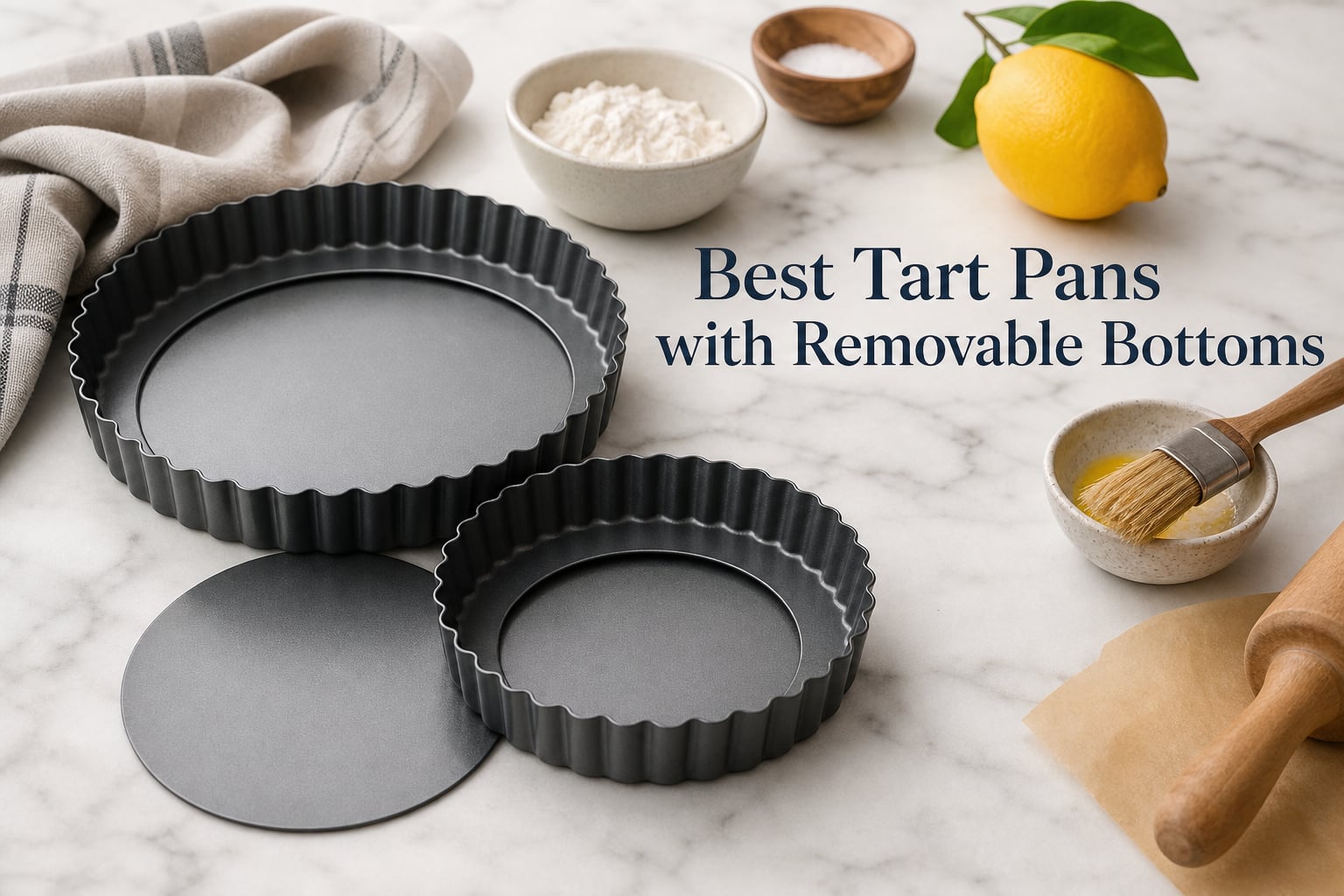
A beautiful tart can go wrong in the last ten seconds: the filling is set, the crust is golden, and the first attempt to lift it from the pan cracks the edge. The best tart pans with removable bottoms prevent that moment by separating the finished pastry from the fluted ring instead of asking you to pry a delicate crust out of a fixed dish.
I look for a stable loose base, a useful diameter, dependable carbon-steel construction, and a coating that matches how I bake. A 9-inch pan is the everyday standard for a lemon tart or quiche, while a 10-inch pan suits a broader dessert and a 4-inch tartlet pan is far more practical for individual servings.
Our shortlist compares eight real products, from perforated pans built around crisp pastry to deep pans for generous fillings and sets for a party. I also cover release technique, cleaning, and the details that matter before you bake this lemon cheesecake tart recipe.
Table of Contents
Top 3 picks answer the needs of most tart bakers
Choose the RICHSC-PAN 10-inch model when you want one full-size fluted pan with a 1.18-inch depth and dishwasher-safe care. Choose the Yamteck perforated 9-inch pan when crisp pastry is the main goal, and choose the RICHSC-PAN 12-piece set when individual tartlets are on the menu.
These are use-case picks rather than claims that one pan is right for every recipe. A deeper tart, a square presentation, a PTFE-free preference, or frequent batch baking may point you toward another option below.


Best tart pans with removable bottoms in 2026 compare eight practical choices
This quick view makes the differences easier to spot: full-size versus mini, round versus square, solid versus perforated, and standard versus extra-deep. Every option here has a removable base, so the finished tart can stay on its base for slicing and serving.
| Product | Specifications | Action |
|---|---|---|
| RICHSC-PAN 10 Inch Tart Pan |
|
Check Latest Price |
| RICHSC-PAN 12-Piece Mini Tart Set |
|
Check Latest Price |
| Yamteck 9 Inch Perforated Pan |
|
Check Latest Price |
 Vnray 10-Piece Mini Tart Set Vnray 10-Piece Mini Tart Set |
|
Check Latest Price |
 Patz&Patz Classic 9 Inch Tart Pan Patz&Patz Classic 9 Inch Tart Pan |
|
Check Latest Price |
 Cyimi Square Tart Pan Cyimi Square Tart Pan |
|
Check Latest Price |
 HAPPIELS 9 Inch Perforated Pan HAPPIELS 9 Inch Perforated Pan |
|
Check Latest Price |
 Quyimy 2-Pack Deep Tart Pans Quyimy 2-Pack Deep Tart Pans |
|
Check Latest Price |
1. RICHSC-PAN is the best 10-inch choice for everyday full-size tarts
RICHSC-PAN Tart Pan 10 Inch Tart Pan Carbon Steel Round Non-Stick Pan.
- Heavy carbon steel
- Nonstick release
- Removable bottom
- Dishwasher safe
- No significant drawback reported
The RICHSC-PAN 10-inch pan is the straightforward choice I would start with for a single full-size fruit tart, quiche, pie, or mousse cake. Its 10-inch diameter gives more room than the standard 9-inch style, and the 1.18-inch depth leaves useful headroom for a filling.
It uses heavy carbon steel, a nonstick coating, fluted edges, and a detachable base. The product data lists oven-safe use, dishwasher-safe care, and an upper temperature rating of 230 degrees Celsius.
A 4.7 rating across 2,953 reviews is a meaningful volume signal here. Review data specifically credits the thermal conductivity, easy food release, and removable base, which are the traits I want checked before calling a pan an everyday workhorse.
The broad 10-inch format suits large tarts and quiche
Use this size when a recipe is written for a 10-inch tart pan or when you want a wider, lower profile for fruit arranged in a single layer. The round fluted ring gives a classic edge without forcing a very deep filling.
It is also a sensible baking pan for tarts when you want one pan to cover sweet and savory work. A quiche lorraine, chocolate tart, and simple pat-in-the-pan crust all fit its listed uses.
The removable chassis makes serving less stressful
After the tart cools, set the pan on a sturdy can or tall glass that is narrower than the base and gently let the ring travel downward. Keep the tart on the metal base; it supports the crust while you cut clean slices.
I would still place the pan on a rimmed baking sheet while it is in the oven, especially with a loose bottom and a very liquid filling. That gives you a safer way to move it without flexing the base.
2. RICHSC-PAN is the best 12-piece set for individual tartlets
RICHSC-PAN Mini Tart Pan 12PCS, 4 Inch Tart Pan Removable Bottom Non-Stick.
- Twelve-pan set
- Four-inch portions
- Removable bottoms
- Dishwasher safe
- Small size is not for full tarts
This RICHSC-PAN set answers the question of whether mini tart pans are worth having: they are, if you bake for guests or want dessert portions that do not need slicing. Each of the 12 carbon-steel pans measures 4 inches across and is listed at 0.9 inches high.
The set has a nonstick coating and individual removable bottoms, with oven and refrigerator suitability in the product details. Its stated temperature range runs from minus 104 degrees Fahrenheit to 445 degrees Fahrenheit.
I like mini pans for lemon curd tartlets, chocolate ganache, or a table of mixed fruit fillings. A 4.7 rating from 2,953 reviews supports the attraction of getting a complete set rather than piecing together individual pans.
The four-inch size makes portions and presentation simple
Four inches is large enough for a personal dessert but small enough to make several flavor variations in one bake. It is a good fit for individual tartlets with berries, custard, or mousse, where a neat fluted rim is part of the presentation.
The trade-off is capacity. Do not buy this set as a substitute for a 9-inch tart pan if your favorite recipes are designed for a single family-size shell.
The separate bases protect fragile mini crusts
Mini crusts crack more easily than a full tart because there is less surface area to support the filling. Push each base upward only after the tart has cooled enough to firm up, then leave it underneath the tart for serving.
Because there are 12 pieces to clean, dry every ring and base fully before nesting them away. Forum bakers repeatedly mention rust as a problem when carbon-steel pans are stored damp.
3. Yamteck is the best 9-inch pan for a crisp pastry shell
- Perforated design
- Crisp crust focus
- PTFE PFOA BPA free
- Cake server
- Lighter construction
The Yamteck is a 9-inch perforated quiche pan for bakers who care most about a dry, crisp base. Its holes promote heat circulation, while its carbon-steel body, removable bottom, and 1.2-inch depth keep it within the familiar tart-pan format.
The listed coating is Whittford Xylan Platinum-3X, described as a double-sided three-layer coating that is PTFE-, PFOA-, and BPA-free. A cake server is included, which is a practical extra once the tart is on its base.
This is the 9 inch tart pan I would compare first if soggy bottoms have been a repeat problem. Its 4.7 rating comes from 1,219 reviews, though the review data also flags lighter-weight construction as the limitation to weigh.
The perforations help moisture escape from the crust
Perforations can assist air and heat movement around the pastry, which is helpful for a blind-baked shell or a quiche with a moist filling. They do not remove the need to follow a recipe’s chilling, docking, or blind-baking instructions.
For liquid fillings, place the pan on a baking sheet before carrying it to the oven. That supports the loose bottom and gives you a level surface while you work.
The 9-inch diameter matches common tart recipes
Many home bakers prefer a 9-inch format because it appears often in tart and quiche recipes. It is a useful middle ground when 10 inches feels too broad and a mini tartlet pan is too small.
The product is dishwasher safe, but I would choose a soft sponge rather than a harsh abrasive to preserve any nonstick surface. The included server should not be treated as a substitute for a thin offset spatula when releasing pastry from the base.
4. Vnray is the best 10-piece mini set for frequent batch baking
Vnray Mini Tart Pans with Removable Bottom 4 inch Set of 10 Non-stick Round
- Ten-pan set
- Heavy-duty steel
- Removable bases
- Silicone scrubber
- Small diameter limits recipes
Vnray gives you 10 individual 4-inch pans made from thickened heavy-duty carbon steel. The 0.7-inch depth is shallower than the RICHSC-PAN mini set, so I see this as the better choice for low-profile tartlets rather than deep custard cups.
The pans have a silicone nonstick coating, removable bottoms, rust-resistant construction, and a listed 450-degree-Fahrenheit temperature rating. A silicone scrubber comes in the set, which matches the need for gentle cleaning around the fluted edges.
Its 4.7 rating from 454 reviews is based on a smaller review pool than the first mini set. Still, the reported praise for durable steel, easy release, and the included scrubber makes it a sound batch-baking option.
The shallow profile suits tidy individual desserts
A 0.7-inch pan works well when the filling is meant to sit close to the crust, such as fruit arranged over pastry cream or a thin chocolate layer. It can also make baking and cooling faster than a deeper individual mold.
Plan your recipe volume before choosing it. A deep lemon curd or thick cheesecake-style filling needs more vertical room than this tartlet pan provides.
The included scrubber supports careful nonstick care
Nonstick coatings are convenient, but their durability is a recurring concern in baking discussions. Use the included silicone scrubber with warm soapy water, and avoid metal scouring pads that can scratch coated surfaces.
Although the pan is listed as dishwasher safe, hand washing and thorough drying are the conservative choices for carbon steel and a nonstick finish. Store the loose bases dry and flat so they do not warp.
5. Patz&Patz is the best 9-inch option for easier blind baking
- Silicone crust shaper
- PTFE PFOA free
- Removable bottom
- 450F rating
- Pan needs hand washing
The Patz&Patz Classic stands out because it includes a patented BPA-free silicone crust shaper for blind baking. The 9.14-inch carbon-steel pan has classic flutes, a removable bottom, and a nonstick coating described as PFOA- and PTFE-free.
For me, that accessory is the main reason to choose it over a standard round pan. It speaks to the step that trips up new tart bakers: pressing dough evenly into the base and fluted sidewall before baking.
The product is oven safe to 450 degrees Fahrenheit and carries a 4.6 rating from 647 reviews. The pan is hand-wash only, while the product data says the silicone crust shaper is dishwasher safe.
The silicone shaper helps form an even pastry shell
Even thickness matters because thin spots brown too fast and thick corners can stay underbaked. A shaper can help press pâte sucrée into the flutes with less direct handling, which keeps the dough cooler.
It is particularly handy for a pat-in-the-pan crust, where neatness depends on pressing rather than rolling. Chill the shaped crust before baking if your recipe calls for it; the shaper does not replace that step.
The hand-wash requirement suits careful long-term care
Hand washing is less convenient, but it gives you more control over a PFOA- and PTFE-free nonstick surface. Let the pan cool first, wash it with a soft sponge, dry the ring and base separately, and store them only when fully dry.
If dishwasher convenience is non-negotiable, consider one of the listed dishwasher-safe pans instead. I would not let that minor chore outweigh the included shaping tool if blind baking is your sticking point.
6. Cyimi is the best square pan for a different tart presentation
- Square presentation
- PTFE PFOA free
- Thick carbon steel
- Dishwasher safe
- Some recipes need greasing
The Cyimi tart pan breaks from the usual round silhouette with an 8.2-inch square shape and a 1-inch depth. That makes it a fun option for a tray-style fruit tart, mousse dessert, or square quiche where tidy straight slices are part of the plan.
It is made from thickened carbon steel with a removable bottom and a nonstick coating reported as PTFE- and PFOA-free. The listing also calls it dishwasher safe and says the material has good thermal conductivity without warping or bending.
This is not the pan I would buy for a recipe that explicitly requires a round 9-inch shell. It is the one I would select when the visual presentation is intentional and I am ready to adjust dough shape and filling volume.
The square geometry creates clean servings and corners
Square pans turn a tart into bar-like pieces, which can be easier to arrange on a dessert platter. Roll or press the pastry with enough extra dough to reach each corner, then gently press it in rather than stretching it thin.
Corner areas deserve attention during blind baking because they can puff or slump differently from the straight sides. Dock the base as your recipe directs and use a lining and weights when the recipe calls for them.
The coating may still benefit from light preparation
Review information says some recipes may require greasing despite the nonstick finish. That is not a failure of the pan; sticky fillings, sugary fruit juices, and delicate dough can all benefit from a light layer of butter or baking spray when the recipe permits it.
Use parchment when a recipe allows it, especially for a very sticky filling. The removable base then becomes an extra safeguard rather than the only release plan.
7. HAPPIELS is the best hand-wash perforated pan for crisp pastry
HAPPIELS 9 inch Tart Pan with Removable Bottom Nonstick, PFOA & BPA Free
- Perforated base and sides
- Removable bottom
- Non-toxic claims
- 450F rating
- Hand wash only
HAPPIELS is another 9-inch perforated tart pan, but its holes run through the sides as well as the bottom. The stated purpose is crisp pastry, and the pan pairs that construction with a removable base, nonstick finish, and a 450-degree-Fahrenheit oven rating.
The product data describes the coating as free of PFOA, PFOS, and BPA, while the pan itself is hand wash only. Its champagne-gold appearance gives it a more decorative look than the black carbon-steel choices.
The review base here is much smaller at 36 reviews, with a 4.5 rating. I would treat the construction details as the central reason to consider it, rather than comparing its rating volume directly with the leading 9-inch pan.
The side perforations target all-around crust crispness
When the goal is a crisp shell for a custard tart or quiche, ventilation around the sidewall can be as relevant as the base. The pan may reduce trapped moisture, but ingredients, oven behavior, and baking method still determine the final crust.
Do not assume that perforations mean no preparation is needed. Chill the dough, use a recipe-tested blind-baking approach where appropriate, and take care not to overwork pastry into the holes.
The hand-wash routine protects the finish
Hand wash the pan with mild soap and a nonabrasive sponge, then dry it right away. Leaving moisture in the fluted ring or around the loose base is the habit most worth avoiding with carbon-steel bakeware.
The 1-inch depth suits classic, relatively shallow tarts. If you make deep-dish quiche or very tall fillings more often, the Quyimy pair below is the more relevant format.
8. Quyimy is the best extra-deep two-pan set for generous fillings
- Extra-deep format
- Two-pan set
- Ceramic coating
- Includes brush and scrubber
- Smaller review base
The Quyimy set changes the usual tart-pan proportions with two 9.5-inch pans that are 2.3 inches deep. It is designed to hold 20 percent more filling, making it the clearest fit here for deep quiche, tall savory fillings, or a substantial dessert tart.
These carbon-steel pans have ceramic-coated nonstick surfaces, removable bottoms, dishwasher-safe care, and a listed 445-degree-Fahrenheit maximum. A silicone brush and scrubber are included for preparation and cleaning.
The 4.5 rating comes from 35 reviews, so the review history is limited. I would choose it for its specific dimensions and two-pan convenience, not because a deep dish is automatically better for a shallow classic tart.
The 2.3-inch depth gives fillings room to rise
Depth is the decision-maker with this pair. A tall quiche or heavily filled savory tart needs sidewalls that can contain the mixture, while a standard lemon tart may look underfilled in this much space.
Check your recipe’s pan specification and filling yield before baking. More depth can also mean a longer baking time, so use the visual and temperature cues in the recipe rather than relying on a shallow-pan schedule.
The two-pan format helps when you bake in batches
Two matching pans let you make two flavors, prepare one for now and one for later, or bake for a larger gathering without changing the pan size. The matching removable bases also make it easier to serve each tart directly from its own support.
Use the silicone brush for a light, even coating of butter or oil only when your recipe calls for it. Even a ceramic-coated nonstick tart pan benefits from careful release habits around sticky fillings.
A good tart pan choice starts with the crust, filling, and serving plan
A removable-bottom tart pan is a two-piece pan: a fluted outer ring rests around a flat base. Once the tart is baked and cooled, lifting the base releases the ring so the crust can stay intact for cutting and serving.
That simple design is especially helpful for pâte sucrée, a sweet, tender pastry that can crack when pried from a fixed pan. It is also useful for quiche, fruit tarts, and delicate chocolate tarts where you want the fluted edge visible.
Carbon steel is the common material in this roundup
All eight picks use carbon steel, often with a nonstick or ceramic-coated surface. Carbon steel is practical for this category because it offers strength and is paired here with features intended to support even heating.
Aluminized steel, stainless steel, and anodized aluminum are materials you may encounter elsewhere, but they are not represented by these products. I would judge the individual pan’s thickness, coating, and care instructions rather than treating one material name as a guarantee of better baking.
A 9-inch pan is the most versatile starting size
Choose a 9-inch pan for many standard tart and quiche recipes, including the Yamteck, Patz&Patz, and HAPPIELS choices. Choose the RICHSC-PAN 10-inch pan for a wider tart, and choose the 9.5-inch Quyimy pans when depth is more important than a traditional shallow profile.
For individual portions, the 4-inch sets are the better answer. They produce mini tartlets rather than slices, which is useful for parties but requires a recipe that yields enough dough and filling for several shells.
Perforations are helpful when a crisp bottom is the priority
The Yamteck and HAPPIELS pans use perforations to promote heat circulation. That can help with crisp pastry, but it does not eliminate the fundamentals of cold dough, correct oven temperature, and blind baking when a recipe requires it.
Blind baking means partially or fully baking the empty crust before the filling goes in. It is often the right move for a wet filling, while a crust shaper like the one included with Patz&Patz can help form the shell evenly first.
A removable-bottom tart pan works best when you support it from below
First, set the empty pan on a flat baking sheet before you add a loose or liquid filling. The sheet provides support during the trip to the oven and catches any spill that could escape between the base and ring.
Second, let the baked tart cool until the filling is set. Pushing too early is a common mistake because warm pastry is fragile and a warm custard can still move.
Third, place the pan over a stable, narrow cylinder such as a can, then press the outer ring downward while the base stays supported above it. Slide a thin spatula between the tart and base only if you need to transfer it; otherwise, slice and serve on the base.
Common tart mistakes have simple fixes
- A shrinking crust: Chill the shaped dough before baking and avoid stretching it into the pan.
- A soggy base: Blind bake when the recipe calls for it, and consider a perforated pan for pastry that needs more circulation.
- Sticking: Follow the recipe’s greasing guidance, cool the tart before release, and do not scrape coated surfaces with metal tools.
- A cracked edge: Support the base on a baking sheet and lift the ring straight down rather than twisting it.
Nonstick coatings need gentle use and realistic expectations
Several pans in this guide list nonstick coatings, while Yamteck, Patz&Patz, Cyimi, and HAPPIELS also make specific PFOA, PTFE, PFOS, or BPA-free claims in their product information. Those claims differ by product, so check the exact listing rather than assuming all nonstick pans use the same materials.
Use silicone, wood, or other nonmetal utensils where possible, clean with soft tools, and do not use an abrasive scrubber. A coating can make release easier, but recipe preparation and proper cooling still matter.
Care keeps carbon-steel tart pans ready for the next bake
Even if a pan is listed as dishwasher safe, hand washing is the gentler habit for a coated fluted pan. Wash the ring and loose base separately with warm water, mild soap, and a soft sponge, then dry both pieces immediately.
Drying matters because baker discussions repeatedly identify rust after damp storage as a frustrating failure point. Do not stack a wet base inside the ring, and place a paper towel between nested pans if space is tight.
Once you have a pan that suits your tart style, put it to work with this apple cinnamon pop tarts recipe for a pastry project that does not need a tart pan, or explore these puff pastry berry hand pies for another fruit-forward bake. For a different everyday bake, our bakery-style muffin recipes are also worth keeping nearby.
These tart-pan questions have clear practical answers
Should a tart pan have a removable bottom?
Yes, a removable bottom is very helpful for delicate tarts, quiche, and fluted pastry. It lets you lift away the outer ring while the tart stays supported on the base, reducing the chance of cracked crust edges during serving.
How do you remove a tart from a removable-bottom pan?
Cool the tart until the filling is set, place the pan over a sturdy narrow cylinder, and gently press the outer ring downward. Leave the tart on its metal base for serving, or use a thin spatula to transfer it after it is fully cool.
How do you use a tart pan with a removable bottom?
Put the pan on a baking sheet, press dough into the base and fluted ring, then bake according to the recipe. After cooling, support the base and lower the outer ring to release the tart without prying at its crust.
What are common mistakes when making a tart?
Common mistakes include stretching instead of pressing dough, skipping a required chill, failing to blind bake for a wet filling, lifting the tart while warm, and storing a carbon-steel pan damp. Follow the recipe, support the loose base, and dry the pan right away after washing.
What should you know about a nonstick tart pan?
Nonstick pans can simplify release, but coating claims and care requirements differ by product. Avoid abrasive cleaners and metal tools, follow the stated oven limit, and remember that chilling dough, correct baking, and complete cooling still help prevent sticking.
The best choice is the pan that fits the tart you actually bake
For an everyday full-size choice, I would begin with the RICHSC-PAN 10-inch pan; for crisp pastry, I would look closely at the perforated Yamteck; and for individual desserts, I would pick one of the 4-inch sets. The best tart pans with removable bottoms in 2026 are not one-size-fits-all, but every option here gives delicate crusts the release method they deserve.
Match the pan to your recipe’s diameter and depth, support the loose base during baking, and let the tart cool before you remove the ring. Those three habits make a bigger difference than chasing a perfect-looking fluted edge alone.