
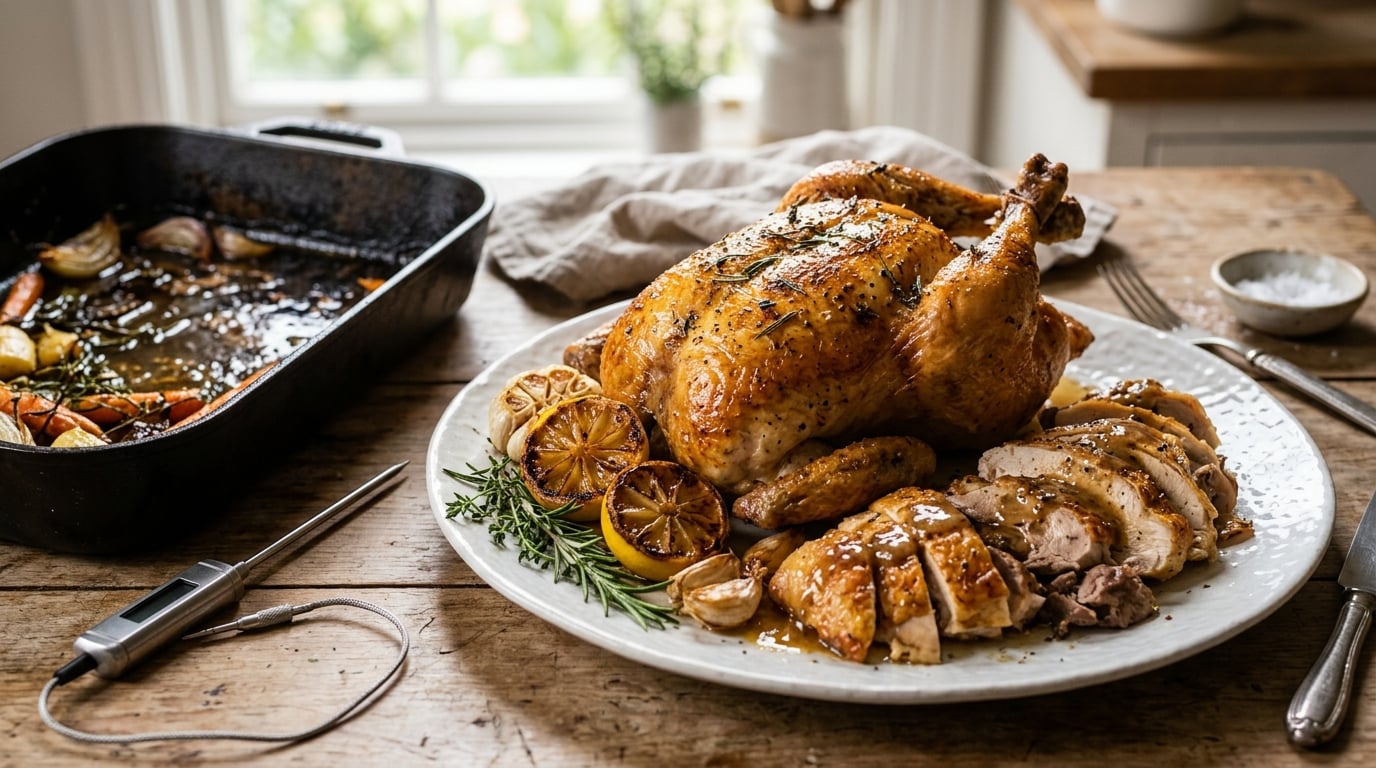
Cook a whole chicken at 425°F (220°C) for the first 20 minutes, then drop the oven to 350°F (175°C) until an instant-read thermometer in the thickest part of the thigh reads 165°F (74°C). Rest it 15 to 20 minutes before carving. The hot start renders the fat and crisps the skin, and the lower finish cooks the meat gently enough that the breast stays juicy.
If you have cooked a whole bird before and it came out dry, you probably cooked it to the recipe’s stated time instead of to a temperature. Time is a guess. Temperature is a fact, and it is the only thing standing between a juicy bird and sawdust breast meat.
Below is everything I have learned roasting chickens for Sunday dinners, with a full temperature chart, times by weight, and fixes for the problems that come up again and again. Updated for October 2026. If you want recipe ideas rather than numbers, start with our best whole chicken recipes roundup.
Table of Contents
What Temperature to Cook a Whole Chicken: the method I use
The short version, in the order the numbers actually matter:
- Oven: 425°F (220°C) for 20 minutes, then 350°F (175°C) until done.
- Internal temperature: 165°F (74°C) in the thickest thigh, probe not touching bone.
- Time per pound: 15 to 20 minutes, more at a lower oven temperature.
- Rest: 15 to 20 minutes before carving.
- Check: 30 to 40 minutes before the recipe’s stated time, not at the end.
Any single temperature works if you use a thermometer. The two-stage method just gives you a better crust while the inside finishes gently, and it is what I default to for a 4 to 6 pound bird.
Never rinse a raw chicken before cooking it. You splash raw bacteria across the sink and the counter, and there is nothing you gain by it. Pat the bird dry instead, and that alone does more for the skin than any spice rub.
Roasting, in the plain sense, is cooking a whole bird in the oven. Baking is the same heat, same pan, same thermometer reading; the words are a naming habit, not a technique difference. We have a pork temperature guide that covers the same thermometer logic if you are cooking both.
Oven Temperature Chart for a Whole Chicken, 325°F to 450°F
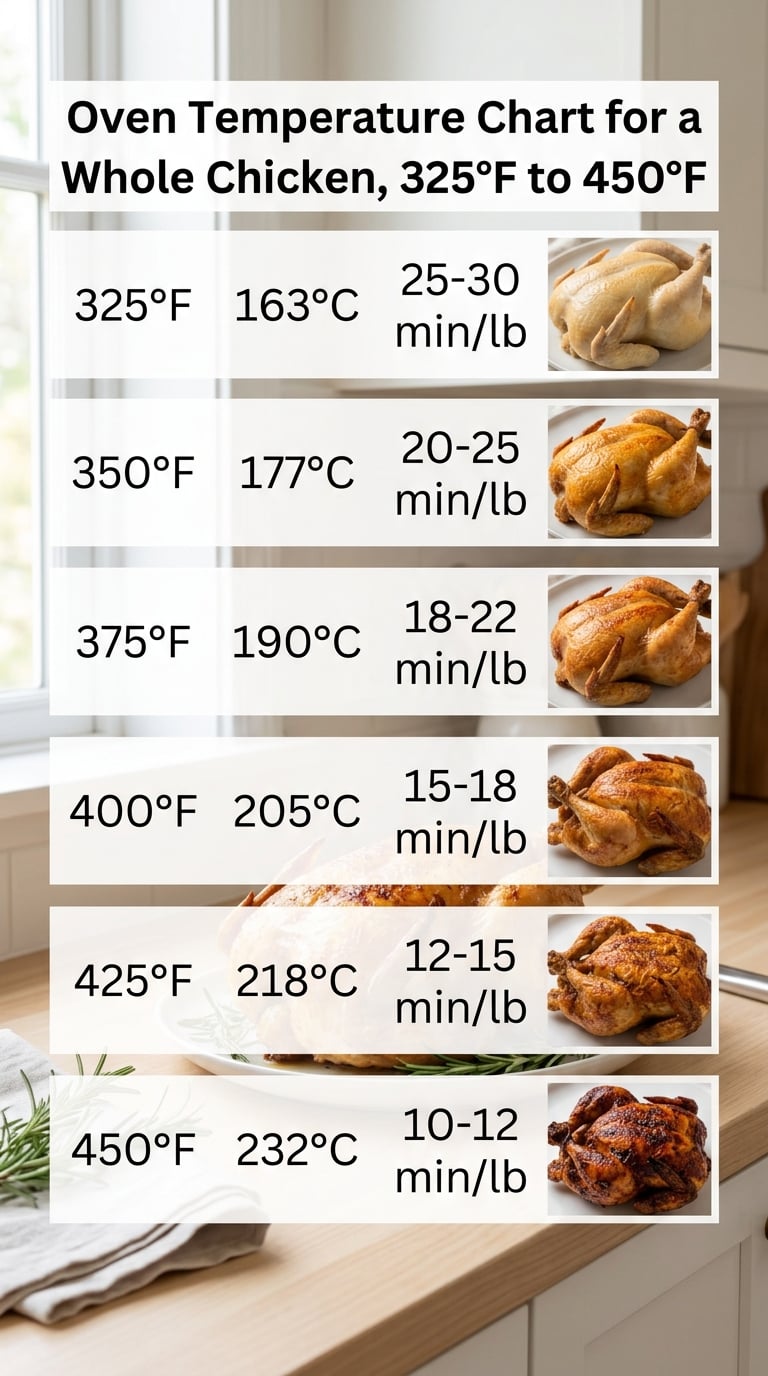
Here is every oven temperature that works, with what each one does to the skin and how long it takes. Pick one and hold it, or use the high-then-low method above.
| Oven temperature | Celsius | Minutes per pound | Skin result | Best for |
|---|---|---|---|---|
| 325°F | 165°C | 25 to 30 | Pale, soft, chewy | Very large birds and stuffing |
| 350°F | 175°C | 20 to 25 | Golden, tender | The most forgiving dinner roast |
| 375°F | 190°C | 20 to 22 | Crisp, well browned | A middle ground with more color |
| 400°F | 200°C | 15 to 20 | Crisp, bronzed | Fast, even cooking with a good crust |
| 425°F | 220°C | 15 to 18 after a 20 minute blast | Fastest crisp skin | Start high, then drop to 350°F |
| 450°F | 230°C | 25 to 35 total when flat | Blistered, crackling | Spatchcocked birds only |
If you cook in Celsius, these are the same oven settings: 325°F = 165°C, 350°F = 175°C, 375°F = 190°C, 400°F = 200°C, 425°F = 220°C, 450°F = 230°C. For doneness, 145°F = 63°C, 155°F = 68°C, 165°F = 74°C.
Turn the oven down 25°F (14°C) if you use convection, so a 425°F (220°C) convection blast becomes 400°F (200°C).
Why You Cook a Whole Chicken at Two Temperatures
One temperature cannot render fat and cook moist meat at the same time, which is why the high-then-low method exists.
- Heat and moisture in the skin: Chicken skin needs to dry out before it browns. A hot 425°F (220°C) start pushes moisture out of the skin fast and renders the fat underneath, which is what makes it crisp and flaky.
- Heat and moisture in the meat: Chicken breast is lean and has little fat to keep it moist. Breast protein tightens and squeezes out water somewhere around 140 to 150°F (60 to 65°C), and by 170°F (77°C) it is dry and stringy.
- Collagen in the leg: Thigh and drumstick meat is mostly connective tissue, and collagen only turns to gelatin somewhere between 160°F and 170°F (71 to 77°C). This is why legs can be rubbery while the breast is perfect.
Hot first, cooler after, and you get the skin and the meat each handled on their own terms. I have cooked birds at a flat 350°F (175°C) for years and never been unhappy, but I have cooked birds at a flat 450°F (230°C) and dried them out before the legs were tender.
Internal Temperature: When Is a Whole Chicken Done?
A whole chicken is done when the thickest part of the thigh, probed without touching bone, reaches 165°F (74°C). That is the USDA safe minimum internal temperature for all poultry, and it is measured in the muscle, not the cavity.
Probe the thigh, not the breast, when you want one number that covers the whole bird. The breast sits closest to the oven heat and is always the first thing to overcook, so a breast reading tells you when to worry, not when the bird is finished.
Here is the honest detail on the lower number. The FDA and USDA both accept 145°F (63°C) held for a short time as an equivalent kill step, because pasteurization depends on temperature and time together. A bird that reaches 145°F (63°C) and then rests 15 to 20 minutes gets the same bacterial reduction as one taken straight to 165°F (74°C). Plenty of experienced cooks pull the breast at 145 to 155°F (63 to 68°C), rest, and call it done.
For most home kitchens I would still cook to 165°F (74°C) in the thigh. The pull-early method is real, but it depends on your thermometer and your rest, and if the bird is for anyone pregnant, elderly, or small, the higher number is the calm choice.
If you cook from a packer label, ignore the suggested time and use it only as a starting point for when to check.
Breast vs Thigh: Why They Finish at Different Times
The breast and the thigh cook at different rates because they are different muscles under different amounts of heat, and the same bird can be 15°F (8°C) warmer in one spot than another.
| Part | Target | What is happening |
|---|---|---|
| Breast, highest quality result | 145 to 155°F (63 to 68°C) plus a 15 minute rest | Juicy, tender, slightly rosy in the center |
| Breast, USDA safe | 165°F (74°C) | Safe and still fine, firmer and drier |
| Thigh and drumstick | 165°F (74°C) minimum, better at 170°F (77°C) | Collagen converts to gelatin, meat turns tender and juicy |
| Wing | 160°F (71°C) is plenty | Wings dry out early, so pull them sooner |
If the breast is reaching its limit before the legs are tender, you have two choices. Take the bird out, cut the breast off at the bone, tent it loosely in foil, and let the rest of the bird go back in for 10 to 15 minutes. Or spatchcock the bird from the start, which lays both breasts flat and evens the whole thing out.
That unevenness is anatomy, not a mistake on your part. Almost every whole bird cooks from the outside in at different speeds, which is why the recipe times on the package are ranges and not promises.
How Long to Cook a Whole Chicken at Each Temperature
These times assume a conventional oven, a thawed bird, and no stuffing. Add 30 minutes if you stuff the cavity, and add more if the bird is still icy in the center.
| Bird weight | 350°F (175°C) | 400°F (200°C) | 425°F then 350°F | Spatchcocked at 450°F | Air fryer at 400°F |
|---|---|---|---|---|---|
| 3 lb | 1 hr 10 min | 50 to 60 min | 45 to 55 min | 25 to 30 min | 30 to 35 min |
| 4 lb | 1 hr 25 min | 1 hr to 1 hr 10 min | 55 to 65 min | 30 to 35 min | 35 to 45 min |
| 5 lb | 1 hr 40 min | 1 hr 15 to 1 hr 25 min | 1 hr 10 to 1 hr 20 min | 40 to 45 min | 45 to 50 min |
| 6 lb | 1 hr 55 min | 1 hr 30 to 1 hr 40 min | 1 hr 25 to 1 hr 35 min | 50 to 55 min | 55 to 60 min |
| 7 lb | 2 hr 10 min | 1 hr 45 to 1 hr 55 min | 1 hr 40 to 1 hr 50 min | 1 hr | 60 to 70 min |
| 8 lb | 2 hr 30 min | 2 hr to 2 hr 10 min | 1 hr 55 to 2 hr 5 min | 1 hr 5 to 1 hr 15 min | not advised, cook in two parts |
Set a timer for 30 minutes before the earliest time in the column, and start checking. A chicken that reads 140°F (60°C) with 20 minutes left in the window will finish with time to spare, and one that reads 160°F (71°C) early needs another 8 or 10 minutes. Times are a range because ovens and birds both vary.
Never cook a chicken straight from the freezer in a standard home oven. Thaw it in the fridge for 24 to 48 hours, or in cold water, changing the water every 30 minutes.
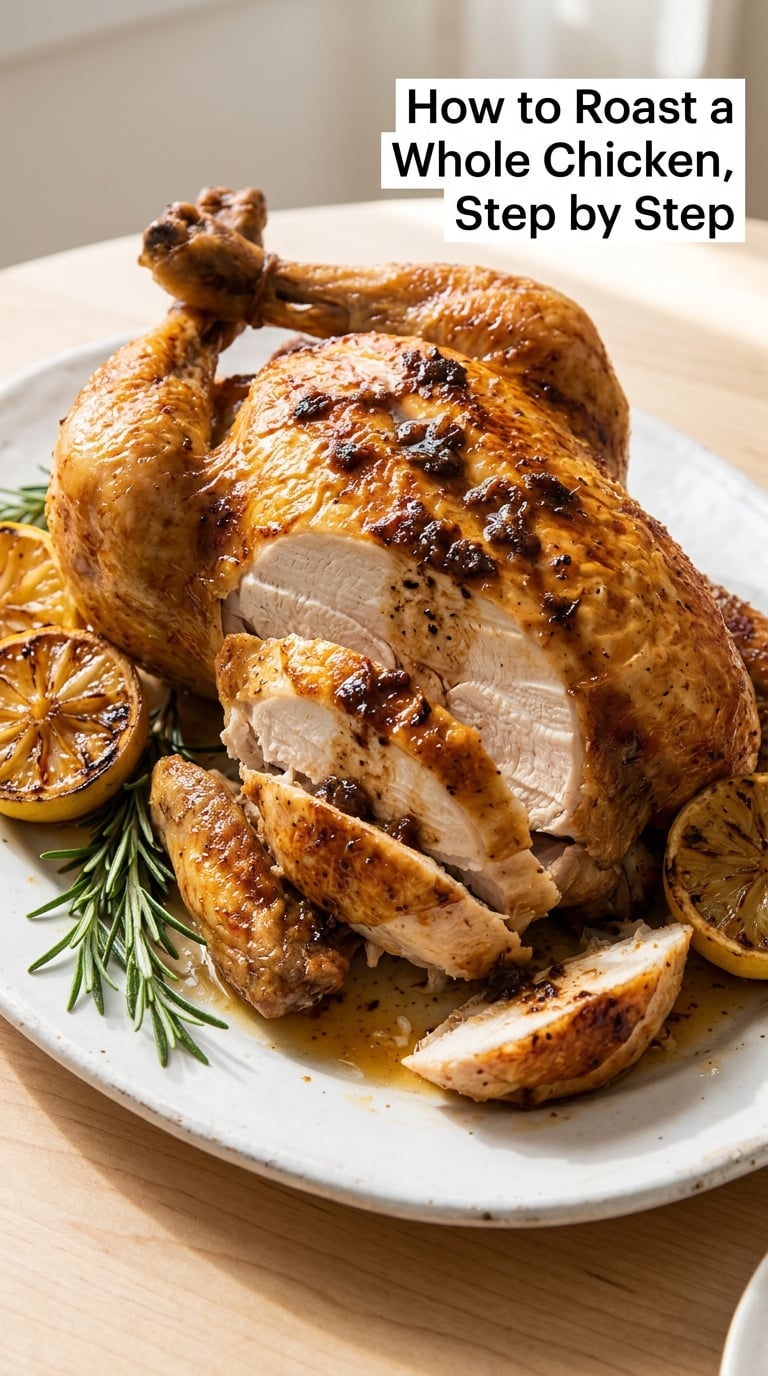
How to Roast a Whole Chicken, Step by Step
This is the recipe I cook almost every week, and it is the method described above written out in full.
Yield: 4 servings · Prep: 15 minutes · Cook: 1 hour 20 minutes for a 5 lb bird · Total: 1 hour 40 minutes · Difficulty: Easy
Ingredients
- 1 whole chicken, 4 to 5 lb (1.8 to 2.3 kg), giblets removed
- 2 tbsp kosher salt (36 g)
- 1 tsp freshly cracked black pepper
- 1 tsp paprika or garlic powder
- 1 tbsp unsalted butter, softened (14 g)
- 1 lemon, halved
- 4 garlic cloves, smashed
- 3 sprigs fresh rosemary
- 3 sprigs fresh thyme
- 1 cup water or chicken stock (240 ml)
- 1 tbsp olive oil (15 ml)
Instructions
- Heat the oven to 425°F (220°C). Set a rack in the lower third of the oven.
- Pat the chicken dry all over with paper towels, then season inside and out with the salt, pepper, and paprika. Rub the softened butter over the skin.
- Stuff the cavity with the lemon halves, garlic, and herb sprigs. If you would rather not stuff it, leave the aromatics on a bed of onions in the pan, which flavors the drippings without adding cooking time.
- Set the chicken breast-side up on a rack in a roasting pan. Pour the water or stock into the bottom of the pan, not over the bird, and drizzle the breast with olive oil.
- Roast at 425°F (220°C) for 20 minutes, until the skin tightens and starts to turn pale gold at the edges.
- Drop the oven to 350°F (175°C) without opening the door more than once. Roast for 15 to 18 minutes per pound, so about 1 hour 20 minutes more for a 5 lb bird.
- At the 30 minute mark of the second stage, probe the thickest part of the thigh, away from bone. Keep roasting until it reads 165°F (74°C). The juices should run clear.
- Transfer the chicken to a board and rest, uncovered, for 15 to 20 minutes before carving.
Tip: The single detail that makes or breaks this is drying the skin properly before it goes in. Moisture is what you are trying to evaporate, and a damp bird steams instead of browning. Pat it dry twice if you have the time.
Swap it: Butter is roughly 18% water, so for the crispest skin use olive oil instead. For a dairy-free version, use all olive oil and skip the butter, and check that your paprika has no dairy in it.
Storage: Refrigerate the carcass and the cooked meat for 3 to 4 days. Freeze cooked chicken for up to 3 months, and thaw it in the fridge overnight. To reheat, cover and warm gently until the thickest part of the meat reaches 165°F (74°C).
Where to Put the Thermometer in a Whole Chicken
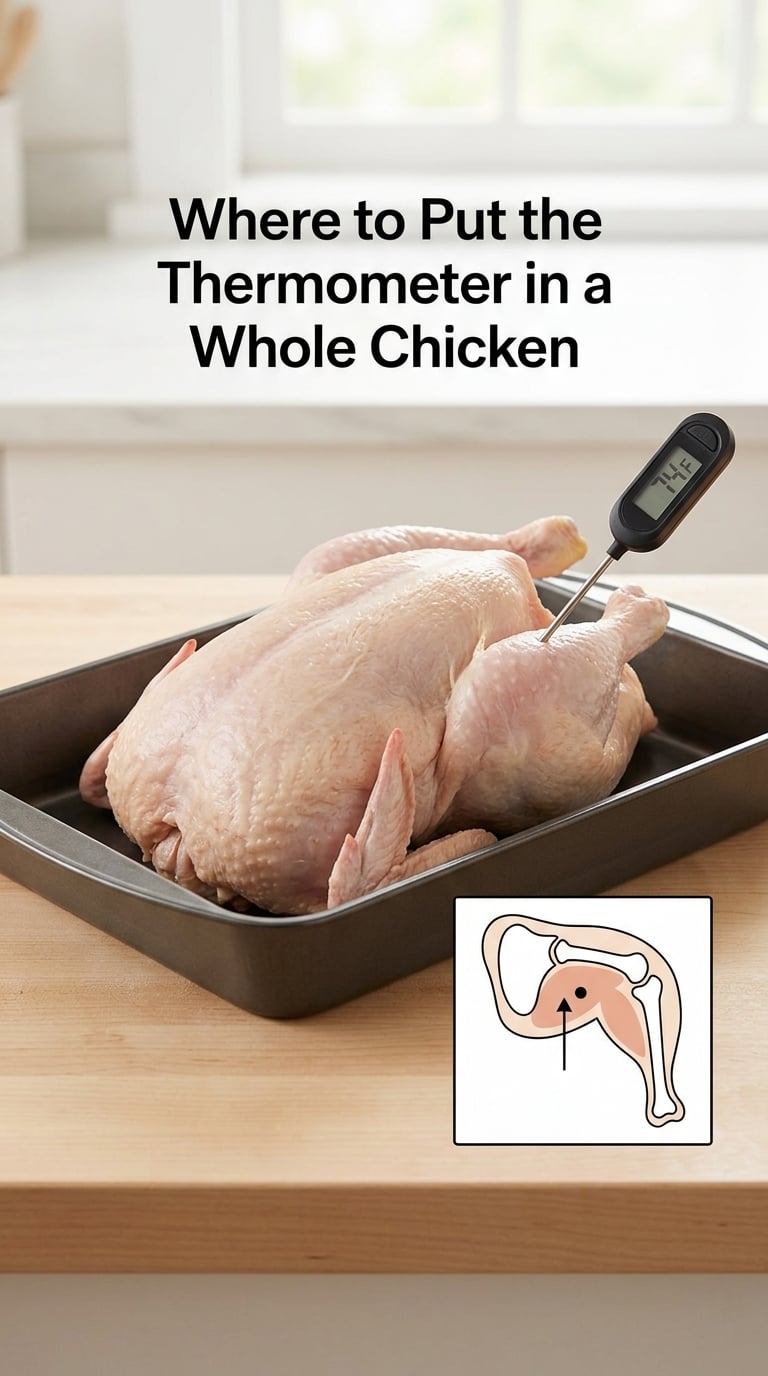
Put the probe in the thickest part of the thigh, just above the joint, pushing it in until you feel the muscle but the tip is not touching bone.
Bone reads hot and will give you a false result. Skin reads cool if you push too shallow. A sideways insertion angle into the meat, away from the joint, is the most reliable move.
Check the thigh, and if you have one for dinner with a breast, check the breast too. Aim for 165°F (74°C) in the thigh and 160°F (71°C) in the breast for the best balance of safety and moisture.
A leave-in probe gives you the same reading without opening the door, and an instant-read thermometer is faster for checking a bird at the end. Either works, as long as you know it reads correctly. Cooks on cooking forums repeatedly report 2 to 3°F of drift on cheap thermometers, so test yours in ice water, where it should read 32°F (0°C), and in boiling water, where it should read 212°F (100°C). If it is off by more than a couple of degrees, replace it or add the offset to your pull target.
For anyone who roasts with a smoker or a pellet grill, the same rule applies to the built-in dial: do not trust it. Probe the bird itself.
How to Tell When Chicken Is Done Without Guessing
Three cues tell you a chicken is done when a thermometer is not at hand, and all three matter more than color.
- Clear juices: Tilt the bird slightly and look at the juices running from the thickest thigh. Clear is right. Any pink or cloudy and it needs more time, even if the meat looks pale.
- The thigh jiggle: Grasp the bone at the top of the thigh and shake it. Fully done meat moves loosely, almost like a hinge with nothing holding it. If it feels springy and solid, keep going.
- The wing tip test: Pull the wing and twist it. When the tip moves easily in the joint, the bird is at least 160°F (71°C) and the legs are likely close behind.
A pop-up timer in the thigh is the least reliable of these methods. It is a single reading taken at one moment in one spot, and it has been known to pop early. A thermometer tells you where the bird is now.
Pink near the bone is common and usually harmless, because the bone and the tissue right against it warm more slowly. Cut into the thickest part of the thigh, away from the joint, and look at the meat itself.
Convection vs Conventional Oven: What Changes
In a convection oven, cook a whole chicken 25°F (14°C) lower and cut the time by about a quarter.
Convection moves hot air across the bird instead of relying on radiant heat, so the skin browns faster and the breast cooks sooner. That 25°F reduction is the important adjustment; the time reduction just means you start checking earlier, which you should be doing anyway.
Gas and electric ovens are not the same oven, either. Gas ovens often run hot and slightly uneven, so rotate the pan once at the halfway mark if your cooking area has a hot spot. Electric ovens are more even but can run cool if the heating element is old.
It is worth checking whether your oven actually holds the temperature you set, because the dial is a request, not a measurement. Put an independent oven thermometer on the middle rack, heat the oven to 350°F (175°C), and read it after 20 minutes. If it is off by more than about 25°F (14°C) in either direction, have the oven serviced, and until then adjust the dial to compensate.
Spatchcocked and Air Fryer Whole Chicken Temperatures
A spatchcocked chicken cooks at 450°F (230°C) for 25 to 55 minutes depending on weight, and an air fryer whole chicken cooks at 400°F (200°C) in 30 to 70 minutes.
Spatchcock: Cut out the backbone with kitchen shears, press the bird flat so the breastbone lies cracked, and roast it skin-side down at 450°F (230°C) for 25 to 35 minutes, flipping once, until the thigh hits 165°F (74°C). Both breasts sit at the same thickness, so this is the best answer to a dry breast on a small bird.
Air fryer: Season the bird the same way, set it breast-side up in the basket, and cook at 400°F (200°C) for 35 to 45 minutes for a 3.5 to 4 lb bird, checking the thigh. Above about 5 lb the basket is too tight for the heat to circulate properly, so cut the bird in half and cook it in two batches instead.
Both methods use the same doneness number as the oven, which is the point. 165°F (74°C) in the thigh means done, no matter which box you are using.
Troubleshooting: What Went Wrong and How to Fix It
Most chicken problems are the same handful of causes wearing different clothes.
| Symptom | Likely cause | Fix |
|---|---|---|
| Dry, chalky breast | Cooked past 165°F (74°C) or rested too long | Pull the breast at 160°F (71°C), cover loosely, rest 15 minutes |
| Rubbery, chewy thigh | Thigh not past 170°F (77°C), collagen not converted | Return to a 325°F (165°C) oven, 10 to 15 minutes more, then rest |
| Pale, rubbery skin | Skin was damp, or the oven is running cool | Pat dry, oil the skin, verify oven temperature, broil 2 to 3 minutes at the end |
| Pink juices | Not done yet, or read too close to the joint | Probe 1 inch above the joint and roast 5 minutes more |
| Uneven cooking, legs done first | Heat reaching the legs faster | Spatchcock it next time, or tent the breast in foil after 20 minutes |
| Sticky, tearing skin | Pulled the bird by the skin instead of the cavity | Use a carving hook or lift from the cavity opening |
If a chicken is already dry, you cannot add moisture back with sauce. Shred it, toss it with a little stock or the pan drippings, and use it in a sandwich or grain bowl, where the dressing does the work.
Save the carcass in the freezer for stock. A single roast chicken carcass plus two onion ends, a bay leaf, and water simmered for a few hours gives you a small pot of stock that is worth more than the bird was.
Resting, Carving, and Storage Times
Rest the bird 15 to 20 minutes, loosely covered, before you carve it. Skipping the rest costs you juice on the carving board.
While it rests, the temperature keeps climbing. This is carryover cooking, and it typically adds 5 to 10°F (3 to 6°C) to the thickest part. It is also why a bird pulled at 158°F (70°C) can land near 165°F (74°C) and still be right. Set the bird somewhere you can see the thermometer, and go make the gravy.
Carve breast meat off the bone first, slicing down the grain from the top of the breast. Then separate the thighs and drumsticks from the joint by twisting, and cut the ribs from the back. Resting first keeps the breast from squeezing out juice during the cut.
Refrigerate cooked chicken for 3 to 4 days at 40°F (4°C) or below. Freeze it for up to 3 months. Reheat pieces to 165°F (74°C) and only reheat what you plan to eat, since every trip from the fridge to the oven dries the meat a little more.
Our stovetop ground beef guide covers the other half of a weeknight dinner, and the same thermometer habits apply.
Frequently Asked Questions
Is it better to roast a whole chicken at 350 or 400?
Both work, and the thermometer matters more than the number. 350°F (175°C) gives you gentler, more even cooking and needs about 20 to 25 minutes per pound. 400°F (200°C) browns the skin faster and needs about 15 to 20 minutes per pound. Most cooks land on 425°F (220°C) for 20 minutes, then 350°F (175°C) until the thigh hits 165°F (74°C).
How long does it take for chicken to fully cook at 350 degrees?
Plan on 20 to 25 minutes per pound at 350°F (175°C) in a conventional oven. That is about 1 hour 25 minutes for a 4 lb bird and 1 hour 40 minutes for a 5 lb bird. Add 30 minutes if the cavity is stuffed. Start checking the thigh 30 minutes before the estimated time rather than trusting the estimate.
Should chicken be cooked at 400 or 450?
400°F (200°C) is the right choice for a whole bird in a roasting pan, since it cooks evenly and still browns the skin well. Save 450°F (230°C) for a spatchcocked bird, where the flat shape lets the skin crisp fast without the breast burning first. A 450°F whole bird in a pan will dry out before the thighs turn tender.
How long does it take to roast a 6 lb chicken at 400 degrees?
A 6 lb bird at 400°F (200°C) takes about 1 hour 30 to 1 hour 40 minutes in a conventional oven. At 350°F (175°C) it needs closer to 1 hour 55 minutes. Check the thigh at the 1 hour mark, because the number that ends the cooking is 165°F (74°C) in the thickest part of the thigh, not the clock.
Is whole chicken done at 165 or 180?
165°F (74°C) in the thickest thigh is the USDA safe minimum internal temperature for all poultry and is where most whole chickens should be pulled. Going to 180°F (82°C) makes the breast noticeably drier with very little gain in the thigh. If you want the legs extra tender, rest time does more for them than extra oven heat does.
Should chicken be 145 or 165?
Both are defensible. 165°F (74°C) is the USDA safe minimum for poultry and the simple choice for a family meal. Cooks who pull breast at 145 to 155°F (63 to 68°C) and rest 15 to 20 minutes are relying on carryover cooking, which the FDA accepts as an equivalent kill when time and temperature are considered together. The thigh should still reach 165°F (74°C).
The Short Answer to Cook a Whole Chicken Right
Start at 425°F (220°C) for 20 minutes, drop to 350°F (175°C), and stop when the thigh reads 165°F (74°C). Rest it 15 to 20 minutes. That is the whole method, and it is why the answer to what temperature to cook a whole chicken is not one number but three: a hot start, a gentle finish, and a thermometer in the thigh.
Set the alarm 30 minutes early so you are checking temperature instead of guessing at the timer. That single habit is the difference between a bird you carve with confidence and one that is dry in the middle.