
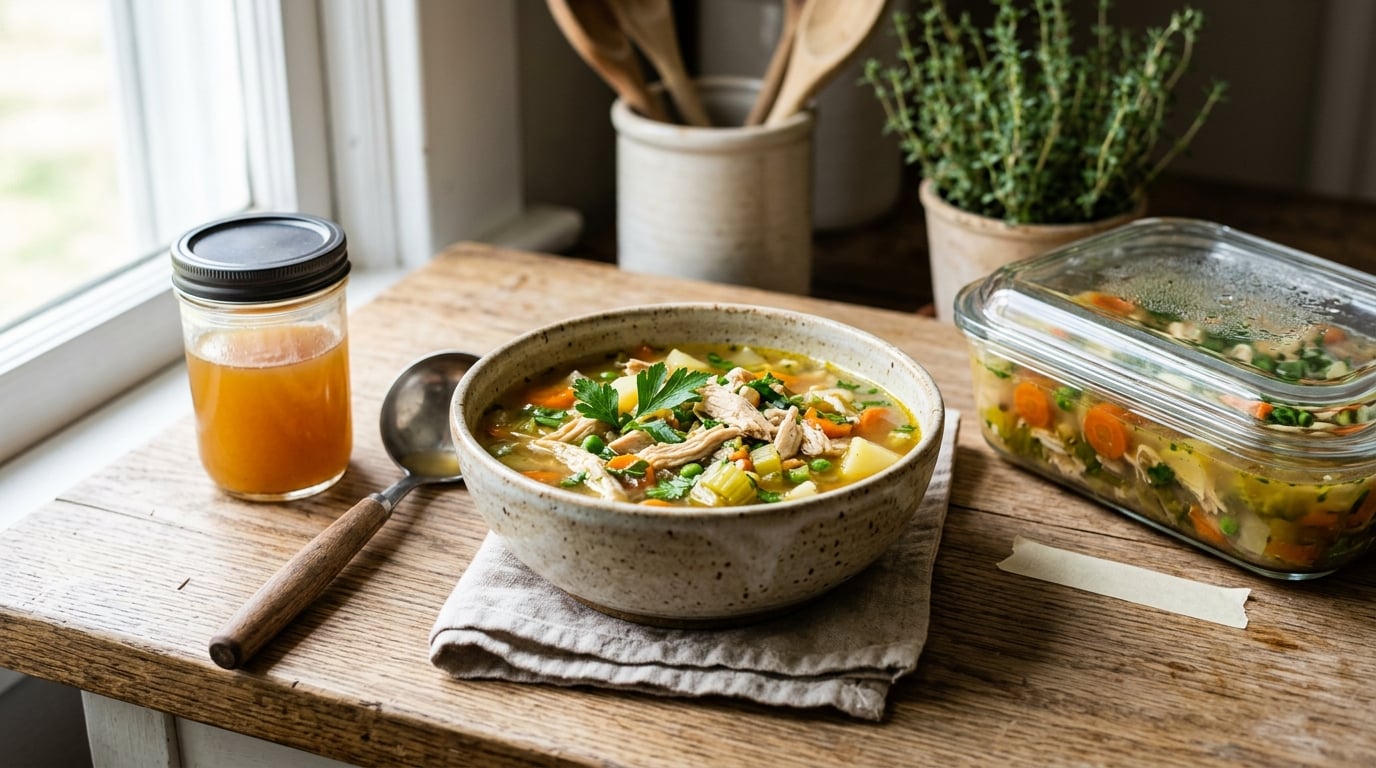
Homemade soup lasts 3 to 4 days in the refrigerator at 40°F (4°C) or below, stored in a covered container. That is the USDA number, and it holds for just about every soup you will make at home, from plain vegetable broth to a creamy potato bowl.
The clock starts the moment the soup is cool enough to refrigerate, not when you set it on the stove. Most soup problems I see come down to one thing: a big pot sitting lukewarm in the middle of the fridge for two days while somebody assumes the lid is enough. It is not.
Below is the full picture, day ranges for each kind of soup, how to cool it properly, and what to do when you find a container on day five and have to decide fast.
Table of Contents
How Long Does Homemade Soup Last in the Fridge?
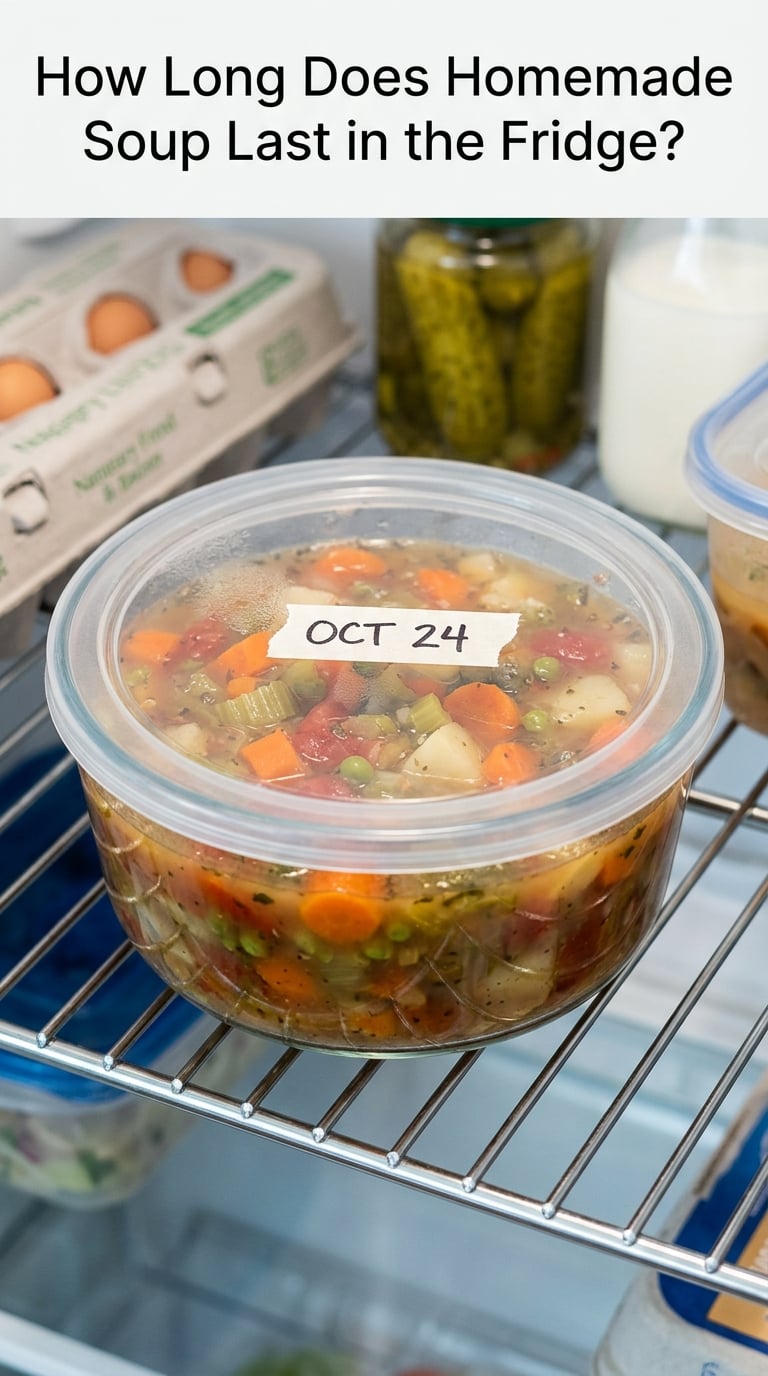
Three to four days. Cool it within two hours, store it covered at 40°F (4°C) or below, and eat it inside that window.
Some soups sit at the short end of that range and some at the long end, based on what is in them. Meat, poultry, seafood, dairy, and eggs add perishable protein or fat, so those soups go first. Plain vegetable, bean, and tomato soups are more forgiving, especially when acid from tomato or vinegar is doing the work.
The other half of the answer is temperature. The food safety danger zone runs from 40°F to 140°F (4°C to 60°C), and bacteria multiply fast inside it. A fridge holding 42°F is not a fridge for leftovers, it is a warm cabinet, and it eats your margin for error.
Home-canned soup is a different animal. A properly pressure-canned jar keeps a year or more on a sealed shelf, and only the low-acid tomato and vegetable styles need pressure canning at all. This guide is about the soup you cooked on your stove in a normal pot.
Fridge Storage Times by Soup Type
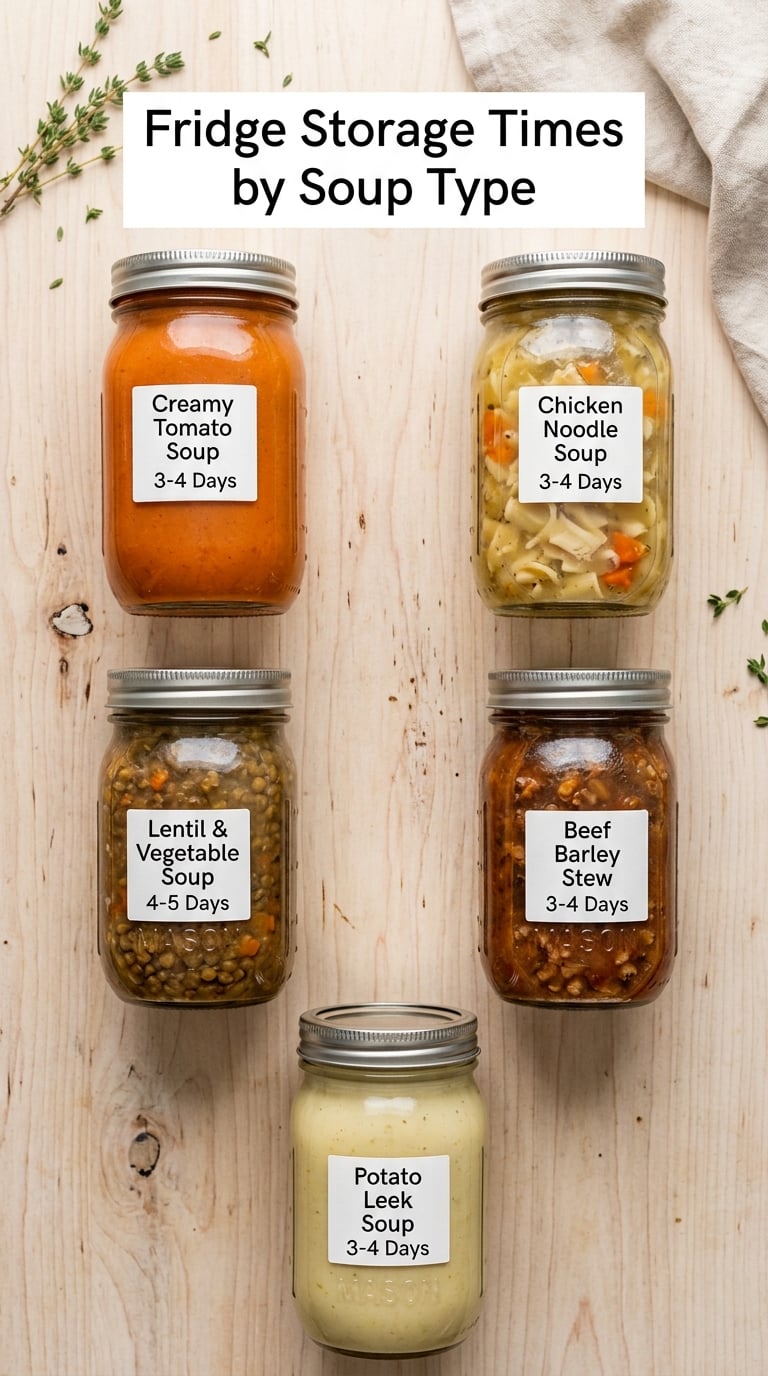
These day counts assume a refrigerator at 40°F (4°C) or below, soup cooled within two hours, and containers covered and labeled.
| Soup type | Days in the fridge (homemade) | What to watch |
|---|---|---|
| Chicken or turkey soup | 3 to 4 days | Poultry is perishable, treat it as the first thing to go |
| Beef, pork, or lamb stew | 3 to 4 days | Reheat to 165°F (74°C) |
| Ground beef soup (taco, chili, meatball) | 3 to 4 days | Cook to 160°F (71°C) when reheating |
| Seafood soup (clam, shrimp, fish) | 1 to 2 days | The shortest window on this list, use it fast |
| Cream, milk, or cheese soup | 2 to 3 days | Curdles, sours, and thickens as it ages |
| Potato soup | 3 to 4 days | Starch thickens the texture noticeably by day 3 |
| Egg drop soup | 3 to 4 days | Egg strands break down and the broth clouds |
| Tomato soup or sauce | 4 to 5 days | Acidity slows growth, but not indefinitely |
| Bean or lentil soup | 4 to 5 days | Fermented flavors turn sour |
| Miso soup | 3 to 4 days | Miso is salty, so always refrigerate it |
| Vegetable soup | 4 to 5 days | The most forgiving of the batch |
| Plain broth or stock | 3 to 4 days | No solids to signal spoilage, so trust the date |
How Long Does Homemade Soup Last in the Fridge Compared With Store-Bought?
Store-bought soup keeps longer because of preservatives and because it is usually processed in a controlled facility. That gap is the single biggest reason homemade soup seems to go off faster for people comparing the two.
| Type | Fridge life once opened | Why the difference |
|---|---|---|
| Homemade soup | 3 to 4 days | No preservatives, cooled at home |
| Store-bought canned soup | 4 to 5 days after opening | Sealed processing plus additives |
| Shelf-stable carton soup | 5 to 7 days after opening | Unopened aseptic carton, no refrigeration needed |
| Pressure-canned home soup | 1 year or more (sealed jar) | Processed to a sealed, shelf-stable state |
Read our guide to how long cooked chicken lasts in the fridge for the same reasoning applied to the protein most soup depends on.
How to Store Homemade Soup Safely
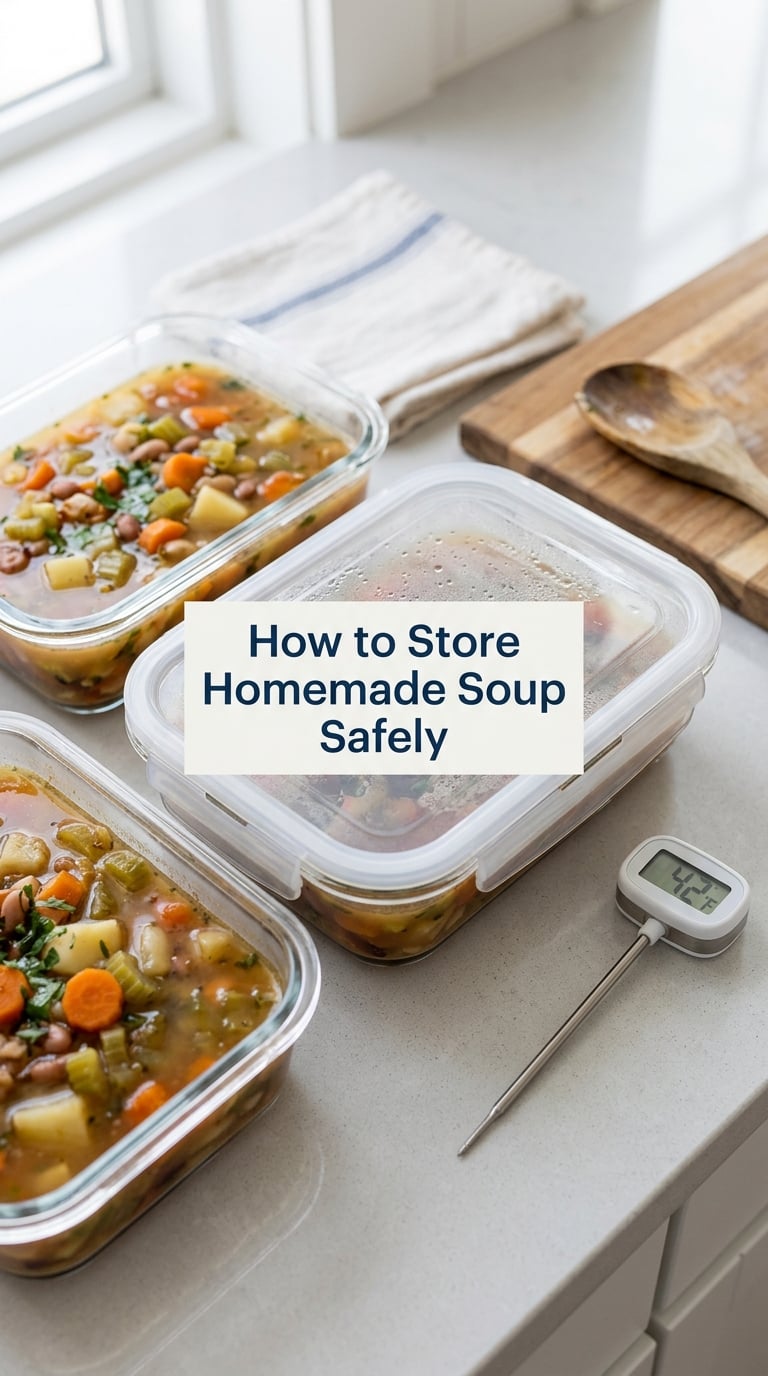
Store soup in shallow, wide containers with a tight lid, and put it on a refrigerator shelf rather than in the door.
A wide surface area is what pulls heat out fast. Soup poured into a tall, narrow jar takes hours to cool through the middle, and those hours in the danger zone are exactly what you are trying to avoid. Two-cup deli containers or a loaf pan covered in plastic wrap and foil both work well.
Leave an inch or two of headspace. Soup expands when it freezes, and a container filled to the rim will split or pop its lid in the freezer.
Label before it goes in, not after. A strip of masking tape with the soup name and the date is enough. When you open the fridge at 9pm on a Thursday, you want to know instantly which tub is from Sunday and which is from Wednesday.
Keep it on an interior shelf, not in the door. The door is the warmest part of the fridge and its temperature swings every time someone grabs a bottle of milk. The back of the top or middle shelf is the steadiest spot.
Check your fridge temperature once in a while with a cheap appliance thermometer. If it reads above 40°F (4°C), fix the seal or dial it down before trusting any leftovers you already have.
One more habit: freeze on day three
If you know you will not finish a batch in time, freeze what is left on day three rather than gambling on day four. Frozen soup is a better outcome than a full container you toss, and portioning takes two minutes while the soup is still cold.
Cooling Soup Before Refrigerating
Get the soup from simmering to cold in under two hours, and use the whole fridge, not just the pot.
- Take the pot off the heat as soon as the cooking is done. Residual heat keeps it climbing for a while, and you are trying to lose heat, not make more.
- Divide it into shallow containers while it is still steaming. A big pot cooling on the counter is a deep container with a lid on it, which is the slowest possible option.
- Set the containers in an ice bath if you have time. A larger bowl of ice and cold water, containers sitting in it, five or ten minutes, and you shave off a surprising amount of time.
- Stir the portions once or twice as they cool. Liquid moves heat from the middle to the edges, and a short stir helps it along.
- Cover loosely while steaming, seal fully once cold. A tight lid traps heat and condensation, which is how containers end up dripping in the fridge.
- Refrigerate promptly and keep the fridge at 40°F (4°C) or below. Do not leave soup on the counter to cool overnight, and do not balance a lid on the pot and walk away.
The two-hour rule is the one to memorize: perishable food should not sit at room temperature for more than two hours, and only one hour when the air is above 90°F (32°C). That includes a warm kitchen, a covered patio table, and a car. A four-hour soup service on a counter is a discard, no matter how it smells.
Our rule at home is simple. If the pot is not going into the fridge within about half an hour of coming off the burner, we portion it first. Cooking a big batch of stuffed cabbage soup or unstuffed cabbage roll soup is a two-hour job, and the cooling step is part of cooking, not cleaning up.
Can You Freeze Homemade Soup?
Yes. Most soups freeze well and keep 2 to 3 months at full quality, with 3 to 4 months as the outer limit from the USDA.
Broths, chicken and turkey soups, tomato soup, bean soup, chili, and meat stews all come back from the freezer in good shape. Cool the soup first, leave headspace, and freeze in flat bags or single-meal containers so you can pull out one portion instead of the whole batch.
Some soups do not freeze well. Cream and milk soups split and turn grainy. Potato soup goes gluey because the starch breaks down. Soups with heavy dairy or lots of potato are best eaten inside the 3-to-4-day window rather than frozen.
Thaw in the refrigerator overnight, not on the counter. From frozen, you can go straight to a slow simmer on the stove, stirring often, or cover a portion and microwave it on high until it bubbles throughout. A quick boil and a stir usually fixes any separation.
| Soup type | Freezer life (quality) | Freezes well? |
|---|---|---|
| Chicken and vegetable soup | 2 to 3 months | Yes |
| Beef or pork stew | 2 to 3 months | Yes |
| Tomato soup | 2 to 3 months | Yes |
| Bean or lentil soup | 2 to 3 months | Yes |
| Chili | 2 to 3 months | Yes |
| Plain broth | 3 to 4 months | Yes |
| Potato soup | 1 to 2 months | Fair, thickens when thawed |
| Cream or cheese soup | 1 to 2 months | Poor, may split |
Signs Your Homemade Soup Has Gone Bad
Check smell first, then look, then feel the texture. Tasting suspicious soup to test it is not a safety method, so do not do that.
Smell it before anything else
Fresh soup smells like its ingredients. Spoiled soup turns sour, faintly rotten, or faintly sweet in a way that makes you pull your head back. Some people describe it as a faint ammonia note. Plain broth going off is harder to catch, which is exactly why dating it matters.
Look at it
Mold on the surface, fuzzy green or white patches, a slimy film, or broth that has thickened into a gel are all reasons to throw it out. Mold in a liquid is harder to see than on a loaf, and any visible mold means the whole container goes.
Discoloration counts too. Tomato soup that has gone brown-grey, or chicken soup where the meat has turned grey-green, is not worth the risk.
Notice the texture
Soup that is slimy, stringy, or oddly gelatinous has bacterial growth in it even when the smell is mild. Watery separation on a potato or bean soup is a texture change, not proof of spoilage, so let the smell decide there.
One more check that costs nothing: the date on the label. If it is past day four and there is no label at all, I freeze what I can and discard the rest. Guessing rarely goes well.
How to Reheat Homemade Soup Safely
Reheat leftovers to 165°F (74°C) and bring them to a rolling boil, stirring, so the middle of the bowl catches up with the edges.
Soup lies to a microwave. The edge can be steaming while the center is barely warm, which is how reheating only half of it leaves food sitting in the danger zone. Stir halfway through, cover the bowl, and let it stand a minute before the final check.
On the stove, heat on medium and stir often. Bring it to a boil, then lower it and let it simmer a minute or two. Boiling for three full minutes is the old-fashioned way to be certain, and it is worth doing for a thick or chunky soup.
From frozen, thaw in the fridge overnight first, or start it on the stove from frozen over low heat with a lid on until it defrosts, then bring it to a boil.
Reheat only the amount you are about to eat and put the rest straight back in the fridge. Reheating a bowl does not reset the clock on the container, and repeatedly taking leftovers up to room temperature is the fastest way to shorten their life.
When you are reheating raw chicken, ground beef, or fish into the soup rather than reheating cooked pieces, hit these minimum internal temperatures:
- Poultry 165°F (74°C)
- Ground meat 160°F (71°C)
- Beef, pork, veal, and lamb steaks, chops, and roasts 145°F (63°C) with a 3-minute rest
- Fish and shellfish 145°F (63°C)
These are the same numbers the USDA uses for the whole meal, and they matter more with reheated soup because the pieces are often small and the reheating is often uneven.
Common Soup Storage Mistakes
Almost every spoiled pot of soup comes down to one of these.
- Putting the whole hot pot in the fridge. A deep pot cools at the center for hours, and a large pot can even warm up the food around it. Portion it into shallow containers instead.
- Covering soup while it is still steaming. Condensation forms, drips land in the soup, and you have made a damp environment. Cover loosely while hot, seal once cold.
- Forgetting to label the container. A fridge full of identical tubs is a guessing game nobody wins. Tape and a marker take ten seconds.
- Storing it in the door. The door is the warmest, swingiest spot in the fridge. Use the shelf.
- Freezing a full container with no headspace. Expanding soup pushes the lid off or cracks the plastic. Freeze in bags or leave room.
- Judging freshness by smell alone. Smell catches a lot, but some spoilage produces no odor at all, and a soup can smell fine and still be past its window. The date comes first.
- Reheating the whole pot every time for a single bowl. That pushes the entire batch into the danger zone repeatedly. Heat one portion, return the rest to cold.
- Tasting to check. If you are unsure enough to taste it, it is already a discard.
Frequently Asked Questions
How long does homemade soup last in the fridge if it contains chicken?
Homemade chicken soup keeps 3 to 4 days in the refrigerator at 40°F (4°C) or below, stored covered. Poultry is perishable, so treat it as the shortest window of the meat soups rather than the longest. Cool it within two hours of cooking, label the container with the date, and if you will not eat it in time, freeze what is left on day three.
Can homemade soup stay in the fridge for 5 days?
Five days is past the USDA window, so plan not to. Day four is the edge for most soups, and creamy or seafood-based ones are done by day three. If your soup is already on day five and it is a plain vegetable, bean, or tomato batch handled cleanly, freezing it now is a better bet than eating it. If you smell anything off, discard.
How long should soup cool before being put in the refrigerator?
Two hours is the limit, and the two-hour rule drops to one hour when the room is above 90°F (32°C). In practice that means portioning hot soup into shallow containers right away, cooling them in an ice bath if you can, and refrigerating while still warm. A tight lid on a steaming pot keeps heat in and condensation out, so leave it loose until the soup is cold.
What is the best way to store soup in the refrigerator?
Use shallow, wide glass or plastic containers with tight lids, leave an inch of headspace, and place them on an interior shelf rather than in the door. Keep the refrigerator at 40°F (4°C) or below, and label each container with the soup name and the date it went in. Deep containers cool too slowly, which pushes the whole batch through the danger zone.
Can I refreeze homemade soup after thawing it in the fridge?
You can refreeze soup that has been thawed in the refrigerator, though you may lose a little quality. Cooked soup thawed on the counter should not be refrozen, and soup thawed in a microwave belongs in the refrigerator and gets used within a day or two. Always reheat or bring the soup to a rolling boil before freezing it again.
Can you eat soup that has been left out for 4 hours?
No. Perishable food should not sit at room temperature for more than two hours, or one hour when it is above 90°F (32°C). A soup pot sitting out for four hours on a counter or a picnic table has spent most of that time in the 40-140°F danger zone, and reheating it will not reliably make it safe. Discard it.
Use the 3-to-4-Day Rule and Label Your Soup
Start with this: cool the soup fast, get it into shallow covered containers within two hours, write the date on the lid, and eat it inside four days. Creamy and seafood soups get three. If day four arrives and the container is half full, freeze it.
If you take one habit from this guide, make it the label. The 3-to-4-day window for how long does homemade soup last in the fridge only helps if you know when the clock started, and a five-second piece of tape removes the guessing.