
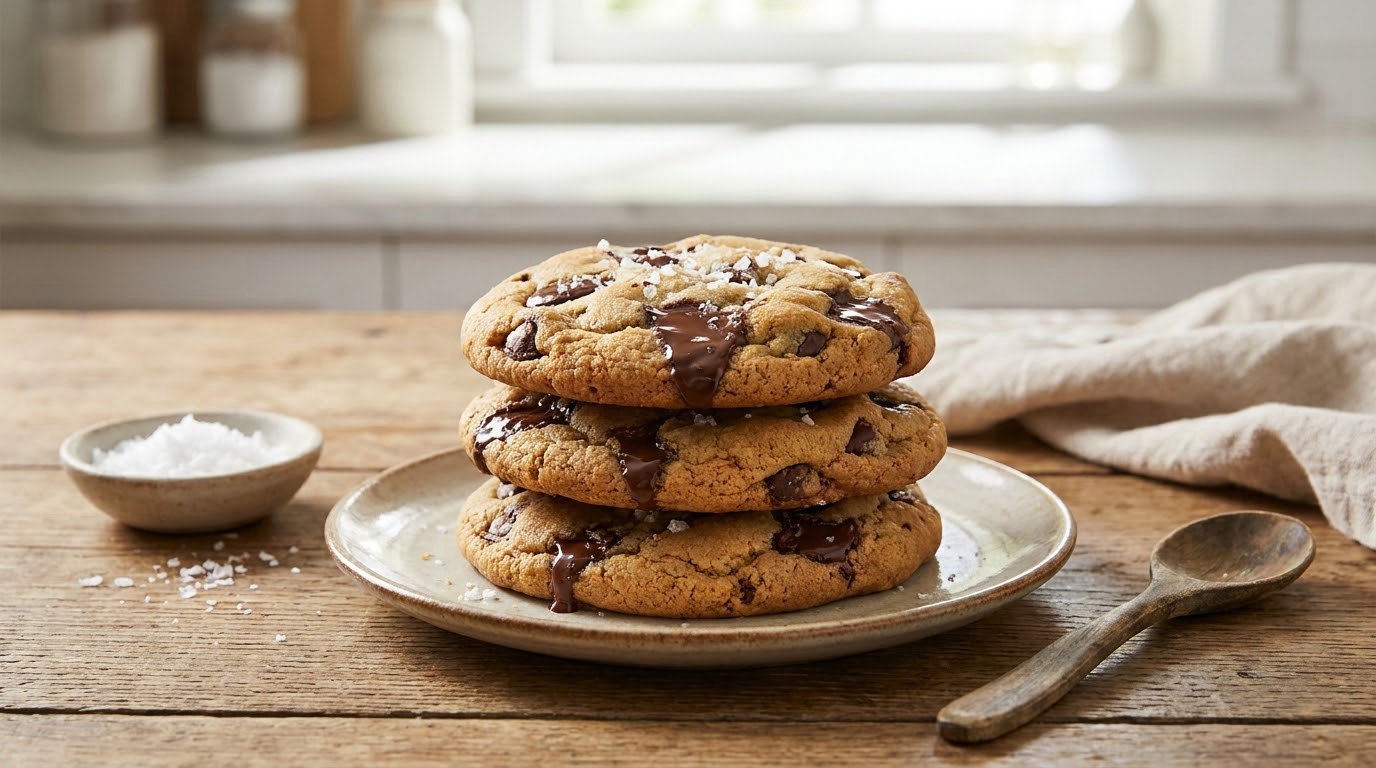
Brown butter chocolate chip cookies are the upgrade your weeknight baking has been waiting for. The butter gets cooked until the milk solids turn deep amber, which adds a nutty, toffee-like flavor you cannot get from creamed butter alone. You get bakery-style cookies with chewy centers, crisp edges, and melty chocolate pools, and the whole thing comes together in one bowl with a whisk and a wooden spoon.
I make these on a Sunday afternoon and stash a few in the freezer for the week. Total hands-on time is about 20 minutes, plus a 30 minute rest for the browned butter to cool and a short chill. The one technique that matters most: pull the butter off the heat when it smells like toasted hazelnuts and looks the color of dark caramel, not a second later. A minute too long and the milk solids turn bitter, and there is no saving burnt butter. For more soft-cookie tips, see our guide on how to keep cookies soft after baking.
Table of Contents
Brown Butter Chocolate Chip Cookies Recipe
Here is the short version: brown 1 cup (226 g) of unsalted butter, cool it until just warm, whisk it together with brown and white sugar, an egg, an egg yolk, and vanilla, then fold in flour, baking soda, salt, and chopped chocolate. Scoop, chill for 30 minutes, and bake at 375°F (190°C) until the edges are set and the centers look slightly underdone. That is the whole recipe in three lines, and the details below make it foolproof.
What sets this brown butter chocolate chip cookies recipe apart from a standard one is the balance of dark brown and light brown sugar, plus a blend of chopped chocolate and chips so you get both gooey pools and defined bits in every bite. You do not need a stand mixer, you do not need to chill the dough overnight, and you do not need any special equipment beyond a light-colored saucepan and a sheet pan.
Why This Brown Butter Chocolate Chip Cookies Recipe Works
- Brown butter, not just melted butter. Cooking the butter until the milk solids turn golden brown triggers the Maillard reaction, which creates hundreds of new flavor compounds: nutty, toffee, caramel, almost a hint of roasted coffee. That is what gives these cookies their depth.
- More dark brown sugar than white. Dark brown sugar carries extra molasses, which adds moisture and chewiness. The small amount of granulated sugar helps the edges crisp up and spread.
- One whole egg plus one yolk. The extra yolk adds fat and richness without thinning the dough the way a second whole egg would. It also helps bind the dough so the cookies hold their shape.
- Chopped chocolate plus chips. Chopped bars melt into wide, glossy puddles. Chips keep their shape and give you little bursts of chocolate in every bite. Using both is a small thing that makes a big difference.
- No dough chill required. A 30 minute rest is enough to firm up the butter and let the flour hydrate. The cookies still bake up thick and chewy.
Ingredients for Brown Butter Chocolate Chip Cookies
- 1 cup (226 g) unsalted butter
- 1 cup (200 g) packed dark brown sugar
- 1/4 cup (50 g) granulated sugar
- 1 large egg, plus 1 large egg yolk, room temperature
- 2 teaspoons pure vanilla extract
- 2 1/4 cups (280 g) all-purpose flour, spooned and leveled
- 1 teaspoon baking soda
- 1 teaspoon fine sea salt (or 3/4 teaspoon Morton kosher salt)
- 1 1/2 cups (255 g) chopped dark chocolate (about 70% cacao), or a mix of chopped chocolate and 1/2 cup chocolate chips
- Flaky sea salt, for finishing (optional)
Notes on the key ingredients: Use a light-colored saucepan so you can see the butter turning amber. If you only have salted butter on hand, cut the added salt to 1/2 teaspoon. For the flour, weigh it on a kitchen scale for the most consistent results, or use the spoon and level method. Dark brown sugar gives the chewiest texture; light brown works in a pinch, just expect slightly less molasses flavor. If you are looking for more ways to use a bar of chocolate, our roundup of 15 easy chocolate chip recipes beyond cookies is a good place to start.
Equipment
- Light-colored saucepan: A stainless steel or white interior pan lets you watch the butter turn amber. Dark pans hide the color and make it easy to overshoot.
- Mixing bowls: One medium bowl for the dry ingredients, one large bowl for the wet.
- Whisk and rubber spatula: No stand mixer needed. A whisk handles the wet ingredients, a spatula folds in the dry.
- Sheet pan and parchment paper: A rimmed half sheet pan lined with parchment gives the most even browning.
- Cookie scoop: A 3 tablespoon scoop (about 1.5 oz / 45 g) keeps the cookies uniform so they bake at the same rate. A spoon works if you do not have one.
- Cooling rack: Lets air circulate under the cookies so the bottoms do not overbake.
How to Make Brown Butter Chocolate Chip Cookies
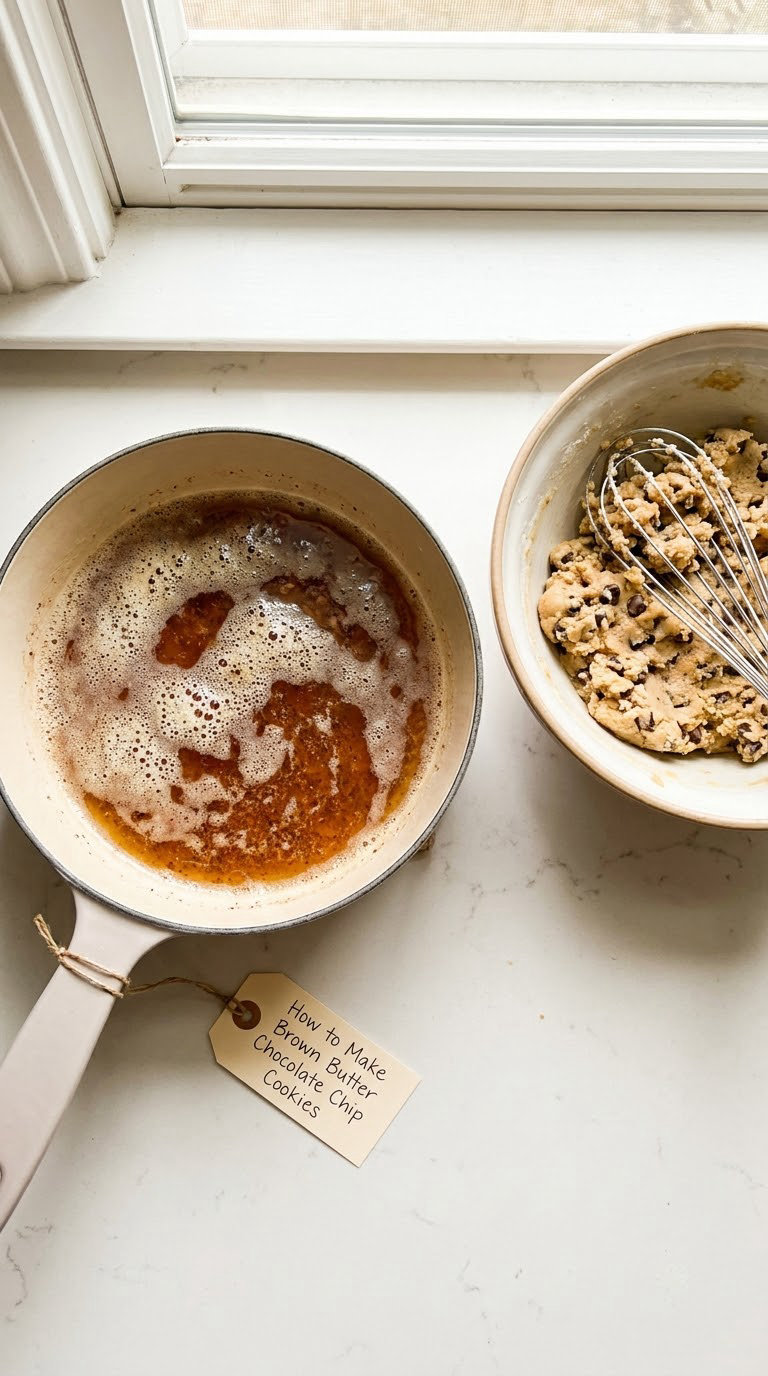
- Brown the butter. Cut the butter into tablespoon-sized pieces and add to a light-colored saucepan over medium heat. Swirl the pan often as the butter melts, foams, and then begins to quiet down. Keep swirling and watch closely. After about 5 to 7 minutes the butter will turn a deep amber color, the milk solids at the bottom will be toasty brown, and you will smell toasted hazelnuts. Pull the pan off the heat immediately and scrape every last brown fleck into a heatproof bowl.
- Cool the butter. Let the browned butter cool for about 15 to 20 minutes, until it is just warm, not hot. You can speed this up by setting the bowl over an ice water bath and stirring for 5 to 7 minutes, or by popping it in the freezer for 10 minutes. The butter should feel neutral, not warm, against your wrist.
- Whisk in the sugars. Add the dark brown sugar and granulated sugar to the cooled butter. Whisk vigorously for 1 to 2 minutes, until the mixture looks glossy and thick, almost like wet sand.
- Add the egg, yolk, and vanilla. Whisk in the whole egg first, then the yolk, then the vanilla. Whisk for about 30 seconds after each addition, until the mixture looks smooth and slightly ribboned.
- Combine the dry ingredients. In a separate bowl, whisk together the flour, baking soda, and salt.
- Fold dry into wet. Add the dry mixture to the wet and fold with a rubber spatula just until no streaks of flour remain. Do not overmix. The dough will look soft, almost like thick cake batter.
- Stir in the chocolate. Fold in the chopped chocolate (and chips, if using). Reserve a small handful of chocolate pieces to press on top of each cookie before baking.
- Scoop and chill. Scoop the dough into 3 tablespoon balls (about 45 g each) and place on a parchment-lined plate or small sheet pan. Chill for 30 minutes in the refrigerator. The dough should feel firm but not rock hard.
- Bake. Preheat the oven to 375°F (190°C) with a rack in the center. Arrange the chilled dough balls on a parchment-lined sheet pan, leaving at least 2 inches of space between each. Press a few extra chocolate pieces on top of each ball. Bake for 10 to 12 minutes, until the edges are set and lightly golden and the centers look puffy and slightly underdone.
- Shape and cool. Pull the pan out and, if you want thicker cookies, bang it firmly on the counter two or three times. Let the cookies cool on the pan for 5 minutes, then transfer to a wire rack. Sprinkle with flaky sea salt while still warm. They will continue to set as they cool.
Tips for Success
- Watch the butter like a hawk. Browning butter goes from perfect to burnt in about 30 seconds. The moment it smells like toasted nuts and the milk solids are deep amber, pull it off the heat. Black flecks and a sharp, acrid smell mean it is burnt and you need to start over.
- Let the butter cool before mixing. Adding hot butter to sugar and eggs can partially cook the eggs, giving you greasy cookies. The butter should feel just barely warm, around 80 to 90°F (27 to 32°C), before you proceed.
- Scoop, then chill. Pre-scooping the dough into balls before chilling is faster and gives you more uniform cookies than chilling the whole batch in a bowl.
- Bake on parchment, not silicone. Parchment gives the most even browning on the bottom. Silicone mats can leave the bottoms pale and a little gummy.
- Pull the cookies when they look underdone. The centers should look puffy and slightly glossy, and the edges should be just set. They will continue to bake on the hot pan for another 2 to 3 minutes out of the oven.
- Add flaky salt while warm. A pinch of Maldon or flaky sea salt on top of each cookie right out of the oven is the difference between a good cookie and a great one. The salt melts slightly into the surface and brightens all the other flavors.
Variations
- Sea salt and dark chocolate. Use a 70% cacao bar and finish each cookie with a generous pinch of flaky sea salt. This is the most popular version in my house.
- Milk chocolate and toffee bits. Swap the dark chocolate for milk chocolate and fold in 1/2 cup (90 g) of toffee bits. The brown butter and toffee echo each other in the best way.
- Brown butter pecan. Add 3/4 cup (85 g) of toasted, chopped pecans along with the chocolate. Toasting the nuts first deepens their flavor.
- Gluten-free. Substitute a 1:1 gluten-free all-purpose flour blend, such as King Arthur Measure for Measure. Let the dough rest an extra 5 to 10 minutes after mixing so the flour fully hydrates.
- Espresso boost. Add 1 teaspoon of instant espresso powder to the dry ingredients. Coffee does not make the cookies taste like coffee; it just makes the chocolate taste more like itself.
Storage, Make-Ahead and Reheating
Baked cookies keep in an airtight container at room temperature for 4 to 5 days. For the softest texture, tuck a slice of white bread into the container, the cookies will pull moisture from the bread and stay tender. To freeze baked cookies, arrange them in a single layer on a sheet pan until firm, then transfer to a zip-top freezer bag. They keep well for up to 3 months.
Raw dough scoops freeze beautifully. Place the scooped dough on a parchment-lined plate, freeze until solid, then move to a freezer bag. Bake straight from the freezer, adding 1 to 2 minutes to the bake time. The dough keeps for up to 3 months.
To reheat, warm a cookie in a 300°F (150°C) oven for 3 to 4 minutes, or microwave for 8 to 10 seconds. The edges crisp back up and the chocolate gets melty again. For more on keeping baked cookies at their best, see our guide on how to store homemade cookies so they stay fresh.
What to Serve With Brown Butter Chocolate Chip Cookies
- Cold whole milk. The classic. The cold milk cuts through the rich, toffee-like flavor of the browned butter.
- Vanilla ice cream sandwiches. Tuck a scoop of softened vanilla ice cream between two cookies, wrap in parchment, and freeze for 30 minutes.
- A shot of espresso. The bitter coffee pulls out the caramel notes in the brown butter.
- Hot cocoa. Dip a slightly warm cookie into a mug of hot cocoa. A few mini marshmallows do not hurt.
- Salted caramel drizzle. Warm a few tablespoons of jarred salted caramel and drizzle over a stack of cookies. Add a tiny pinch more flaky salt on top.
Frequently Asked Questions
How do you know when the butter is browned enough and not burned?
Pull the butter off the heat when it smells like toasted hazelnuts and the milk solids at the bottom of the pan are a deep amber color, the shade of dark caramel. Burnt butter smells sharp, almost acrid, and the milk solids will look black. Once butter burns, there is no rescuing it, so start over with a fresh batch and watch more closely next time.
Do brown butter chocolate chip cookies need to chill the dough?
A 30 minute chill is enough for this recipe. Browning the butter removes moisture and firms up the fat, so a long overnight rest is not necessary the way it is with creamed-butter doughs. If you want to bake straight away, the cookies will spread a bit more and bake up thinner, but they will still taste great. For thicker bakery-style cookies, the short chill is worth the wait.
Can I use salted butter instead of unsalted in this recipe?
Yes, just reduce the added fine sea salt from 1 teaspoon to 1/2 teaspoon. Different brands of salted butter vary in saltiness, so taste a small pinch of your browned butter on a fingertip and adjust from there. If you use a flaky finishing salt on top, a slightly less-salted dough underneath is actually ideal for balance.
Why are my brown butter cookies spreading too much or too little?
If your cookies spread into flat puddles, the browned butter was probably still too warm when you scooped, or your oven runs cool and the butter melted before the cookies set. Chill the scooped dough longer, up to an hour, and check your oven with a thermometer. If your cookies are puffy and barely spread, you likely added too much flour, scoop and level next time, or weigh the flour on a scale for 280 g.
Can I freeze the dough or baked cookies, and for how long?
Both freeze well for up to 3 months. Scoop the raw dough into balls, freeze on a parchment-lined plate until solid, then transfer to a zip-top bag. Bake straight from the freezer, adding 1 to 2 minutes to the bake time. For baked cookies, let them cool completely, freeze on a sheet pan until firm, then move to a freezer bag. Thaw at room temperature or warm briefly in a 300 degree F oven.
What type of chocolate works best in brown butter chocolate chip cookies?
A mix of chopped dark chocolate (around 70 percent cacao) and a handful of semisweet chips gives the best of both worlds: the chopped bars melt into wide, glossy pools, and the chips hold their shape for little bursts of flavor. If you only have one or the other, a good quality bar of dark chocolate chopped into rough chunks will give you the most dramatic melty pockets.
This brown butter chocolate chip cookies recipe is the one I keep coming back to on Sunday afternoons, when I want the kitchen to smell like toffee and there is a pot of coffee on the counter. The browned butter does most of the heavy lifting on flavor, the rest is just simple pantry baking, and the result is a cookie that tastes like it came from a really good bakery. Make a batch, sprinkle with flaky salt while they are still warm, and try one with a glass of cold milk before the chocolate sets.