
Last updated: October 2026
Most homemade salsa keeps in the refrigerator for 3 to 4 days, and a cooked or blended batch stretches to 5 to 7 days when it is sealed airtight and kept at or below 40°F (4°C). Fruit salsa is the shortest of the bunch, usually 2 to 3 days.
That is the short answer. The real answer is a range, because how long does homemade salsa last in the fridge depends on three things: how much acid is in the bowl, whether the salsa was cooked, and how well it is sealed.
Late summer is when this question comes up most. You have a crate of garden tomatoes on the counter, and somewhere in the back of your mind you are wondering whether Friday night’s batch will still be good by Tuesday. I make salsa most Augusts, and the answer I have landed on is simple: refrigerate it fast, seal it tight, and eat it in the first few days. Extra goes in the freezer.
If you want to start with flavor rather than shelf life, my 10 Easy Salsa Recipes With Fresh Tomatoes roundup has a version for every style, from chunky pico de gallo to fire-roasted.
Table of Contents
How Long Does Homemade Salsa Last in the Fridge?
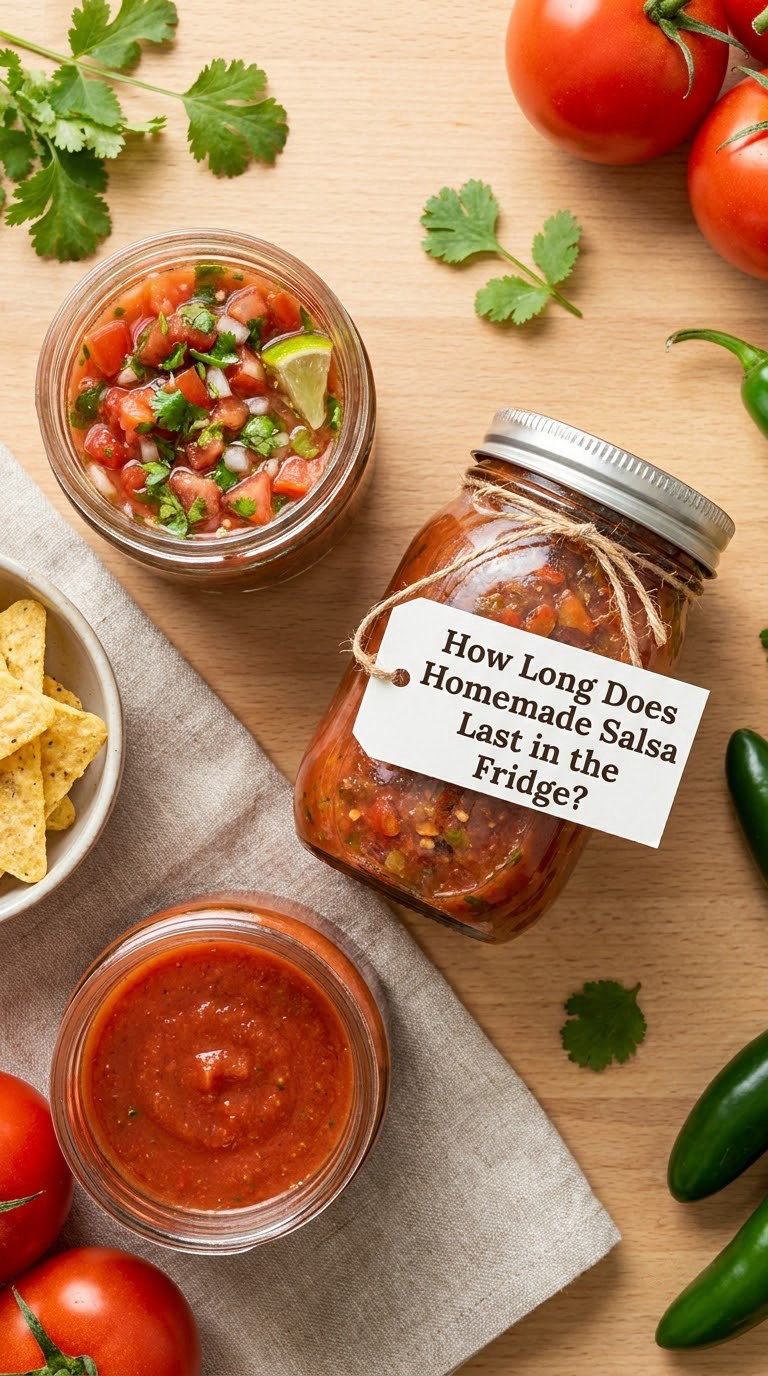
Three to four days for a fresh, raw batch. Five to seven days for a cooked or blended restaurant-style batch. Two to three days for a fruit salsa made with mango, pineapple, or peaches. Those are the three numbers most recipes are circling when they say 3 to 5 days or up to a week.
None of them is wrong. They are describing different things, and almost every conflicting number you find online comes down to a raw batch being compared against a cooked one.
Salt and acid are what buy you the extra days. A bowl with a tablespoon of lime juice and a decent pinch of salt in it can safely sit a day or two longer than a plain chopped-tomato mix, because acid and salt both slow down the bacteria that spoil cut produce.
Fresh vs. Cooked Salsa: How Long Does Homemade Salsa Last in the Fridge?
This table is the fastest way to find your batch. The safe window is when it will not make you sick. The best-flavor window is usually shorter, because fresh salsa tastes best early.
| Salsa type | Safe in the fridge | Tastes best | Freezer | Storage note |
|---|---|---|---|---|
| Fresh pico de gallo (raw tomato, onion, cilantro, lime) | 3 to 4 days | Day 1 to 3 | 2 to 3 months | Airtight container, lime juice added, refrigerate within 2 hours |
| Cooked or blended restaurant-style tomato salsa | 5 to 7 days | Day 2 to 4 | 3 to 6 months | Cool fully before sealing; leave headspace in the jar |
| Salsa verde (tomatillo, raw or cooked) | 3 to 5 days | Day 1 to 3 | 2 to 3 months | Naturally acidic, so it holds slightly longer raw than tomato salsa |
| Fire-roasted or roasted salsa | 5 to 7 days | Day 2 to 5 | 3 to 6 months | Roasting concentrates flavor, so the drop after day 4 is noticeable |
| Fruit salsa (mango, pineapple, peach, strawberry) | 2 to 3 days | Day 1 to 2 | Not recommended | Low acid and very juicy; freeze the fruit before blending if you want to keep it |
| Salsa with heavy olive oil | 4 to 6 days | Day 1 to 3 | 2 to 3 months | Oil slows air exposure but adds almost nothing to safety |
| Store-bought jar, opened | 2 to 4 weeks | Per the label | 3 to 6 months | Acidic, cooked and preserved, which is why it outlasts homemade |
| Canned or jarred salsa, unopened | Follow the label, sealed and pantry-stable | Per the label | Not needed | Heat processed with a tested recipe only, never just sealed in a jar |
That last row is the one home cooks get wrong most often. A sealed jar of properly canned salsa can sit in a pantry for a year, but only if it went through a tested water-bath process. A mason jar full of homemade salsa that you screwed a lid onto is not that.
Why Homemade Salsa Lasts Only a Few Days
Four ingredients do most of the work, and all of them are on your counter right now.
Cut produce. Every knife stroke through a tomato or a jalapeño exposes raw cell contents and surface area to whatever is on your hands, the board, and the tomato skin. That is the single biggest reason homemade salsa goes faster than the jar you bought.
Water. Salsa is a high-moisture food. Microbes need available water to grow, and a watery tomato mixture gives them plenty of it. You can see this happen: the seeds and the salt pull liquid out of the tomatoes overnight, and the jar has a layer of cloudy juice at the bottom by morning.
Low acid. Tomatoes and peppers sit on the low-acid side of the food safety scale, which is exactly why tested canning recipes for salsa add vinegar or bottled lemon juice. Acid is what stops the bacteria that refrigerator temperature alone cannot stop.
No preservatives. Jarred salsa gets acidifiers, stabilizers, and a heat process. Homemade salsa gets none of those, so the only tools slowing spoilage are cold, salt, and whatever acid you added yourself.
That watery layer at the bottom is worth pausing on, because people throw good batches out over it. A thin layer of clear liquid after a night in the fridge is normal. Stir it back in, or drain it and serve it with a slotted spoon. It is not a sign of spoilage, and it has nothing to do with the 3 to 4 day limit.
One more thing that changes the timeline, and it is the part most recipes skip: resting improves salsa before it ever hurts it. A batch that is barely balanced in the morning tastes noticeably better after a few hours, because the salt draws juice from the tomatoes and the acid softens the raw onion. That is why day two is often the best day, and why you should plan to serve it before the safe window runs out rather than treating the last day as the goal.
How to Store Homemade Salsa in the Fridge
Follow these steps and you will land at the top of the range every time. If you want the same treatment for a different dish, how long homemade soup lasts in the fridge follows the same rules.
- Cool cooked salsa before you seal it. A warm jar goes into the fridge, raises the temperature inside the fridge, and creates condensation under the lid. Divide the batch into shallow containers so it cools fast, or let the pot cool on the stove for 20 minutes before you jar it.
- Refrigerate within two hours of making it. In a hot kitchen, the limit is one hour above 90°F (32°C). This is the single rule that protects you most, and it is the one that gets ignored at parties.
- Use a clean spoon every time. Do not dip the same spoon that was in someone’s mouth back into the jar. That one habit moves a batch past its window faster than anything else on this list.
- Seal it airtight and press out the air. A mason jar with a screwed-down band, or a container with the snap lid clicked shut, keeps air from getting back in.
- Leave a finger of headspace in the jar. Salsa expands slightly as it chills. Fill to the shoulder, not to the brim, or you will find it leaking down the front of your fridge the next morning.
- Keep the fridge at or below 40°F (4°C). If your fridge cannot hold that, put the salsa in the coldest back corner you can find, away from the door and away from raw meat.
- Label the jar with the date you made it. Masking tape and a Sharpie take ten seconds. Two weeks from now, when you find a jar behind the mustard, you will not be guessing.
For a very large batch, the practical move is to not make a very large batch. Most home cooks waste more salsa by making four cups for a two-person household than by any other kitchen mistake. Make two cups, eat them, and freeze the rest on a tray so it is portioned before it freezes solid together.
How to Freeze Salsa for Longer Storage
Freezing is the easy answer for the surplus half of a batch. Frozen salsa keeps 3 to 6 months, and it is safe for the whole window as long as the container stays sealed.
Cooked and blended salsas freeze best. Raw chunky pico de gallo loses a little of its crunch, and fruit salsa turns mushy unless you freeze the fruit first, before it meets the onion and lime.
Portion before you freeze, not after. A tablespoon in each slot of an ice cube tray, frozen solid and tipped into a bag, gives you weeknight quantities. Flat freezer bags pressed thin freeze faster and stack better than jars, and they cost a fraction of what a wide-mouth jar costs.
Thaw in the fridge, never on the counter. A bag moved from freezer to counter passes straight through the 40°F to 140°F (4°C to 60°C) danger zone, and a thawed salsa that sat out for two hours is a bowl you toss.
Thawed salsa is softer and a little wetter than fresh. Spoon it onto eggs or grilled fish and nobody will notice. Set it out with a bag of tortilla chips and someone will, so freeze what you plan to eat as a dip separately from what you plan to cook.
Signs Your Homemade Salsa Has Gone Bad
Check these in order, and stop at the first one that fits. Never taste salsa to test whether it is safe.
- Smell it first. Good salsa smells fresh and slightly tangy. A sour, fermented, beer-like, or sharp vinegary smell means the batch is done, even if it looks and smells fine on the surface.
- Look for fuzzy growth. White, green, blue, or black fuzzy patches on the surface or under the lid mean mold. Fuzzy is the operative word. A flat discoloration or browning from air exposure is different, and it is only a flavor issue.
- Check the container. A swollen jar, a leaking seal, or a lid that is hard to open all point to gas and pressure inside. Discard without opening it over your sink.
- Watch for bubbles and slime. Active fizzing when you open the lid, or a slimy film that the spoon drags through, is fermentation you did not plan on. Do not skim it and continue.
If mold shows up, discard the entire batch. Do not scrape the top layer off and eat the rest. The visible fuzz is the part that grew above the surface, and its threads run down into a moist, low-acid mixture where you cannot see them. One jar of salsa is not worth a stomach illness, especially after an hour of chopping.
Two things people mistake for spoilage. A thin layer of separated liquid is the salt pulling water out of the tomatoes, and stirring it back in fixes it. And salsa that darkens from pale red to brick red overnight is just oxidation, which costs flavor and looks alarming but is not bacterial growth.
If you cannot decide, throw it out. The batch cost you twenty minutes. Food poisoning costs you more than that.
Common Mistakes That Shorten Salsa’s Fridge Life
Most short-lived batches come down to one of these six things, and all of them are easy to fix.
- Warm salsa going straight into the fridge. It cools slowly, and the jar spends hours in the danger zone. Cool it fast in shallow containers first.
- A lid that is closed but not sealed. A band screwed on loosely, or a plastic lid snapped shut without pressing all the way around, leaks air and odors both ways. Push down until it clicks.
- Big air pockets in the jar. That headspace you left is now a small oxygen reservoir. Either leave a proper inch for expansion and pack the salsa down, or fill a container that does not need headspace at all.
- Double-dipping. The chip that went in a mouth and back into the jar carries bacteria on every trip. A dedicated salsa spoon costs nothing and is the fix.
- Forgetting the date. Without a label you will absolutely serve day eight salsa to guests and call it a taste test.
- Expecting fresh salsa to behave like a sealed commercial jar. A jarred salsa is cooked, acidified, and preserved. Your batch is none of those things, so plan on days, not weeks.
One more that is not really a mistake, but feels like one. If you make a double batch and eat a few spoonfuls straight from the mixing bowl, the bowl counts as a container, and the leftover in the bowl has a much shorter clock than the rest.
What to do with the last day instead of discarding it: cook it into scrambled eggs, spoon it over grilled chicken (there are four easy chicken and salsa recipes for that), or blend the rest with a little oil and vinegar into a dressing for a salad.
Frequently Asked Questions
Can homemade salsa last a week in the fridge?
Yes, if it is a cooked or blended batch sealed airtight and kept at or below 40°F (4°C). A seven-day mark is the ceiling, not the target, and quality usually drops after day four. Raw pico de gallo and fruit salsa are different: expect three to four days and two to three days respectively, because neither has been cooked down.
How do I know if homemade salsa is still good?
Smell it first, then look. A sour, fermented, or sharp vinegary odor means the batch is finished, even if it looks normal. Fuzzy white, green, or black growth, a swollen jar, a leaking seal, or fizzing when you open the lid are all clear discard signals. A thin layer of separated liquid and a darker color from air exposure are normal and not spoilage.
Does homemade salsa need to be cooked before storing?
No. Most fresh salsa is served raw, and that is the version with the shortest window at three to four days. Cooking tomatoes, onions, and peppers down before storing softens the produce, lowers the water content, and typically extends the safe refrigerated life to five to seven days. Chilling, not cooking, is what matters most for safety.
Can I leave salsa on the counter overnight?
No. Do not leave homemade salsa at room temperature for more than two hours, and no more than one hour when the room is above 90°F (32°C). A dip bowl warms slowly and sits in the 40°F to 140°F (4°C to 60°C) range the whole time, so bacteria can multiply long before anything smells wrong. Refrigerate within that window every time.
How long does homemade salsa last after freezing?
Frozen salsa stays safe for three to six months in an airtight container, and cooked or blended versions hold quality the longest. Thaw it in the refrigerator overnight rather than on the counter, then use it within three to four days. The texture softens slightly, which suits eggs, grilled fish, and tacos more than a dip served with chips.
Should homemade salsa be kept in a glass jar or plastic container?
Either works, as long as the seal is airtight. A glass mason jar is the better choice for long storage because it does not stain or absorb odors, and leave about an inch of headspace because salsa expands as it chills. A quality plastic container is fine for a batch you will eat in a few days. In both cases, press out air and refrigerate promptly.
Use Salsa While It’s Fresh and Flavorful
So, how long does homemade salsa last in the fridge? Three to four days raw, five to seven days cooked, sealed airtight, and kept at or below 40°F (4°C). That is the working number, and the safest day to plan your batch around is the fourth, not the seventh.
Chop less than you think you need, refrigerate within two hours, label the jar, and freeze the part you will not eat. If a batch smells sour or grows fuzz, throw the whole thing out rather than skimming the top.