
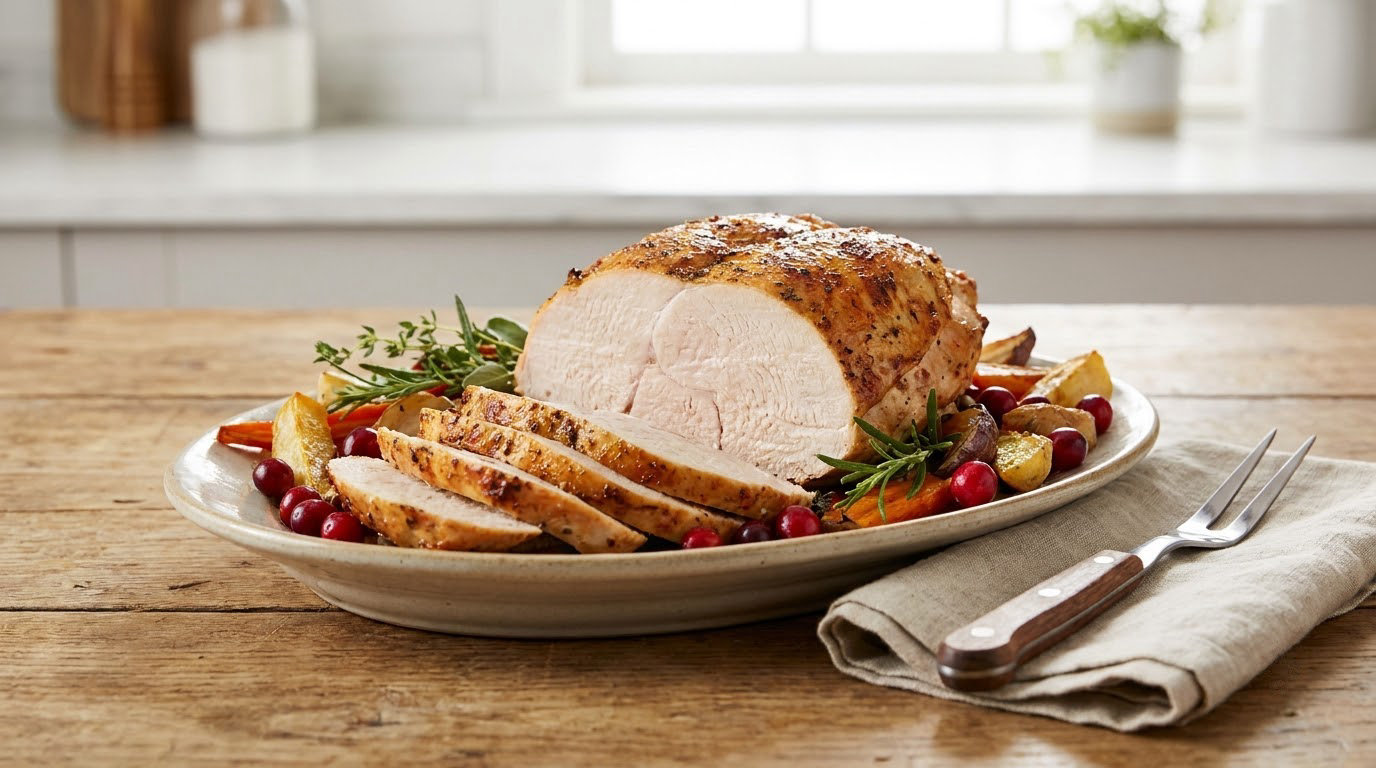
If you are wondering what temperature to cook turkey breast in the oven, the short answer is 350°F (177°C), and you take it out of the oven when the thickest part reaches 165°F (74°C), the USDA safe minimum internal temperature for poultry. Those are two different numbers, and confusing them is the single biggest reason turkey breast comes out dry or underdone.
The oven temperature is what you dial. The internal temperature is what the meat actually reaches inside. You can roast at 325°F or 400°F and the breast is still only done at 165°F in the center, so a thermometer is the part that decides.
Turkey breast is lean white meat with almost no fat under the skin, so it loses moisture quickly. Time alone will not save it. Set the oven, then watch the thermometer.
Table of Contents
What Temperature to Cook Turkey Breast in the Oven?
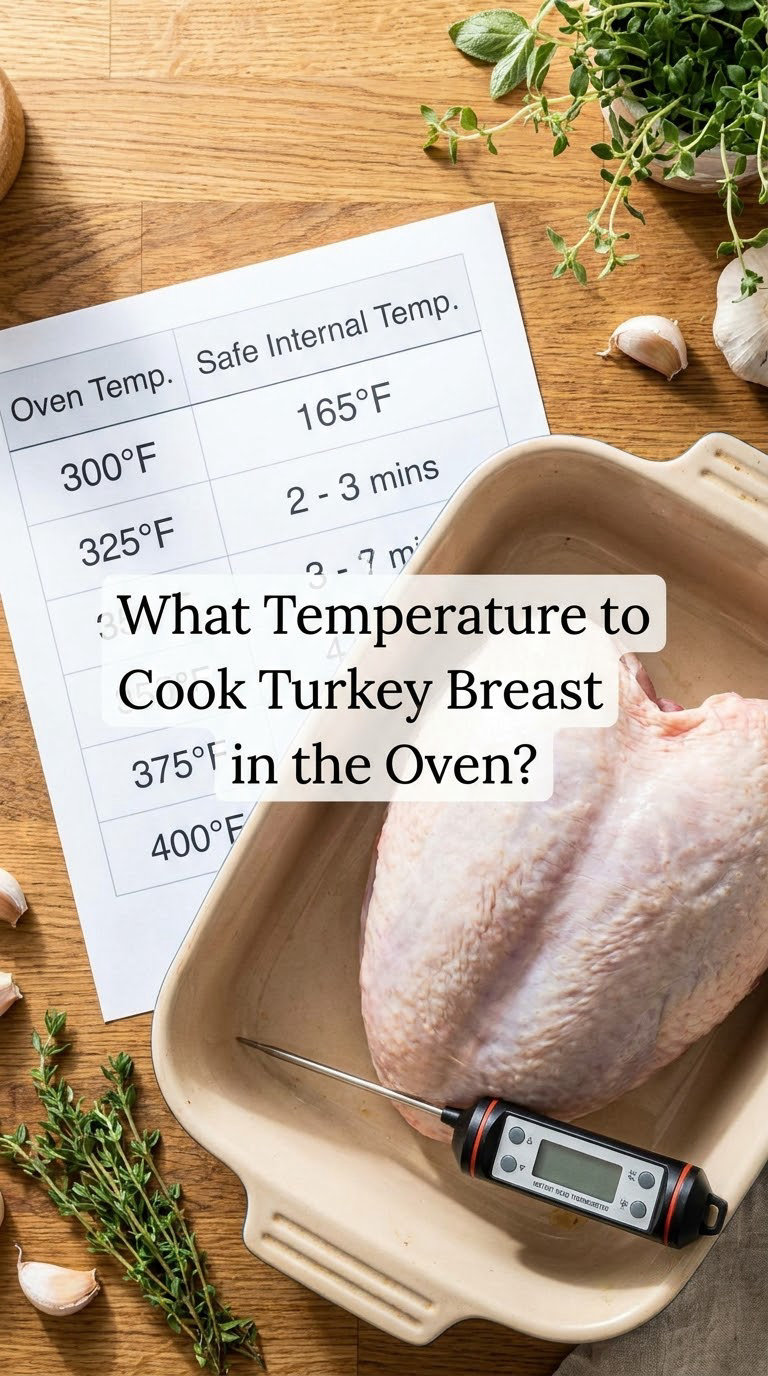
350°F is the number I use most often. It browns the skin reasonably well, cooks a 3-pound boneless breast in about an hour, and gives you a comfortable margin above the temperature where lean meat starts to tighten up and lose juice.
325°F is the gentler option and my pick for a large bone-in breast that needs two hours or more. The oven is cooler for longer, which means the outside is less likely to scorch before the middle catches up. The trade is skin that is less crisp.
400°F cooks fast and browns hard. It works well for a small boneless breast under about 2 pounds, where the whole thing reaches temperature before the surface burns. On anything larger, the outside will be well past done while the center is still working.
300°F is the low-and-slow method. It produces a breast that some cooks swear is the juiciest roast they have ever made, and the longer gentler heat does keep the interior moist. It also means a 6-pound bone-in breast can take close to three hours.
Whichever setting you choose, the finish is the same. Cook until the thermometer reads 165°F (74°C) in the thickest part, not touching bone.
Oven Temperature to Cook a Turkey Breast by Size
| Oven temperature | Approximate time | Result | Best for |
|---|---|---|---|
| 300°F (149°C) | 30 to 40 minutes per pound | Very moist, pale skin | Large bone-in breasts, brine-forward roasts |
| 325°F (163°C) | 20 to 30 minutes per pound | Moist, lightly golden | Bone-in breasts over 4 pounds |
| 350°F (177°C) | 20 to 25 minutes per pound | Golden skin, juicy center | Most home cooks, boneless and bone-in alike |
| 375°F (190°C) | 15 to 20 minutes per pound | Firm texture, quick browning | Medium boneless breasts |
| 400°F (204°C) | 10 to 15 minutes per pound | Dark crust, dries fastest | Small boneless breasts under 2 pounds |
Every row above finishes at the same place: 165°F (74°C) in the thickest part, measured with an instant-read thermometer.
How Long Should You Bake a Turkey Breast?
Weight matters most, then whether the breast is bone-in or boneless, then the oven setting. Starting temperature matters too, and a breast straight out of the fridge adds 15 to 25 minutes because the oven is heating a cold mass rather than a room-temperature one.
At 350°F, a boneless skin-on turkey breast runs about 20 to 25 minutes per pound. A bone-in breast needs a little more, closer to 25 to 30 minutes per pound, because the bone holds heat and the surrounding meat cooks at a slightly different rate.
| Turkey breast weight | Boneless at 350°F | Bone-in at 350°F |
|---|---|---|
| 2 lb | 40 to 50 minutes | 50 to 60 minutes |
| 3 lb | 60 to 75 minutes | 75 to 90 minutes |
| 4 lb | 80 to 100 minutes | 100 to 120 minutes |
| 5 lb | 100 to 125 minutes | 125 to 150 minutes |
| 6 lb | 120 to 150 minutes | 150 to 180 minutes |
| 7 to 8 lb | 140 to 175 minutes | 175 to 210 minutes |
Start checking the temperature with 30 minutes left on your estimate. If you want a firmer number for a whole bird instead, our per-pound turkey timing guide breaks that down separately.
Time is an estimate, not a finish line. Package directions are written for a whole turkey in a standard oven, not for a breast in yours, and they are frequently optimistic.
How to Cook Turkey Breast in the Oven
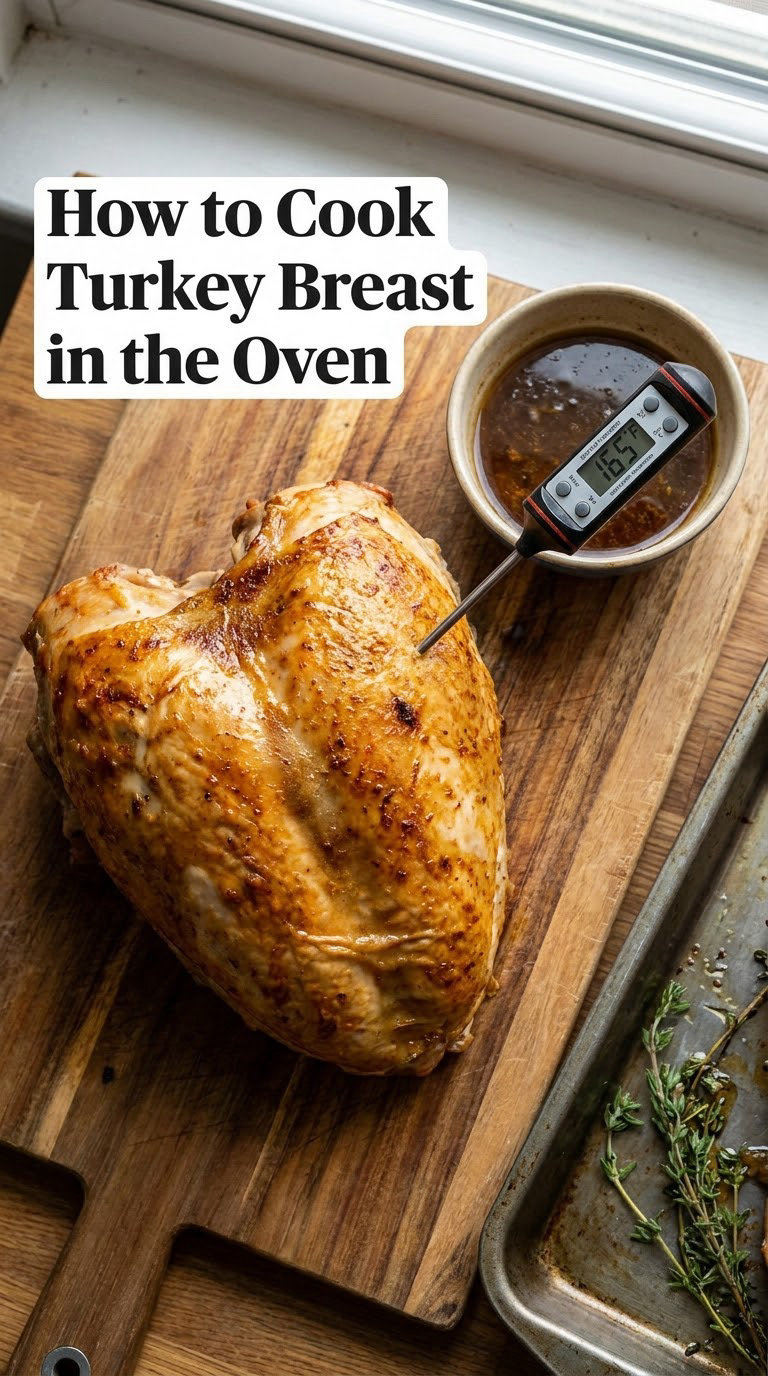
- Take the breast out of the fridge 30 to 45 minutes ahead. Room-temperature meat cooks more evenly and takes less time in the oven.
- Preheat the oven to 350°F (177°C). Let it sit at temperature for a full 10 minutes after the preheat signal if you have the time; ovens often cycle on and cool before they settle.
- Pat the skin dry and season it. Blot the skin with paper towels, then rub it with oil or butter and salt. If you are brining, do that 12 to 24 hours before and skip the salt now.
- Set the breast on a wire rack in a shallow roasting pan. Add a cup of chicken stock or water to the pan. The liquid keeps steam around the meat and gives you drippings for gravy.
- Roast uncovered. Start checking at the low end of your time estimate, and tent with foil only if the skin is browning much faster than the center is cooking.
- Check with an instant-read thermometer in the thickest part. Push in about half an inch, staying clear of the center bone. If you serve a bone-in breast, check the thickest part of the meat beside the bone, not the bone itself.
- Pull at 160°F (71°C) and let carryover finish the job. The center climbs several degrees during the rest and lands at or above the USDA-safe 165°F (74°C). Resting 15 to 20 minutes keeps the juices where you want them.
If you like a crisper top, rest the breast first and then set it under the broiler for 2 to 3 minutes. Broiling first dries out the interior, so do it last.
Bone-In vs. Boneless Turkey Breast: What Changes?
Bone-in breasts cook more evenly on the inside because the bone acts as a heat conductor, but they take longer and there is less usable meat. The bone also holds heat near the center, so a reading taken directly on bone is misleading. Aim for the meat just beside it.
Boneless breasts cook faster and give you more meat per pound, but they are harder to keep juicy. Rolled and tied breasts are dense cylinders with no natural insulation, so the outside overcooks before the middle firms up.
Two practical fixes for boneless: tie the breast tightly with kitchen twine so it holds its shape, and check the temperature at three points along the thick end. The thin tail finishes a good ten minutes before the fat end does.
On a Costco-style frozen Butterball breast, thawing matters more than technique. A breast that still has ice in the center when it goes in the oven will cook unevenly no matter what temperature you set.
How to Tell When Turkey Breast Is Done
Use a thermometer, and place it in the thickest part of the breast without touching bone. A bone-in breast reads several degrees higher than the surrounding meat, and a reading taken on bone is meaningless. If your oven thermometer lags, a leave-in oven thermometer is a cheap way to know whether the oven itself is holding true.
Color is not a doneness test. A properly cooked turkey breast can still show a faint pink tint near the center, and undercooked meat can look deceptively pale after being dyed by the juices around it. Push juices are equally unreliable in a brined or smoked breast.
For the juiciest result, pull the breast at 160°F (71°C) and rest it 15 to 20 minutes. Residual heat carries the center past 165°F (74°C), which is the USDA safe minimum for poultry, and the meat spends less time at high heat. Many cooks on r/AskCulinary pull even earlier, around 150°F, and report very good results with a longer rest.
If you have guests who are pregnant, elderly or otherwise at higher risk, probe the deepest point and confirm it has reached 165°F (74°C) before serving, rather than relying on the rest alone.
Tips for a Juicy Turkey Breast
- Brine ahead. A dry brine of 1 tablespoon kosher salt per pound, applied 12 to 24 hours before and rinsed off, seasons the meat all the way through. A full wet brine in the refrigerator works too; just pat it very dry afterward.
- Dry the skin properly. Moisture is what stops browning. Blot with paper towels, even if you brined.
- Use a shallow pan with liquid. A wire rack lifts the breast above the drippings so the underside steams instead of stewing. Chicken stock in the pan also makes gravy for free.
- Tent only when needed. Foil traps steam and softens skin. Put it on when the top browns faster than the center cooks, and take it off as soon as the color evens out.
- Rest before carving. Skipping the rest is why the first slice runs dry and the last slice is fine. Fifteen to twenty minutes changes that.
- Broil at the end. Two or three minutes under the broiler after the rest gives you crackling skin without drying the meat.
If you are roasting chicken as well, my oven-baked chicken breast method uses the same thermometer placement and rest logic, just at a different temperature.
Common Mistakes When Cooking Turkey Breast
- Cooking to 165°F in the oven with no carryover plan. Fix: pull at 160°F and rest 15 to 20 minutes. You arrive at the same safe temperature with a juicier breast.
- Taking the reading next to or on the bone. Fix: move the probe to the thickest meat, a half-inch in from the bone.
- Trusting a whole-turkey timing chart. Fix: use breast timings. A whole bird carries a cavity, a frame and often a higher mass that changes the cooking curve completely.
- Roasting too hot for too long. Fix: 350°F for anything over 2 pounds, 325°F for large bone-in breasts. High heat is not the same as thorough heat.
- Leaving the foil on for the whole cook. Fix: uncover for the last 20 to 30 minutes, or broil after the rest.
- Skipping the rest. Fix: give it 15 to 20 minutes. The juices need the time to redistribute before the knife goes in.
Frequently Asked Questions
What is the best oven temperature for a turkey breast?
350°F (177°C) is the best all-round setting for most home cooks. It browns the skin, cooks a 3-pound boneless breast in about an hour, and keeps the interior moist. Use 325°F (163°C) for a large bone-in breast that needs a long cook, and 400°F (204°C) only for a small boneless breast under 2 pounds. Whatever you set, finish at 165°F (74°C) internally.
How long does a turkey breast take to cook at 350°F?
At 350°F, plan on 20 to 25 minutes per pound for a boneless turkey breast and 25 to 30 minutes per pound for a bone-in breast. That puts a 3-pound boneless breast at roughly 60 to 75 minutes and a 5-pound bone-in breast at about 125 to 150 minutes. Start checking 30 minutes early, because the thermometer decides doneness, not the clock.
Do I need to cook turkey breast to 165°F even if it looks done?
Yes. 165°F (74°C) is the USDA safe minimum internal temperature for poultry, and color is not a reliable substitute because a fully cooked breast can still look faintly pink. Many home cooks pull at 160°F (71°C) and rest the breast 15 to 20 minutes, and residual heat carries the center past 165°F. Verify the deepest point reaches 165°F before serving, especially for anyone at higher risk.
Should I cover a turkey breast while baking it?
Start uncovered so the skin can brown. Cover loosely with foil only when the top is browning much faster than the center is cooking, which usually happens on a large bone-in breast. Take the foil off as soon as the color evens out, or leave it on too long and the skin turns soft and pale. For crisp skin, uncover for the last 20 to 30 minutes or broil for 2 to 3 minutes after resting.
How do I know when a bone-in turkey breast is done?
Check the temperature with an instant-read thermometer in the thickest part of the meat, a half-inch in from the center bone. A reading taken directly on bone runs several degrees high and tells you nothing. Bone-in breasts need 25 to 30 minutes per pound at 350°F, and you can pull at 160°F (71°C) and let the rest carry the center to the USDA-safe 165°F (74°C).
How should I store and reheat cooked turkey breast?
Cool the breast within two hours and refrigerate it in a sealed container for up to 3 to 4 days, or freeze sliced meat in airtight bags for up to three months. Reheat in the oven at 325°F (163°C) until the center reaches 165°F (74°C), usually 20 to 30 minutes for slices. A splash of broth in the pan keeps reheated slices from turning dry.
Conclusion
Set the oven to 350°F (177°C), give the breast about 20 to 25 minutes per pound if it is boneless or 25 to 30 if it is bone-in, and let the thermometer make the call. If you only remember one thing from this guide on what temperature to cook turkey breast in the oven, make it this: the oven setting changes the crust, but 165°F (74°C) in the thickest part is the only thing that means done.
Pull at 160°F, rest 15 to 20 minutes, then slice. That single change fixes the dry breast problem better than any seasoning trick.