
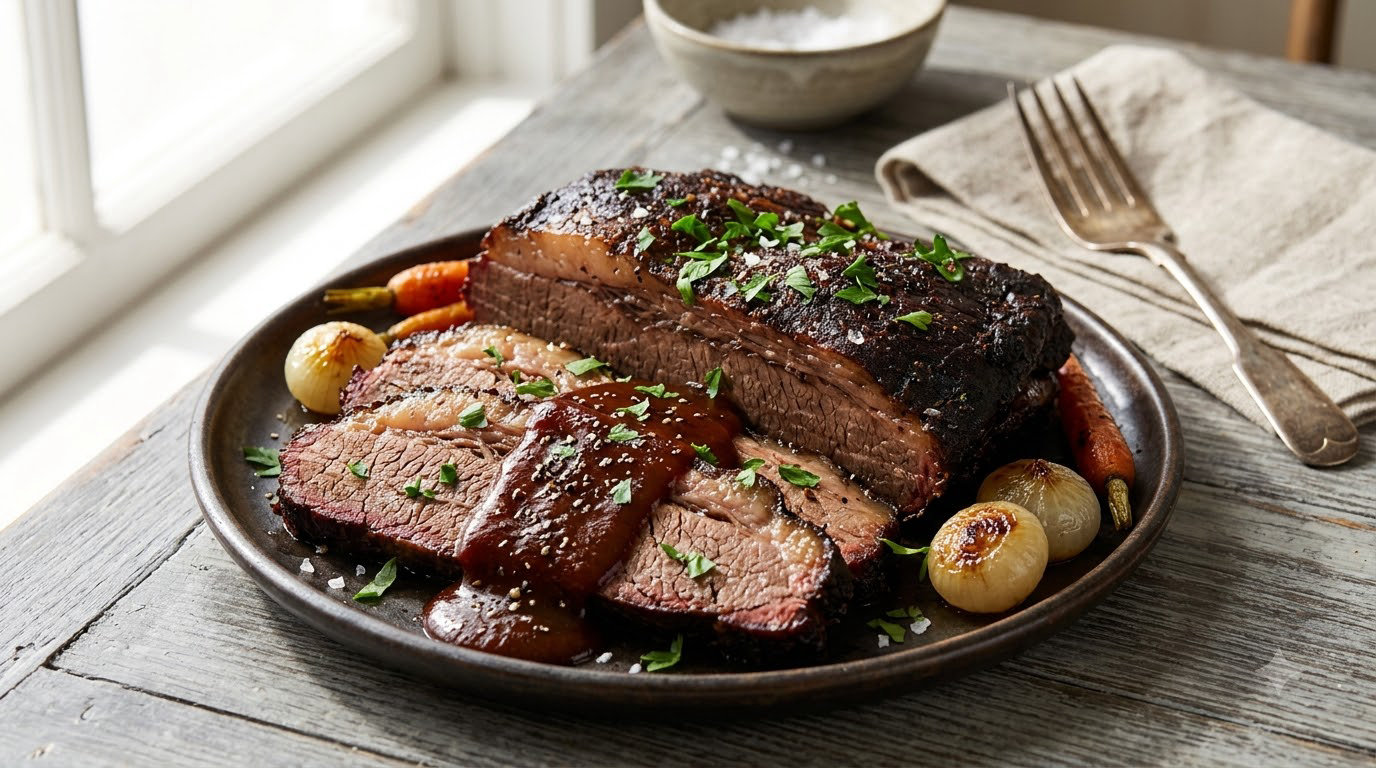
What temperature to cook brisket in the oven? For a classic home roast, set the oven to 325°F (165°C); for the most tender, barbecue-style result, cook it low and slow at 275°F (135°C). Either way, the brisket is done when the thickest part reaches 195°F to 205°F (90°C to 96°C) and a probe slides in with no resistance.
Those two numbers are the whole answer, and everything else on this page is the detail that makes them work. The oven setting decides how fast the connective tissue converts, and the probe reading decides when you stop. Time is just a rough estimate on the way there.
Table of Contents
What Temperature to Cook Brisket in the Oven? Quick Guide
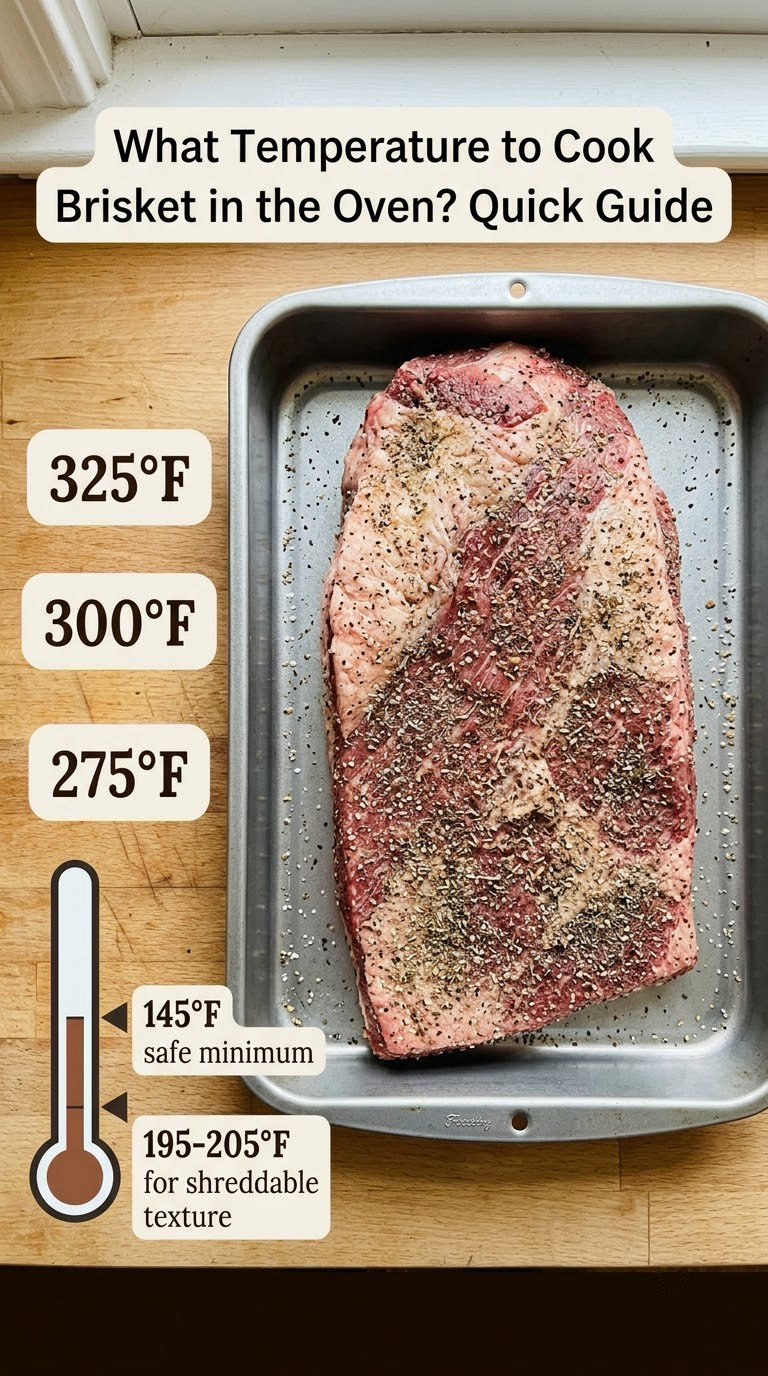
There is no single correct oven temperature for brisket, because there are two jobs. You are either roasting a holiday dinner that needs to be sliceable and forgiving, or you are chasing the shreddable, collagen-heavy texture that takes all afternoon. Here is how the three common settings compare.
| Oven setting | Internal target | What you get | Best for |
|---|---|---|---|
| 325°F (165°C) | 145°F minimum, 165-175°F for a juicy roast, 195°F+ for shreds | Brown crust, juicy slices, dependable timing | First brisket, holiday dinner, weeknight roast |
| 300°F (150°C) | 165-180°F covered, then finish uncovered | Moist, forgiving, closer to a braise | Braised brisket, covered roasts, busy kitchens |
| 275°F (135°C) | 195-205°F before pulling | Soft bark, deep flavor, shreddable texture | Weekend cooks chasing Texas-style results |
One safety note before anything else. The USDA safe minimum internal temperature for intact beef roasts is 145°F (63°C) with a three-minute rest. That is the number for food safety, not the number for a good brisket. At 145°F, brisket is safe and it is still chewy, because collagen has barely started converting to gelatin.
Barbecue-style brisket generally reaches 195-205°F (90-96°C) before you pull it. That is well past the safe minimum and it is where the texture turns.
How Long Does Brisket Take to Cook in the Oven?
Cook time depends on three things: the weight of the cut, the oven setting, and how much of the fat cap you trimmed. A 10-pound packer at 325°F is not a 10-pound roast, because a big packer carries more connective tissue than a smaller flat.
| Brisket weight | At 325°F (165°C) | At 275°F (135°C) |
|---|---|---|
| 4-6 lb | 2 to 3 hours | 3 to 4 hours |
| 7-9 lb | 3 to 4 hours | 4 to 6 hours |
| 10-12 lb | 4 to 5 hours | 6 to 8 hours |
| 13-15 lb | 5 to 6 hours | 8 to 10 hours |
Those are oven hours only. Add 30 minutes to an hour for trimming and seasoning, plus a rest of at least 45 minutes for a brisket under 8 pounds and an hour or more for anything bigger. Covering the brisket once it is wrapped shaves off roughly an hour on a large packer.
The clock is a starting guess, not a decision. Two briskets of the same weight can differ by two hours because of marbling and how tightly the collagen is packed. Check the temperature every 30 minutes once you pass the two-hour mark and let the probe call it.
How to Cook Brisket in the Oven Step by Step
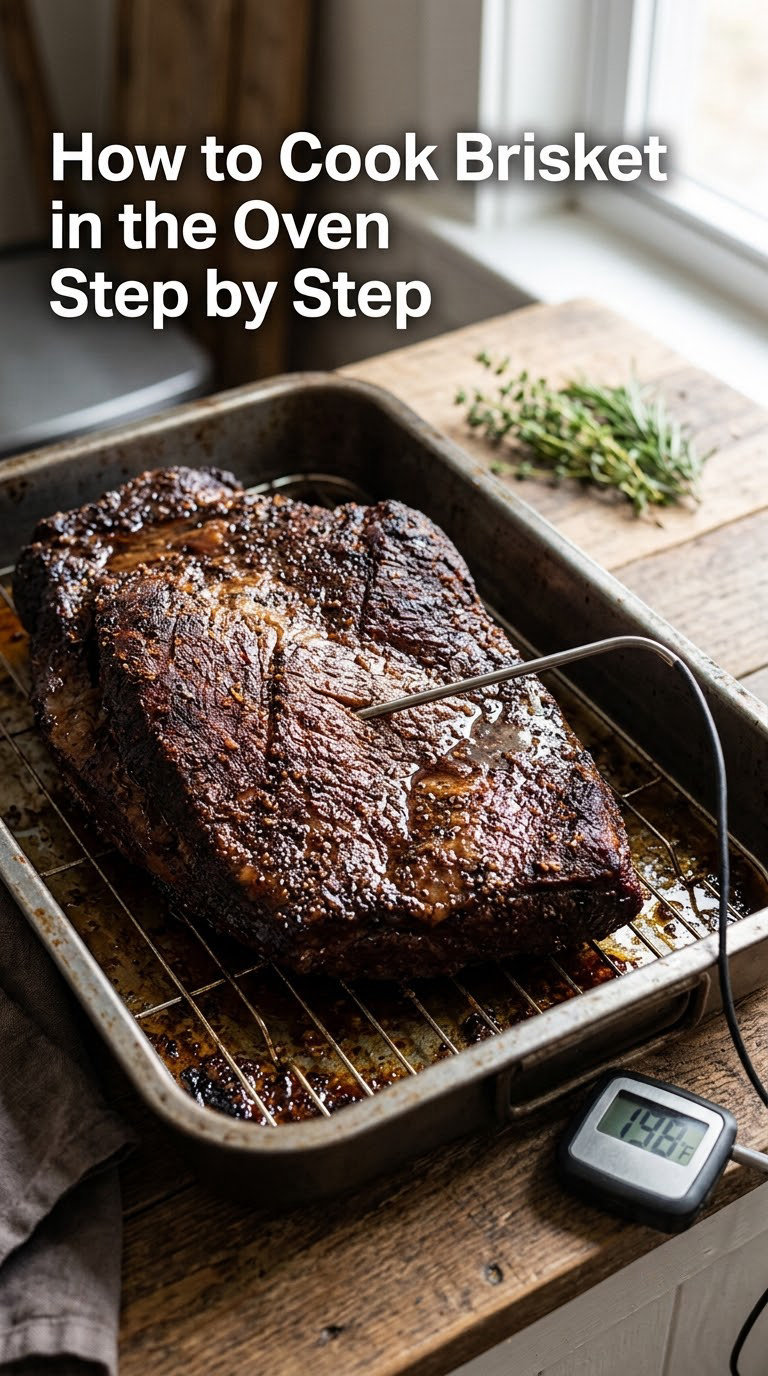
This is the 325°F method, the easiest one to learn. It gives you a browned exterior and a moist interior in an afternoon.
- Trim the brisket. Cut away the thick hard fat cap on the underside and any loose silverskin. Leave a thin even layer of fat on top, because that layer seasons and protects the meat as it roasts.
- Dry and season. Pat the surface dry, then apply salt and pepper generously, about 1 tablespoon of salt per pound of meat. If you have time, season it 4 to 12 hours ahead and keep it uncovered in the fridge.
- Preheat to 325°F (165°C). Let the oven reach temperature fully before the meat goes in, and put the pan on a center rack.
- Roast uncovered. Set the brisket fat-side up in a roasting pan. Leave it uncovered so the outside can brown and build a crust.
- Start checking at 2 hours. Push a probe thermometer into the thickest part, aiming for the center without touching bone or pan.
- Wrap when the temperature stops climbing. Once it reaches 150-170°F and plateaus, wrap tightly in foil or butcher paper and return it to the oven.
- Finish until probe tender. Keep cooking until 195-205°F (90-96°C) and the probe slides into the flat with no drag.
- Rest, then slice. Rest at least 45 minutes, longer for a large packer. Slice the flat against the grain, thin, and serve.
What Temperature Gives the Most Tender Brisket?
Low and slow wins on tenderness. At 275°F, the outside renders and browns slowly while the inside has time for collagen to break down into gelatin, which is what makes brisket fall apart instead of chew.
325°F is the practical choice. It browns faster, it finishes sooner, and a home cook can manage it on a Saturday afternoon without rearranging the whole day around a 10-hour cook. The texture difference between 275°F and 325°F is real but smaller than the difference between cooking to temperature and pulling off the clock.
What to avoid is heat above 350°F (175°C). The fat cap and the rub will darken long before the connective tissue gives up, and you get a crust that tastes bitter and a center that still resists the knife.
Texture cues tell you which target you are aiming for. Sliced roast brisket is right around 160-170°F: firm, sliceable, juices run a little when you cut. Shreddable brisket lives at 195-205°F, where a fork twists through the flat with almost no pressure and the fibers separate into strands.
Should You Wrap Brisket in the Oven?
Wrap it once the brisket stalls. That plateau usually shows up between 150°F and 170°F (66°C and 77°C) and can last an hour or more while the interior works through its densest collagen.
Wrapping does three useful things. It traps steam so the surface stays moist, it softens the bark so it stops tightening as the meat cooks, and it speeds up the finish by raising the effective humidity around the meat.
| Wrapper | Best for | Watch out for |
|---|---|---|
| Foil | Home ovens, sealing in moisture and steam | Softens bark the most; can turn the crust rubbery if wrapped early |
| Butcher paper | A drier bark with a little more bite | Not airtight, so less moisture retention than foil |
| No wrap | Small flats under 6 lb, or a very short roast | Exterior dries out over a long cook |
Wrapping too early is the most common mistake here. Cover a brisket at 120°F and the bark never sets, and you get a pale, steamed exterior instead of a crust. Hold off until the color is genuinely dark mahogany and the temperature has plateaued.
When you wrap, wrap tight. Double the foil and crimp it down, or fold butcher paper and secure it with twine. Loose wrapping lets steam escape and the bark re-tightens, which defeats the purpose.
How to Tell When Oven-Cooked Brisket Is Done
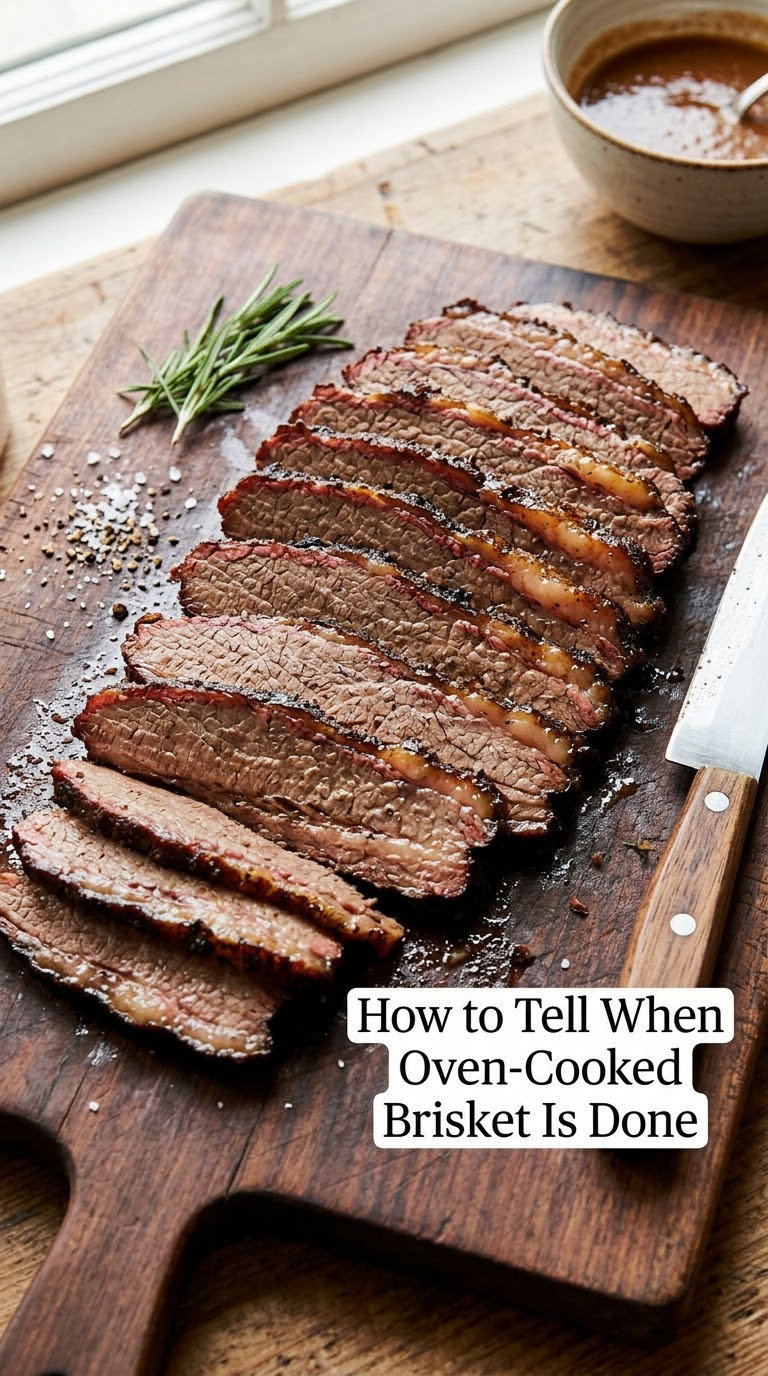
Temperature tells you when brisket is approaching done. Texture tells you when it is actually done. Use both.
| Internal temp | What is happening | What to do |
|---|---|---|
| 145°F (63°C) | USDA safe minimum for intact beef roasts | Rest three minutes to be safe, but expect a chewy roast |
| 150-170°F (66-77°C) | The stall. Collagen and fat are rendering | Wait it out, then wrap tightly |
| 170-190°F (77-88°C) | Bark sets, fat renders, collagen converting | Check for probe tenderness every 20 minutes |
| 195-205°F (90-96°C) | Probe slides in like butter, shreddable texture | Pull and rest |
Two kinds of thermometer do different jobs. A leave-in oven thermometer is better for long cooks because it keeps logging without you opening the door, which slows the cook and lets the bark dry out. For short checks, an instant-read probe in the thick center is all you need.
Probe tenderness is the real test. Slide the tip into the thickest part of the flat with almost no downward pressure. If it stops somewhere, keep cooking. When it passes through the whole thickness with no resistance, you are there.
Carryover cooking adds a few degrees after the pan leaves the oven. Pull brisket at 195°F if you plan to slice it, and slightly earlier if you are pushing toward shredded texture and want to avoid drying out.
Common Mistakes and How to Fix Them
- Cooking from a cold oven. Preheating first sounds obvious but skipping it means the brisket spends 20 minutes drying out. Give the oven 15 minutes at temperature with the pan inside.
- Using the wrong cut. The point section is denser and takes longer. Cook the flat to a lower internal temperature for slicing, and give the extra time to the point.
- Trimming away all the fat. Leave a thin even layer on top. That fat bastes the meat and seasons the bark.
- Seasoning too late. A salty dry rub applied 10 minutes before cooking mostly sits on the surface. Salt it hours ahead and the flavor goes all the way into the meat.
- Probing in the wrong spot. Aim for the thick center of the flat. Touching bone, fat, or the pan gives a false reading.
- Relying on cooking time. A timer estimates. The probe decides. This is the single change that fixes most tough briskets.
- Wrapping too early. Wait for the stall at 150-170°F and a genuinely dark exterior, then wrap tight.
- Cutting before resting. Resting lets the juices redistribute. Skipping it means dry slices and a cutting board full of juice.
- Running the oven too hot. Above 350°F the outside burns before the inside softens. If your oven runs hot, an independent oven thermometer helps you know.
Two more worth knowing. If your oven has hot spots, rotate the pan once halfway through; the rear element can brown one side long before the other is tender. And if you are planning ahead for a party, cooked brisket holds at 150-170°F in a cooler overnight, which gives you a low-stress morning. Line your pan with something heavy if you are working with a large cut, or a heavy Dutch oven liner makes it easier to move a 12-pound packer without flexing the whole thing.
Frequently Asked Questions
Is 350°F better than 325°F for brisket?
Not for most briskets. Going from 325°F to 350°F darkens the bark and the fat cap faster while the interior connective tissue is still converting, so you tend to end up with a bitter crust and a chewy center. Save 350°F for a small cut you are slicing, and stay at 325°F or drop to 275°F for anything you want to shred.
Should I cover brisket with foil while it cooks?
Start it uncovered so the bark can brown, then wrap it tightly in foil once the temperature stalls at 150-170°F. Wrapping traps steam, softens the bark, and speeds the finish. Wrapping too early is the problem, not wrapping itself, because a covered brisket that never browned will steam instead of crust.
How long does a 10-pound brisket take at 325°F?
Plan on about 4 to 5 hours of oven time at 325°F for a 10-pound brisket, and expect a wider window for a large packer with a heavy fat cap. Add trimming and seasoning time on the front, and rest the brisket for at least an hour after cooking. Check the temperature every half hour after the two-hour mark.
What is the USDA-safe temperature for brisket?
For intact beef roasts, the USDA safe minimum internal temperature is 145°F with a three-minute rest. That covers food safety but not texture, because brisket at 145°F is still quite chewy. Shreddable barbecue brisket usually reaches 195°F to 205°F internal, which is well past the safe minimum and where collagen has converted to gelatin.
How should leftover brisket be stored and reheated?
Cool the brisket in shallow containers and refrigerate it within two hours; most cooked dishes keep three to four days in the fridge, and brisket also freezes well for a few months. Reheat slices in a single layer in a skillet with a splash of liquid and a lid over low heat, or use a warm oven with a damp towel over the tray.
Start at 325°F and Let the Thermometer Decide
If brisket is new to you, cook it at 325°F. It browns properly, it finishes in an afternoon, and it is forgiving of the mistakes beginners make. When you want the shredded, melt-in-your-mouth version, drop the oven to 275°F and give the cook the extra hours it asks for.
Either way, let the probe make the call at 195-205°F rather than the clock, and give it a real rest before you slice. Then turn whatever is left into burnt ends or a brisket hash, which is honestly the best part of cooking a whole cut.
15 easy leftover brisket recipes covers that second half, and if you are planning a large packer for a gathering, an appliance with two ovens makes the timing far less stressful.