
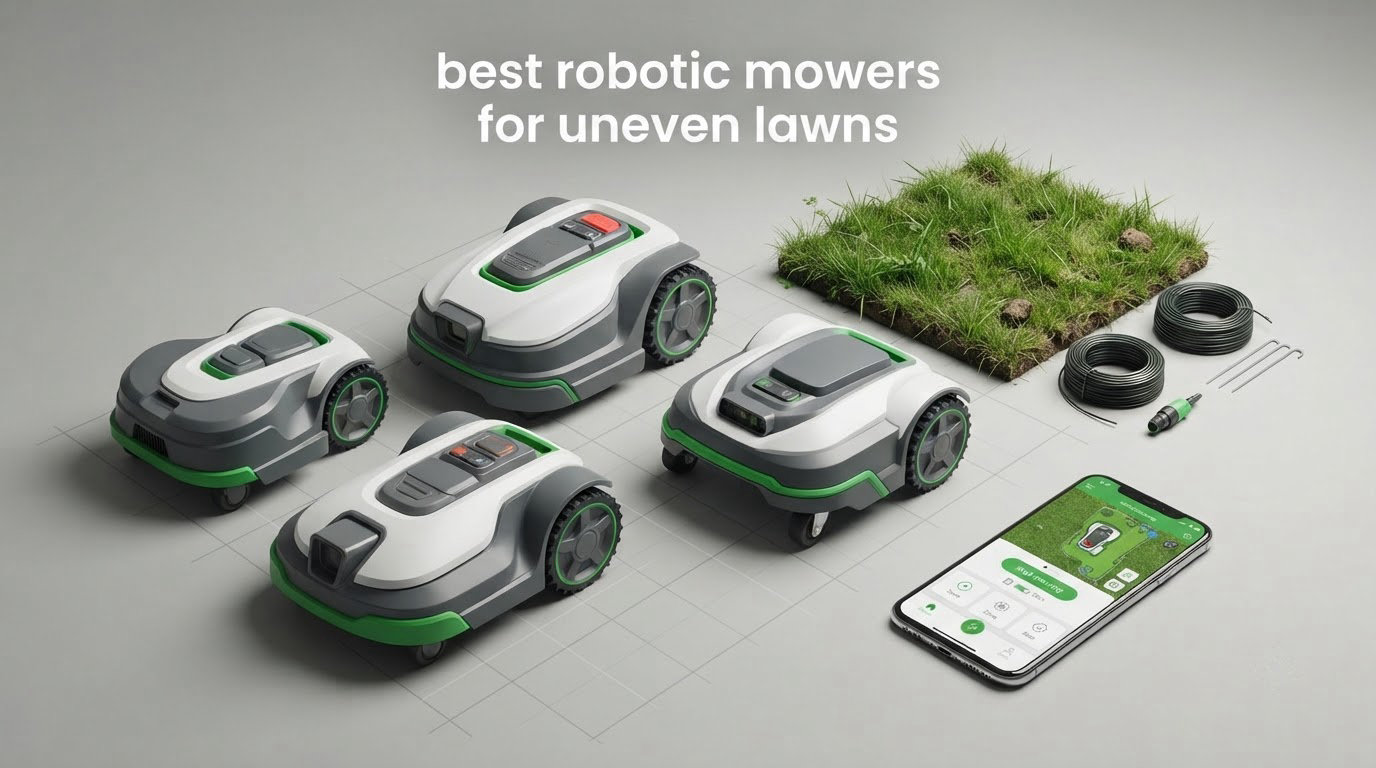
Robot mowers handle rough ground far better than they did three years ago, but the gap between a mower that finishes your lawn and one that sits stuck under a tree root is still enormous. The best robotic mowers for uneven lawns are the ones with all-wheel drive or tracked chassis, a published incline rating above 45 percent, and a cutting deck that floats rather than a rigid frame that high-centers on the first divot.
We spent weeks working through spec sheets, owner reviews and failure reports on twelve of the strongest wire-free mowers on the market right now to separate the machines that genuinely cope with hills, divots and exposed roots from the ones that merely advertise the word.
Our pick for most people with a broken-up lawn is the Mammotion LUBA 2 AWD 5000HX, which pairs 165 W motors on all four wheels with a claimed 80 percent (38 degree) climb. If your problem is small-scale roughness rather than big hills, the ANTHBOT M5 and Roborock RockNeo Q110H cover more ground for less money.
Two things to know before you buy. You will still need a string trimmer for edges on every model here, and no robot mower on the market survives deep ditches, cliff edges or roots taller than its wheels. We cover exactly where that line falls further down, and whether a manual mower is the smarter purchase.
Table of Contents
Which Robot Mower Is Best for Uneven Terrain?
The Mammotion LUBA 2 AWD 5000HX is the best robot mower for uneven terrain overall. Its four independent 165 W motors drive an 80 percent (38 degree) incline rating, the dual-blade disk floats over divots, and the UltraSense vision system keeps working under tree cover where RTK alone drops out. Owners on genuinely hilly, broken lawns report it climbing ground that stranded a wire-guided predecessor.
An uneven lawn is any yard with hills, dips, divots, holes, exposed tree roots or sunken edges. Judging one is not about cutting width or app polish. It comes down to three numbers: the published incline rating, the drivetrain (2WD, AWD or tracked), and whether the deck floats to follow the ground contour.
Max incline is quoted two ways. Percent is the rise over a 10-foot run, so 45 percent means roughly 24 degrees, and 80 percent works out to about 38.6 degrees. Brands quote whichever number looks larger, which is why the two rarely match across different spec sheets.
Top 3 Picks for Uneven Lawns in 2026

Mammotion LUBA 2 AWD 5000HX
- All-wheel drive to 80% (38 degree) slopes
- Vision plus RTK for shaded lawns
- Dual-blade disk to 15.8 in

Mammotion LUBA 3 AWD 3000
- LiDAR plus NetRTK plus vision
- 80% (38.6 degree) AWD climb
- Adaptive suspension over 50 mm roots

Best Robotic Mowers for Uneven Lawns in 2026
| Product | Specifications | Action |
|---|---|---|
| Mammotion LUBA 2 AWD 5000HX |
|
Check Latest Price |
| Mammotion LUBA 3 AWD 3000 |
|
Check Latest Price |
 Sunseeker X5 AWD Sunseeker X5 AWD |
|
Check Latest Price |
 Dreame A3 AWD 1000 Dreame A3 AWD 1000 |
|
Check Latest Price |
| ANTHBOT M5 |
|
Check Latest Price |
 Roborock RockNeo Q110H Roborock RockNeo Q110H |
|
Check Latest Price |
 Segway Navimow i105N Segway Navimow i105N |
|
Check Latest Price |
 MOVA LiDAX Ultra 1000 MOVA LiDAX Ultra 1000 |
|
Check Latest Price |
 Ecovacs Goat A2000 LiDAR PRO Ecovacs Goat A2000 LiDAR PRO |
|
Check Latest Price |
 Ecovacs Goat O1000 LiDAR PRO Ecovacs Goat O1000 LiDAR PRO |
|
Check Latest Price |
 eufy E15 eufy E15 |
|
Check Latest Price |
 Worx Wire-Free Robot Lawn Mower Worx Wire-Free Robot Lawn Mower |
|
Check Latest Price |
1. Mammotion LUBA 2 AWD 5000HX — Best Robot Mower for Uneven Terrain Overall
- Climbs hills that stranded previous mowers
- Very quiet with headlights for night mowing
- Vision plus RTK holds up under trees
- Handles 50 mowing areas without getting stuck
- Narrow deck means long mow times
- Setup and app mapping take real effort
- Will tear grass on sharp right turns
This is the machine we keep coming back to when a lawn is genuinely awkward. The LUBA 2 AWD 5000HX puts 165 W motors on all four wheels and publishes an 80 percent, 38 degree incline rating, which puts it in the same traction class as much heavier machines. Owners report it climbing ground that ended a wire-guided mower they had owned for years.
What separates it from cheaper AWD units is the sensor stack. UltraSense AI vision runs alongside RTK positioning, so shaded lawns under mature trees do not knock the mower offline the way pure RTK systems do. It recognizes more than 200 obstacle types and manages up to 50 mowing areas, which matters when your rough spots are scattered rather than concentrated.
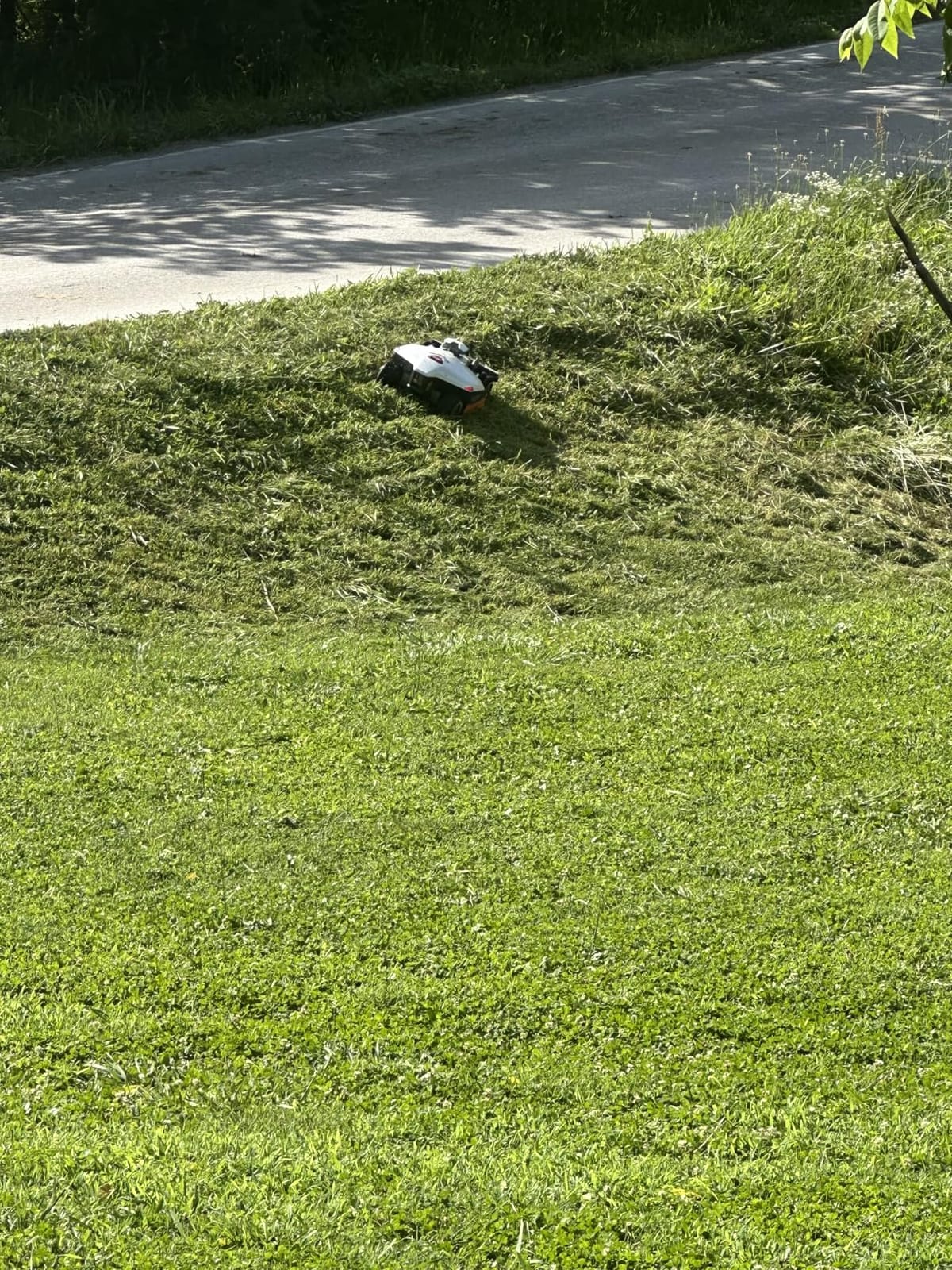
The honest weakness is the 15.8 inch dual-blade disk. On a large rough lawn that translates into long mow sessions and mid-lawn recharging, so owners sometimes need the mower over two days to cover a full property. At 41 pounds it is also one of the heavier machines here, which matters if you plan to carry it back to the dock.
Reviewers also flag that it does not mulch fallen leaves, so you will want to clear those before a mowing cycle. Sharp right turns can tear grass when the app commands a tight maneuver that the terrain did not require.
How it holds up on divots and exposed roots
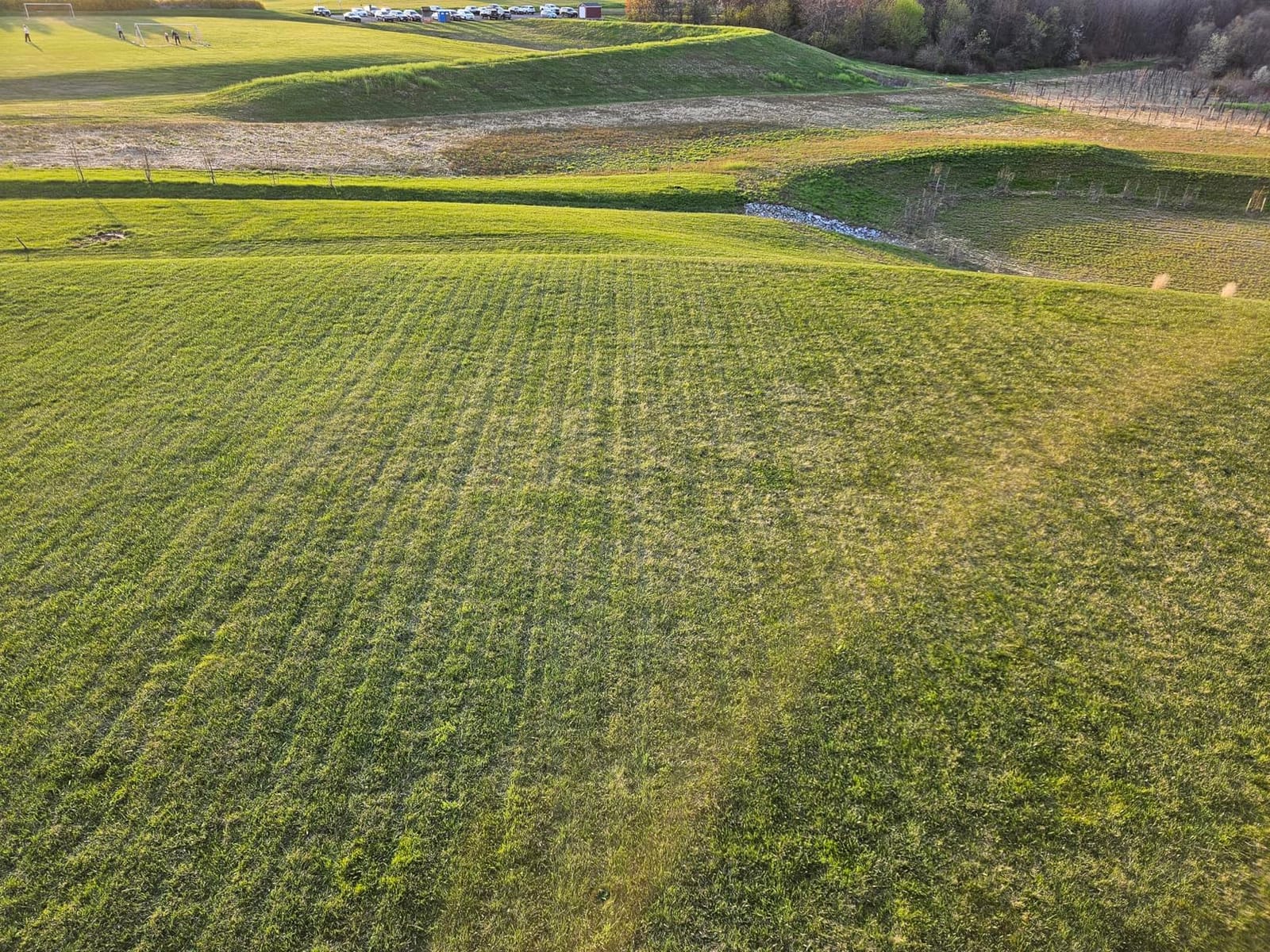
The four-motor layout gives it enough torque to keep pushing when a wheel drops into a hollow rather than spinning. Obstacle recognition across 200-plus object types means a root or a forgotten garden tool gets steered around instead of jammed under the chassis. This is the mower we would pick for a property with a mix of slopes and dips.
The one trap owners report is thin wire or small posts caught behind the front tires, which can stop it dead without triggering an obstacle response. Clearing irrigation tubing and low-voltage lighting lines before the first run solves that.
Where it falls short
Budget for a long first mapping session. Owners describe the setup, manual and app mapping as genuine work rather than a ten-minute formality, and the same learning curve returns whenever you add a new zone. If you want something running within an hour of unboxing, look at the ANTHBOT M5 instead.
The mow pace is the second limit. If your uneven lawn is also large, a wider deck from a tracked or heavy AWD platform will finish in a fraction of the sessions. On a half-acre or smaller yard, the trade is worth making.
2. Mammotion LUBA 3 AWD 3000 — Best for Steep Slopes and Heavy Tree Cover
- Category-leading traction on broken lawns
- Positioning holds under heavy tree cover
- Adaptive suspension steps over roots and curbs
- Long runtime per charge
- Modest review base for a recent release
- Premium tier pricing
- Large chassis for narrow yards
The LUBA 3 AWD 3000 is the more sophisticated of the two Mammotion machines here, and the better answer when your uneven lawn is also shaded. Navigation is a genuine tri-fusion stack: 360 degree LiDAR with a range of up to 230 feet, network RTK for centimeter accuracy with sky view, and dual cameras that keep it oriented when neither of those has anything to work with.
Four independent motors handle the 80 percent, 38.6 degree incline rating, and the adaptive suspension is the feature owners single out on rooty ground. It is specced to step over curbs, roots and thresholds up to 50 mm, which is exactly the geometry that trips up lesser chassis. An upgraded AI processor recognizes more than 300 obstacle types.
Why the sensor stack matters on rough ground
Rough terrain slows a mower down, which means more time in the dark, more shade and more moments where satellite positioning drifts. VSLAM keeps it holding its line in those gaps. On a lot with heavy tree cover and a hill on the boundary, that combination is the difference between finishing the lawn and ending the session early.
The dual 165 W cutting motors with six-blade discs push up to 175 minutes of runtime and about 500 square meters per hour, so the mow time penalty against the LUBA 2 is smaller than the deck width alone would suggest.
Where it falls short
The review base is modest at 130 ratings, which is typical of a recent release, and the rating sits at 4.3 with 64 percent five-star. Buyers consistently point at terrain handling and positioning reliability, but there is less long-term data on durability than the older LUBA 2 has accumulated.
If your lawn is under a quarter acre, this is a lot of machine. The 27.2 by 21 inch footprint will not thread a 31.5 inch passage comfortably, so tight lots are better served by something in the Sunseeker or Ecovacs O1000 class.
3. Sunseeker X5 AWD — Best Balanced All-Wheel Drive Machine
Sunseeker X5 AWD Robot Lawn Mower, RTK, Vision AI, 0.5 Acre, Wire-Free
- AWD traction beats two-wheel-drive rivals
- Holds position under trees and shade
- Very quiet at 60 dB
- Handles 31.5 in passages
- Can catch on the lip from lawn to sidewalk
- Tall grass gets treated as an obstacle
- Needs Wi-Fi extenders on larger yards
The Sunseeker X5 AWD is the middle ground in this list, and for a lot of yards it is the right size. It rates to 30 degrees, which is 60 percent incline, and pairs that with independent front suspension and rugged tires so the chassis stays planted over bumps rather than pitching.
The 8.7 inch floating deck is the part that matters most on uneven ground, because it rises and falls with the contour instead of scalping high spots and missing low ones. Cutting height runs from 1.6 to 3.2 inches, and RTK plus VSLAM plus Vision AI keeps coverage steady under tree cover and in weak RTK areas, day or night.
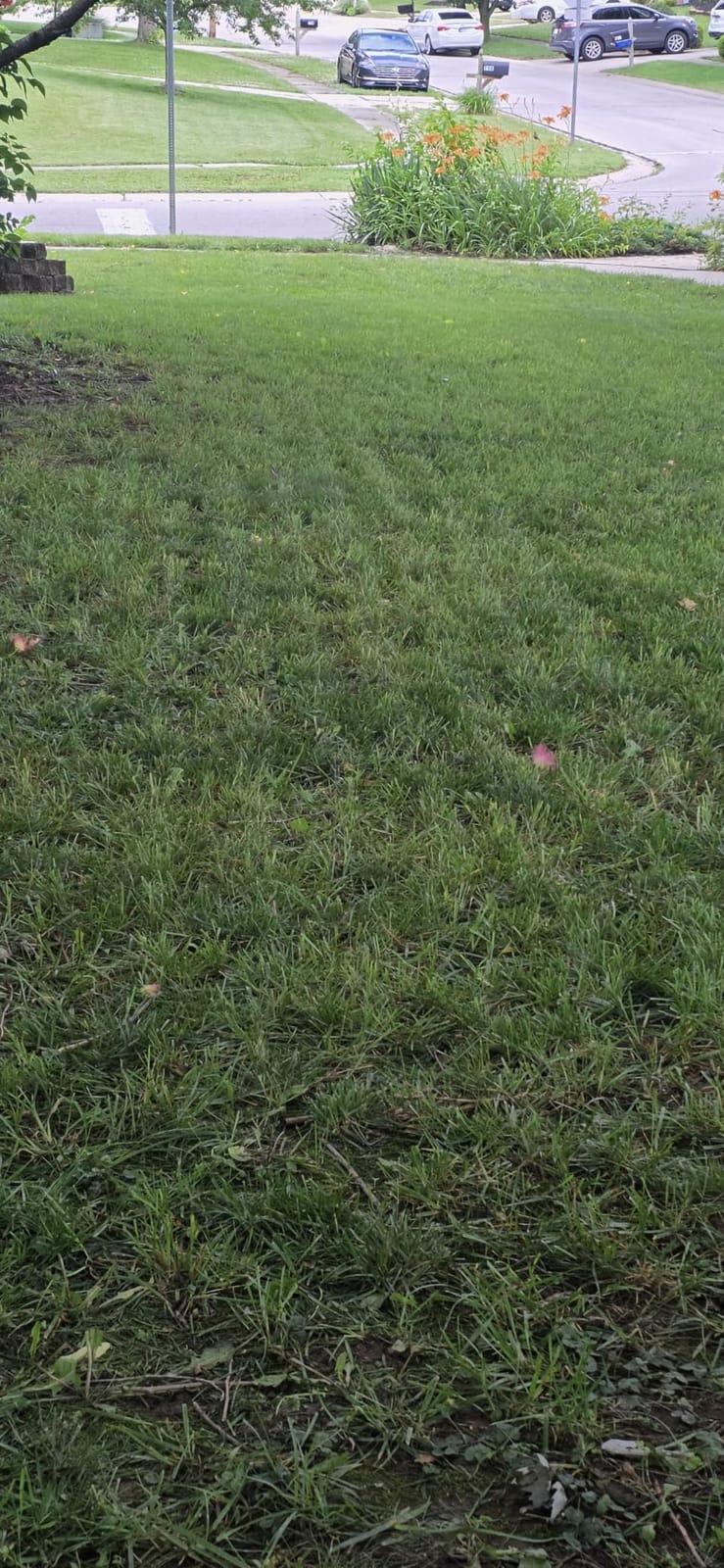
At 26 pounds and 60 dB it is also one of the quieter and lighter machines we looked at. A two-year warranty with US-based support is a reasonable commitment from a newer brand, and the 26.7 by 16.3 inch body still fits through a 31.5 inch passage.
Reviewers like the striping and the choice of mowing directions and patterns, and report that setup is straightforward. The 4.4 average across 29 ratings comes with 67 percent five-star, though a small sample deserves a caveat.

How it behaves on rough transitions
The recurring complaint is not slope performance but small grade changes. Owners report the mower catching on the lip between lawn and sidewalk, which is a lip-and-lateral-traction problem rather than a climb problem. If your uneven ground is mostly transitions like that, factor in whether you can shave those edges flat first.
Tall grass is a second quirk. The vision system sometimes treats overgrown patches as obstacles and skips them until they have been cut down elsewhere, so the first pass on an unkempt uneven lawn will leave visible patches behind.
Where it falls short
Mapping takes patience on complex yards, and larger properties need Wi-Fi extenders to reach the corners. Some owners report programming and app reliability hiccups, which is worth considering before you commit if you plan to schedule across multiple zones.
Compared with the Mammotion machines, the 60 percent incline rating gives up real climbing headroom. On a genuinely steep property, that difference decides whether the mower keeps going or starts hunting for a flatter line.
4. Dreame A3 AWD 1000 — Best for Small Rough Yards with Tight Edges
[All-Terrain Wire-Free] DREAME LiDAR Robot Lawn Mower A3 AWD 1000 + Cleaning Set+Blade Set, 360° 3D LiDAR & AI Dual Vision Smart Robotic Mowers for 0.25 Acre
- Highest average rating in this group
- Wire-free LiDAR mapping under tree cover
- Edge cutting within about 1.97 in
- Bundled cleaning kit and spare blades
- Small review base for a new listing
- Covers only 0.25-0.5 acre
- Trimmer module is a separate purchase
The Dreame A3 AWD 1000 posts the highest average rating of any mower we evaluated, at 4.7 across 30 ratings with 84 percent five-star. The hardware justifies the score: AWD hub motors rated to 80 percent, or 38.7 degrees, and the ability to clear 2.17 inch obstacles.
Navigation is a 360 degree 3D LiDAR paired with binocular AI vision through Omnisense 3.0, with no boundary wire and no RTK station to install. That combination matters on small uneven yards where a tree or a tall wall blocks satellite signals. Owners report wire-free mapping that works under heavy tree cover and right beside tall walls.
![[All-Terrain Wire-Free] DREAME LiDAR Robot Lawn Mower A3 AWD 1000 + Cleaning Set+Blade Set, 360° 3D LiDAR & AI Dual Vision Smart Robotic Mowers for 0.25 Acre customer photo 1](https://thesweetandsimplekitchen.com/wp-content/uploads/2026/10/B0H761SNFG_customer_1.jpg)
The edge result is the sleeper feature here. It cuts to within about 1.97 inches of walls and hedges, and an optional trimmer module brings that under 1.18 inches, which cuts down on the string trimmer work on a small lawn more than any other single feature here.
It is also quiet enough to schedule for night mowing through the Dreamehome app, and the 5A adapter recharges in about 45 minutes, which keeps downtime short on a 0.25 to 0.5 acre plot.
Where the traction and edge cutting pay off
A 38.7 degree rating on a machine this light is unusual, and it means you can put the Dreame on a rolling lot without worrying about wheel slip. The AWD hub motors also do less turf damage on slopes than a two-wheel-drive machine spinning its rear wheels, which matters if your uneven grass is thin in places.
The bundle includes a cleaning set and a blade set, which is genuinely useful on rooty ground where grass wraps around the underside of the deck faster than on flat lawn.
Where it falls short
Thirty ratings is a thin base, and new listings tend to accumulate their early five-star reviews faster than their problems. Treat the 4.7 as encouraging rather than settled.
Coverage caps at 0.25 to 0.5 acre, so this is not the machine for a large uneven property. If the lawn is bigger than that, move up to the LUBA 2 or LUBA 3.
5. ANTHBOT M5 — Best Value Mower for Sloped and Uneven Yards
- 370 ratings from owners
- Easy wire-free setup with fast mapping
- Handles sloped and uneven yards for the price
- Reliable rain detection and dock return
- Needs about three passes for even cut
- 7.9 in cut path forces frequent recharging
- Leaves an uncut strip along some edges
The ANTHBOT M5 draws on 370 owner ratings at a 4.2 average, making it the most thoroughly reviewed budget option in this list for uneven ground. The 45 percent slope rating works out to roughly 24 degrees, which covers rolling terrain and moderate hills but not serious inclines.
Positioning combines dual 150 degree HDR cameras with full-band RTK and Adaptive Cruise Control, and the cameras recognize more than 1,000 common garden object types. Owners report that it copes well with garden furniture, trees and general yard clutter, and that the app supports per-zone cutting height and schedules across up to 20 work zones with custom no-go areas.
Setup is the quiet strength. The app builds a virtual map automatically in about ten minutes with no wire to lay, which matters enormously on an irregular lawn where boundary wire is a genuine weekend project. At 58 dB or quieter it runs without waking the household.
The automatic self-charging and resume works reliably, and owners report dependable rain detection that keeps the mower on the dock until conditions improve.
How it copes with slope and small rough patches
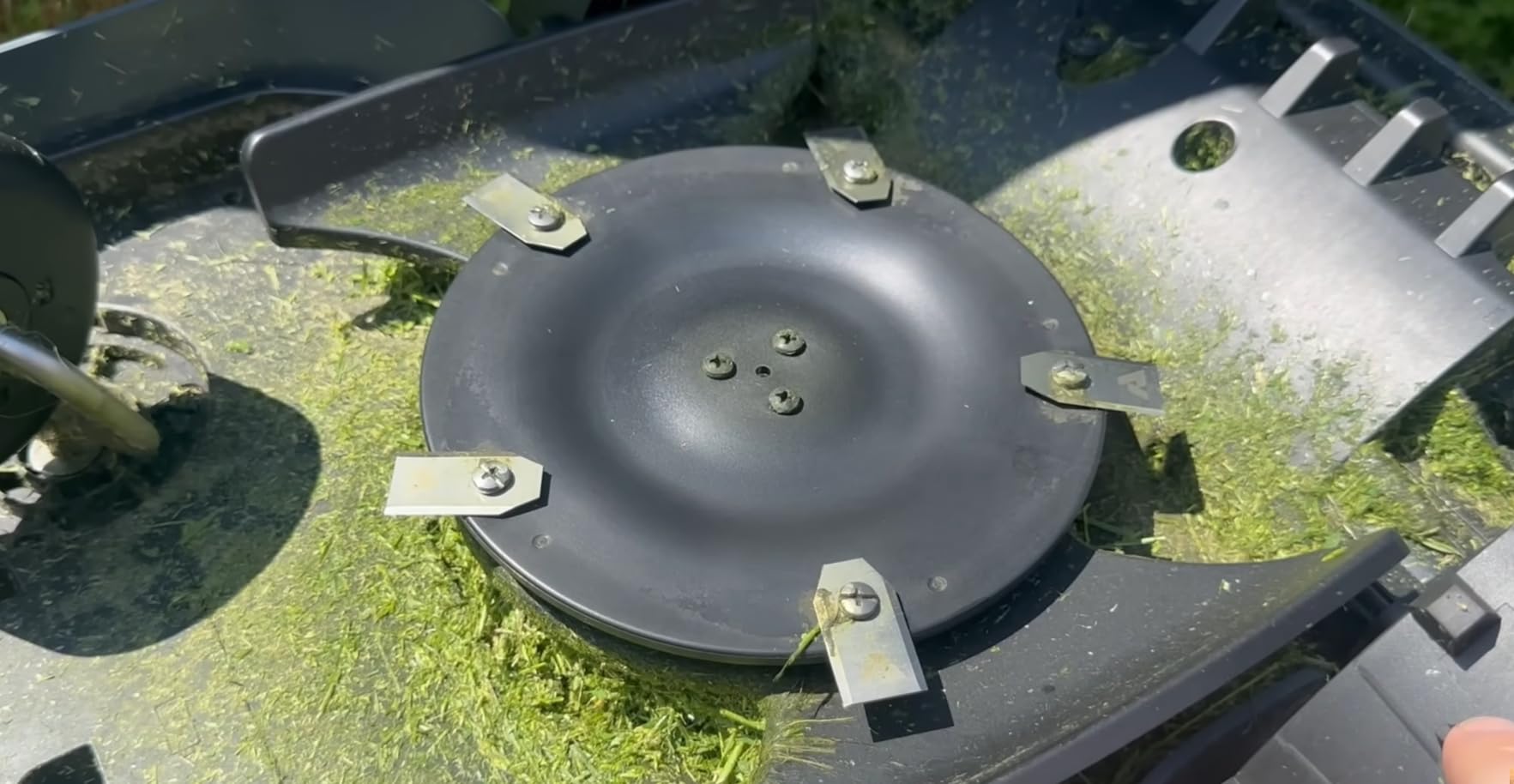
At this price, the 45 percent rating is genuinely useful on a yard that is uneven rather than hilly. Combined with adaptive cruise control, it slows into dips rather than driving across them, and reviewers specifically call out good handling of sloped and uneven yards for the money.
The 12 kg weight keeps it manageable if you need to move it, and the machine holds a line well enough on rough ground that the missing all-wheel drive rarely surfaces outside steeper sections.
Where it falls short
The 7.9 inch cut path is the real cost. Owners consistently report needing about three passes for an even cut, plus frequent recharging on anything but small yards, and some note a slower mowing pace than expected on ordinary lawns.
There is also a recurring note about an uncut strip along some edges. On a lawn where trimmer work is already unavoidable, plan for that strip rather than expecting the mower to solve it.
6. Roborock RockNeo Q110H — Quiet Wire-Free Mower With a Floating Deck
- Floating deck handles bumps and dips well
- Very quiet with clean straight lines
- Works at night with headlights
- Good on hilly yards with obstacles
- Auto-mapping often falls back to manual
- Leaves 1-1.5 feet unmowed at boundaries
- Weak traction in thick St. Augustine grass
The RockNeo Q110H is the most interesting spec sheet in the budget tier and the lowest-scoring product we tested. At 3.8 from 35 ratings, it carries a heavy one- and two-star tail at 30 percent combined, and it is worth understanding why before you consider it.
The positives are real on rough ground. A floating cutting deck adapts to ground contours and large-diameter wheels roll over dips and bumps, which owners specifically praise. Stereo vision rolls over low crossable obstacles instead of treating them as blockers, and the 45 percent slope rating with 1.57 inch obstacle clearance is respectable for the tier. It handles passages as narrow as 2.3 feet, narrower than anything else here.
Full-band RTK plus VSLAM holds navigation under tree canopies and near fences, and the machine is quiet enough to run after dark with headlights, cutting in very straight lines.
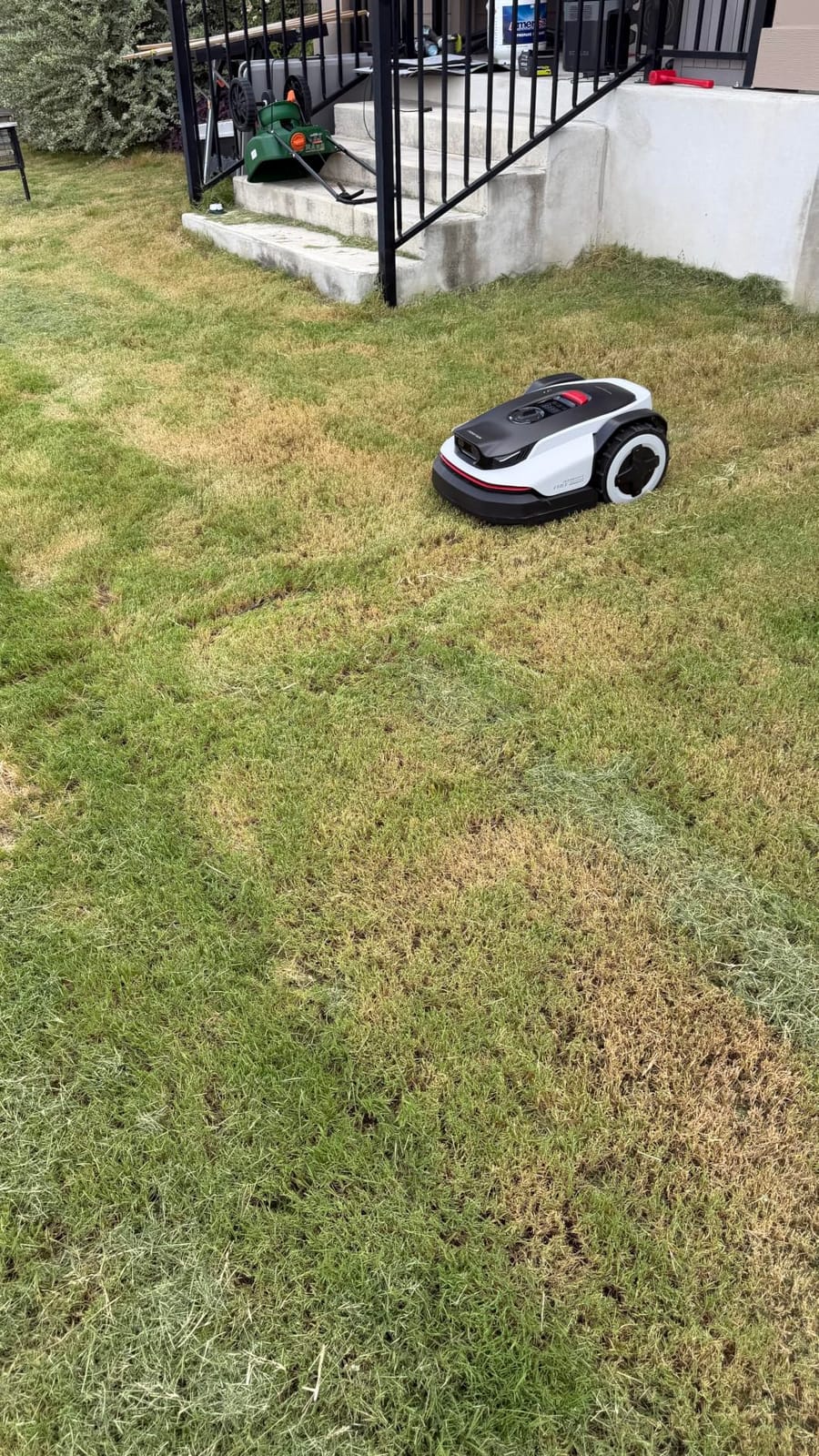
The app will be familiar if you already own a Roborock vacuum, and it supports multi-zone schedules, a progress dashboard and a wildlife mode. PIN lockout with a high-decibel alarm covers the basics of theft deterrence, with an optional 4G tracking module for live position.
Battery life is about 130 minutes per charge with cutting height from 1.6 to 3.1 inches, and an optional edge module reaches 1.2 inch edge precision if you can get one.
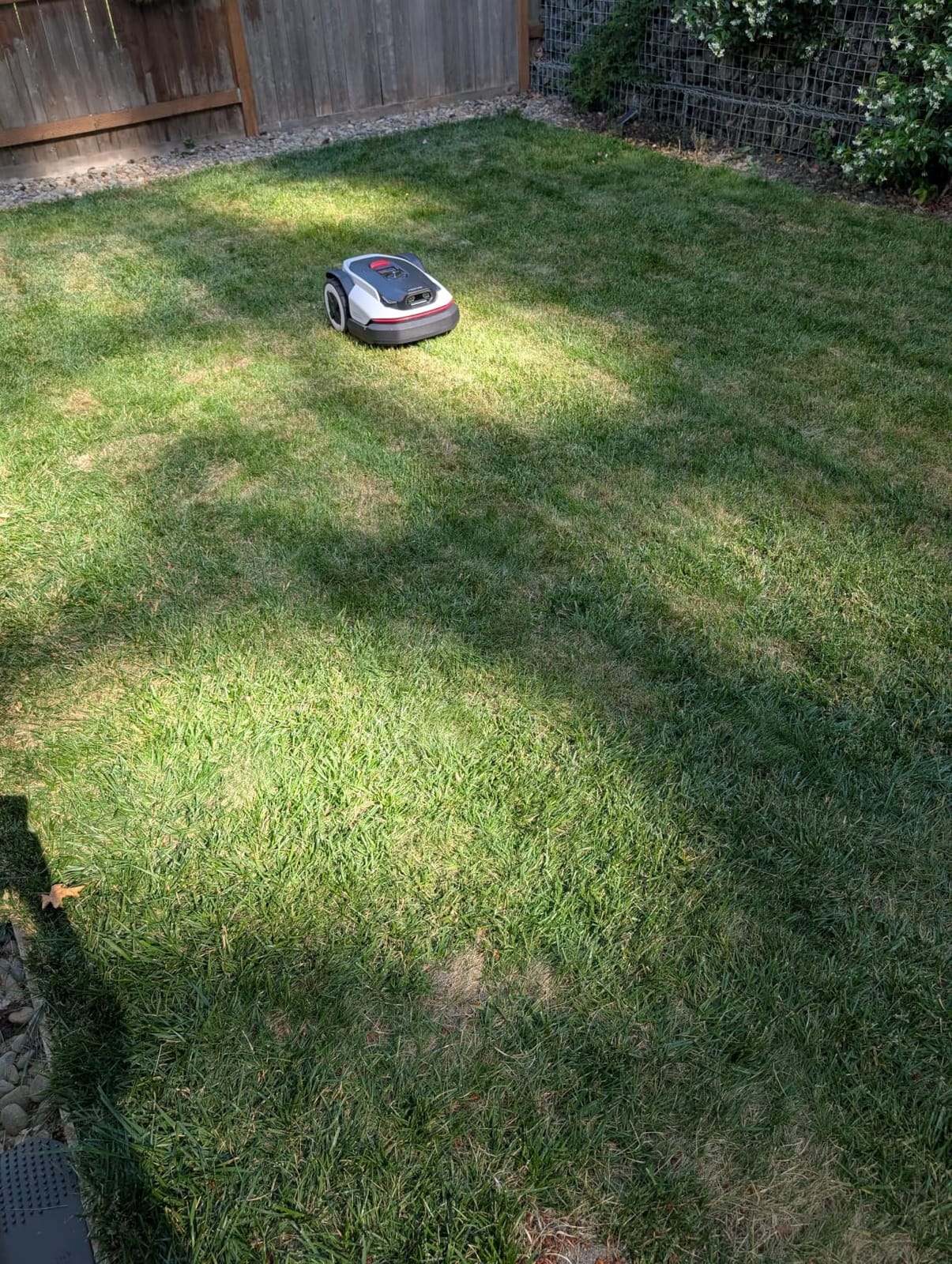
Where the floating deck genuinely helps
On an uneven lawn the floating deck is the feature that keeps blades in contact with the grass over humps and hollows. Reviewers call out that it handles bumps and dips without getting stuck, which is precisely the divot problem that stops rigid-deck machines.
The narrow-passage figure also matters on irregular lots where the route between a front and back lawn squeezes past a wall or a fence line. Most competitors will not fit where this one does.
Where it falls short
Auto-mapping frequently falls back to manual boundary mapping, which adds real setup time on a complex lawn. Boundaries also come out conservative, leaving one to one-and-a-half feet unmowed along fences, trees and bushes, and the optional edge module has limited availability in the US.
Two more specific complaints: traction weakens in thick St. Augustine grass, and the unit raises a spurious unit-has-been-lifted error on small bumps and potholes, which on an uneven lawn is a frequent and irritating false alarm.
7. Segway Navimow i105N — Best for Tree Cover and Shaded Yards
- Holds position under heavy tree cover
- Clean parallel striping
- Extremely quiet
- Reliable auto-return and resume
- Stock wheels have poor slope traction
- Stuck events at curbs and gullies
- Antitheft tracking needs a paid module
The Navimow i105N is the pick when your uneven lawn is uneven because of shade and structure rather than grade. EFLS 2.0 combines RTK with vision for centimeter-level positioning under trees and in narrow corridors, and at 4.1 from 391 ratings it has one of the larger review bases in the group.
The camera covers a 140 degree field of view and detects more than 150 obstacle types, while AI-assisted Assist Mapping identifies clear lawn edges automatically. You get up to 12 zones with schedules and mowing direction, and 58 dB(A) operation is quiet enough to run at night.
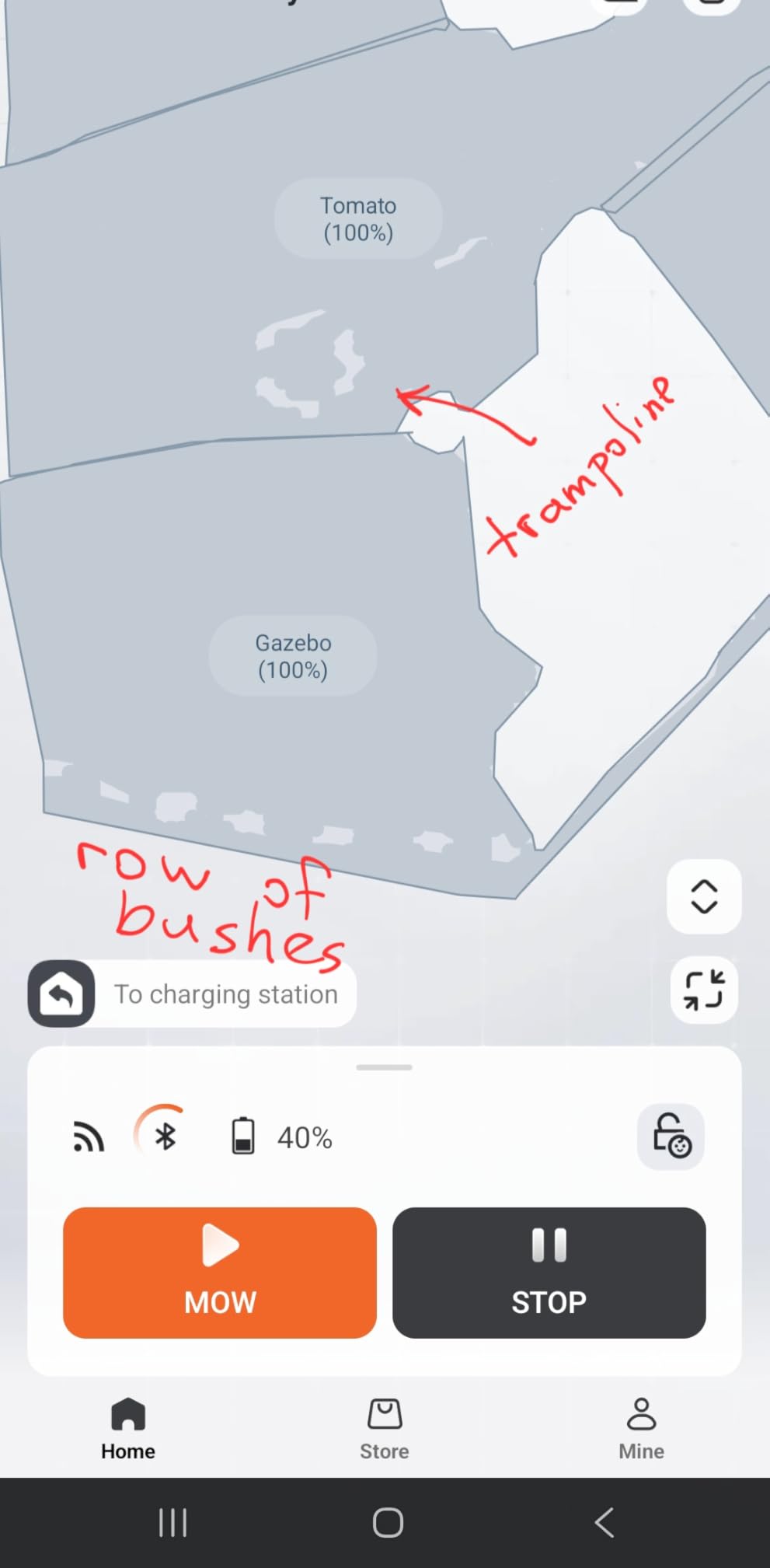
Owners highlight clean parallel striping with direction changes to avoid worn tracks, a straightforward app with clear mowing progress, and reliable auto-return to the dock with resume. A full three-year warranty backs it, and the package includes the charging station, a GNSS antenna kit, nine spare blades and an extension cable.
The catch is traction. The i105N uses standard wheels, and reviewers are direct about poor grip on slopes. Off-road tires reportedly improve this substantially, which is the single most useful modification for an uneven yard.
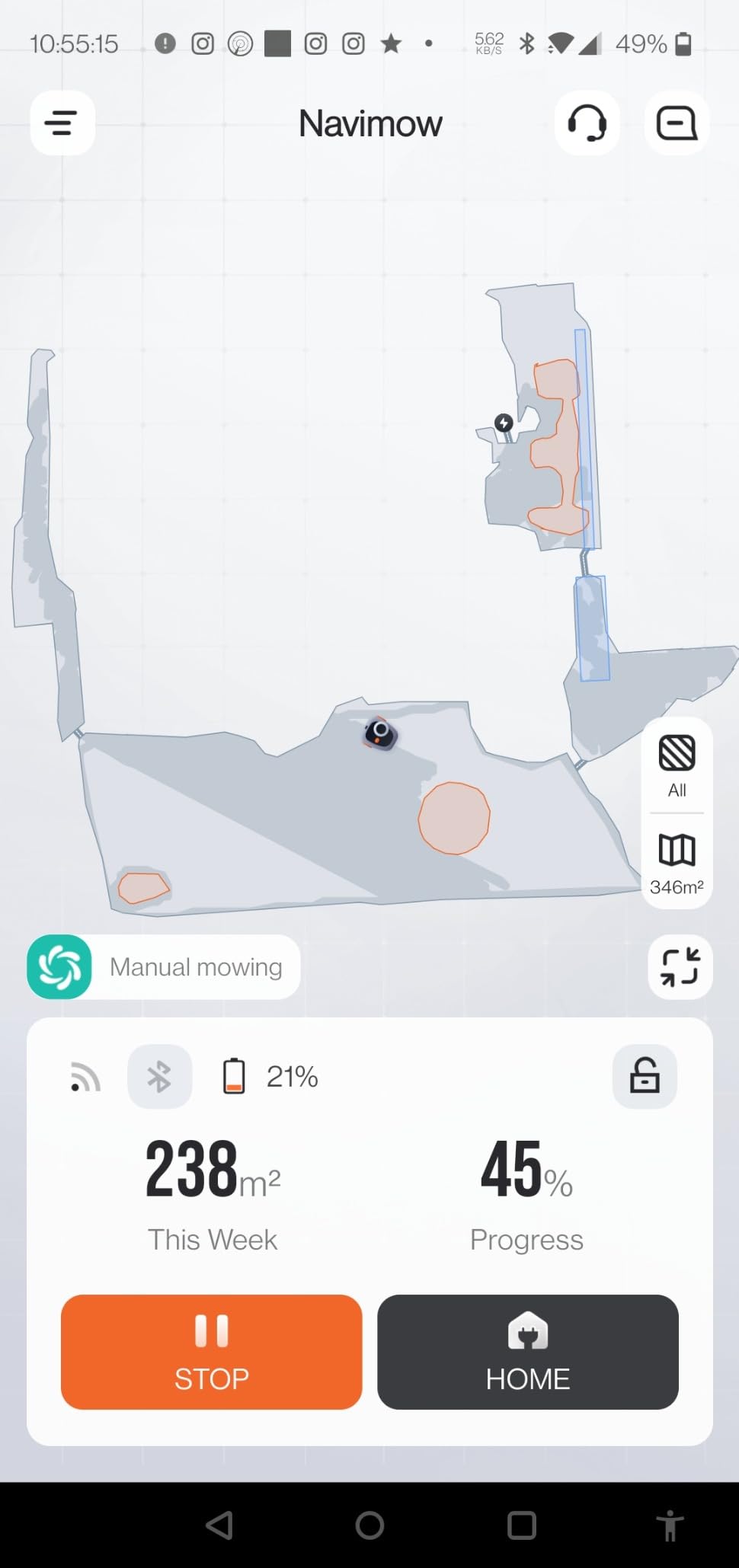
Where positioning beats traction here
On a wooded lot, the navigation stack is what keeps the mower working. RTK alone drifts under canopy, and a mower that loses position mid-lawn on rough ground tends to stop, relocalize and burn runtime. Vision fusion is what prevents that, and it is the reason this model keeps a 4.1 average despite the traction complaints.
It is also comfortable in confined corridors where a wire-free virtual boundary is much easier to install than physical wire, particularly on a lawn broken up by trees and planting beds.
Where it falls short
Get stuck events are reported around curbs, mulch beds and V-shaped gullies, all common on uneven lawns. Vision Fence also misses some obstacles, including gates, mailboxes, hoses and sprinklers, which you should clear before mapping.
Mapping edits require driving the robot rather than adjusting boundaries in the app, some units have lost saved maps after camera-assisted processing, and antitheft tracking requires a separately purchased Access+ module with the garage sold on its own.
8. MOVA LiDAX Ultra 1000 — Best for Edge Cutting on Uneven Lawns
- RTK-free mapping works in poor light
- Strong traction on 45% slopes
- Cuts close to walls and raised edges
- Supports separate front and back maps
- Newer product with limited long-term data
- Rear-wheel drive limits steep climbs
- Heavier body for a small mower
The MOVA LiDAX Ultra 1000 solves a problem most competitors ignore on rough lawns: edges. UltraTrim 1.0 cuts within about 2 inches of walls, hedges and raised edges, and the machine rides on those edges for a flush cut along lawn and pavement. On a bumpy lawn, where a fixed cutting arm would lift off the grass, that matters more than the headline slope number.
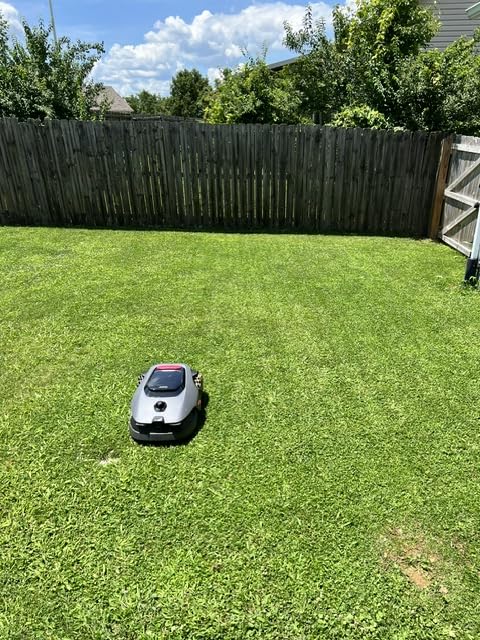
Mapping is fully RTK-free, using 360 degree 3D LiDAR with AI vision for 3D auto-mapping and no base station. Owners report it working in complex layouts and poor light, which is a real advantage on a yard shaded by large trees.
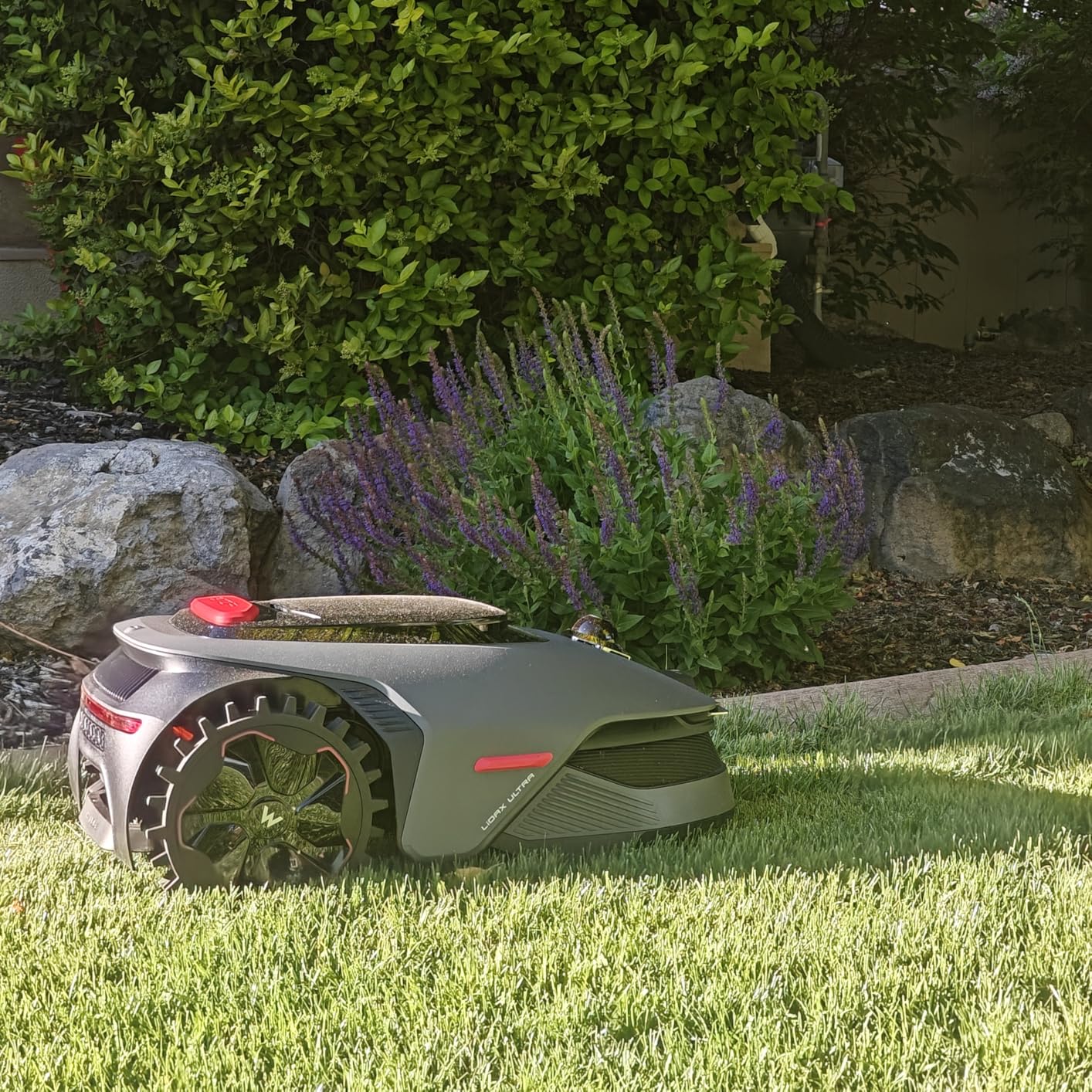
Traction comes from rear-wheel drive with off-road wheels rated for 45 percent slopes and 1.6 inch obstacles, and the 23.6 inch path width helps offset the slower climb. A 3D point cloud combined with AI vision detects more than 300 obstacle types, and U-shaped path planning handles dock return and resume automatically.
For complex properties it supports two independent maps with up to 150 managed zones, cutting height adjustable from 1.2 to 3.9 inches in the MOVAhome app, and TrueGuard antitheft monitoring with an optional link module for real-time tracking.
Where edge cutting earns its place
On uneven ground, edges are where robot mowers fail most visibly because a floating deck rides up and away from a wall. A machine that rides on the edge recovers that strip. If your property has a lot of wall, hedge and hardscape border, this changes how much trimmer work you have left afterward.
Being RTK-free also means no antenna to mount and no signal to lose, which simplifies installation on a lawn broken up by trees and outbuildings.
Where it falls short
Rear-wheel drive is a meaningful limitation on steep ground. The 45 percent rating is real but modest compared with the four-motor machines, so expect more wheel slip and more time spent on inclines than a true AWD unit.
At 4.1 from 74 ratings with 54 percent five-star, the written detail in the review base is limited because the product is newer. The 30 pound unit count and 34 by 20 inch body make it larger than its quarter-acre rating suggests.
9. Ecovacs Goat A2000 LiDAR PRO — Best Built-In Trimmer on a Half Acre
ECOVACS Goat A2000 LiDAR PRO Robot Lawn Mower, Dual LiDAR Navigation
- Dual-LiDAR mapping stays accurate under trees
- Built-in trimmer cuts follow-up string work
- Fast charging reduces downtime
- Handles thick Bermuda and St. Augustine
- Wide chassis struggles in sand and soft spots
- Front casters can bog down
- 22% of ratings are one or two stars
The Goat A2000 LiDAR PRO is the pick if trimming is your biggest complaint about robot mowing. It carries an integrated TruEdge trimmer, and the package includes two rolls of trimming line covering roughly 3 km of edging each, so the machine handles its own border work instead of leaving you a 6 to 7 inch strip.
Positioning comes from HoloScope 360 degree dual-LiDAR with 2 cm precision, with no perimeter wire and no RTK antenna. Owners report it stays accurate under trees, near fences and in shade, which is the same strength that serves the Navimow i105N.
A 32V motor with a dual-blade disc handles dense, fast-growing American grass types including Bermuda, Zoysia, Fescue and St. Augustine, and the 3.0Ah battery with 113.4W fast charging recharges in about 50 minutes. App control covers multiple zones, no-go areas, cutting height, speed and travel paths, with height adjustable from 1.2 to 3.6 inches on lawns up to half an acre.
The 3.9 average across 155 ratings is the weak point, with 22 percent of ratings landing at one or two stars. That tail is mostly about getting stuck rather than about cutting quality.
How the chassis behaves on soft ground
This is where the A2000 struggles on uneven lawns. The wide chassis with front casters has trouble in sand and soft spots, and soft spots are exactly what an uneven lawn tends to produce near root lines and drainage channels. On firm rolling ground it is fine; on loose or spongy soil it is the first model here we would steer away from.
There is also no published incline rating in the specification sheet, which makes it difficult to place on a slope comparison at all. Owners report it handling rolling hills rather than steep ones.
Where it falls short
Beyond the sand and caster issues, the price sits well above comparable wire-free mowers in this group, and the 30.24 inch length is unwieldy in a narrow yard. If your uneven ground is soft rather than merely sloped, this is not the machine.
The rating distribution deserves respect too. A 22 percent one-and-two-star share is larger than any other product here, and those reviews do not suggest a quality-control problem so much as a fit problem.
10. Ecovacs Goat O1000 LiDAR PRO — Best for Narrow Passages and Rooty Turf
- Local-first LiDAR mapping with no cloud dependency
- Handles bumpy root-filled lawns and vole-torn turf
- Very quiet with built-in string trimmer
- IP water-rated for hose cleaning
- Edge trimmer steers off the line and gouges turf
- Drive wheels slip on gentle slopes and tear turf
- Struggles with roots over 2 in and in sand
The Goat O1000 LiDAR PRO is the compact Ecovacs, and its selling point on uneven lawns is shape rather than strength. At 23.62 inches long and 11.97 inches wide, it fits through passages as narrow as 31.5 inches, which is where wider AWD machines simply cannot follow.
Navigation is the same HoloScope 360 degree dual-LiDAR as the larger model, but maps are stored locally on the device rather than pushed to a cloud server. Owners value that independence, and AI vision plus 3D ToF LiDAR detects more than 200 outdoor obstacles. Built-in rain detection has a customizable delay in the app, and an IP water rating makes rinsing the underside with a hose easy after a day in wet grass.
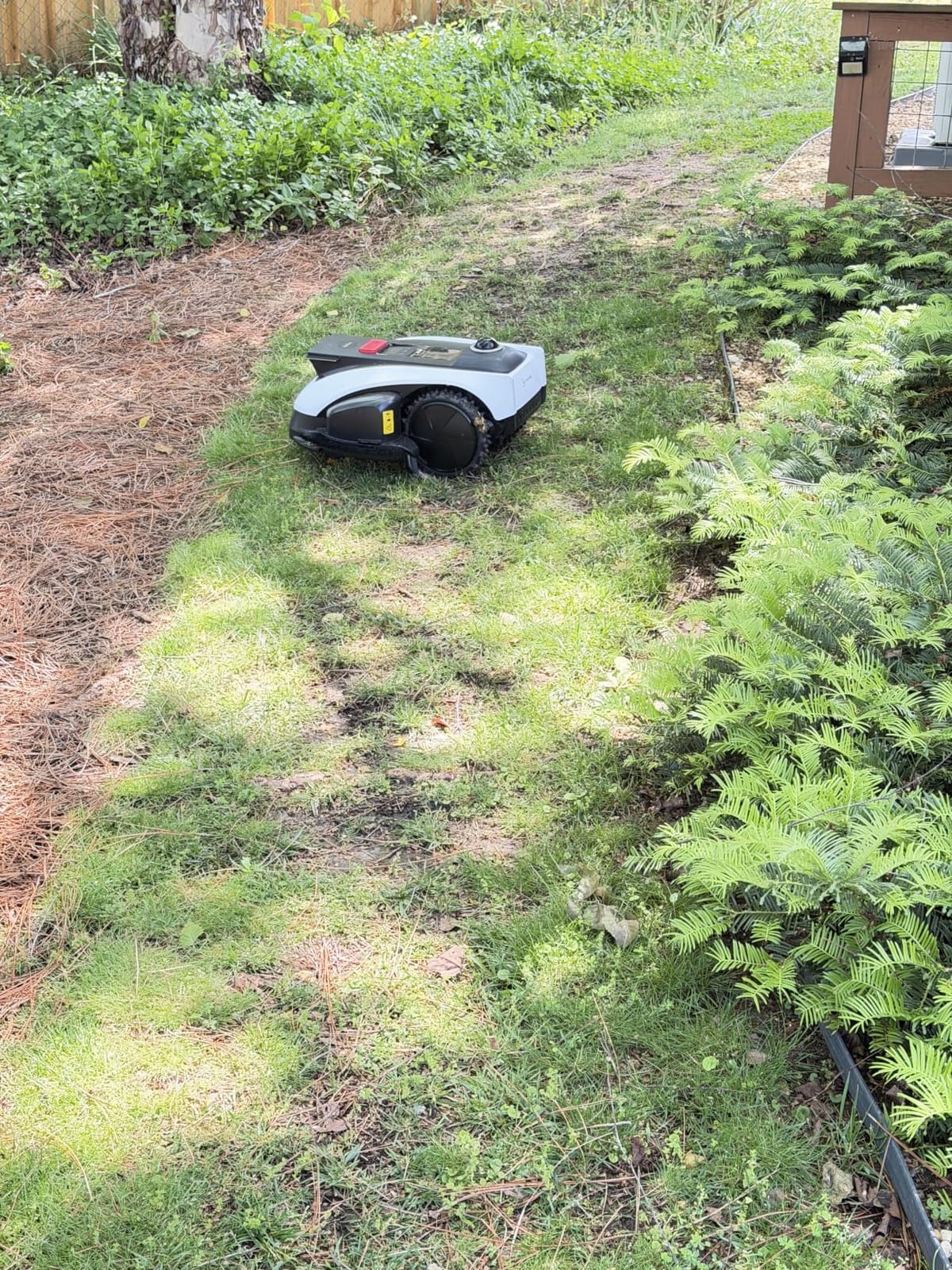
Reviewers specifically praise it on bumpy, root-filled lawns and on vole-torn turf, which is an unusual kind of lawn to find praise for. It runs very quietly and carries three sharp razor blades plus the built-in string trimmer.
At 4.0 across 155 ratings the score is solid but not exceptional, with 60 percent five-star and a 12 percent one-star tail.
Where it handles roughness and where it slips
It copes with moderate roughness well. Rooty, torn turf and uneven turf are both called out as handled well, and the LiDAR plus vision stack keeps a map even where the ground does not.
But there is a hard limit: owners report struggles with exposed roots over 2 inches, with deeply rutted ground and with sand. The drive wheels also slip on even gentle slopes and tear up turf when they do, which is a specific risk on an uneven lawn that slopes in more than one direction.
Where it falls short
The edge trimmer is the most complained-about feature. It steers off the boundary line and can gouge the main lawn, which is an uncomfortable trade for a function meant to save you trimming time.
The LiDAR also treats slightly tall grass as an obstacle, causing zigzag coverage, and straight boundary lines are hard to create with either auto or manual mapping. The app merges adjacent areas and blocks manual separation, so a multi-zone lawn needs planning before setup.
11. eufy E15 — Best for Small, Quiet Yards With Gentle Slope
eufy Robot Lawn Mower E15, Auto Mapping, Pure Vision Navigation
- Setup in about 10-15 minutes with no wire
- Neat parallel stripes and clean lines
- Quietest operation in this group
- Reliable rain detection
- Daylight-only operation with vision navigation
- 18 degree slope ceiling and 1.2 in height limit
- Mapping struggles on sparse or sandy lawns
The eufy E15 is the least suited to uneven ground in this list, and we include it because knowing its ceiling is useful. Its published limits are 18 degrees of slope and height differences under 1.2 inches, which on a genuinely uneven lawn rules it out. If your lawn is only slightly rolling, it is a very good machine.
What it does well is simplicity. Stereo camera navigation with Vision SLAM needs no boundary wire and no external station, and owners report setup in about 10 to 15 minutes out of the box. At under 54 dB it is the quietest mower we evaluated, which makes it easy to schedule around pets and sleeping children.
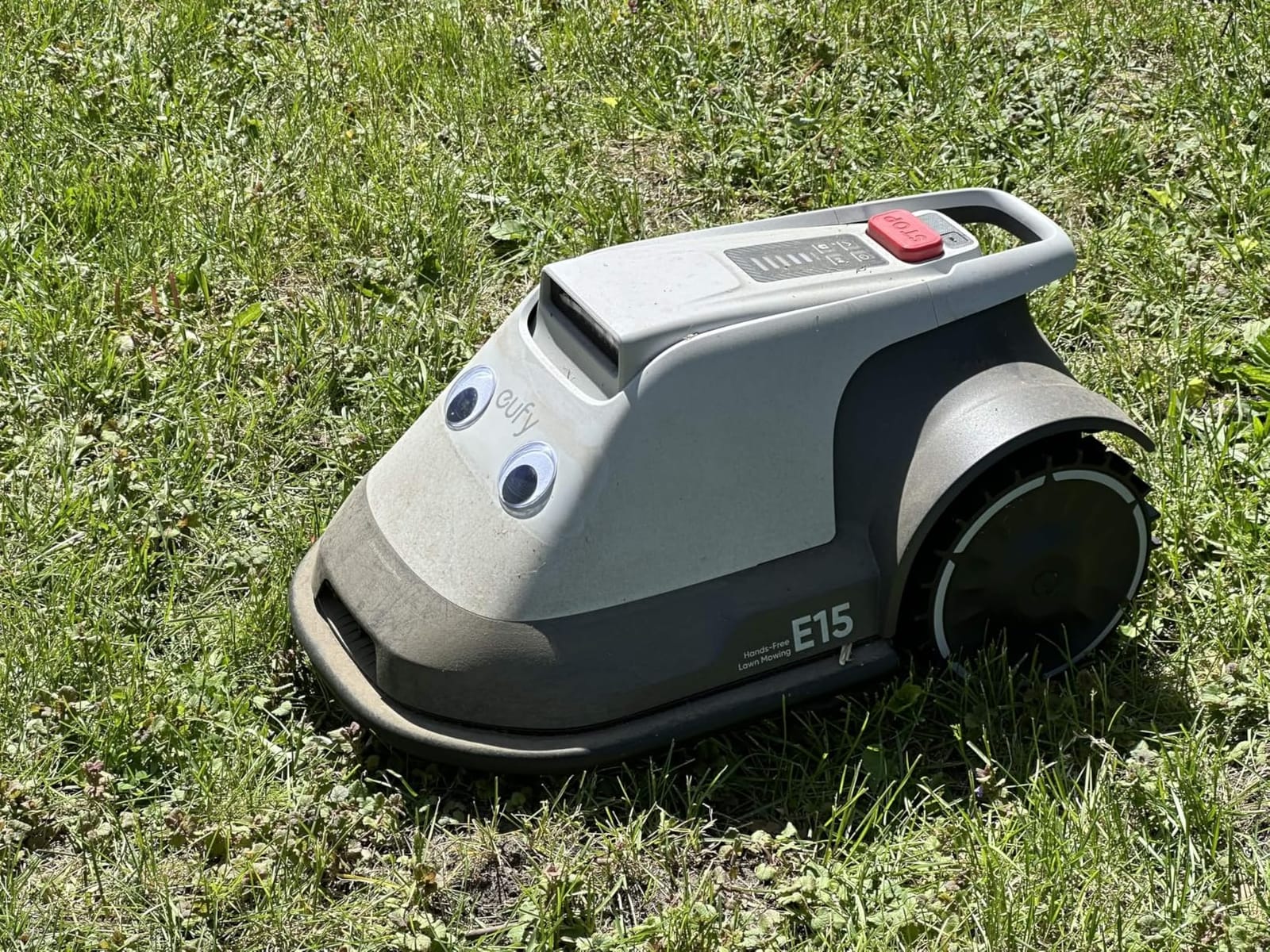
Ride-on Edge technology cuts to the lawn boundary, virtual walls have 0.2 m precision with custom exclusion areas and multi-zone management, and GPS anti-theft tracking with automatic recall in rain or low light is included. Lawns up to 0.2 acre, grass under 3.5 inches, cutting height across five positions from 1 to 3 inches.
There is also a manual joystick control through the built-in camera, which owners describe as a genuinely useful feature rather than a gimmick.
The 18 degree ceiling, in context
Eighteen degrees is roughly a 32 percent incline. That covers a gently rolling suburban yard and it will not cover a hill. The companion limit matters just as much: height differences under 1.2 inches means a raised root or a settled edge more than an inch high can stop it, and uneven lawns are full of both.
The brand also states it is not suitable for St. Augustine or dense Zoysia, and a 4G subscription is needed if Wi-Fi does not reach across the yard.
Where it falls short
Vision-based navigation means daylight-only operation, which removes the night mowing option that several competitors here offer. Mapping struggles on sparse or sandy lawns with bare patches, and owners report missed spots and imperfect edge trimming when grass is tall.
There is no spot-cleaning mode, and at least one owner reported a cut-height motor failure after about a year. On uneven ground those limitations stack up quickly.
12. Worx Wire-Free Robot Lawn Mower — Best Setup Time on a Two-Tier Yard
WORX Robot Lawn Mower for 1/4 Acre, Wire-Free with Brushes
- No RTK antenna and no cloud fees
- Auto-mapped a two-tier yard with a ramp and 45 ft of lake front
- Cut 0.15 acre in about 3.5 hours including recharging
- Quiet with straight evenly spaced stripes
- Two-wheel drive only
- Limited battery run without a swap
- Edge module sold separately at added cost
The Worx wire-free mower is the least powerful drivetrain here and still posts a 4.4 from 26 ratings with 73 percent five-star. The reason is setup and mapping. RTK Cloud gives centimeter-level positioning with no local antenna and no cloud fees, and Vision AI auto-mapping handles lawn shapes and boundary types on its own.
One owner auto-mapped a two-tier yard with a ramp and 45 feet of lake front without errors, and handled a sloped half of the yard alongside a swing set and saucer swing. That is a genuinely difficult layout, and completing it without manual driving says a lot about the mapping software.
They cut a 0.15 acre yard in about 3.5 hours including recharging, against multiple days with an older wire robot. V-SLAM sensor fusion maintains navigation in shade, and RadioLink connectivity extends range beyond standard Wi-Fi.
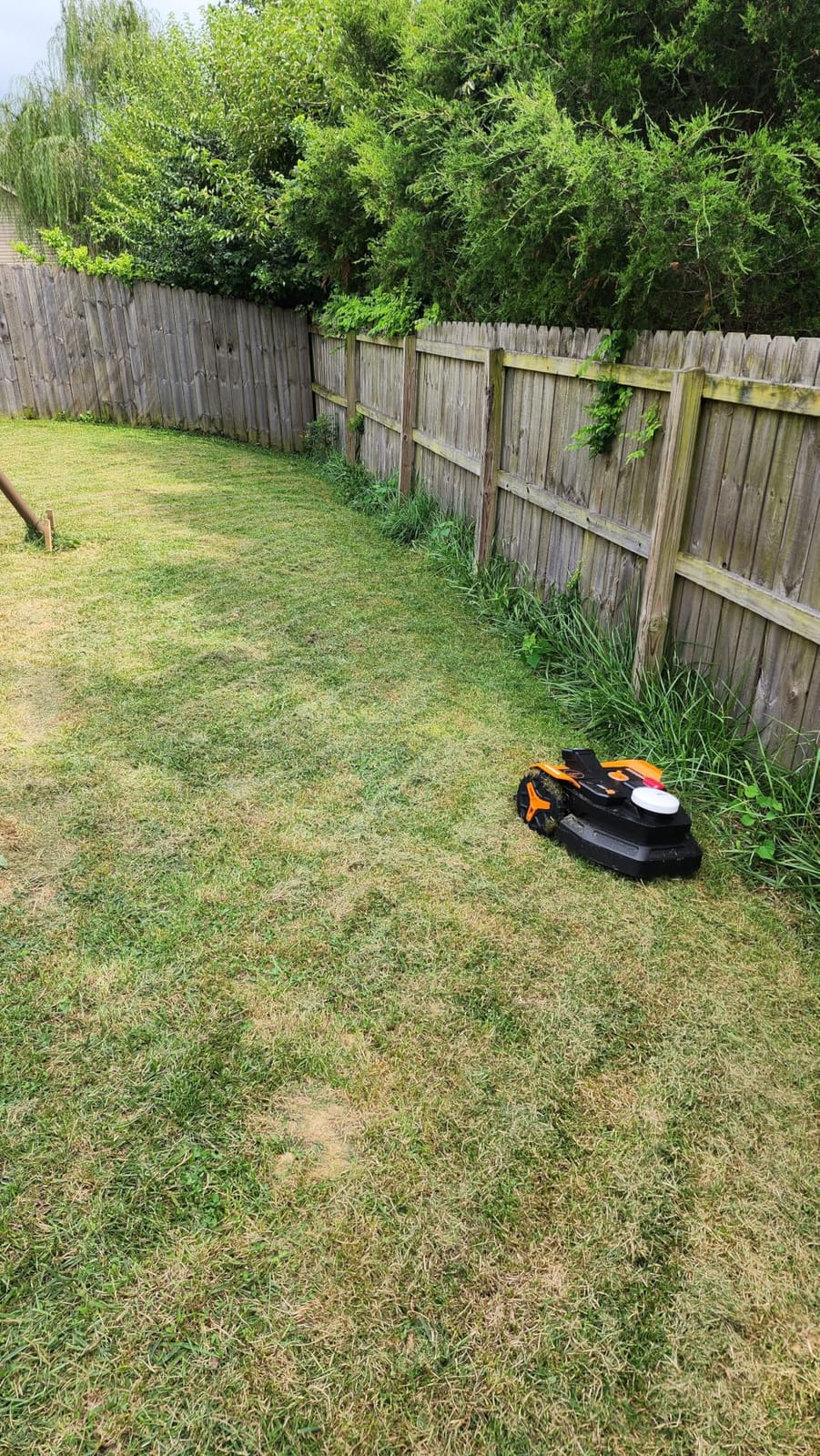
The machine handles 30 percent slopes, which is about 17 degrees, so it manages gentle rolling ground rather than real inclines. Battery life is about 80 minutes with cutting height from 1.57 to 3.54 inches, and mowing patterns include Parallel, Checkerboard, Diamond and Natural, with unlimited mowing zones, custom paths and no-go areas.
Cut-to-edge border cutting crosses ridable edges, which is worth noting on a lawn with uneven transitions to a sidewalk.
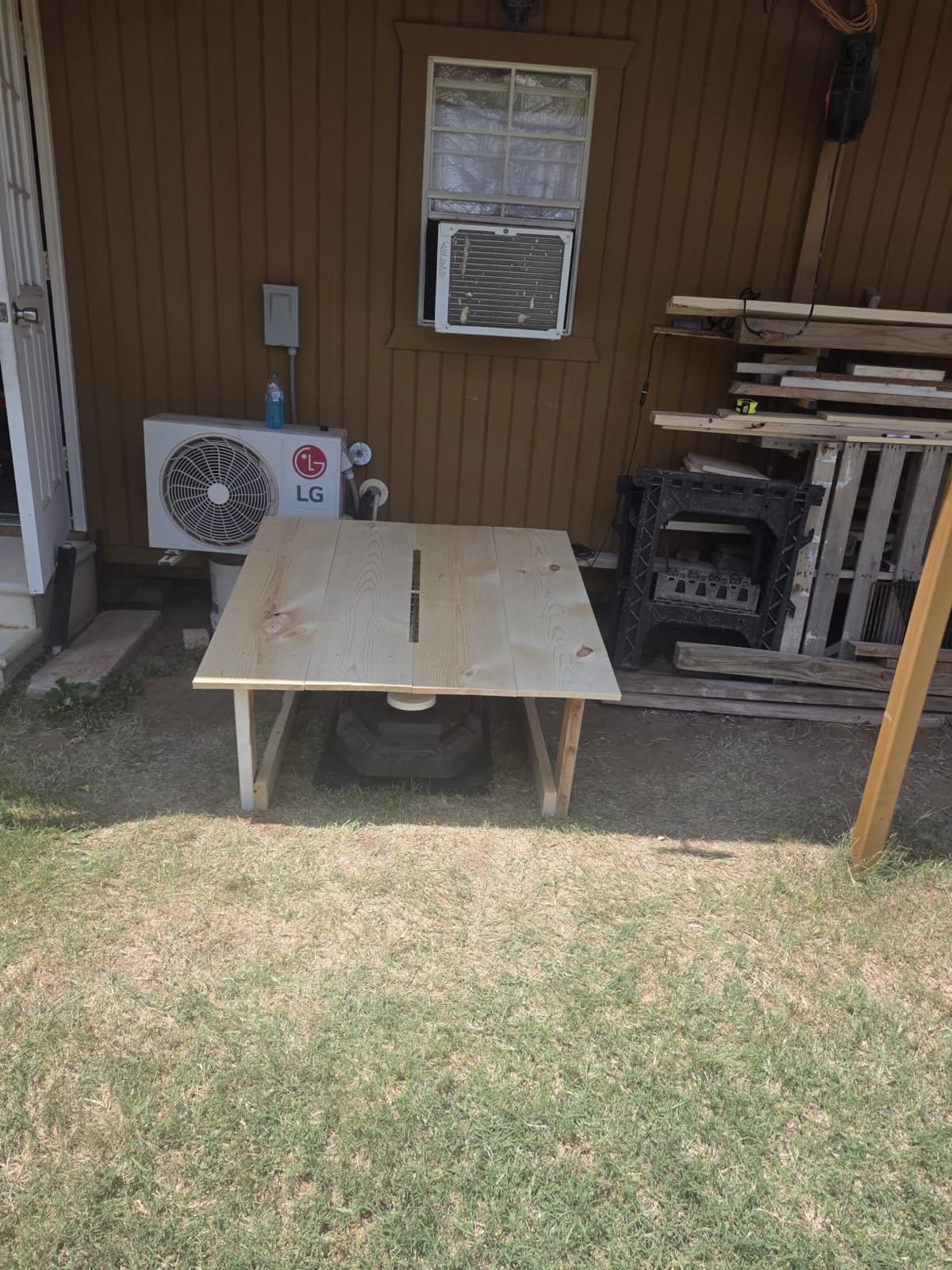
Why two-wheel drive still worked
Two-wheel drive is a limitation on slopes, and at 30 percent it is the lowest incline rating among the powered options here. It worked in owner reports largely because the terrain was uneven rather than steep. The mower handled the sloped half of a yard with obstacles around it, which is a different problem from climbing a 40 percent grade.
The 39.2 pound weight adds stability on uneven ground compared with the lighter two-wheel-drive units, which reduces the wheel slip that usually sinks traction at this drivetrain.
Where it falls short
This two-wheel-drive version does not include the cut-to-edge or headlight module, and the edge module is a separate add-on. Anyone wanting full edge capability should factor that in from the start.
It also needs a battery swap to finish a yard larger than about 1,600 square feet, and owners note the app takes time to learn. On steep or rooty ground, move up to an all-wheel-drive model.
What Uneven Terrain Actually Means for a Robot Mower
An uneven lawn is one containing any of the following: rolling hills, divots and dips, exposed tree roots, holes or collapsed ground, sunken edges along paving, cracked or lifted hardscape, and raised irrigation heads. Each one stresses a different part of the machine, which is why a single incline rating tells you only part of the story.
Divots and hollows test whether the cutting deck floats. A rigid deck lifts off the ground over a bump and leaves the crown untouched, which shows up as a stripe of unmown grass across every hump. Roots and small ledges test wheel diameter and suspension. Holes and ditches test cliff detection, and every consumer machine on the market is a poor candidate for a real drop-off.
Sunken edges and cracked paving test approach angle. The Sunseeker X5 reviews mention the lip between lawn and sidewalk as a recurring snag point, and the Ecovacs O1000 wheels are reported to slip on even gentle slopes. Slopes themselves test traction, and that is where 2WD versus AWD versus tracked becomes the whole conversation.
Five signs a robot mower is the wrong purchase
If any two of these describe your lawn, think carefully before buying. A manual machine will handle ground that stops every robot on the market.
First, ditches, retaining walls or cliff edges anywhere inside the mowing area. Second, exposed roots or rocks taller than roughly 2 inches across a wide area. Third, deep gullies or V-shaped drainage channels where a wheel can trap. Fourth, holes or animal burrows large enough for a wheel to drop into. Fifth, a surface that is mostly sand, gravel or soft mud rather than turf.
The manual alternatives are worth a look. If your lawn is genuinely too small or too broken for autonomy, our guides to the best reel push mowers and the best zero turn mowers cover the ground-based options that handle rough terrain without any electronics. For open acreage, the best riding lawn mowers are faster on slopes than any robot. If you want to keep the automation but move to a different job entirely, our guide to the best robotic pool cleaners covers the pool and nothing else, so that is a separate purchase.
Drivetrain and Navigation: What Actually Decides Uneven-Lawn Results
Drivetrain is the single biggest factor. Two-wheel drive puts all torque through the rear wheels, so on a slope or in a wet divot the front lifts and the rear spins, which scalps the turf and leaves the mower stalled. All-wheel drive spreads torque across four motors, which is why every steep-rated machine in this list uses it. Tracked chassis spread weight over a longer contact patch and climb the highest, at the cost of loudness and visible wear paths in soft grass.
Nobody in this group uses tracks, which is worth noting. If your terrain is broken enough that you are seriously weighing tracked mowers, you are likely past the point where any of these twelve is the right purchase.
Navigation is the second factor, and rough ground amplifies every navigation weakness. RTK alone drifts under tree cover, and a mower that loses position on a slope stops, relocalizes and burns runtime. Network RTK improves accuracy but still needs sky view. LiDAR builds a geometric map from physical structure and works with no satellite signal at all, which is why the LUBA 3, Dreame A3, MOVA LiDAX and both Ecovacs models all carry 360 degree LiDAR. Vision SLAM sits in between, using cameras to supplement satellite positioning.
The pattern across owner reviews is consistent: sensor fusion wins on complex lawns. The specific failure everyone reports is a mower that stops mid-slope under trees, throws an error code, and then needs to be carried back to the dock.
What still needs a string trimmer
Every model here still leaves an uncut border, whether that is 6 to 7 inches on standard decks or closer to 2 inches on the edge-equipped machines. The Dreame A3 with its trimmer module and the two Ecovacs models with TruEdge come closest to edge-to-edge, and the RockNeo Q110H reaches 1.2 inch edge precision only with an optional module.
Plan on a trimmer pass every week or two regardless of what you buy, and factor it into the time savings rather than expecting the robot to eliminate it. Owners of tracked machines also report that treads and drive wheels can damage soft grass and leave worn paths, which is worth checking on your own lawn before committing.
How to Measure Your Steepest Slope in 60 Seconds
Most published incline numbers are marketing claims, and buyers in owner forums consistently ask for measured figures instead. Here is how to get your own in about a minute.
First, find your steepest continuous run. Walk the lawn and locate the longest slope that the mower would have to climb in a straight line, not a single awkward bump.
Second, stretch a string or a piece of twine from the top of that slope to the bottom and mark where the ground meets it at the high end. If you lack a string, lay the mower’s charge cable or a garden hose down the slope.
Third, measure the horizontal run in feet, then measure the rise in inches and multiply by 12 to convert to inches of rise over that many inches of run.
Fourth, divide rise by run and multiply by 100. That gives you the percent. Convert to degrees by multiplying by 0.9 roughly, so 45 percent is about 24 degrees and 80 percent is about 38.6 degrees.
Fifth, match the result to a mower. Under 25 percent means nearly anything here will cope. Between 25 and 45 percent rules out the eufy E15 and points to a 45 percent-rated AWD unit. Above 45 percent means you need an 80 percent all-wheel-drive machine such as the LUBA 2, LUBA 3 or Dreame A3, and only then is it worth checking whether the rest of your lawn passes the diagnostic above.
Frequently Asked Questions
Which robot mower is best for uneven terrain?
The Mammotion LUBA 2 AWD 5000HX is the best overall. Four independent 165 W motors deliver a published 80 percent, 38 degree incline rating, its dual-blade disk rides over divots rather than scalping them, and UltraSense vision plus RTK keeps it working under tree cover. The LUBA 3 AWD 3000 is the stronger choice when shade is the main problem.
Are robot lawn mowers any good on uneven ground?
They are good on uneven ground that is rolling rather than hazardous. Mowers with all-wheel drive and an incline rating above 45 percent handle hills, divots and moderate root systems well, and owners report visible improvement over two-wheel-drive machines on the same lawn. They are not good on ditches, cliffs, holes, roots taller than two inches or surfaces that are mostly sand or mud.
What is the maximum slope a robot mower can handle?
It depends entirely on the drivetrain. Two-wheel-drive consumer models are usually rated between 30 and 45 percent, which is 17 to 24 degrees. All-wheel-drive machines reach 80 percent, about 38.6 degrees, and tracked chassis go higher still. Measure your own slope first, because published ratings are manufacturer claims and tend to be optimistic.
Can robot mowers cope with uneven ground?
Yes, within limits. A floating cutting deck follows contours over bumps and hollows so blades stay in contact, and obstacle detection steers around roots and holes up to about 2 inches. The limits are divots deeper than the wheels can bridge, cliffs and ditches, and repeated high-centering that triggers error codes and requires manual recovery.
Which robot lawn mower is best for rough ground?
The best budget option for rough ground is the ANTHBOT M5, which handles 45 percent slopes and has the largest review base in this group at 370 ratings. The best dedicated rough-terrain machine is the Mammotion LUBA 2 AWD 5000HX at 80 percent. If you also have deep shade, the LUBA 3 AWD 3000 adds LiDAR and NetRTK positioning.
What type of mower is best for rough and uneven ground?
For automation, an all-wheel-drive robot mower with an incline rating above 45 percent and a floating deck. For ground that ditches, cliffs or deep roots make impassable, a manual machine is the honest answer, and a self-propelled or riding mower on the steeper sections will finish faster than any robot. A reel mower works well on mild uneven ground where you want to avoid electronics entirely.
Final Verdict for Uneven Lawns in 2026
The best robotic mowers for uneven lawns are the ones that put torque on all four wheels and rate themselves honestly against a slope. For most uneven lawns the Mammotion LUBA 2 AWD 5000HX is the pick, with 80 percent incline capability and vision that keeps working in shade. Larger and shadier properties suit the LUBA 3 AWD 3000, and tighter budgets get real terrain handling from the ANTHBOT M5.
Before you order, measure your steepest slope and run the diagnostic above. If your lawn has ditches, cliffs or deep roots in the mowing area, a manual machine will finish the job faster and cost less than any robot. If you want a non-mower upgrade for the same yard, our guide to the best electric lawn mowers covers battery options for rough ground.